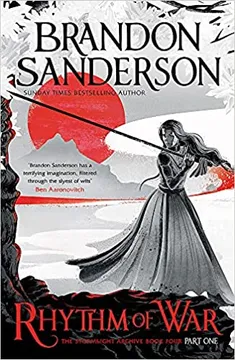


Plot Summary
Prologue
Seven years before the main story, Navani Kholin2 manages a crowded feast while her husband, King Gavilar, hides a secret meeting in her study. He shows her gemstones that seem to swallow light, then refuses to explain his work and tells her she is unworthy of greatness.
Their last argument ends with Navani2 drawing a prayer for his death. Later that night, the Parshendi assassinate Gavilar. Navani2 finds his body, discovers the strange pouch is empty, and chooses to protect the legacy she had threatened to destroy.
Navani’s first wound is not widowhood but the belated recognition that her marriage has made her useful to a man who considers usefulness her only value. Gavilar’s secretive ambition and Navani’s resentment converge in the prayer she writes at the height of anger. His assassination then refuses to give either of them the reconciliation they expected might still come. Navani’s decision to preserve his public legacy is not forgiveness; it is an act of control over a story he can no longer shape. The empty pouch leaves his greatest ambition unresolved and turns his secrets into a burden inherited by the living.
Hearthstone's Hidden General
A year after the Everstorm, surgeon Lirin11 tends refugees in occupied Hearthstone while his wife, Hesina,12 helps singers inspect newcomers. Lirin11 and Laral secretly hide Dieno, the Mink, a Herdazian resistance leader the enemy wants captured. To smuggle him through the checkpoint, Lirin11 stages an injured patient and uses former citylord Roshone as a distraction.
Before the general can escape, a Fused arrives searching for a spy. Kaladin,1 disguised among the refugees, is recognized by his slave brand and erupts with Stormlight. His arrival turns Lirin’s11 quiet deception into an open confrontation, putting the refugee operation and Hearthstone’s people in immediate danger.
Lirin’s deception is deliberately modest: he uses medical authority, a staged wound, and Roshone’s humiliating performance rather than force. The plan reveals how occupation makes ordinary care politically dangerous. Kaladin’s exposure then collapses the boundary Lirin had tried to maintain between his family and the war. The father sees his son not as a returning hero but as the danger he had feared, while Kaladin’s branded forehead makes the past visible even beneath a disguise. Their conflict begins not as a philosophical debate but as a practical crisis: who will be endangered by Kaladin’s presence?
Hearthstone Takes Flight
Kaladin1 fights the unfamiliar Fused, who abandons bodies and attacks as a streak of red light, forcing Kaladin1 to adapt rather than rely on his usual aerial advantage. When the Fused’s soldiers threaten civilians, Kaladin1 drives them back, then discovers that the Mink has slipped away.
Lirin11 refuses to abandon Hearthstone, so Kaladin1 brings the Fourth Bridge, Navani’s2 experimental flying platform, to evacuate the entire town. During the boarding, Windrunners meet the Heavenly Ones in the sky while Navani2 coordinates passengers and supplies.
Kaladin1 duels their leader, Leshwi,21 who releases one of his wounded men instead of killing him. The enemy’s restraint complicates the simple picture of an honorable human side against a dishonorable singer one.
The rescue turns Navani’s engineering into a form of civic responsibility. The Fourth Bridge is not merely an impressive invention; it allows Kaladin to honor his parents’ refusal to leave their patients by moving the whole community with them. Meanwhile, Leshwi’s decision to spare a Windrunner interrupts the military habit of treating every opponent as a target. Kaladin recognizes honor in an enemy whose side has conquered his homeland. The battle therefore carries two opposing pressures: the need to defend civilians and the unsettling possibility that the enemy contains people capable of restraint.
Moash Finds Kaladin
During the evacuation, Kaladin1 enters Roshone’s burning manor to rescue prisoners and finds the former citylord already dying. Moash,9 once Kaladin’s1 closest friend in Bridge Four, has slit Roshone’s throat and refuses to fight. Instead, he urges Kaladin1 to surrender to despair, using Kaladin’s1 own memories of Tien and failed rescues to make the offer feel persuasive.
Renarin arrives in a blaze of light and helps Kaladin1 escape the moment, but the episode confirms that Kaladin’s1 numbness and freezing are worsening. Later, after a battle in which his soldiers watch one another die, Dalinar5 removes him from active command. Kaladin1 accepts the order and begins working as a surgeon with Lirin.11
Moash does not defeat Kaladin by overpowering him. He uses intimacy as leverage, turning the trust they once shared into a weapon and presenting despair as relief from responsibility. Renarin’s arrival interrupts that pressure, but it does not cure Kaladin. Dalinar’s decision to remove him from battle recognizes that a celebrated commander can become a danger to the people he is trying to protect. Kaladin’s acceptance is painful because service has become his identity; leaving the front is not a simple retreat but an attempt to discover whether protection can exist without violence.
Ialai's Last Vintage
Shallan,3 using her Veil persona, infiltrates the Sons of Honor in the Shattered Plains warcamps by posing as a merchant sympathetic to their anti-Kholin cause. The cult initiates her and claims responsibility for the return of the Radiants, a boast she recognizes as false. Its members also reveal that someone close to Dalinar5 is feeding them information.
When Shallan3 is brought to Ialai Sadeas,18 she expects to expose the highprincess, but Ialai18 mistakes her for a Ghostblood agent and warns that another group is eliminating the Sons. Shallan3 refuses to kill her. Ialai18 is then found dead from poison, and Shallan3 discovers a concealed notebook containing the Ghostbloods’ names, interests, and plans.
Shallan’s infiltration works because she understands that conspiracies recruit people through the stories they want to believe about themselves. The Sons imagine themselves architects of history, while Ialai presents political ambition as loyalty to a displaced royal heir. Their competing fictions obscure a more dangerous network, the Ghostbloods. Shallan’s refusal to kill Ialai matters because it separates her judgment from Mraize’s likely preference. Yet Ialai’s death makes the distinction unstable: Shallan has avoided becoming an executioner, but someone inside her circle has acted without her consent, leaving her unable to trust the apparent boundaries of her own operation.
A False Trail in Shadesmar
While preparing to enter Shadesmar with Adolin,4 Shallan3 learns that her communications cube has been moved and suspects one of her Lightweaver agents. She feeds different information to her suspects and reports a supposed corrupted spren to Mraize.
When he repeats the detail, she concludes that Beryl is the Ghostblood spy. But the evidence remains uncertain. In Shadesmar, the cube is disturbed again, and Shallan3 suspects Pattern,14 her own Cryptic.
Pattern14 eventually admits he used the device to contact Wit22 because he feared for Shallan,3 not because he was serving Mraize. His confession reveals that the investigation itself has become entangled with Shallan’s3 buried past, her fear of betrayal, and her difficulty trusting even the person bonded to her.
The spy hunt becomes a test of how Shallan handles uncertainty, not simply a puzzle with a culprit. Her false lead against Beryl shows how easily plausible evidence can harden into accusation when fear supplies the missing certainty. Pattern’s secret use of the cube is a breach of trust, but not the betrayal Shallan feared; his motives are protective, though his secrecy worsens the damage. Shallan’s shifting personas help her function, yet they also make knowledge feel unstable. The question is no longer only who moved the cube, but whether her own memory and judgment can be trusted.
Kaladin Leaves the Front
Dalinar’s5 order to remove Kaladin1 from active duty forces him to consider a life without the spear. He returns to the work Lirin11 taught him and begins treating patients in the clinic at Urithiru. When Kaladin1 and Teft15 find Noril, a refugee locked in a dark sanitarium after a suicide attempt, Kaladin1 recognizes the despair the ardents have mistaken for permanent incapacity.
He brings Noril into daylight and helps him speak with people who understand his trauma. Kaladin1 then organizes a small peer group for others suffering battle shock. His work does not cure them, but it gives them company, practical care, and a reason to endure the next day.
Kaladin’s medical work does not erase his military identity; it redirects the same attentiveness that once kept a bridge crew alive. His anger at the sanitarium is grounded in a specific failure: isolated patients are treated as dangerous problems rather than people whose needs might vary. Noril’s response gives Kaladin a method no textbook has supplied, companionship among those who recognize the same darkness. The shift also alters his understanding of strength. Protection can mean preventing a wound, but it can also mean creating conditions in which a wounded person is not left alone.
The Airship Changes War
Navani’s2 Fourth Bridge proves that paired fabrials and carefully redirected force can lift and move a vast platform, carrying troops and refugees without relying on Windrunners alone. The invention depends on engineers, laborers, pulleys, gemstones, and constant coordination. Its first major mission rescues Hearthstone and demonstrates the strategic value of mobile high ground.
Navani2 also investigates the mysterious sphere Gavilar once carried, whose light distorts the air and differs from ordinary Voidlight. When a stranger warns her by spanreed that captured spren are being imprisoned, Navani2 dismisses the accusation at first, then begins to suspect the tower’s hidden systems and the enemy’s fabrials may use related principles.
Navani’s achievement is collaborative rather than solitary: she makes other people’s partial discoveries work together. That matters because the Fourth Bridge exposes the limits of heroic thinking. A Windrunner can rescue individuals, but a transport system can move a whole population. At the same time, the invention raises an ethical question that Navani cannot dismiss forever. Her engineering treats spren as components, and an unseen correspondent calls that imprisonment. The book places technological progress between two claims: it can save lives, and it can reproduce domination in a more elegant form.
The Mink Chooses Emul
After Kaladin1 brings the Mink to Urithiru, Dalinar5 and Jasnah16 show the Herdazian general their troop map and ask for an honest assessment. The Mink sees that the coalition’s apparent concentration in southern Alethkar is partly defensive, because Dalinar5 distrusts Taravangian.10 He argues that an advance on Kholinar would strike the enemy’s strongest position while exposing the coalition to betrayal.
Emul is the better target: its enemy forces are isolated between the coalition and Ishar’s army in Tukar. Dalinar5 accepts the advice, despite his longing to reclaim Alethkar. Later, Taravangian10 orders his followers to betray the coalition, confirming that Dalinar’s5 caution was justified.
The Mink’s advice forces Dalinar to distinguish loyalty to a homeland from sound command. His desire to reclaim Alethkar is emotionally intelligible, but strategically dangerous while Taravangian remains suspect. The map makes that tension visible: troop placements reveal political distrust as clearly as military intent. Dalinar accepts a plan that delays his personal goal, an act of discipline that contrasts with his earlier belief that decisive force could unify everything. Yet the strategy is not vindicated without cost. Taravangian’s betrayal shows that sound planning can reduce danger without removing it.
Venli's Chosen Rebellion
Venli6 once helped bring the Everstorm to Roshar, believing that the Fused would restore her people’s power. The invasion instead places ordinary singers beneath a new ruling class, and Venli6 begins secretly gathering those who reject both Fused control and human rule.
She serves as Voice to Leshwi21 while hiding her bond with Timbre, a spren that helps her resist Odium’s influence. When Raboniel8 arrives and proposes seizing Urithiru, Leshwi21 assigns Venli6 to the expedition as a hidden observer. Venli6 hopes to use the mission to learn, protect her small group, and eventually find a place where listeners can govern themselves.
Venli’s rebellion is compromised from its beginning because she cannot simply undo the choices that made the invasion possible. Her ambition once made her useful to Odium; now she tries to build a form of freedom that does not repeat the same coercion. The contrast between her public Regal form and private bond with Timbre is not merely a disguise. It dramatizes how identity can be shaped by power while still retaining the possibility of choice. Her hope for a listener homeland is fragile, but it gives her a purpose beyond either side’s victory.
Maya Crosses the Oathgate
Adolin4 and Shallan3 lead a small delegation through the Oathgate into Shadesmar, seeking an alliance with the honorspren of Lasting Integrity. The journey’s limits are immediate: their armor cannot cross, Stormlight will run out, and they must rely on a barge pulled by mandras.
Adolin4 brings Maya,19 his Shardblade, as a companion rather than equipment, though the other spren insist she is a mindless deadeye. At a waystop, Adolin4 meets Notum, an honorspren captain exiled for helping Kaladin’s1 party in the past. Notum warns that Lasting Integrity will reject them, but Adolin4 continues, carrying the coalition’s letters and his own hope of opening a conversation.
Adolin’s treatment of Maya is an ethical claim expressed through routine. He talks to her, brings her along, and includes her in ordinary activity even when she cannot answer. The spren around him interpret this as sentimental confusion; Adolin treats it as an obligation of recognition. His mission likewise asks whether diplomacy can begin with people who assume the worst of one another. Notum’s exile warns that good conduct may be punished by rigid institutions. Adolin proceeds anyway, partly for the coalition and partly because he needs to discover what kind of leader he will be apart from his father.
A Captain Is Rescued
As Adolin’s4 party nears Lasting Integrity, Tukari travelers shadow them without attacking. Adolin4 eventually realizes they were following Notum’s patrol instead. When the Tukari surround and stab the exiled honorspren, Adolin4 rides Gallant into the mob, dismounts, and uses his greatsword to draw the attackers away.
Outnumbered and wounded, he holds his ground long enough for Maya19 to join him. She picks up a sword and mirrors the kata Adolin4 has practiced beside her. Their coordinated movement unsettles the attackers until Adolin’s4 soldiers arrive. They rescue Notum, whose anger at humanity has been complicated by Adolin’s4 willingness to risk himself for him.
Adolin’s usefulness is no longer measured by whether he can match a Radiant or his father in battlefield power. He makes a decision with incomplete information, then uses training, timing, and fear to hold off a larger force. Maya’s participation is the scene’s central reversal: the supposed weapon chooses to protect the person who has treated her as a person. Notum’s rescue also gives Adolin a living witness to human conduct, though it does not guarantee that the honorspren will hear him. Courage opens a door; it cannot make the other side walk through it.
Maya Speaks for Herself
The honorspren reject Adolin’s4 letters and accuse humanity of murdering their kind during the Recreance. Rather than retreat, Adolin4 demands a trial for himself, arguing that they cannot punish him for ancestral actions without hearing his case. The judges admit him to Lasting Integrity with Shallan,3 Pattern,14 and Maya,19 but keep the rest of his party outside.
During the proceedings, Maya19 is brought forward as evidence of human cruelty. The testimony overwhelms her, yet she suddenly speaks, insisting that the spren chose their sacrifice. Her words expose a history far more complicated than the honorspren’s account. The trial’s judgment is no longer a simple verdict on Adolin;4 it becomes a dispute over who gets to define the past.
Adolin’s demand converts a diplomatic rejection into a legal encounter, accepting personal risk to force the honorspren to apply their own stated principles. The crucial witness is not a scholar or a king, but Maya, whose apparent silence has allowed others to define her as a corpse, victim, or weapon. Her testimony destabilizes both sides’ inherited certainty. The scene does not erase the harm of the Recreance. It does insist that historical pain cannot substitute for the voices of those who experienced it. Justice begins when the supposedly voiceless are permitted to complicate the story.
The Tower Falls Quiet
Raboniel8 leads a covert force through the tower’s neglected passages, using Deepest Ones who can move through stone. They reach the Sibling’s20 crystal pillar, kill guards and scholars, and use Voidlight to corrupt part of the tower’s defenses. Across Urithiru, Radiants collapse and fabrials stop working. Kaladin1 remains awake, but his Lashings fail just as Moash9 appears and kills Roshone before him.
Renarin’s sudden light drives Moash9 away, while Kaladin1 is left shaken and unable to protect the tower alone. Navani2 organizes the scattered defenders, leads a costly push toward the pillar, and eventually surrenders when the soldiers are beaten. Raboniel8 takes control of the city and offers Navani2 a place in her research.
The invasion attacks not only a fortress but the coalition’s assumptions about what makes it defensible. Radiant powers and fabrials have become infrastructure; once disabled, the tower’s apparent security collapses. Navani’s defense is brave but cannot substitute for the absent army. Kaladin’s encounter with Moash makes that collapse personal: the old friend returns at the moment Kaladin’s powers fail, and repeats the argument that everyone he loves will die. The surrender is therefore both military and psychological. The defenders preserve lives, but the cost is a city whose systems and symbols have been turned against its inhabitants.
The Sibling Answers Navani
Navani’s2 investigation of the strange spheres and tower mechanisms leads her to a hidden presence communicating through veins of garnet in the walls. The Sibling,20 the spren of Urithiru, reveals that it is wounded and that Raboniel8 is using the tower’s own defenses to suppress Radiants.
Navani2 and the Sibling20 disagree over fabrials: Navani2 sees technology as a way to help, while the Sibling20 sees captured spren as enslaved. Still, they identify a protective mechanism that can shield the Sibling20 from further corruption. Navani2 gathers Stormlight through a newly shared Thaylen technique and activates it. The shield buys time, but it also traps her behind enemy lines with Raboniel8 still in control.
The Sibling’s reappearance turns the tower from an inert setting into a wounded participant in the conflict. Its distrust of Navani is not a misunderstanding to be cleared up with kindness; Navani’s work has real ethical stakes. Their cooperation begins through necessity, not agreement. The shield they create is therefore a provisional bond between incompatible forms of knowledge: the Sibling’s ancient defenses and Navani’s experimental methods. It protects the tower’s heart without restoring the city, buying time rather than victory. That distinction keeps the alliance honest and the danger present.
Light Learns Its Opposite
Under Raboniel’s8 supervision, Navani2 studies Stormlight, Voidlight, and the strange sphere Gavilar once carried. Their work shows that light responds to tones, and that gemstones can transfer it through sound as well as ordinary fabrial methods.
Raboniel8 admits she wants to end the endless war, not merely win a battle, and believes new knowledge may make that possible. Navani2 eventually uses paired tones to combine Stormlight and Voidlight into a new Light. Raboniel8 calls it the Rhythm of War.
Their discovery proves the two powers can coexist, but Raboniel’s8 experiments also show that anti-Light can destroy a Fused permanently. When Raboniel8 uses it on her own daughter, Navani2 understands both the weapon’s cost and the grief behind the research.
The laboratory partnership is the book’s sharpest challenge to simple moral categories. Navani and Raboniel share curiosity and a wish to end the war, but their cooperation takes place under occupation and threat. Discovery does not make them allies; it gives each more leverage over the other. The new Light offers a model of combination without erasure, while anti-Light offers a means of permanent destruction. Raboniel’s use of that danger against her own daughter makes the theoretical cost intimate. Knowledge can end a cycle, but the instrument that ends it may wound the people who seek peace.
Taravangian Makes His Choice
Taravangian10 prepares to accompany Dalinar’s5 army into Emul, knowing that his Veden forces will betray the coalition on Odium’s orders. He sends his loyal staff away and dismantles the Diagram organization, insisting that its purpose — protecting Kharbranth — has been fulfilled. When Odium visits, Taravangian10 sees the god’s plans and realizes Renarin’s presence obscures parts of the future.
He also glimpses that Odium fears Szeth and the black Shardblade. Taravangian10 still carries out the betrayal, but sends a brief instruction through a spanreed that signals a private scheme of his own. He accepts capture rather than abandon his city, and for the first time refuses to regard his role as finished.
Taravangian’s moral system rests on a brutal division between the many he can save and the many he expects to lose. His sacrifice of himself appears noble, but it also preserves his image as the one person willing to bear any cost. The discovery that Odium’s vision has gaps unsettles his certainty and gives him a sliver of agency. He does not become innocent; he remains responsible for betrayal and mass suffering. Yet his decision to keep plotting suggests that even a man who has made himself a tool can still choose what to do with the remaining edge of his will.
The Storm Claims a Voice
With the tower occupied, Kaladin1 hides Teft15 and tries to keep his family safe, but the Pursuer hunts him through the upper floors. He steals Stormlight, food, and a spanreed, then follows the Sibling’s20 hidden signals to sabotage the enemy’s plan. When Navani’s2 node is threatened, Kaladin1 uses a makeshift fabrial to move through the tower and confront the Fused.
Venli,6 meanwhile, learns that the surviving listeners are alive and begins to see her own guilt clearly. She frees Rlain7 and helps him escape with the other Radiants, then joins Leshwi’s21 side against the Pursuer’s troops. The battle exposes the cost of every allegiance, but also lets Venli6 act for someone besides herself.
The two arcs meet around the question of whether responsibility can be chosen after failure. Kaladin has spent years treating survival as a duty to others, while Venli has spent years converting ambition into excuses. Their actions are not equivalent: Kaladin’s exhaustion and Venli’s complicity carry different histories. Yet both must act without certainty of success. Venli’s decision to help Rlain and the unconscious Radiants does not erase what she caused, just as Kaladin’s return to danger does not cure his trauma. Each takes one concrete step that resists the role others have assigned them.
The Next Step Remains
After a costly campaign in Emul, Dalinar5 learns that the tower has been restored and that Navani2 has bonded with the Sibling.20 He also discovers that the Herald Ishar has regained the Honorblade once held by Szeth’s father and can manipulate the bonds between people and spren. Dalinar5 hopes Ishar can teach him to restore the Oathpact, but the Herald remains unstable and dangerous.
Meanwhile, Odium bargains with Dalinar:5 a contest between champions will determine the fate of Alethkar, Herdaz, and the war. Dalinar5 accepts terms that promise an end to hostilities, but place his own soul at stake. He now has ten days to prepare, while Shallan3 breaks with the Ghostbloods and Adolin’s4 victory leaves the honorspren reconsidering their refusal.
The ending resolves several immediate questions without pretending the war is finished. The tower can function again, the honorspren have reason to reconsider, and Shallan has chosen honesty over continued apprenticeship to Mraize. Yet peace is made conditional on a contest whose terms transfer risk to Dalinar personally. This structure converts an immense political conflict into one intimate decision while leaving the consequences open. The book’s repeated demand for a next step becomes literal: no character can undo the past, but each must decide what they are willing to risk in order to keep it from defining the future.
Analysis
The novel repeatedly asks what it means to protect someone without claiming ownership over them. Kaladin’s1 instinct to save everyone becomes destructive when he treats his own suffering as irrelevant; his turn toward healing and peer support offers a less heroic but more sustainable form of protection. Navani’s2 engineering similarly sits between care and control. The Fourth Bridge rescues a town, while fabrials depend on captured spren whose consent remains uncertain. Her work with the Sibling20 forces that ethical tension into the open rather than letting technical progress appear innocent.
The book’s competing histories are equally important. The humans remember the Recreance as ancient; the honorspren experience it as a recent betrayal. The singers remember slavery as lived history, while the Fused present conquest as restoration. Adolin’s4 trial and Maya’s19 testimony expose how memory becomes political authority: whoever controls the account of the past can decide who deserves trust in the present. Yet no single testimony cancels the others. The point is not that all sides are equally culpable, but that reconciliation requires listening to people whose pain does not fit a convenient explanation.
Finally, the book refuses to equate weakness with moral failure. Kaladin’s1 trauma, Shallan’s3 divided identity, Venli’s6 guilt, and Taravangian’s10 fluctuating mind all complicate the idea that good people are consistently clear or strong. Their choices matter precisely because they are made under pressure, with incomplete knowledge and imperfect motives. The contest Dalinar5 accepts gives the conflict a deadline, but not a simple solution. Victory will depend on whether power can be joined to humility, whether memory can become accountability instead of revenge, and whether characters can keep moving without pretending they are unbroken.
Review Summary
Rhythm of War, Part One receives mixed but generally positive feedback from readers. Many note the first half feels slow and filled with world-building detail, while the final 150–200 pages pick up significantly. Character arcs—particularly Shallan, Adolin, and Kaladin—are highlighted, with Kaladin's mental health journey proving emotionally exhausting for some. Several readers mention the book's split publication format as frustrating. Overall, most remain enthusiastic about the series despite pacing concerns, eagerly anticipating Part Two.
Characters
Kaladin Stormblessed
The wounded protectorA former slave, soldier, and leader of the Windrunners, Kaladin measures himself by the people he can protect. His courage is real, but so is the exhaustion and battle shock that make him freeze, withdraw, or mistake self-sacrifice for duty. He is skeptical of authority when it fails ordinary people, yet he trusts his companions deeply. His relationships with Syl13, Teft15, Rlain7, and his parents expose different sides of him: commander, friend, son, and healer. He wants to save everyone, and the strain of that impossible wish is central to his character.
Navani Kholin
The inventive queenNavani has spent much of her life managing other people’s ambitions, but she is also an exacting observer who loves fabrials, maps, and practical problems. Gavilar’s contempt left her doubtful that she could create anything of her own. She counters that doubt by bringing scholars and engineers together, making their work useful even when she is not the most technically gifted person in the room. Her marriage to Dalinar5 is built on respect and warmth, but she remains alert to the cost of being valued mainly for what she can organize.
Shallan Davar
The divided investigatorShallan is an artist, Lightweaver, spy, wife, and the creator of distinct personas that help her function when memories become unbearable. She uses invention to survive, but also to evade truths she fears will make her unlovable. Her curiosity can be generous and scholarly; her secrecy can be dangerous to herself and her allies. Her bond with Adolin4 offers affection without demanding instant confession, while her attachment to the Ghostbloods tempts her with access to answers. She is trying to become whole without pretending her past was harmless.
Adolin Kholin
The honorable princeAdolin is a skilled duelist and highprince who prefers direct human contact to the distance of command. He notices clothing, manners, and the comfort of people around him, but is more thoughtful than his easy confidence suggests. He resists being treated as a perfect extension of Dalinar5, and he does not accept that leadership must mean copying his father. His bond with Maya19 is built through patient attention rather than technical mastery. He wants to be useful, even when the world’s most conspicuous powers belong to Radiants.
Dalinar Kholin
The reforming commanderOnce known for conquest and brutality, Dalinar now tries to build a coalition and live by obligations rather than appetite. He remains a commanding military thinker, but increasingly recognizes that force cannot solve every problem. His autobiography exposes his past rather than polishing it, straining his relationships with Adolin4 and Jasnah16 even as it gives him moral credibility. As a Bondsmith, he can connect people and realms, but his power is still poorly understood. His central struggle is whether he can achieve peace without repeating the violence that once made him powerful.
Venli
The regretful listenerVenli is intelligent, ambitious, and deeply susceptible to the promise of recognition. She once pursued power for herself and helped unleash events that devastated her people. Now she serves among the Fused while secretly trying to build a future in which ordinary singers can govern themselves. Her bond with Timbre gives her a way to resist Odium’s influence, but does not absolve her of her choices. Venli’s struggle is not simply to be forgiven; it is to make decisions that do not repeat her old habit of treating others as instruments.
Rlain
The listener among friendsRlain is a listener who spent years among the Alethi, first as a spy and later as a member of Bridge Four. His position gives him a sharp understanding of both human and singer assumptions, and makes him wary of easy claims that either side is innocent. He wants recognition without being reduced to a symbol or representative. His refusal to accept a forced bond shows that inclusion without consent can repeat the very hierarchy it claims to repair. He is loyal to Kaladin1 and his friends, while remaining attentive to the history of his own people.
Raboniel
The scholar of warRaboniel is an ancient Fused whose curiosity is as formidable as her military authority. She studies fabrials, spren, and the tower with a scholar’s concentration, yet accepts ruthless methods when she believes they can end the war. She sees the conflict as a cycle that has outlived its purpose, and is willing to test dangerous ideas to break it. Her relationship with Navani2 is a contest between captor and captive, but also an intellectual partnership neither can dismiss. Raboniel’s daughter and her own long history complicate her reputation for cold calculation.
Moash, called Vyre
The friend turned enemyMoash once belonged to Bridge Four and shared Kaladin’s1 anger at the injustices that shaped their lives. He now gives his pain to Odium and presents emotional numbness as freedom. This bargain lets him act without ordinary guilt, but his fixation on Kaladin1 reveals that he is not truly detached. Moash understands the wounds he exploits because he once shared them. His conflict with Kaladin1 is therefore intimate: he does not merely want to defeat his former friend; he wants Kaladin1 to accept his bleak account of existence.
Taravangian
The calculating kingTaravangian’s intelligence and compassion fluctuate, leaving him to experience leadership from sharply different mental states. He founded the Diagram as an attempt to save Kharbranth, then committed assassinations and betrayals in service of that goal. He is capable of genuine care, but turns people into numbers when he believes the stakes demand it. His relationship with Dalinar5 is painful because the two recognize the same burden of leadership and arrive at opposite conclusions about what it permits. He fears being useless as much as he fears being wrong.
Lirin
The principled surgeonLirin believes a surgeon’s first duty is to preserve life, even when the surrounding society rewards violence. His refusal to fight has protected his ethical center, but can leave him unable to see why others choose resistance. He loves Kaladin1, yet often expresses that love through standards and expectations that make his son feel judged. As a father and healer, Lirin is neither simply right nor simply wrong: his discipline saves people, while his absolutism can confuse survival with surrender.
Hesina
The steady family anchorHesina is perceptive, warm, and less constrained by the arguments that divide Lirin11 and Kaladin1. She sees the emotional costs both men conceal and uses humor, practical care, and direct affection to keep the family connected. In the occupied tower, she helps care for refugees and patients while recognizing that Kaladin’s1 work among the traumatized matters. Her steadiness is not passivity; she challenges Lirin11 when his principles risk becoming a way to avoid seeing their son clearly.
Syl
The steadfast honorsprenSyl is Kaladin’s1 honorspren and companion, curious about human life and far less solemn than the traditions of her kind suggest. Her loyalty does not mean she always understands Kaladin’s1 pain; she knows when he is withdrawing, but struggles to help him without sharing the feeling herself. She makes choices that defy her people’s expectations, and that independence mirrors Kaladin’s1 own tension between duty and selfhood. Her connection to him is both a source of power and a relationship that requires care, honesty, and room for change.
Pattern
The curious CrypticPattern is Shallan’s3 Cryptic spren, fascinated by lies, logic, art, and the ordinary habits of humans. His literal curiosity can be comic, but his bond with Shallan3 carries serious consequences: he knows parts of her history she cannot face and tries to protect her by withholding information. His secrecy is meant as care, yet it damages trust. Pattern’s questions about people reveal his central difficulty: understanding a human being is not the same as understanding the patterns that describe them.
Teft
Bridge Four's old sergeantTeft is a veteran soldier whose bluntness and weary humor conceal years of addiction and self-contempt. He has been a stabilizing presence for Kaladin1, often recognizing when his commander needs a sergeant more than a subordinate. Teft understands that recovery is not a single victory and that old pain can return without erasing progress. His loyalty is practical rather than grand: he stays near the people he cares about, even when he is frightened or uncertain.
Jasnah Kholin
The pragmatic queenJasnah is a scholar and monarch who trusts evidence, strategic planning, and direct argument. Her confidence can make her seem emotionally distant, but she is willing to challenge inherited institutions, including monarchy and slavery. She values Dalinar’s5 experience without accepting his assumptions, and she resists being treated as a symbol of his authority. Her private relationship with Wit22 complicates her public reserve, while her decisions show a ruler trying to make moral change without pretending that the timing or consequences are simple.
Eshonai
The listener explorerEshonai is a bold explorer who believes the world is larger than the old cities and rivalries that constrain her people. She is curious about humans without mistaking them for harmless, and she wants her people to choose their own future. Her relationship with Venli6 is loving but strained by their different temperaments: Eshonai reaches outward, while Venli6 fears being left behind. Eshonai’s willingness to take risks makes her a source of inspiration, but also places her at the center of choices whose consequences she cannot control.
Ialai Sadeas
The exiled political operatorIalai is a skilled political survivor who uses loyalty, lineage, and resentment to build influence after the old order collapses. She is intelligent enough to present ambition as service to Alethkar, and suspicious enough to recognize that other secret organizations may be using her. Her rivalry with the Kholins reflects a world where political power is rarely separated from private grief. Shallan’s3 encounter with her shows that Ialai’s apparent control is fraying, but her guarded manner makes it difficult to know how much she truly reveals.
Maya, or Mayalaran
The silent deadeyeMaya is an ancient honorspren whose mind and appearance were damaged when her bond with a Radiant ended. As Adolin’s4 Shardblade, she is treated by others as a weapon or a lost cause. Adolin4 instead includes her in daily routines and addresses her as a companion. Their relationship challenges the assumption that a deadeye has no inner life simply because it cannot communicate in familiar ways. Maya’s dignity is not measured by how much she can explain.
The Sibling
The wounded tower sprenThe Sibling is the ancient spren bound to Urithiru, secretive and distrustful of both humans and the systems they build. Its voice reveals that the tower is not merely a city but an active being whose functions depend on its own power and history. The Sibling sees fabrial use as a form of enslavement, making Navani’s2 engineering a moral problem as well as a technical one. It is frightened by Raboniel’s8 interference, yet its reluctance to trust Navani2 reflects a long history of betrayal.
Leshwi
The honorable Fused commanderLeshwi is a respected Heavenly One whose age and experience have not erased her capacity for restraint. She enjoys the challenge of fighting Windrunners and recognizes courage in opponents, but is not simply an ally or a convert. Her decisions reveal disagreements within the Fused over how the war should be fought and what victory should mean. She is also a leader to whom Venli6 can speak with unusual candor, though both understand that their relationship remains shaped by rank and danger.
Wit
The dangerous storytellerWit is a court wit, storyteller, and adviser whose jokes often hide precise observations about power. He understands more than he explains, and his allegorical stories give listeners room to draw their own conclusions. His relationship with Jasnah16 is unusually intimate in thought, though he remains difficult to pin down. Wit treats secrecy as a tool and knowledge as something earned, which makes him both useful and suspect. His presence reminds the other characters that cleverness can reveal a path without guaranteeing a safe one.
Lift
The irreverent EdgedancerLift is a young Edgedancer who hides from expectation in the tower’s service passages and treats food as both comfort and private rebellion. Her humor disguises a serious fear of growing older and losing the identity she associates with her dead mother. She dislikes solemn authority, but her instincts repeatedly lead her toward people who are overlooked or in danger. Her unusual relationship with Cultivation and her powers makes her difficult for others to categorize, including herself.
Kelek
The frightened HeraldKelek, also called Kalak, is one of the ancient Heralds, burdened by an age and history that have worn down his judgment. He is involved in the creation of the Oathpact and in the political history of the Sons of Honor, but his fear of further suffering often leaves him indecisive. His role as judge in Adolin’s4 case reveals both his authority and his deterioration. He wants escape from the cycle, yet his choices continue to affect the lives of people who are still fighting within it.
Plot Devices
Radiant bonds and oaths
Power bound to promisesRadiants gain Surgebinding through bonds with spren and progress by speaking oaths that must be sincerely held. The system links power to moral commitment, but the bond is not a simple reward for good behavior. Kaladin’s1 struggle to keep protecting others while acknowledging his limits, Shallan’s3 truths about her past, and Venli’s6 first steps toward a bond all show different pressures on the same structure. When the tower suppresses Radiants, their abilities disappear without erasing the choices that made them Radiants. The device turns character decisions into practical consequences, while asking whether an oath can survive a person’s failure.
Fabrials and Stormlight
Power made practicalGemstones capture Stormlight, and fabrials use spren, metals, and paired stones to produce effects such as communication, heating, lifting, and transportation. Navani2 and her scholars expand these principles into the Fourth Bridge, a flying transport that changes the movement of troops and refugees. The technology is both an instrument of protection and an ethical problem, since some fabrials depend on trapping spren. Raboniel’s8 countermeasures show that technological understanding can be turned against its makers. The book’s repeated experiments make invention feel collaborative, fallible, and politically consequential rather than miraculous.
Lightweaving and personas
Identity as concealmentShallan3 can alter appearances and create illusions, while also using distinct personas to handle different kinds of stress. Veil excels at espionage, Radiant at discipline, and Shallan3 at art and invention. These divisions help her act, but they also make it easier to postpone painful memories and distrust her own choices. The communication cube and the false leads around the Ghostblood spy externalize that uncertainty: concealment can protect a person, but it can also obscure who is acting and why. Shallan’s3 central challenge is not merely to see through others’ disguises, but to inhabit her own history.
The Oathgates
A network under siegeThe Oathgates let the coalition move people and supplies across Roshar almost instantly, making Urithiru a strategic center rather than simply a fortified city. Their use ties distant armies together and gives Navani’s2 engineers an infrastructure on which to build. When the tower’s systems are corrupted, communication and transport fail at once, isolating the defenders and allowing the enemy to seize the city. The gates therefore function as both a logistical advantage and a single point of failure. Their vulnerability turns a technical system into a political question: how much of a coalition can depend on one place?
Shadesmar and deadeyes
The other side of bondsShadesmar reflects the physical world in beads, lights, and embodied spren. It is a place of travel and commerce, but also of memory: the condition of deadeyes makes visible the cost of broken Radiant bonds. Adolin’s4 journey there forges a direct encounter with the honorspren’s grievance, while his care for Maya19 challenges the assumption that a deadeye has no remaining personhood. The realm’s strange geometry, limited Stormlight, and distinct communities make it more than a fantasy backdrop. It reveals that humans and spren inhabit different versions of a shared reality, each with claims the other has ignored.
The Stormlight Archive Series

About the Author
Other books by Brandon Sanderson







Download PDF
Download EPUB
.epub digital book format is ideal for reading ebooks on phones, tablets, and e-readers.








