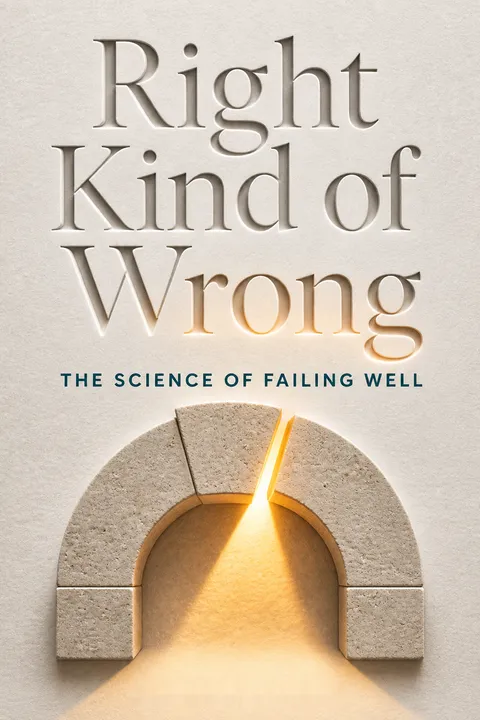


Key Takeaways
Judge a failure by its context, not by how painful it feels.
Three kinds of wrong. A failure is an outcome that misses a desired result. An error is an unintended departure from a known rule or procedure. A violation is a deliberate departure from one. These distinctions matter because a bad outcome does not, by itself, reveal whether someone was careless, exploring, or caught in a flawed system.
Sort before responding. An intelligent failure yields useful information in unfamiliar territory. A basic failure is a preventable mistake in familiar territory. A complex failure emerges when several factors combine, often with an unexpected event. A failed experiment can be progress; a preventable mistake calls for better safeguards; a complex breakdown demands investigation beyond one person’s actions.
What's valuable here is the separation of outcome from cause. People often treat every bad result as evidence of incompetence, even when the task involved genuine uncertainty. This classification gives teams a more precise starting point: ask what was known, what was intended, and how many factors interacted. It also resists the opposite error, romanticizing every setback as a learning opportunity. The categories are useful lenses rather than airtight boxes. A small mistake can sit inside a wider system failure, so classification should open inquiry, not close it.
Experiment intelligently: learn something new without making the cost needlessly large.
Four conditions help. An intelligent failure happens in new territory, pursues a worthwhile goal, uses the best available knowledge, and keeps the test small enough to limit waste and harm. Learning from the result is essential. A research team trying to understand how to manipulate RNA first tested approaches that did not work, then found a useful method by drawing on an older scientific paper.
New is not careless. Early heart surgeons faced deaths while attempting operations that had no established solution. Their work eventually helped make open-heart surgery routine, but the story is not a license to gamble with people’s lives. The practical lesson is to test carefully, manage risks, and gather information before scaling an uncertain idea.
This is a sharper alternative to the slogan that organizations should simply fail faster. Small, informative tests resemble the logic of controlled experiments: change one thing, observe the result, and update the next attempt. That approach is useful in product design, research, and personal decisions. Yet “small” depends on who bears the cost. A pilot can be cheap for a company and consequential for its customers or workers. Intelligent experimentation therefore requires not only efficient learning, but also informed consent and serious attention to who is exposed to risk.
Treat routine mistakes as design problems, not invitations to hide them.
Basic failures are often preventable. They arise when someone fails to use knowledge that is already available, commonly through inattention, neglect, overconfidence, or a faulty assumption. In 2020, Citibank employees mistakenly sent lenders $900 million instead of about $8 million. A software process that required several checks had been overridden incorrectly, turning a familiar task into an enormous loss.
Build in defenses. Aviation checklists help crews remember crucial steps, but a checklist can become dangerous if followed mechanically. Air Florida Flight 90 crashed after its pilots left an anti-ice system off in freezing conditions, following a routine that fit warmer weather. Useful safeguards include checklists, training, equipment designed to prevent common slips, and regular maintenance. The aim is not flawless humans, but fewer errors reaching a harmful outcome.
The design perspective shifts attention from exhorting people to concentrate toward making the safe action easier and the dangerous action harder. Human-factors engineering applies this principle in interfaces, medical devices, and transport systems. Checklists work best when they prompt active verification rather than ritual recitation, and when people can raise concerns about a procedure that no longer fits conditions. The remaining challenge is to identify the right level of intervention: a reminder may help with a lapse, while recurring mistakes may signal understaffing, confusing design, or incentives that reward speed over care.
Trace disasters through interacting causes before appointing a single culprit.
Complex failures accumulate. In 1967, the tanker Torrey Canyon struck a reef and spilled millions of gallons of oil. A deadline, navigational uncertainty, fog, unexpected lobster boats, and a steering delay converged. Removing any one factor might have prevented the accident. The captain was initially blamed alone, obscuring the wider conditions that shaped the outcome.
Look for the holes. The Swiss cheese model pictures safety as several imperfect barriers. Each has gaps, but harm is less likely when the gaps do not line up. Complex failures occur when vulnerabilities across people, procedures, equipment, and circumstances align. Small warning signs often precede the breakdown. Investigating them can reveal opportunities to interrupt the chain, even when no single cause explains the whole event.
This account counters hindsight bias, the tendency to see an outcome as obvious once it has happened. Multiple contributing factors are not a reason to excuse every action; they are a reason to understand how the event became possible. Safety research adds that repeated workarounds can gradually make unsafe practice seem normal, especially when earlier close calls end harmlessly. A useful investigation therefore asks both who made a decision and what conditions made that decision likely. It should identify accountable choices without pretending that replacing one person repairs the system.
Pair high standards with safety to speak up before small problems grow.
Candor improves detection. In Edmondson’s early hospital research, teams reporting better teamwork appeared to have more medication errors. The apparent contradiction dissolved when further observation showed that open teams reported more of the errors they detected. In less open units, mistakes could remain hidden. The original measure captured reported errors, not every error that had actually occurred.
Make speaking up safer. Psychological safety is a shared belief that questions, concerns, and mistakes can be voiced without humiliation or retaliation. It does not mean low expectations. In operating rooms learning a new surgical method, surgeons had to invite nurses and other team members to question what they saw. The team could then catch problems early while still holding itself to demanding standards.
The distinction between actual events and reported events is a major measurement lesson: better transparency can make an organization look worse before it becomes safer. Psychological safety also matters because expertise is distributed. The person nearest a problem may not have the highest rank, and a hierarchy can filter out crucial information. Still, a welcoming climate alone cannot substitute for technical competence, staffing, or reliable procedures. It is most effective when leaders respond constructively to concerns and then visibly act on what people report.
Pause the shame reflex long enough to choose a useful response.
Failure can feel like identity. Shame turns “I made a mistake” into “I am a failure,” encouraging concealment rather than repair. A study of learning from feedback found that people often learned less from their own failures than from successes, apparently because failure threatened their self-image. Observing someone else fail was less threatening, making lessons easier to absorb.
Use a deliberate pause. The Stop-Challenge-Choose technique interrupts an automatic reaction. Stop long enough to notice the emotion. Challenge the first explanation by asking what evidence supports it and what else might be true. Choose a response that serves the longer-term goal. A novice who assumes that difficulty at bridge proves stupidity can instead recognize that a new game requires practice, then keep playing and improve.
The technique resembles cognitive behavioral approaches, which examine how interpretations shape emotion and action. Its strength is not forced optimism, but a pause that creates room for a more accurate account. That distinction matters: a person who caused harm should not reframe responsibility away. The goal is to replace global self-condemnation with specific, testable learning. Emotional recovery also takes time. Reasoning can help, but it should not become another demand to suppress grief, anger, or disappointment before those feelings have been acknowledged.
Match vigilance to uncertainty and stakes, not to habit.
Read the situation. Consistent contexts have established methods and relatively low uncertainty, such as routine production. Variable contexts use known expertise but include changing conditions, as in an emergency room. Novel contexts lack a reliable playbook, as in an original research project. The more uncertainty, the more likely a failure becomes.
Then assess the stakes. A failed recipe is usually cheap; a failed aircraft procedure can cost lives. In a classroom exercise called the Electric Maze, teams had to discover a safe path by stepping on squares that might sound an alarm. Many hesitated because they treated each wrong step as a personal mistake instead of information. Their task called for rapid experimentation, not careful execution. High-stakes work calls for the reverse: more checks, rehearsal, and caution.
This framework helps distinguish productive uncertainty from genuine danger. It also explains why the same behavior can be sensible in one setting and reckless in another. In low-stakes exploration, excessive caution can prevent learning; in safety-critical work, improvisation can expose others to harm. Context, however, can change mid-task. Familiar work becomes variable when fatigue, unusual conditions, or unfamiliar teammates enter the picture. A quick reassessment is therefore more useful than labeling a whole job routine or risky once and for all.
Change the system around recurring failures, not just the person caught in them.
Connections shape outcomes. In the Beer Game, teams simulated a supply chain and each participant tried to manage inventory. Small delays and individually sensible orders produced wild swings in stock, even though customer demand barely changed. The system amplified local decisions into collective waste.
Fix causes, not symptoms. Nurses facing missing supplies often borrowed from another unit, solving the immediate problem but leaving the shortage untouched. Reporting the cause could prevent recurrence. Systems thinking asks who else is affected by an action and what consequences may follow over time. Toyota’s production system embodies this approach: workers can flag possible defects so teams can investigate before a flaw spreads through the production line.
The supply-chain example illustrates emergence: group outcomes can differ sharply from what each participant intended. Similar dynamics appear in traffic, public health, and organizations where incentives encourage local optimization. A workaround may be necessary in an emergency, but if it becomes routine, it can hide the defect and transfer the burden to someone else. Systems analysis is not an excuse to map everything indefinitely. Its value lies in choosing a useful boundary, finding a leverage point, and checking whether a proposed fix improves the whole process rather than one isolated metric.
Make bad news useful by rewarding disclosure, analysis, and shared learning.
Disclosure needs proof. At Ford, CEO Alan Mulally asked leaders to label project reports green, yellow, or red. Executives initially avoided red, until one reported a troubled vehicle launch. Mulally thanked him and asked colleagues to help. That response showed that sharing a problem could trigger joint action rather than punishment.
Separate learning from discipline. Blameless reporting encourages prompt disclosure of errors so teams can reduce harm. It is not immunity for deliberate misconduct or reckless violations. Aviation’s anonymous reporting system gathers details about mistakes and near misses, helping reveal recurring risks. Sharing what failed also prevents colleagues from repeating an unproductive test. A celebration or award is worthwhile only when it leads to analysis, a changed practice, or knowledge others can use.
Disclosure systems depend on credibility. A policy promising safety to speak up will fail if the first person who reports a problem is punished or ignored. The strongest response combines respect for the reporter with rigorous follow-up and clear accountability for intentional misconduct. This is also where power matters: junior staff may face greater personal risk in raising concerns than senior leaders do. Rituals that celebrate candor can help, but they cannot replace protection, fair investigation, and tangible changes to the conditions that produced the problem.
Take worthwhile risks, but let evidence tell you when to pivot.
Fallibility is unavoidable. Champagne entrepreneur Barbe-Nicole Clicquot faced failed harvests, war, and uncertain markets. She learned the craft, used resources carefully, and persisted until a new production method and a bold shipment helped her business grow. Persistence mattered, but the story also shows the value of preparation and timing.
Do not confuse courage with endless commitment. Reflection can reveal whether a project still has a credible path or whether effort is being driven by sunk costs. People also differ in how safely they can fail: a public setback can carry extra weight for those expected to represent a whole group. Choose meaningful experiments, learn from the result, and treat changing course as a responsible response to evidence, not a verdict on personal worth.
The closing principle is neither relentless grit nor risk avoidance. It is adaptive commitment: pursue goals that matter, but keep updating beliefs as evidence arrives. Research on regret suggests that people often lament chances they never took, while a failed attempt can still provide a sense of agency and learning. Yet opportunity is not distributed evenly. Money, status, and social protection determine who can afford experimentation. A humane culture makes room for learning while also reducing the unequal penalties attached to being visibly wrong.
Analysis
The book’s central contribution is not a celebration of failure, but a decision rule for responding to it. First determine whether the situation involved discovery, a preventable lapse, or a convergence of interacting causes. Then choose the response that fits: experiment, strengthen safeguards, or investigate the system. This is more useful than treating every setback as either a badge of courage or proof of incompetence.
Its most revealing episode is the hospital study in which stronger teams appeared to have more errors. The result changed meaning once the researchers recognized that open teams reported more mistakes. This is a lesson in measurement as much as management: observed failures reflect both what happens and what an organization permits people to disclose. In domains where reporting is uneven, performance comparisons can reward silence and punish transparency.
The frameworks also have limits. The boundaries between failure types are porous, and deciding whether a risk was intelligent depends on who bears its consequences. A small experiment for a firm may expose workers or customers to substantial costs. Likewise, psychological safety is not simply kindness. It must coexist with expertise, accountability, and processes capable of acting on what people say. Without those conditions, candor can become theater.
The book is strongest when it joins individual habits to institutional design. Pausing to question one’s interpretation matters, but so do checklists, reporting channels, and incentives that make accurate information travel. The broader insight is epistemic humility: people and organizations need ways to discover that their current model is wrong. Good learning cultures do not expect perfect judgment. They make errors visible, keep experiments proportionate, and update practices before local failures accumulate into system-wide harm.
Review Summary
The Right Kind of Wrong receives mixed reviews, with praise for its insights on learning from failure and creating psychological safety. Readers appreciate the categorization of failure types and practical advice for embracing intelligent failures. However, some find it repetitive and lacking novel ideas. Critics argue it oversimplifies complex issues, while supporters value its accessible approach to a challenging topic. The book's emphasis on reframing failure as a learning opportunity resonates with many readers, particularly in business and leadership contexts.
People Also Read







Glossary
Intelligent failure
Informative failure in new territoryAn unsuccessful result from a thoughtful attempt to pursue a worthwhile opportunity where the answer was not already known. It uses relevant prior knowledge, limits the scale of risk, and produces information that can guide future action. The term distinguishes useful experimentation from careless mistakes or avoidable failures.
Basic failure
Preventable failure in known territoryA failure caused by an unintended mistake in a setting where useful knowledge, instructions, or established procedures already exist. Inattention, neglect, overconfidence, and faulty assumptions are common contributors. Basic failures are often preventable through training, careful execution, checklists, maintenance, or better-designed tools.
Complex failure
Failure from interacting causesA breakdown produced by multiple factors that combine in a familiar but uncertain setting. Contributing conditions may include human actions, organizational procedures, equipment, and external events. No single factor is usually enough to explain the result, so preventing recurrence requires examining interactions and missed warning signs rather than blaming one person alone.
Psychological safety
Safety for interpersonal risk-takingA shared team belief that people can ask questions, acknowledge uncertainty, raise concerns, and discuss mistakes without being humiliated or punished for speaking up. It supports learning and early error detection, particularly in interdependent work. It does not mean that standards are low or that deliberate misconduct escapes accountability.
Situation awareness
Reading uncertainty and stakesThe capacity to assess the context of a task, including how much is known, how much may vary, and what consequences failure could have. It helps people decide whether a situation calls for routine execution, heightened vigilance, or careful experimentation. The same activity can require different responses as conditions change.
System awareness
Seeing connections and consequencesThe ability to view a problem as part of a larger whole shaped by relationships among people, processes, incentives, and resources. System awareness helps identify how local decisions create downstream effects, why quick fixes can backfire, and where changes may prevent recurring failures or support better performance.
Stop-Challenge-Choose
A pause for deliberate responseA three-part technique for responding to an upsetting event. Stop to interrupt the automatic reaction, challenge the initial interpretation by checking its evidence and usefulness, then choose an action better aligned with longer-term goals. It is intended to replace reflexive shame or defensiveness with a more accurate, constructive response.
Swiss cheese model
Layered defenses against harmA model of safety in which each protective layer has weaknesses, represented as holes. A single flaw may not cause harm because other defenses can catch it. A serious failure becomes more likely when weaknesses across several layers align, allowing a sequence of problems to pass through the system.
High reliability organization
Organization that catches deviationsAn organization operating in a high-risk environment that maintains a strong record of safety through collective vigilance. Common practices include attention to small failures, resistance to oversimplified explanations, sensitivity to current operations, rapid correction of problems, and respect for expertise regardless of rank.
Blameless reporting
Nonpunitive reporting for learningA policy or practice that encourages people to report mistakes, concerns, and near misses promptly so an organization can detect risks and improve its processes. It protects honest reporting from automatic punishment, but does not excuse deliberate violations, unethical behavior, or reckless disregard for established safety standards.
Andon Cord
Signal for a possible defectA Toyota production-floor mechanism that lets a worker flag a suspected quality problem for prompt review. A team leader and worker assess the issue, and the line stops if they cannot resolve it quickly. Its function is both practical and cultural: it helps catch defects early and signals that frontline observations are valued.
FAQ
What's Right Kind of Wrong about?
- Focus on Failure: The book explores failure as a crucial element of learning and growth in both personal and organizational contexts.
- Types of Failures: It categorizes failures into intelligent, basic, and complex, each with unique characteristics and learning implications.
- Framework for Success: Provides a framework for navigating failures, encouraging a growth mindset and awareness in various contexts.
Why should I read Right Kind of Wrong?
- Transformative Insights: Offers a fresh perspective on failure, viewing it as a stepping stone rather than a setback.
- Practical Tools: Provides frameworks and tools for learning from failures, enhancing innovation and adaptability.
- Real-World Examples: Includes case studies from various fields, making concepts relatable and applicable to everyday life.
What are the key takeaways of Right Kind of Wrong?
- Embrace Failure: Not all failures are bad; some are necessary for progress and innovation.
- Psychological Safety: Creating a safe environment for discussing mistakes is crucial for learning and improvement.
- Types of Failures: Understanding intelligent, basic, and complex failures helps in developing appropriate responses and strategies.
How does Right Kind of Wrong categorize failures?
- Intelligent Failures: Occur in new contexts, leading to valuable insights through thoughtful experimentation.
- Basic Failures: Preventable errors in familiar settings, often due to inattention, easily corrected.
- Complex Failures: Involve multiple causes, harder to predict, often occurring in familiar settings.
What is "psychological safety" as discussed in Right Kind of Wrong?
- Safe Environment: Refers to an environment where individuals feel safe to take interpersonal risks, like admitting mistakes.
- Encourages Learning: Promotes sharing concerns and learning from failures, leading to improved performance.
- Critical for Innovation: Essential for fostering innovation and effective teamwork in organizations.
What is the definition of "intelligent failure" in Right Kind of Wrong?
- Thoughtful Experimentation: Occurs in new territory, informed by prior knowledge, representing a thoughtful approach.
- Small Risks: Characterized by manageable risks that provide insights without significant costs.
- Learning Opportunity: Seen as opportunities for growth, leading to new discoveries and advancements.
What are some practical tools for learning from failure mentioned in Right Kind of Wrong?
- Checklists: Help ensure important steps aren't overlooked, reducing basic failures.
- Blameless Reporting: Encourages sharing mistakes without fear, facilitating learning and improvement.
- Rapid Response Teams: Address early warning signs of potential failures, allowing timely interventions.
How can I apply the concepts from Right Kind of Wrong in my life?
- Reframe Failures: View failures as learning opportunities rather than setbacks.
- Create a Safe Space: Foster psychological safety in relationships, encouraging open discussions about mistakes.
- Practice Reflection: Regularly reflect on experiences, identifying improvements using the book's frameworks.
How does Right Kind of Wrong suggest we deal with perfectionism?
- Aim for Excellence: Set realistic goals that stretch abilities without being unattainable.
- Focus on Progress: Measure success based on progress, fostering a positive mindset.
- Safe Space for Mistakes: Cultivate an environment where mistakes are learning opportunities.
What is the Stop—Challenge—Choose technique mentioned in Right Kind of Wrong?
- Pause to Reflect: Encourages pausing before reacting to situations for thoughtful responses.
- Assess Thoughts: Involves questioning the validity of spontaneous thoughts, reframing irrational beliefs.
- Make Informed Choices: Decide on actions aligning with goals and values, empowering control over responses.
How can I create a culture of learning from failure in my organization?
- Encourage Open Communication: Foster an environment where team members feel safe sharing mistakes.
- Implement Blameless Reporting: Create systems for anonymous error reporting without fear of punishment.
- Celebrate Intelligent Failures: Recognize and reward risk-taking and learning from failures.
What role does reflection play in learning from failure according to Right Kind of Wrong?
- Identify Lessons Learned: Analyzing experiences to extract valuable lessons from failures.
- Build Resilience: Develops a healthier relationship with failure, encouraging a growth mindset.
- Enhance Decision-Making: Helps in recognizing patterns and avoiding similar mistakes in the future.
About the Author
Download PDF
Download EPUB
.epub digital book format is ideal for reading ebooks on phones, tablets, and e-readers.








