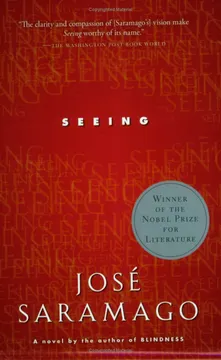


Plot Summary
Rain Clears, Ballots Stay Blank
On municipal election day, the rain keeps voters away from polling stations, where officials wait beside empty ballot boxes and imagine the weather is to blame. A few people arrive before noon, but at four o'clock the capital suddenly pours into the streets, heading for the polls without explanation.
Journalists celebrate the crowds as a revival of civic duty. The count tells a different story: more than seventy percent of the ballots are blank, while the three parties receive only a small share.
The election has followed every legal procedure, yet its result refuses to endorse any candidate. Ministers and party leaders can neither dismiss the ballots as abstention nor claim them as support, leaving the government with a protest it cannot name.
The first vote turns participation itself into a political problem. The citizens do not stay home, which would let officials classify their absence, and they do not spoil ballots, which could be called confusion. By entering the polling stations and leaving the choice blank, they use the institution while withholding its expected meaning. The government’s discomfort begins here: it can count the marks but cannot convert them into a mandate. The sudden shared timing unsettles the authorities further because the voters appear coordinated without evidence of an organizer.
The Second Count
The government orders a new election eight days later, insisting that the first result came from an unexplained disturbance. Under a clear sky, voters form orderly queues, while plain-clothes agents listen for signs of a conspiracy. At the polling stations, nearly everyone keeps silent when asked how they voted.
The final count leaves no room for a weather excuse: there are no abstentions, and eighty-three percent of ballots are blank. The party in power and the center party each receive eight percent; the left receives one. The prime minister3 declares the result an attack on democracy and seeks emergency powers. Instead of asking why citizens used a lawful option, the government begins treating the option itself as evidence of treason.
The rerun is meant to restore normality, but it converts an anomaly into a deliberate collective refusal. The vote totals also expose the weakness of party claims: the blank ballots dwarf every organization’s support, including the governing party’s. Rather than recognize that the secret ballot protects a citizen’s right not to endorse any listed option, the government recasts privacy as suspicious silence. Its response reveals a crucial asymmetry. Voters exercise a right without demanding power; officials interpret that restraint as a threat because they cannot control or represent it.
A Machine for Certainty
The interior minister4 sends agents to search voter queues for clues, then detains five hundred people whose casual remarks seem suspicious when stripped of context. Investigators question them about metaphors, pauses, and word choices, hoping to identify who cast blank ballots.
A polygraph is supposed to separate truth from deception, but it catches anxiety rather than guilt. When an agent denies casting a blank vote, the machine marks him as lying, although he believes his denial.
The woman under examination explains why: fear and bodily reactions cannot be neatly sorted into truth and falsehood. Meanwhile, citizens repeat the law that protects their ballots and refuse to cooperate. The minister's4 investigation produces no confession, only a growing record of state abuse.
The interrogation campaign mistakes legibility for truth. The agents assume that a hidden political choice can be extracted from ordinary speech, then trust a machine to confirm what their questions already presume. The polygraph’s failure is more than technical: it exposes how the state turns nervousness into guilt by defining the categories in advance. Citizens’ evasions and legal knowledge are not proof of an organized plot. They are practical defenses against a government that has made innocent privacy dangerous.
The Capital Left Alone
After emergency rule fails to change the vote, the government declares a state of siege, closes routes out of the capital, and sends in soldiers. It then withdraws the president,6 ministers, parliament, police, and army, leaving the city under blockade.
As the official convoys depart at night, residents switch on lights across their buildings, illuminating the government’s escape without confronting it. The feared breakdown never comes. People keep shops open, and neighbors begin handling local problems themselves.
When refuse collectors strike under pressure from the interior minister,4 women sweep the streets outside their homes; the workers soon return in ordinary clothes, making clear that only their uniforms had been withdrawn. The city’s quiet cooperation contradicts the government’s forecast of chaos.
The state’s abandonment is designed to make the capital experience freedom as punishment. Instead, residents answer institutional absence with small acts of maintenance: lighting windows, cleaning streets, and preserving daily life. These acts are politically potent because they do not mimic government power or stage a rival regime. They show that civic order can be sustained through shared responsibility, even when authority has withdrawn. The government’s choice to besiege its own capital also exposes a contradiction: officials claim to defend national unity by treating citizens as enemies.
A Bomb in the Metro
The city council leader,13 the only substantial local authority left, senses that the calm is fragile. At dinner, a bomb explodes at an overground metro station, killing and injuring people and setting the building ablaze.
He runs to the scene, organizes firefighters and volunteers, and asks for help from retired police officers. The interior minister4 immediately blames the blank voters. The council leader,13 who has seen the wreckage, rejects that explanation and accuses the minister4 of responsibility.
He resigns from the council and his party rather than lend his position to the official story. Later, the prime minister3 and interior minister4 discuss the blast as a government operation whose bomb proved deadlier than intended. The attack is meant to manufacture the disorder the city has not produced.
The bombing marks the shift from coercion to deliberate fabrication. The government cannot make peaceful voters look dangerous through surveillance, so it creates violence and assigns blame in advance. The council leader’s response matters because he moves from institutional loyalty to moral judgment: his evidence is not a secret document but the gap between the scene he witnessed and the story officials tell. His resignation costs him political standing, yet it preserves a distinction between public service and obedience to a lie.
Graves Without Sermons
Thirty-four people die in the station blast. Families bury twenty-seven of them together in a garden near the ruins, laying white flowers on shared graves because many bodies cannot be identified. Churches stay away after the prime minister3 warns them against appearing to support the blank voters. At the funeral, mourners refuse a speech and insist on grieving together.
The crowd then moves toward the presidential6 palace in silence. Reporters predict an assault, but the demonstrators stop outside, remain for half an hour, and disperse peacefully. Their restraint unsettles both the government and the media, which have prepared themselves to document violence. The council leader13 joins the procession as a citizen, no longer as an official.
The funeral converts the government’s attempt to isolate the blank voters into a public act of mourning. Shared graves resist the sorting of victims into politically acceptable and suspect categories, while the refusal of speeches keeps grief from becoming a party platform. The silent march gives the crowd a visible form without supplying the slogans journalists expect. Its nonviolence is not passivity: it denies officials the spectacle they need to justify repression. The council leader’s presence also signals that moral allegiance can outlast party identity.
Xenophon Turns Back
Alarmed by the march and the bombing, voters loyal to the right and center parties organize a secret mass departure called Operation Xenophon. At night, families load cars with possessions and head for military checkpoints, believing the government has agreed to let them leave.
The soldiers stop the convoy, and the interior minister’s4 broadcast urges the travelers back by claiming that their homes are being looted. The returnees find no mob waiting. Their former neighbors instead help carry furniture, family silver, and even elderly relatives back upstairs.
The government has tried to turn political divisions into street violence, but the residents answer with practical kindness. The failed escape leaves the state’s siege intact and its account of the city less credible.
Operation Xenophon reveals that the blank vote has not erased political difference. Some residents fear their neighbors and flee; others remain, and the government exploits that fear with a fabricated report of looting. Yet the return becomes a test that official propaganda cannot pass: the blank voters help the people who had tried to escape them. Care here is concrete, involving the labor of moving belongings through stairwells. That work makes solidarity harder to dismiss as an abstract slogan and frustrates the state’s effort to provoke a civil conflict.
Blindness Rebranded
After the failed exodus, the cabinet debates how to make citizens abandon their blank ballots. The prime minister3 proposes linking the vote to the mass blindness that struck the city four years earlier, arguing that public memory can be used to shame residents back into political obedience.
The justice15 and culture ministers16 resist the comparison; both eventually resign, with the culture minister16 admitting he cast a blank ballot. The interior minister4 adds a plan to distribute leaflets from helicopters.
Rain delays the operation, but the government eventually scatters material claiming that the past epidemic explains the present protest. The campaign transforms an unexplained catastrophe into an accusation, preparing the public to accept a specific culprit when one appears.
The cabinet’s strategy depends on making memory serve the state. Rather than investigate why the city rejected its parties, officials borrow the emotional force of the earlier blindness epidemic and attach it to a new political event. The ministers who resign expose the moral price of that maneuver: remaining in office would mean helping convert an uncertain history into a convenient charge. The comparison is deliberately crude, but political propaganda need not be persuasive to everyone. It needs only to make suspicion feel like common sense.
The Woman in the Photograph
A man from the group that survived the earlier blindness epidemic7 sends letters to the president6 and government. He identifies the doctor's wife1 as the only person in their group who kept her sight and says she once admitted killing a man.
The interior minister4 dispatches a superintendent2 and two officers to investigate, hoping to connect her to the blank vote. The letter writer7 tells them about the asylum, where a group of blind men controlled the food and sexually assaulted women.
The doctor's wife1 killed their leader with scissors, then guided six people through the city and helped them survive. A group photograph confirms who was there. The police now possess a genuine story of violence, but it does not establish any role in the current political protest.
The letter writer presents himself as a patriot, but his account is shaped by resentment toward his former wife and by the wish to make her past incriminate her present. The photograph offers a more humane record: people gathered because one woman could see and because they depended on one another. The state seizes on the unexplained exception of her sight as if difference itself were evidence. The result is a collision between two kinds of testimony, one trying to punish a private history and another documenting survival under conditions where law had collapsed.
The Superintendent Changes Sides
The superintendent2 questions the doctor's wife1 and her husband,5 then realizes the minister4 expects him to invent evidence tying her to the blank vote. The inspector11 and sergeant12 also find no political conspiracy, though their orders direct them toward that conclusion. The superintendent2 tells the couple that the government wants a scapegoat, and he warns the woman1 that the minister4 has taken the group photograph.
At the frontier, he gives it to a courier in a blue tie with white spots, unaware of the full purpose behind the transfer. He refuses to call an innocent woman guilty. The interior minister4 removes his assistants but leaves the superintendent2 in the capital for the remainder of the investigation period.
The superintendent’s change is not a sudden conversion to the voters’ politics. It begins when professional judgment collides with a predetermined verdict. He sees that the inquiry is designed to produce a suspect, not discover one, and the distinction makes obedience feel like participation in a crime. His concern for the doctor's wife also grows from memory of the earlier blindness, when survival depended on her care. The two junior officers’ doubts matter because they show that institutional complicity is a choice, even when rank and career narrow the available choices.
A Story Copies Itself
The interior minister4 publishes the group photograph and labels the doctor's wife1 the hidden leader behind the blank ballots. The superintendent2 contacts a newspaper director and editor, reveals his identity, and gives them a written account of the investigation and its false premise.
The paper publishes a restrained version the next morning, describing how the government manufactured its case. Officials seize copies, impose a fine, and try to stop the story. But residents photocopy the article and distribute it through streets and mailboxes.
The superintendent2 watches the account escape official control, then learns that the interior minister4 has arranged to replace him. His assistants11 are ordered back across the checkpoint, while he remains alone in the city.
The leak reverses the direction of surveillance. The state has collected private speech and images to construct a conspiracy; the superintendent gives the public a record of how that construction works. The newspaper’s cautious editing and the censor’s presumed inattention make publication possible, but the decisive act belongs to residents who copy and circulate the story after the state suppresses it. Reproduction becomes a civic countermeasure. The episode also strips the superintendent of institutional protection: once he tells the truth, his former employer can treat him as an obstacle.
Three Shots in the Dark
Plain-clothes police take the doctor5 away for questioning while his wife1 remains in their apartment. The superintendent,2 disobeying an order to meet his replacement at the checkpoint, goes to a park and reads the papers as residents spread copies of the censored article.
The man in the blue tie with white spots shoots him there. The interior minister4 presents the death as an assassination by the blank voters, but the prime minister3 dismisses the minister4 and takes over his post.
The same gunman waits across from the doctor's5 apartment. When the wife1 steps onto her balcony, he kills her; Constant17 rushes to her and is shot as well. The novel ends with the sound of three shots reaching blind listeners, while the political crisis remains unresolved.
The final violence closes the superintendent’s attempt to interrupt the machinery of accusation, but it does not restore the state’s authority. The minister turns the superintendent’s death into further propaganda, then loses office when the prime minister decides his failures have become a liability. The doctor's wife and Constant are killed after the doctor is taken, leaving the people who could contradict the official story exposed. The last perception belongs to blind listeners, a bitter return to the earlier epidemic: they hear violence clearly, but cannot see who has arranged it.
Analysis
Seeing asks what happens when a democratic system can count every vote but cannot accept what the count means. The citizens do not overthrow their institutions; they use one of the choices those institutions permit. The government's response reveals that its deeper commitment is not to procedure but to predictable consent. Once the blank ballots break that expectation, officials reinterpret legality as subversion, privacy as concealment, and public order as obedience.
The earlier blindness epidemic gives the novel a second, more intimate register. The doctor's wife1 once used sight as practical care, guiding a small group through a world where ordinary protections had vanished. Years later, the government turns her difference into a political accusation. Her exceptional vision is not evidence of hidden power; it is a reminder that people survive disaster through unequal capacities and mutual dependence. By invoking the old catastrophe as propaganda, the state tries to replace a difficult memory with a simple culprit.
The superintendent's2 investigation makes this transformation personal. He begins as an officer willing to serve the government's account, then finds that his inquiries are expected to produce guilt rather than test it. His refusal to manufacture evidence does not repair the institutions around him, but it restores a basic distinction between investigation and persecution. Meanwhile, residents answer isolation with concrete cooperation: they sweep, bury the dead together, help returning families, and circulate a censored report. These acts do not make the crisis safe. The final killings show how exposed truth remains when the state controls force and the press. The novel ends without resolving the political conflict, leaving its central question open: whether people can defend shared life when those appointed to represent them treat disagreement as an enemy.
Review Summary
Seeing is a politically charged novel that sharply satirizes government corruption and democratic dysfunction. Readers praise Saramago's biting sarcasm, philosophical depth, and imaginative premise — where a city's population votes blank en masse, sending authorities into panic. Many find the first half brilliantly comic and the political commentary strikingly relevant to real-world events. However, some feel the pacing slows considerably, particularly in the second half. The connection to Blindness is appreciated though occasionally seen as forced. Saramago's unconventional punctuation and style challenge readers, yet most find the experience rewarding.
People Also Read



Characters
The doctor's wife
The sighted caretakerThe doctor's wife is the central figure linking the earlier blindness epidemic to the new political crisis. When the city lost its sight, she cared for a small group of survivors and guided them through danger. She is observant, practical, and capable of acting when institutions have failed. Her care is not sentimental: it involves feeding people, navigating streets, and accepting responsibility for difficult choices. In the present, she values the privacy of the people she once protected and resists being turned into a public symbol. Others project extraordinary meaning onto her, but she remains grounded in the specific lives and obligations around her.
The superintendent
The reluctant investigatorThe superintendent is a seasoned police officer sent to investigate the doctor's wife1 after the government decides that the blank ballots must have an organizer. At first he accepts the task as professional duty, but the evidence does not support the accusation. He is reflective and self-critical, alert to the gap between what officials claim and what his inquiries reveal. His memories of the earlier blindness and of the wife's1 care complicate his role as investigator. He is not free of institutional habits, yet he retains the capacity to judge whether an order is just. His central tension is between the security of obedience and the risks of moral independence.
The prime minister
The government's strategistThe prime minister protects the governing system through tactical calculation, presenting coercion as necessary defense of democracy. He prefers staged escalation to immediate military violence and constantly measures how public actions will affect the government’s legitimacy. His fluency lets him frame retreats as strategy and failures as temporary setbacks. He can recognize the cost of an operation without abandoning its political purpose. Rather than embodying simple fanaticism, he represents a more adaptable danger: power that changes tactics whenever citizens resist, while preserving the assumption that the state must win.
The interior minister
The crackdown's architectThe interior minister directs surveillance, interrogation, propaganda, and covert operations against the capital’s voters. He treats political dissent as an infection to be contained and believes that sufficient pressure will force people back into acceptable behavior. His ambition is visible in his struggle to control the government's response and claim credit for its successes. He is inventive when a tactic fails, but his ingenuity serves repression rather than understanding. The minister’s confidence depends on converting uncertainty into an enemy he can name, monitor, and punish.
The doctor
The sighted woman's husbandThe doctor is an ophthalmologist whose patients included several people who later survived the blindness epidemic together. He shares with his wife1 the memory of the asylum and the dependence that shaped their group. Measured and intelligent, he does not mistake professional expertise for an explanation of everything: he cannot account for why his wife1 kept her sight. His loyalty to her is steady, and his experience makes him wary of investigators who arrive with conclusions already formed. He represents a disciplined form of knowledge that acknowledges its limits rather than disguising them as certainty.
The president
The ceremonial power brokerThe president formally represents the nation while the prime minister3 and ministers conduct the crisis response. He supports exceptional measures and delivers a public address that blames the capital for its own isolation. At cabinet meetings, however, he also seeks influence over strategy and presses for a physical wall around the city. His authority is real but constrained by political arrangements, leaving him eager to make his office visible in moments when decisions are made elsewhere.
The first blind man
The wounded accuserThe first man to lose his sight during the earlier epidemic, he later became part of the group guided by the doctor's wife1. He is also the former husband of one of the group’s women8. His recollection of the asylum includes the dependence and humiliation that shaped their survival, but his account carries personal grievance. He approaches the government as a citizen claiming to serve his country, while his disclosure also places the woman he resents8 under renewed scrutiny.
The first blind man's former wife
The survivor witnessThe former wife of the first blind man7 survived the asylum alongside the group led by the doctor's wife1. She remembers both the solidarity that kept them alive and the violence that divided them. Her account makes clear that the doctor's wife1 did not merely guide the others through the city; she protected them when food and safety were controlled by abusive men. The former wife is guarded about her past, partly because her former husband7 uses it as a source of accusation.
The girl with dark glasses
The guarded companionA young woman who survived the blindness epidemic, she became the companion of the old man with the black eye-patch10. Before the crisis, she worked as a prostitute; during the asylum ordeal, she was among the women exposed to sexual violence by men controlling the food. Her frankness and steadiness challenge the labels others put on her. She is part of the small community whose shared history makes the government’s attempt to isolate the doctor's wife1 a threat to them all.
The old man with the black eye-patch
The one-eyed companionAn older member of the group that survived the blindness epidemic, he has lost sight in one eye and wears a black eye-patch. He lives with the girl with dark glasses9 and shares her history of survival. His reserve should not be mistaken for passivity: he recognizes when questions are designed to trap rather than clarify, and he protects the people close to him. His presence gives the group a memory of age and experience amid the government's attempt to reduce their lives to evidence.
The inspector
The skeptical field officerThe inspector assists the superintendent2 in the inquiry and follows the government's assignment to identify a conspirator. He is observant enough to recognize that the case lacks evidence, though he is initially more willing than his superior to assume guilt. His professional ambition and his moral unease pull in different directions. He respects the superintendent’s2 judgment but understands the personal danger of contradicting the interior minister4.
The sergeant
The eager junior officerThe sergeant is the junior member of the police team, eager to prove his usefulness and sometimes too quick to act. His concern about being taken seriously makes him prone to overreach, but he is also capable of listening and revising his assumptions. Working beside the inspector11 and superintendent2 exposes him to the difference between following procedure and serving justice. His practical, imperfect presence gives the investigation a human scale.
The city council leader
The local conscienceThe council leader is a member of the governing right-wing party who becomes the principal civic authority left in the capital after the government withdraws. He responds to the station bombing by helping victims and coordinating emergency aid. His direct experience of the blast makes the official accusation against the blank voters impossible for him to accept. He is reflective and uneasy about the limits of his office, yet willing to risk his political career rather than endorse a story he believes is false.
The minister of defense
The militarist hardlinerThe defense minister advocates forceful measures, including a full state of siege, and regards military power as the clearest answer to political resistance. He presses for containment and is impatient with legal objections. His perspective narrows dissent into a battlefield problem, even when the citizens have committed no crime. He provides the most overtly martial voice in the cabinet and helps reveal how quickly a democratic government can borrow the language and methods of war.
The minister of justice
The law's cautious defenderThe justice minister challenges the cabinet’s claim that lawful blank ballots amount to rebellion. He insists that rights do not disappear simply because officials find their exercise inconvenient. His legal reasoning sets him against colleagues who want to redefine dissent as a security threat. He is cautious rather than revolutionary, but his willingness to defend procedure makes the political cost of remaining in the government increasingly difficult to ignore.
The minister of culture
The dissenting intellectualThe culture minister questions the government's assumptions about anarchism, terrorism, and political symbolism. He uses historical memory and careful distinctions to expose the weakness of the cabinet’s rhetoric. His role is not to offer a ready alternative policy, but to insist that words and comparisons have consequences. His skepticism makes him an uncomfortable presence among officials who prefer a single, politically useful explanation.
Constant
The dog of tearsConstant is the dog who comforted the doctor's wife1 during the earlier blindness epidemic by approaching her as she cried. He remains close to her and accompanies her through the present crisis. His attentiveness is physical and immediate: he recognizes fear, keeps watch, and responds to the people who have cared for him. In a story crowded with officials interpreting motives, Constant offers a form of loyalty that requires no political explanation.
Plot Devices
The blank ballot
A lawful refusalThe blank ballot allows citizens to attend the election without endorsing any of the listed parties. Its use is initially modest, then becomes overwhelming in the capital: more than seventy percent of ballots are blank in the first count and eighty-three percent in the rerun. Because the choice is legal and secret, the government cannot identify individual voters or explain the collective result. Officials therefore try to turn an expression of political dissatisfaction into evidence of conspiracy. The ballot is the story's central political mechanism and the test of whether democracy can tolerate refusal as well as selection.
The earlier blindness
A buried civic memoryThe city suffered an unexplained epidemic of blindness four years before the elections. The doctor's wife1 alone retained her sight within the small group at the center of this story, and she used it to guide and protect others. The event remains a shared but largely unspoken memory. When the government needs a culprit for the blank ballots, it revives the epidemic and links the woman's1 unusual survival to political dissent. The parallel is not proven by evidence; its force comes from the state's ability to make unresolved history sound like an explanation.
The state of siege
Isolation as punishmentThe government suspends constitutional guarantees, blocks the capital's roads, and withdraws its own institutions, expecting deprivation and disorder to make residents surrender. The strategy instead reveals how much ordinary civic life can continue without police and national officials. Local residents clean streets, help neighbors, and manage problems themselves. The siege also gives the government cover for surveillance, press censorship, and arbitrary detention, while its own failure to provoke chaos undermines the justification for those measures.
The group photograph
A past made evidenceA photograph of the survivors of the earlier blindness epidemic identifies the doctor's wife1, her husband5, and the people she helped. The first blind man7 supplies it to police through his letter, and the superintendent2 is ordered to hand it to a government courier. The image begins as a record of a community formed under extreme dependence. The interior minister4 then uses it to publicly isolate the woman1 and imply that the group conceals a political conspiracy. Its meaning changes according to who controls its circulation.
The copied newspaper
Truth beyond censorshipA newspaper publishes the superintendent's2 account of the fabricated investigation, carefully shaping the report to slip past a censor. The government confiscates the issue and fines the paper, but residents photocopy the article and pass it from hand to hand. Copies turn a vulnerable source into a public record that is difficult to erase. The device makes information itself a form of collective action: the story can be suppressed at the press, but not once citizens begin reproducing and distributing it.
Blindness Series
About the Author
Other books by José Saramago

Download PDF
Download EPUB
.epub digital book format is ideal for reading ebooks on phones, tablets, and e-readers.








