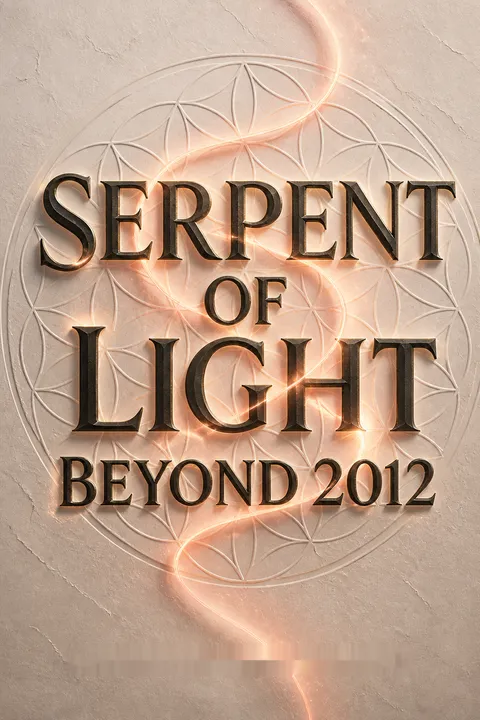


Key Takeaways
Read the Earth's Kundalini as a mythic argument for a female-led cycle
A long cosmic clock. The book's central idea is that Earth has a spiritual current, the Serpent of Light, which changes its resting place about every 12,920 years. The author links this cycle to the precession of Earth's axis, a real astronomical phenomenon that takes roughly 26,000 years to complete. In his account, the current shift began around 2002, moving spiritual influence away from Tibet and India toward Chile and Peru.
A transfer of influence. The author connects the shift to a change from male to female spiritual leadership. He recounts China's 1949 invasion of Tibet and the Dalai Lama's 1959 flight as moments accompanying the Serpent's departure. The Andes, he argues, become a new center of spiritual teaching, while feminine wisdom is meant to guide the coming era.
The cycle gives a sweeping spiritual interpretation to political upheaval and changing cultural influence. Its symbolic claim is easier to assess than its literal one: a society can use a story of cyclical renewal to imagine different leadership and responsibilities. Axial precession is established astronomy, but the book supplies no evidence that it moves an Earth energy or causes cultural shifts. Keeping those claims distinct lets readers engage the myth without mistaking metaphor for measurement.
Let ceremony turn ecological care into a shared responsibility
Care made visible. The author treats ceremony not as decorative tradition but as a community's way of honoring obligations to Earth, ancestors, and other life. He describes a Taos Pueblo ceremony involving the climb of a tall pole, which participants understood as helping sustain the world's order. Whether or not every participant took the belief literally, the ceremony made collective care tangible and memorable.
A different measure of knowledge. The book contrasts this worldview with modern confidence in technical expertise. Its argument is that knowledge should be judged partly by whether it sustains life, not only by whether it explains mechanisms. Across the travel stories, ceremony repeatedly gives people a shared task, a defined place, and a way to act together in the face of environmental anxiety.
Ritual can create social coordination: repeated gestures, shared attention, and common symbols help a group recognize mutual obligations. That makes ceremony potentially valuable for ecological action even when its supernatural explanation is not accepted. The sharper question is whether a ritual also changes material conditions. A ceremony can focus commitment, but environmental repair still requires practical decisions about land, water, energy, and policy. The book is strongest when ritual deepens responsibility rather than substituting for it.
Treat sacred sites as a map of consciousness, not isolated ruins
A landscape of chakras. In the book's model, sacred sites are connected parts of an Earth-wide energy pattern, and the Yucatan temples mirror the human body's energy centers. Uxmal represents a new cycle's base, Labna the sexual center, Chichen Itza the heart, Tulum the throat, Kohunlich the third eye, and Palenque the pineal center. Tikal begins another level of the sequence.
Crystals as markers. In 1985, the author and his brother Ken travel through eight sites, placing crystals at locations they believe will balance the pattern. At Chichen Itza, a Mayan guide leads them to a cenote, a sacred pool, where they place a crystal in the water. Later journeys revisit these sites with larger groups and renewed ceremonies. The ruins become participants in a living spiritual geography, not merely archaeological remains.
This way of reading place resembles pilgrimage traditions in which a route turns geography into a sequence of inner transformations. It can make ancient structures feel connected to present-day responsibilities, rather than sealed off as relics. The chakra correspondences, however, are interpretive assignments, not archaeological findings established in the text. Respect for living communities and their own accounts matters especially here, since assigning meanings to sacred places can easily overshadow the people who maintain them.
Trust becomes useful when a shared task crosses cultural boundaries
A blocked passage. The author says the Serpent of Light stalled at the Panama Canal, which he interprets as an energetic barrier between North and South America. In 2001, Maya leaders and members of hundreds of Indigenous groups from across the Americas performed a joint Ceremony of the Eagle and the Condor, representing the two continents. The author says the ceremony helped the energy cross the canal and continue south.
Coordination without command. In his own part of the effort, he meditates over the canal while other groups perform ceremonies elsewhere. He describes feeling a change on the third day, followed by the Serpent's movement toward Chile, where 112 Indigenous groups wait in a circle. The story's central human theme is cooperation among people who do not share a single language, nation, or tradition, but understand themselves to be serving a common purpose.
The narrative's strongest evidence is not for a moving planetary force, but for the possibility of coordinated action across communities. Shared ceremonies can build trust and a sense of common identity, much as synchronized movement has been found to strengthen social affiliation. Yet the book's account is filtered through one narrator and does not independently document the event's alleged energetic effects. The distinction matters: collective solidarity can be real and consequential without requiring every metaphysical interpretation to be true.
Balance gendered power without turning symbolic roles into biological destiny
A planned handoff. The author describes a ceremony involving forty-two women, forty-two pieces of green calcite, and sacred locations around the world. At Moorea, he and his partner take part in a ritual he understands as balancing female sexuality and preparing the Earth for a female-led era. He also recounts a fourth-dimensional handoff on Kauai, where a female figure receives responsibility for guiding humanity from a male figure.
Power made ceremonial. The book later tells of a ceremony on Bolivia's Island of the Sun, where men symbolically yield leadership in ritual to women. These scenes express the author's conviction that female wisdom and care have been suppressed and need room to guide public life. His cyclical story casts the coming period as a correction to a long male-dominated era.
The call to widen women's authority is clear, and ritual can give that change emotional weight beyond an abstract appeal to fairness. The limitation is the book's recurring equation of women with nurturing wisdom and men with protection or control. Such symbols may serve the story, but they can harden into expectations that constrain people of every gender. A more inclusive reading treats feminine and masculine as qualities available to all, while still confronting the historical exclusion of women from power.
Repair historical rupture by making space for people left between worlds
The Ancient Ones return. The author interprets the Anasazi departure from the Four Corners region as a spiritual retreat into an inner world. He connects that departure to severe drought and pressure from Spanish conquistadors, then presents the Anasazi as trapped between worlds. This account is his spiritual interpretation, not a settled archaeological explanation for the Anasazi's disappearance.
A circle of repair. In 2003, an international group visits Navajo, Anasazi, and Ute sites, seeking permission and guidance from local people. At Hovenweep, they build a medicine wheel, a circular ceremonial arrangement of stones, and pray for healing, rain, and reconciliation. The author reports that rain arrived five days later. The deeper work is communal: participants acknowledge the damage between Native and non-Native communities and try to approach the land and one another with respect.
The journey frames historical injury as a relationship that requires attention, not merely a fact to be archived. That is valuable, especially when the group seeks permission and accepts guidance from Native hosts. Archaeology, however, describes Anasazi settlement changes through evidence such as climate, resources, and social organization; the inner-world account is not demonstrated here. Ritual can support reconciliation, but it cannot replace Indigenous sovereignty, material restitution, or careful historical inquiry.
Meet inherited violence with ritual accountability, not spiritual bypassing
A difficult reckoning. During the Mayan journey, the group encounters what the author interprets as a dark force connected to ancient human sacrifice. At one point, a woman attempts to damage a crystal skull, and several people intervene. The author later describes a ritual meant to remove the force from her. These episodes show how he understands spiritual conflict, though the text does not provide independent evidence for the entity he describes.
Pain brought into the open. At two temples, the group performs separate ceremonies for men and women. Men are asked to confront harm done to women; women are invited to acknowledge and release pain linked to generations of violence. The men offer comfort as women grieve. The author's aim is not to erase the past, but to make its emotional burden visible and create a shared act of remorse, care, and forgiveness.
The scenes recognize that gendered violence is both historical and intimate, and that listening and support matter during difficult emotional work. Contemporary trauma-informed practice adds an important condition: participants need informed consent, control over their involvement, and access to appropriate support. Intense catharsis is not automatically healing, and forgiveness should never be demanded from people who have been harmed. Ritual can create a container for accountability, but it should not displace safety or justice.
Let ancestral memory travel through place, ritual, and intergenerational teaching
Memory held in place. In Peru, the author recounts ceremonies at Machu Picchu, Lake Titicaca, and Cahuachi, a buried ceremonial city near the Nazca lines. He says Incan elders saw the group's arrival and a condor's appearance as signs that an ancestral prophecy was being fulfilled. At Lake Titicaca, a ceremony on the Island of the Sun symbolically transfers spiritual authority to women.
Memory carried in relationship. In New Zealand, the author meets the Waitaha, whose traditions connect ceremony, collective dreaming, and belonging. A formal welcome includes reciprocal songs, a shared meal, and the hongi, a greeting in which people touch foreheads and noses and breathe together. The group then sleeps under one roof. The author understands their Dreaming from the Heart as a way of shaping shared reality and preserving knowledge across generations.
The emphasis on memory as a social practice is powerful. Songs, meals, greetings, and repeated visits can carry identity across generations in ways that written records alone cannot. Oral histories also deserve to be heard on their own terms, not treated as automatically confirmed by a visitor's visions or a prophecy he reports. Claims about ancient lineage or extraterrestrial origins require separate evidence. The ethical center is more durable: listen carefully, honor custodianship, and let communities define what their traditions mean.
Practice the heart as attention, not proof of supernatural certainty
An inner discipline. The book's closing advice is to move attention away from constant analysis and toward the heart, which the author describes as a sacred inner space where people can experience connection with God, Earth, and one another. He links this practice to unconditional love and to images or dreams that, in his worldview, help shape the outer world.
A way to live. Across the journeys, the author says that entering the heart means approaching other people and the land without assuming separation. This appears in the Maya greeting that recognizes kinship, in ceremonies of welcome, and in the group's attempts to listen before acting. The book presents this inner shift as the foundation for its larger vision of human transformation.
As a contemplative practice, shifting attention from rumination toward embodied awareness can help people notice emotion, reduce reactivity, and respond with greater care. That psychological value does not establish the book's stronger claim that inner images alter external events. A useful distinction is between treating the heart as a source of ethical attention and treating intuition as infallible evidence. The first can deepen compassion; the second needs humility, testing, and room for disagreement.
Analysis
Serpent of Light is part spiritual memoir, part speculative cosmology, and part travel narrative. Its organizing image is a planetary energy that moves on a roughly 13,000-year rhythm, redirecting spiritual authority from one region to another and, in the current cycle, from masculine to feminine leadership. The author turns that premise into a series of journeys. Each site adds a stage to the story: Tibet supplies the point of departure, the Maya and other Indigenous communities guide the route, and the Andes and Pacific cultures become centers of renewal. The ceremonies give the account its emotional continuity, linking personal visions to collective acts of welcome, grieving, and service.
The book's value depends on distinguishing its kinds of claims. Precession of the equinoxes is a genuine astronomical phenomenon. The specific Earth Kundalini, energy grid, crystal transmission, inner-world populations, and prophetic dates are presented as spiritual knowledge, but the text does not independently establish them. Precise forecasts about 2009 and 2012 to 2013 are part of the author's period-specific worldview, not evidence that the predicted transformations were scientifically verified. Personal testimony can reveal what an experience means to the person reporting it; it cannot, on its own, demonstrate a planetary mechanism.
That distinction need not erase the book's ethical themes. It argues against treating land as inert, asks readers to take ceremony and cultural memory seriously, and imagines cross-cultural cooperation as a form of healing. Its most compelling moments are those in which the narrator listens to hosts, seeks permission, or describes people supporting one another through grief. A continuing tension is that Indigenous voices are largely interpreted through his metaphysical framework, and some communities' traditions are treated as parts of a universal system. Readers can appreciate the call to humility and care while also asking who has authority to interpret a tradition, and what evidence would be needed to distinguish spiritual meaning from historical fact.
Review Summary
The Serpent of Light receives mostly positive reviews, with readers praising its spiritual insights, engaging storytelling, and thought-provoking concepts. Many find the book inspiring and transformative, appreciating Drunvalo's unique perspective on Earth's energy shifts and sacred geometry. Some readers express skepticism about certain claims but still find value in the overall message. Critics note the writing can be disorganized and repetitive at times. The book is recommended for those interested in metaphysics, indigenous cultures, and personal spiritual growth.
People Also Read






Glossary
Precession of the Equinox
Slow axial orientation shiftEarth's rotational axis slowly changes its orientation relative to distant stars, shifting the position of the equinoxes over a cycle of roughly 26,000 years. The book uses this astronomical cycle to organize alternating spiritual eras of about 12,920 years. The astronomical phenomenon is established; the proposed spiritual effects and gendered eras are the author's interpretation.
Serpent of Light
Earth's spiritual currentThe author's name for an Earth energy, compared to the rising Kundalini energy of a human body. In his cosmology, it rests in one surface location for roughly 12,920 years, then moves to another, influencing spiritual life and human consciousness. The book places its new center in the Andes region of Chile and Peru.
Unity Consciousness Grid
Earth's higher-consciousness patternA proposed geometrical and electromagnetic structure surrounding Earth that, in the author's account, supports a higher level of human consciousness. He describes its male, female, and neutral aspects as associated with Egypt, the Yucatan, and Tibet. Sacred sites, ceremonies, and the Serpent of Light are said to affect its balance. This is an esoteric framework, not an established scientific model.
Mer-Ka-Ba
Human light-body fieldThe author uses Mer-Ka-Ba for a human energy field associated with sacred geometry and higher consciousness. He describes it as a spherical field extending roughly 27 to 30 feet around the body and links its pattern to a corresponding field around Earth. In the book, meditation on this field is also used in ceremony. These energetic claims are not scientifically established.
Sacred Space of the Heart
Inner place of connectionA special inner space that the author associates with the physical heart and with direct connection to God, creation, and other beings. He distinguishes entering this space from ordinary analytical thought and treats it as a basis for unconditional love and unity. The book presents it as an experiential spiritual practice rather than a measurable anatomical structure.
Dreaming from the Heart
Heart-centered reality makingA way of dreaming that the author associates especially with the Waitaha. It means more than nighttime dreams: shared intention and inner images, held in ceremony, are understood to shape future reality. In the book, this concept links collective dreaming with cultural memory and human transformation. Its metaphysical claim is distinct from the observable social effects of shared ritual and imagination.
Medicine Wheel of the New Dream
Ceremonial circle for healingThe name the author gives to a large stone circle created by an international group at Hovenweep during the Anasazi journey. Stones mark a circle and its directional center, while participants offer prayers for rain, healing, and reconciliation between Native and non-Native people. The author also understands the wheel as helping reconnect the Anasazi with the present world.
FAQ
1. What is Serpent of Light: Beyond 2012 by Drunvalo Melchizedek about?
- Core theme: The book explores the movement of the Earth's Kundalini energy—a serpent-like spiritual force that shifts every 13,000 years—shaping human consciousness and spiritual evolution.
- Historical and spiritual journey: It traces this energy’s migration from Atlantis to Tibet, India, and finally to South America, highlighting the rise of female spiritual power and a new era of unity consciousness.
- Personal narrative: Drunvalo Melchizedek shares his direct experiences with indigenous tribes, ceremonies, and spiritual guides, illustrating how these cosmic events are unfolding and impacting humanity’s future.
- Connection to 2012: The narrative ties into the Mayan calendar’s end, describing a planetary shift from the Fourth to the Fifth World and a transformation in global consciousness.
2. Why should I read Serpent of Light: Beyond 2012 by Drunvalo Melchizedek?
- Unique blend of wisdom: The book combines esoteric knowledge, indigenous traditions, and personal spiritual experiences, offering insights into hidden histories and energetic realities.
- Practical spiritual guidance: Readers learn about sacred ceremonies, meditations like Living in the Heart, and the importance of balancing male and female energies for healing.
- Hopeful vision for the future: It inspires readers to consciously participate in the planetary shift, emphasizing the role of women and children in leading a new cycle of unconditional love and unity.
- Relevance to modern times: The book provides tools and perspectives for navigating the changes associated with the 2012 transition and beyond.
3. What are the key takeaways and spiritual advice from Serpent of Light: Beyond 2012 by Drunvalo Melchizedek?
- Live from the heart: The book emphasizes shifting consciousness from the mind to the heart, where true wisdom and unity reside.
- Unconditional love as the secret: Love, especially as expressed by women and children, is presented as the transformative force for healing humanity and the planet.
- Participate consciously: The years around 2012–2013 are seen as critical for human evolution, requiring responsibility for thoughts, feelings, and actions.
- Trust in the process: Readers are encouraged to embrace the new cycle with open hearts, trusting Mother Earth and the Great Spirit to guide and protect.
4. What is the Earth’s Kundalini and why is it significant in Serpent of Light: Beyond 2012 by Drunvalo Melchizedek?
- Definition and analogy: The Earth’s Kundalini is a powerful, serpent-like energy coiled within the planet, analogous to the Kundalini energy in the human body.
- Cyclical movement: This energy remains in one location for about 13,000 years before moving to a new site, guided by the Precession of the Equinox.
- Impact on humanity: Its movement awakens people near the new location, alters electromagnetic grids, and initiates a global shift in consciousness, especially emphasizing the rise of female spiritual energy.
- Spiritual leadership: The Kundalini’s shift marks the transfer of spiritual leadership from one region and polarity (male/female) to another.
5. How does Serpent of Light: Beyond 2012 by Drunvalo Melchizedek explain the Precession of the Equinox and its spiritual role?
- Astronomical cycle: The Precession of the Equinox is a 25,920-year wobble of Earth’s axis, moving through twelve constellations every 2,160 years.
- Spiritual significance: Ancient cultures divided this cycle into Yugas, each with distinct energies influencing humanity’s development.
- 2012 as a turning point: December 21, 2012, marks the axis pointing toward the galactic center, triggering the Earth’s Kundalini to move and initiating a new spiritual era led by female energy.
- Cosmic timing: The book links this astronomical event to the rise of unity consciousness and the shift in planetary energy grids.
6. What is the Unity Consciousness Grid in Serpent of Light: Beyond 2012 by Drunvalo Melchizedek and why is it important?
- Definition: The Unity Consciousness Grid is a complex electromagnetic energy field surrounding Earth, enabling higher human consciousness beyond duality.
- Threefold structure: It consists of male (Egypt), female (Yucatan), and child/neutral (Tibet) aspects, each requiring balance for planetary ascension.
- Role in ascension: The grid’s proper functioning is essential for humanity’s evolution into unity consciousness and survival during the planetary shift.
- Serpent of Light’s guidance: The movement of the Kundalini energy helps humanity access and integrate this grid.
7. How does Serpent of Light: Beyond 2012 by Drunvalo Melchizedek describe the shift from male to female spiritual power?
- Cycle of polarity: Every 12,920 years, the Kundalini’s polarity shifts, transferring spiritual leadership from male to female.
- Cultural and societal impact: This shift influences leadership roles in business, religion, and governance, with female spiritual light becoming dominant.
- Ceremonial support: Indigenous ceremonies, such as the Ceremony of the Eagle and the Condor, help facilitate this transition by balancing energies across continents.
- Empowerment of women: The book highlights the importance of women reclaiming their spiritual power to lead humanity into a new era.
8. What is the significance of the Anasazi, Maya, and Inca journeys in Serpent of Light: Beyond 2012 by Drunvalo Melchizedek?
- Healing ancient wounds: The journeys aimed to heal energetic blocks in the Unity Consciousness Grid caused by ancient decisions of these cultures to retreat into inner Earth worlds.
- Ceremonial work: The group performed medicine wheel and other ceremonies to restore balance, bring rain, and reconnect these cultures with the surface world.
- International cooperation: Participants from many countries symbolized global unity and the fulfillment of ancient prophecies.
- Activation of Kundalini: The successful completion of these journeys allowed the Serpent of Light’s energy to empower women in South America.
9. How does Serpent of Light: Beyond 2012 by Drunvalo Melchizedek explain dimensions, overtones, and their spiritual implications?
- Vibrational universe: The book describes a universe made of sound and vibration, with dimensions corresponding to musical harmonics and wavelengths.
- Structure of dimensions: There are 12 major and 12 minor overtone dimensions in each octave, totaling 144 dimensions per octave.
- Overtone worlds: Ancient cultures like the Anasazi moved into overtone worlds, which are lower vibrational realities interpenetrating our own but invisible without special knowledge.
- Spiritual evolution: Understanding these dimensions is crucial for evolving consciousness and avoiding spiritual entrapment.
10. What role do Mayan temples, crystals, and crystal skulls play in Serpent of Light: Beyond 2012 by Drunvalo Melchizedek?
- Temples as chakras: Eight Mayan temples correspond to the eight primary chakras, each channeling specific energies for planetary balance.
- Crystal placement: Specially programmed crystals were placed at these temples to balance the female aspect of the Unity Consciousness Grid.
- Crystal skulls as knowledge keepers: The thirteen Mayan crystal skulls contain the spirits and wisdom of ancient Mayan individuals, serving as repositories for awakening humanity during the End of Time.
- Ceremonial importance: Ceremonies involving these objects were crucial for healing, protection, and the transmission of ancient knowledge.
11. What is the Waitaha prophecy and its connection to the Serpent of Light in Drunvalo Melchizedek’s work?
- Ancient lineage: The Waitaha are an indigenous people of New Zealand, linked to Lemuria and holding the secret of Dreaming from the Heart.
- Dreaming from the Heart: This concept teaches that reality is a hologram created by the heart’s images and intentions, not by the mind.
- Prophetic awakening: The Waitaha prophecy predicts a pivotal awakening around August 15, 2009, leading to a new human dream and cosmic revelation.
- Role in ascension: The Serpent of Light’s energy is awakening the Waitaha and Maori, catalyzing humanity’s shift to higher consciousness.
12. What are the best quotes from Serpent of Light: Beyond 2012 by Drunvalo Melchizedek and what do they mean?
- “Behold! The Jewel in the Lotus!” This phrase symbolizes the awakening of divine consciousness within the human heart, calling readers to recognize their inherent divinity.
- “The Dream is really ‘only light and intention.’” This highlights the teaching that reality is a manifestation of consciousness and intention, inviting readers to become conscious creators.
- “Now, look into the Light and breathe deeply the joy of life. Eternal Life without suffering was yours all along.” This encourages embracing the present moment with joy and trust, recognizing that separation from the Source is an illusion.
- Quotes as spiritual guidance: Each quote encapsulates the book’s core messages of unity, love, and conscious participation in the planetary shift.
About the Author

Download PDF
Download EPUB
.epub digital book format is ideal for reading ebooks on phones, tablets, and e-readers.








