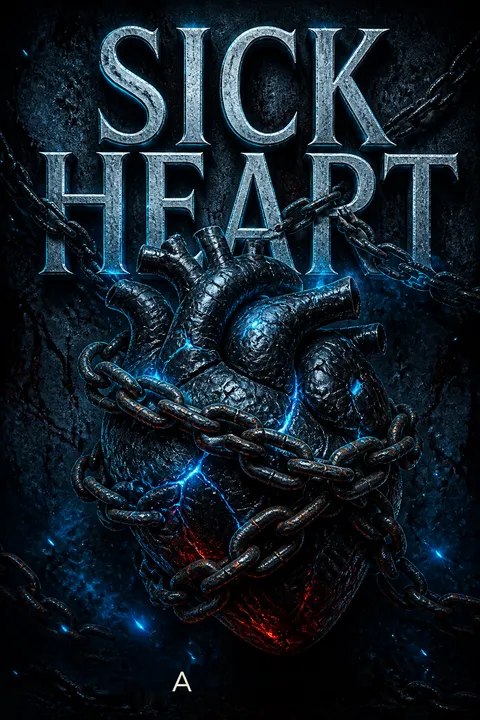


Plot Summary
The Prize on the Bull
On the Bull of Light, a floating industrial city hosting an illegal death match, Anya Bokori waits to learn which fighter will own her. Her guardian, Lazar, backs Pavo Vervonal, his champion and Anya’s promised captor; the other fighter is Cort van Breda, the undefeated Sick Heart, arriving for what is supposed to be his final bout.
Anya’s younger sister, Bexxie, defies Pavo and gets slapped for it, while Anya stays still because resistance has taught her to measure danger before acting. Cort walks into the reception room, ignores Pavo’s protests, and takes a costly bottle of the blue drug Lectra. Anya laughs at Pavo’s helpless fury, then meets Cort’s unreadable gaze and realizes the fight will decide more than ownership of a ship.
The opening makes Anya’s status brutally legible: the men treat her and the ship as interchangeable stakes, while her practiced stillness is the only immediate control she possesses. Bexxie’s defiance briefly interrupts that system, but Pavo’s slap shows how quickly it restores itself. Anya’s laugh at Cort’s audacity is therefore more than amusement. It is a rare response not dictated by the men around her. Cort’s silence draws her attention because it resembles her own, though his reputation makes that resemblance frightening rather than comforting.
The Knife Beneath the Rail
The fighters meet on the darkened helipad, their bodies painted as a glowing skeleton and serpent while Anya stands between them as the advertised prize. Pavo exposes Cort’s silence to provoke him, then punches Anya hard enough to split her mouth and start the fight. When the lights fail, she searches the platform for the knife she suspects Pavo’s team planted and finds it fastened beneath a stair rail.
Pavo uses it to wound Cort and nearly strangles Anya, but she drives the blade into Pavo’s side. Cort regains his footing, defeats Pavo with a spinning kick, and kills him. Anya then stabs Pavo herself before Cort finishes the killing and throws the body overboard. Lazar’s protest cannot undo the result: Cort has won.
Anya’s intervention changes her from a passive stake into an active participant, but the scene does not pretend that one courageous act makes her safe. She acts because Pavo has already attacked her and because she understands the danger of the planted knife. Cort’s victory depends on her intervention, yet he does not erase her agency by claiming the entire fight as his own. Their shared violence creates an uneasy bond: both know how to survive inside the rules, and both have just crossed from watching those rules to shaping their outcome.
The Helicopter to the Rock
Cort is stitched and transfused in the ship’s clinic while Anya discovers that he can sign, though he does not speak aloud. At the celebration, the injured champion and his companions drink Lectra; Anya joins their sexual celebration through deliberate gestures, though the drug leaves her memories blurred.
When Cort later wakes alone with her, he carries her unconscious body onto a helicopter and leaves the Bull of Light before his father can stop him. He takes her to the Rock, a decommissioned oil rig far out in the Atlantic.
Udulf arrives and demands Anya, revealing that Cort’s claim to her is uncertain. Cort persuades him to leave her there temporarily, presenting her as a prize he wants. Anya has escaped Lazar’s immediate reach, but she has not gained freedom.
The transfer from ship to rig changes the scale of the story. The crowded spectacle gives way to isolation, where control is no longer enforced by an audience but by food, water, and physical access to the outside world. Cort’s choice to take Anya is partly protective and partly possessive; he does not yet know how to separate those motives. Anya’s uncertain claim to her own future remains central. Being removed from one owner’s reach is not the same as choosing where to go, a distinction the Rock will make increasingly difficult to ignore.
A Rope Between Strangers
Anya wakes among enormous seabirds on the bare rig and finds Cort already jumping rope below. He gives her a rope and a place on a chalkboard, then expects her to follow his routine without explanation. With supplies limited, he rations meals and punishes her resistance by locking her on the lower level. Anya spends the night without food, then retrieves the rope he leaves within reach and begins skipping rather than surrendering.
Cort eventually releases her, teaches her to work the heavy bag, and dresses her knuckles when they split. Their days settle into a rough pattern of drills, sparse meals, and bird-filled nights. Cort trusts the albatrosses, which once helped him survive here as a child; Anya has no reason yet to trust him.
The rig’s apparent calm conceals a familiar coercion. Cort reproduces the deprivation that shaped him, treating hunger and discipline as useful teachers because they once kept him alive. Anya’s refusal to speak lets him mistake her silence for simple defiance, while her choice to retrieve the rope reveals a more deliberate form of endurance. The birds complicate Cort’s hard exterior: he is gentle with creatures that cannot threaten his authority. That contrast does not excuse the punishment, but it makes his conduct less predictable and begins to unsettle Anya’s assumption that every kindness is merely bait.
The Puzzle in the Dark
After several days of inadequate rations, Anya faints during training and cuts her head. Cort carries her to the clinic, stitches the wound, and divides his scarce food with her. He brings her to a children’s room hidden inside the rig, where books, puzzles, and battered board games give their hard routine an unexpected softness.
They finish a puzzle together, then spend hours playing games; Anya’s grief for Bexxie surfaces, and Cort stays beside her instead of sending her away. In the days that follow, he takes her swimming beneath the platform, showing her the reef the structure has created. Their closeness becomes physical, but Anya remains alert to the difference between a tender moment and a promise of safety.
The game room matters because it gives Anya something beyond survival to respond to. The puzzle asks her to notice and assemble, not merely obey; the games let her experience competition without a death sentence attached. Cort’s care after her injury is concrete, but his motives remain difficult to read, so her suspicion is psychologically coherent rather than a failure to appreciate kindness. The reef offers a temporary image of another world beneath the machinery. It does not free them, yet it lets them inhabit curiosity together, a small rehearsal for a relationship not organized entirely around danger.
A Camp Full of Children
After Anya and Cort have spent a month alone, a supply boat brings the children of Cort’s training camp to the Rock. Maart, Cort’s longtime friend, arrives with Rainer and takes charge of the strict training schedule. Anya is assigned the kitchen and told to stay away from the fighters, including Cort.
She sees children working in disciplined silence and learns that their camp prepares them for lethal matches. When Maart dismisses her wish to train, Anya slaps him. Maart strikes back, but she blocks his next blow, and he allows Cort to take her onto the mat. She trains with the children while continuing to cook and clean. What had been an exile now has a purpose she has chosen for herself.
The arrival of the children reveals the machinery behind Cort’s legend: his success is inseparable from a camp that teaches children to survive by preparing them to kill. Anya’s kitchen assignment repeats the gendered confinement she knows, while her slap makes the cost of that confinement visible to everyone. Her willingness to accept Maart’s retaliation is not evidence that she welcomes violence; it is a calculated risk to gain access to training. The camp’s rules are harsh, yet they offer her a role defined by effort rather than sexual ownership, making this a consequential change in how she imagines herself.
Irina’s First Lesson
At the children’s first test, Maart pairs Anya with Irina, a teenage fighter far more experienced than she is. Irina toys with her before beating her unconscious; Cort and Maart carry Anya to the clinic, where she wakes badly bruised but unwilling to abandon training.
While she recovers, she explains to Cort that she can understand seventeen languages and that Lazar used her as a spy, sending her to listen to men and report what she heard. Her silence began after an encounter with Udulf when she was seven.
Cort also shares his worry over Ainsey, a small fighter repeatedly weakened by pneumonia. Anya’s knowledge turns her from an inexplicable survivor into someone who has been gathering information for years, though she still withholds the worst of what she knows.
The defeat makes Anya’s physical limits unmistakable, but it also clarifies that her survival has depended on a different intelligence. Her languages are not a magical escape from captivity; they were converted into labor for Lazar, who made her listening useful to his power. Silence, by contrast, remains hers. Cort’s willingness to disclose his worry about Ainsey lets Anya see care in him, but it also exposes his selective attachment to the children. The two survivors are beginning to recognize each other’s damage without yet agreeing on what should be done with it.
The Warrior Speaks
During the next stage of training, Maart denies Anya a formal test because he believes she will not face a death match. She challenges him instead, and he accepts. Maart knocks her out with a single punch, but when she wakes, Anya curses him aloud for treating her as a girl who needs to be protected rather than a fighter who deserves a real contest.
Irina cleans her wounds and welcomes her as an ally. The children’s training continues, and Cort’s conflict deepens when Rainer says he plans to stay behind with them rather than leave for freedom. Cort knows the choice will preserve the camp but keep Rainer inside its violent system. Anya’s voice has returned briefly, yet she still decides when it is hers to use.
Anya’s spoken outburst is not a cure for trauma or a surrender of her chosen silence. It is a tactical use of speech at a moment when she wants her anger unmistakably heard. By demanding a fairer test, she rejects the assumption that protection must mean exclusion. Rainer’s decision offers a parallel challenge to Cort: freedom can feel morally unbearable when others remain trapped. The section therefore refuses an easy division between brave action and cowardly retreat. Each character is trying to decide what responsibility means when no available choice can save everyone.
Heart Sick, Not Sick Heart
In a tropical storm, Anya admits through signs that she is afraid she cannot keep surviving. Cort tells her that Udulf took him as a child, abused him, and once left him alone on the Rock. An injured albatross brought him fish, and the bird became his first companion. When Anya jumps into the sea, Cort follows; underwater, she finally speaks to him, then asks him never to demand her voice again.
She explains that he has mistaken the source of his name: his heart is not sick by nature, but wounded by loss. Cort recognizes that her insight reaches something he has buried, though he still cannot remember the full truth. Their intimacy grows from recognition, not from the promise that either can repair the other.
Cort’s story gives the Rock a double meaning: the place that once represented abandonment also contains the first relationship he remembers as freely chosen. Anya does not rescue him by explaining his identity; she gives him a different interpretation that he may accept or refuse. Her spoken boundary is equally important. She makes her voice audible without making it permanently available, preserving the agency that silence has protected. Their connection deepens through mutual recognition, but the section keeps its limits visible: understanding a wound is not the same as undoing it.
The Last Night on Rock
Anya’s training continues through the final stage, even as Maart warns Cort that his attachment to her and to Ainsey threatens their plans to leave. In the last test, Anya faces Paulo, a skilled young fighter; she surprises him with a move Cort once used, though Paulo ultimately wins. The camp celebrates its completed training with food, games, and a small amount of Lectra.
Anya, Cort, and Maart share the night, and Rainer tattoos a key on Anya that fits the lock over Cort’s anatomical heart. Under the drug’s influence, Cort remembers a childhood shipyard, the silent girl who taught him signs, and the moment she was taken. The memory begins to return, but the full truth remains just beyond his grasp.
The final test measures growth without pretending that effort guarantees victory. Anya’s copied capoeira move shows how training has become embodied knowledge, while Paulo’s win preserves the camp’s brutal hierarchy. The tattoo turns a private bond into a visible symbol, but it also carries the danger of treating another person as the missing piece of oneself. Cort’s recovered memory shifts the emotional stakes: his longing for rescue is tied to a specific lost child, not only to an abstract wish for a different life. The celebration is therefore both a milestone and an unstable threshold.
A Deal Built on Betrayal
Back at Cort’s training village, Maart reveals that he arranged an ultimate fight against Cort: if Maart wins, the camp’s fighters will be freed, while Cort’s victory can save Anya and Ainsey. Lazar arrives carrying Ainsey and tells Anya that Bexxie was killed in her place after the Bull of Light fight. The revelation drives Cort to accept the contest.
Anya, returned to Udulf’s control while the men negotiate, confronts him over a film he once forced her to watch. She identifies Cort as the boy in it and names the secret shared by Udulf and Lazar: they abused and killed Cort’s sister, then used the recording to control one another. Anya asks Udulf to let her live, buying time rather than trusting his answer.
The apparent choice between Cort and Maart is engineered by men who still presume they can define what freedom costs. Maart’s deal turns loyalty into a lethal wager, while Lazar’s announcement about Bexxie reveals the private price Anya has paid for surviving. Her confrontation with Udulf is not a confession made for emotional release. She uses knowledge as leverage because she understands that these men respond to risk and control. The secret connects her silence to Cort’s fractured memory, but it does not make her a mere key to his past. She is acting on her own account.
The Camp Turns Its Guns
The fight begins in Cort’s training ring, with Maart striking first while the owners watch. His duel is a diversion: children crawl beneath the platform, older fighters move in from the edges, and the camp attacks the gathered owners and mercenaries.
Anya distracts Udulf long enough for Irina to slit his throat. Elsewhere, Lazar runs into the jungle with Ainsey, and Cort follows. The old memories return as Cort recognizes the shipyard, his sister’s capture, and the violence he had repressed.
He catches Ainsey when she claws Lazar’s eyes and he falls from the cliff. Anya and the girls reach the shore as the ship begins to leave; Cort calls them toward it, and they jump into the water under gunfire. The escape succeeds, but several fighters are wounded and two children die.
The uprising succeeds because the owners mistake discipline for obedience and children for harmless dependents. Maart’s staged fight exploits that arrogance, giving the camp a coordinated opening rather than asking one champion to defeat an entire network alone. Anya’s role against Udulf is deliberately indirect: she creates the moment Irina needs, then accepts help rather than making revenge her sole measure of justice. Cort’s memory returns amid action, not through a safe therapeutic conversation, and the truth costs him no less for being recovered. Escape is real, but it arrives with casualties that resist any clean triumph.
A Home Made Afterward
The survivors reach the ship, but the uprising leaves lasting injuries and grief. Sammy and Peng die, Jafari is pulled from the water, and Zoya, Ling, and Rainer recover from gunshot wounds.
When Ainsey’s pneumonia returns, doctors discover a heart defect; the camp raises money through a legitimate fight so she can have surgery in Costa Rica. Six months after the escape, Anya joins the others at Lençóis Maranhenses to build small memorials for the children who died.
She makes one for Bexxie and tells the camp the story she has never before spoken aloud. Cort, Maart, and Rainer remain connected, though their plans differ. The former fighters begin building a life around ship work, training, and chosen family rather than the owners who once controlled every prize.
Freedom here is not represented as a sudden return to ordinary life. The survivors carry trauma, injury, financial strain, and the knowledge that some of their friends did not make it out. Ainsey’s surgery makes care concrete: the camp must organize money, time, and labor around a child’s health rather than her usefulness as a fighter. Anya’s memorial for Bexxie gives speech a new purpose, not as proof that she has abandoned silence but as a choice to witness. The ending locates hope in collective practices of remembrance and care, not in the erasure of loss.
Epilogue
A year later, Cort and Anya celebrate Paulo’s first professional win with their former camp. The Ring of Fire reporter has survived and now tells Cort she helped expose the network, though she offers few details. She urges him toward a public fighting career; he declines, content with the life he and Anya have built.
Later, he blindfolds Anya and takes her by helicopter to the Rock. The albatrosses greet them, and the couple shed their formal clothes, run across the platform, and jump into the sea together. The place that once held Cort in isolation has become a destination they choose.
The return to the Rock completes a transformation of place rather than a restoration of the past. Cort once experienced the rig as an abandonment imposed by Udulf; now he brings Anya there by choice, with no contest or owner deciding what the visit means. Their jump repeats an earlier gesture, but its meaning has changed from danger and desperation to shared play. Cort’s refusal of a public fighting career also matters: survival no longer requires him to perform the Sick Heart for an audience. The reporter’s uncertain account suggests that the larger world remains unsettled, while the couple’s chosen quiet offers a more modest, credible form of freedom.
Analysis
Sick Heart makes ownership concrete through objects that can be counted: a ship’s controlling shares, a fighter’s purse, a bottle of Lectra, a body offered as a prize. The system’s horror lies not only in its violence but in its fluency. Udulf and Lazar treat exploitation as ordinary business, while fighters are taught to confuse survival with consent to the rules. Anya’s silence interrupts that fluency. Because she withholds the expected response, she can observe, remember, and choose when to act. Her silence is neither simple power nor uncomplicated healing; it is a defense formed under conditions where speech has been made dangerous.
Cort’s arc turns on a similar distinction between adaptation and identity. The Sick Heart is a reputation that protects him and helps him survive, but it also obscures the child whose loss gave the name its deeper meaning. Anya’s insight does not magically restore his past. Instead, it creates the possibility that his violence need not be the only truth about him. The Rock serves as the novel’s central experiment: it begins as a place of punishment, becomes a space of training and uneasy care, and finally becomes a place the characters can choose to revisit.
The book refuses a clean rescue fantasy. Maart’s uprising frees many, but it cannot undo the deaths that came before or prevent losses during escape. Bexxie remains irretrievable; children are wounded and killed; Ainsey’s recovery requires money and collective labor. The ending’s hope is therefore practical rather than absolute. The survivors build routines, work, remember the dead, and decide whom to keep close. Their freedom is not the absence of damage. It is the growing ability to make choices that are not dictated by the people who once owned them.
Review Summary
Sick Heart by J.A. Huss is a dark, gritty romance set in an underground fighting world. Readers are divided on its content, with some praising its unique storyline and compelling characters, while others criticize the lack of romance and unexpected sexual content. The book features intense violence, complex relationships, and themes of survival. Many reviewers found it emotionally challenging but captivating, appreciating the author's ability to create a unique and twisted world. However, some readers were disappointed by the misleading blurb and unexpected plot elements.
People Also Read

Characters
Anya Bokori
The silent strategistAnya is a young woman raised among powerful men who treat people as property. She studies faces, gestures, and shifts in mood because words have rarely protected her. Her silence is not an absence of thought but a boundary she has defended at great cost. Beneath her careful composure are a sharp intelligence, a capacity for humor, and an instinct for reading the motives others conceal. Her relationship with Cort begins in mutual recognition, but she resists becoming merely his prize or his source of information. She wants the right to choose when to speak, whom to trust, and what kind of strength she will claim.
Cort van Breda
The undefeated fighterKnown as the Sick Heart, Cort is an elite death-match fighter who has spent most of his life surviving a system designed to make children into weapons. He rarely speaks aloud, relying on sign language and on an unnerving ability to read others. His violence is deliberate, but so is his care for the small circle he has gathered around him. Cort values routine because it gives shape to a life controlled by other people, and he distrusts desires that might endanger the people he loves. Beneath the feared champion is a man who wants freedom but has not decided what responsibility to those left behind will require.
Maart
The fierce second-in-commandMaart is Cort’s closest longtime friend, trainer, and practical caretaker. He has medical skill, a sharp temper, and little patience for hesitation when children’s survival is at stake. Unlike Cort, he often puts hard rules ahead of comfort, believing discipline can prepare young fighters for dangers they cannot avoid. His bluntness can look like cruelty, but it grows from an intimate knowledge of the system and its consequences. The loyalty between him and Cort is deep, complicated by old sacrifices and by their different ideas of what freedom should mean.
Rainer
The camp’s warm caretakerRainer is a large, easygoing fighter and trainer whose humor softens the camp’s severe routines. He is especially attentive to younger children and often translates Cort’s gestures for people who do not know sign language. Beneath his genial manner is a serious attachment to the children he helps raise. Rainer’s sense of duty does not always match Cort’s plans, which gives their friendship a quiet moral tension. He is the person most likely to notice when affection, guilt, or fear is shaping a decision.
Udulf van Hauten
The champion’s ownerUdulf is Cort’s powerful patron and the controlling figure behind the ships, training camps, and fighting contracts. He presents himself as practical and composed, treating cruelty as an ordinary cost of doing business. His relationship with Cort mixes paternal language with ownership, making affection difficult to distinguish from control. Udulf believes that people reveal themselves through the choices they make under pressure, but he is skilled at arranging those pressures to serve his own interests.
Lazar
Anya’s calculating guardianLazar controls Anya’s household and owns Pavo’s training camp. He is socially polished when it benefits him, but his treatment of Anya and the people around him is possessive and volatile. He sees loyalty as something to be extracted and people as assets whose value can change with circumstance. His long familiarity with Anya gives him a troubling confidence that he understands her, while her silence leaves him unable to know what she has noticed.
Pavo Vervonal
The favored challengerPavo is Lazar’s accomplished fighter and Cort’s former childhood companion. He is skilled, ambitious, and acutely sensitive to Cort’s reputation, which turns old familiarity into rivalry. His Lectra use magnifies his appetite for domination, and he treats Anya as a prize rather than a person. Pavo’s confidence is not empty bravado: he is a dangerous fighter who knows how to exploit distraction and fear.
Bexxie
Anya’s fearless little sisterBexxie is the nine-year-old girl Anya loves most. She is spirited, funny, and unafraid to challenge men whose authority frightens everyone else. Her boldness gives Anya a rare source of uncomplicated affection and a reason to imagine protecting someone besides herself. Though young, Bexxie has learned how to read danger and how to make her objections impossible to overlook.
Ainsey
The smallest fighterAinsey is a very young child in Cort’s camp, physically small and often vulnerable to illness. Her persistence and blunt gestures make her difficult to dismiss, even in a place where tenderness is treated as a risk. She responds strongly to the adults who train and care for her, while still having the stubbornness of a child who wants to do things for herself.
Evard
The watchful young traineeEvard is a young member of Cort’s circle, anxious about danger but deeply attached to the people who protect him. He notices more than he says and often looks to Rainer for reassurance. His first experiences around the elite fights expose the gap between a child’s fear and the adults’ practiced acceptance of violence.
Irina
The disciplined young fighterIrina is a Russian teenager in Maart’s training group, disciplined, direct, and proud of her ability. She treats combat as a serious craft rather than a performance and expects other fighters to meet her honestly. Her relationship with Anya develops through training and frank mutual respect. Irina dislikes being treated as fragile simply because she is a girl.
Zoya
The defiant small fighterZoya is a small, independent child who takes rules as challenges rather than assurances. She has a practical sense of humor and a keen instinct for claiming whatever small pleasures she can. Her stubbornness makes her a vivid presence among the younger trainees.
Rasha
The compassionate traineeRasha is a young fighter whose empathy distinguishes her from the camp’s harder children. She is capable and loyal, but violence weighs on her rather than becoming routine. Her connection to her brother Paulo gives her a place within the camp, while her gentleness complicates the qualities the fighting system rewards.
Jafari
The quick young studentJafari is a tall, quick child in Cort’s group, focused on his training and eager to prove himself. His work with Anya gives her a demanding partner and shows how even very young fighters are taught to measure progress through combat.
Budi
The solemn young fighterBudi is a quiet, observant boy whom Cort selected for his seriousness and unusual gravity. He takes training and loyalty deeply to heart, and he is more comfortable showing respect through action than through display. His presence hints at the long future Cort hopes his students might earn.
Paulo
The gifted young fighterPaulo is one of Maart’s strongest young students, a disciplined fighter who can unsettle even older trainees. His skill brings expectations with it, and his relationship with Rasha gives his competitive nature a more personal dimension. He is still a child, despite the adult responsibilities placed on him.
Maeko
The determined traineeMaeko is a young fighter who trains alongside Peng and Paulo. Quietly persistent, he measures himself against the camp’s strongest students and wants his effort to be taken seriously.
Peng
Maeko’s training partnerPeng is one of Maart’s young trainees and a close companion to Maeko. He shares the camp’s demanding routines and the private camaraderie that lets children remain children, briefly, within a violent system.
Cintia
A veteran camp trainerCintia is one of the adult women who survived the fighting system and helps maintain Cort’s camp. She has experience, practical authority, and a protective investment in the younger fighters. Her work makes the camp function beyond the spectacle of its champion.
Sissy
A veteran camp fighterSissy is an adult survivor in Cort’s circle, one of the women who came up alongside the core fighters. She understands the camp’s routines and the cost of surviving within them, and her presence represents a form of loyalty built over years rather than sentiment.
Ling
A seasoned camp survivorLing is one of the adult women who helped build and sustain Cort’s training community. She is capable, experienced, and closely connected to Cintia and Sissy. Like them, she knows that survival in the camp depends on skills and relationships rarely visible to outsiders.
The Ring of Fire reporter
The persistent witnessThe reporter covers the underground fighting circuit and pursues interviews with fighters who refuse to explain themselves. Her curiosity is sharpened by years in a world that rewards spectacle, though she is also searching for a way to tell stories beyond its official version.
Plot Devices
The Ring of Fire
A machine for ownershipThe Ring of Fire is an illegal international circuit where fights have no rules and end only when one fighter is dead or incapacitated. Wealthy owners gamble ships, money, training camps, and people as prizes. Fighters can win status and resources, but each victory tightens the system’s dependence on their bodies. The circuit supplies the central danger of the novel and explains why Cort’s record matters to Udulf, why Pavo is desperate to win, and why Anya’s future is attached to a fight she never chose.
Lectra
A blue path to disinhibitionLectra is an expensive, addictive blue drug used by the elite and by fighters who want to blunt pain or heighten aggression. Its effects differ from person to person, and its aftereffects can include emotional volatility and distorted memory. The drug shapes the fight-night celebration, complicates Anya and Cort’s recollections of it, and later pulls Cort toward traumatic memories he has repressed. It functions as both an intoxicant and a narrative route into the past.
The Rock
A prison turned refugeThe Rock is a decommissioned oil-rig platform isolated in the Atlantic. Cort was once left there as a child, and later uses it as a training ground for young fighters. Its scarce food, dangerous stairs, open sea, and albatross rookery make it physically harsh, while its distance from the owners allows new routines and relationships to form. The setting turns deprivation into a test of control, but its reef, birds, and hidden playroom also make room for forms of companionship the fighting world does not intend.
Silence and signing
A language of chosen controlAnya refuses to speak, while Cort communicates through sign language and lets Maart or Rainer speak for him in public. Their different forms of silence become a way to recognize one another without surrendering immediate access to their thoughts. Anya’s silence protects the one part of herself she believes no owner can claim; Cort’s silence is bound to habit, trauma, and his identity as a feared fighter. Learning signs lets them communicate, but the story treats the right not to answer as just as meaningful as the words they exchange.
The heart and key tattoos
A body carrying its historyCort’s tattoos make his body a record of the world that shaped him. Skulls, figures, and small stars invite others to read him as a killer, while the anatomical heart and keyhole suggest a more private grief. As Anya learns to interpret the images, their meanings shift from reputation toward memory and connection. The key tattoo later links her to the heart image, turning an existing motif into a marker of intimacy. The device is powerful because it makes the body both evidence of violence and a surface on which chosen meaning can be added.
Sick World Series Series

About the Author









Download PDF
Download EPUB
.epub digital book format is ideal for reading ebooks on phones, tablets, and e-readers.








