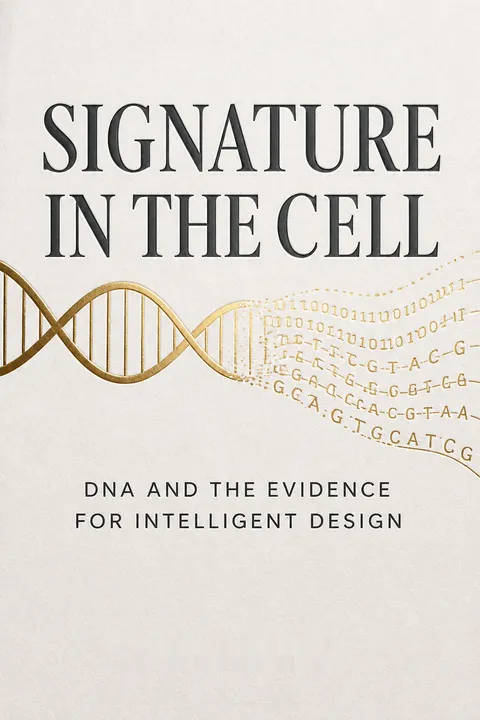


Key Takeaways
Treat DNA’s origin as an information problem, not merely a chemistry problem.
The central mystery. In 1985, while working as an oil-company geophysicist, Meyer attended a conference where origin-of-life researchers acknowledged that they lacked a satisfactory account of how the first life began. DNA’s coded sequences, he realized, were central to the gap. Its four chemical bases can be arranged in sequences that direct the construction of proteins, so explaining life’s origin requires explaining how those functional instructions first appeared.
A new question. The book’s argument begins with a shift in emphasis: matter and energy are not the whole story if living cells also depend on stored, processed information. Meyer calls the unresolved question of where that biological information came from the DNA enigma. His answer is that intelligent design best explains its origin.
The information framing makes the problem more precise than asking how a cell assembled from chemicals. It directs attention to sequence, function, and the machinery that reads instructions. That is a productive shift for research, even for readers unconvinced by Meyer’s conclusion. Yet calling DNA a code can blur metaphor and mechanism: biological sequences have measurable physical properties, while their functional meaning depends on cellular processes. The strongest version of the question therefore asks not whether DNA resembles software, but how the sequence-dependent system that produces function arose.
Darwin explains adaptation after life begins, not the first living system.
A boundary of scope. Darwin’s natural selection explains how heritable variations can spread through populations. But selection requires organisms that already reproduce, so it does not by itself explain the first replicating system. Meyer traces how nineteenth-century scientists tried to extend evolutionary thinking backward, from species change to life’s origin.
Early proposals. Friedrich Wöhler’s 1828 laboratory synthesis of urea weakened the idea that organic compounds required a special vital force. Later, Aleksandr Oparin proposed that simpler chemicals formed organic building blocks and that competition among primitive cell-like structures favored more effective metabolisms. Stanley Miller’s 1953 experiment produced amino acids from gases and electrical sparks, seeming to support this picture. Meyer argues that the experiment did not solve the harder question of how functional information arose.
Separating biological evolution from abiogenesis prevents a common category error: evidence for change among living populations does not automatically explain life’s first appearance. The reverse is also important. A difficulty in explaining abiogenesis does not, on its own, undermine evidence for evolution after replication exists. The book’s historical arc shows how scientific explanations expand when new discoveries change what must be explained. Its account is strongest when it marks the boundary between questions, rather than treating one unresolved origin problem as a verdict on all evolutionary biology.
Separate a sequence’s improbability from its biological meaning.
Two kinds of information. Shannon information measures how much uncertainty a sequence removes, using the probability of its characters. It does not tell whether the sequence means anything or performs a function. Two strings of equal length can carry the same Shannon information while one is meaningful English and the other is gibberish.
Function matters. Meyer calls information that is both complex and arranged to perform a function specified information. He argues that DNA and proteins possess this additional feature: their specific sequences help produce functional proteins and cellular activity. The distinction matters because a random sequence can be improbable without being useful. For Meyer, the origin of DNA’s functional specificity, not just its chemical complexity, is the central explanatory challenge.
This distinction is essential to the book’s argument and to careful reasoning about information. A low-probability sequence is not automatically a message, and a functional sequence cannot be identified without specifying the system in which it works. That creates a useful discipline: state the relevant function and the evidence for it, rather than sliding from improbability to design. The distinction also limits what information theory alone can prove. Shannon’s mathematics quantifies uncertainty, but it does not independently establish meaning, biological function, or the cause that produced either.
A cell needs an information-processing system, not just an information-bearing molecule.
The machinery matters. DNA cannot build proteins on its own. In transcription, RNA polymerase copies genetic sequences into messenger RNA. At the ribosome, transfer RNAs and other molecules help translate that message into an amino-acid chain. Proteins also help copy DNA, regulate genes, and supply energy for cellular work.
A circular dependency. Meyer emphasizes that many components depend on the same system they help operate. The cell needs proteins to process genetic instructions, yet it uses those instructions to build proteins. He presents this interdependence as another origin problem, sometimes described as a chicken-and-egg dilemma. A theory of life’s beginning must explain not only coded information, but also a workable system for reading, copying, and using it.
The emphasis on systems is a strength: a file is not useful without a reader, and a biological message requires machinery and context. Systems thinking also clarifies why isolated molecule experiments cannot automatically stand in for a living cell. Still, the dependence observed in modern cells does not prove that the first life had the same components or architecture. A historical explanation could involve precursors, alternative pathways, or gradual changes in dependencies. The key research task is to identify a plausible sequence of states, not merely point to the present system’s interdependence.
Test origin stories by comparing causes, not by demanding laboratory reenactment.
Reasoning backward. Historical scientists infer past causes from present evidence. Meyer calls this abductive reasoning, or inference to the best explanation. Geologists, archaeologists, and forensic investigators cannot replay ancient events, so they compare competing explanations against what is known about cause and effect.
Two tests. Meyer emphasizes causal adequacy, whether a proposed cause is known to produce the evidence, and causal existence, whether that cause was present at the relevant time. He applies this method to biological information: intelligent agents demonstrably produce coded, functional systems, while he argues that material processes have not shown comparable power. He concludes that design is the best explanation, not simply a possible one.
This framework correctly resists the idea that only controlled experiments count as scientific tests. Historical explanations can be assessed by how well they account for evidence and whether their proposed causes have relevant powers. But the phrase only known cause needs care. It can mean no alternative has been demonstrated so far, not that alternatives are impossible or have been exhaustively ruled out. The quality of the inference depends on how broad the search is, how fairly alternatives are represented, and whether the causal analogy is strong enough to support the conclusion.
Chance is not an explanation until its process and odds are specified.
Chance needs a model. Meyer distinguishes a substantive chance explanation, which names a process and its possible outcomes, from a vague appeal to chance that merely admits ignorance. He uses roulette to illustrate: a ball landing in a particular pocket is plausible by chance, but a player winning repeatedly may prompt investigation of cheating or a faulty wheel.
The probability case. Drawing on protein experiments, Meyer cites an estimate that a functional 150-amino-acid sequence is about one among 10^74 possible sequences. Adding assumptions about amino-acid handedness and chemical bonds, he calculates odds near one in 10^164 for a protein arising in a prebiotic mixture. He compares this with an estimated 10^139 possible events in the observable universe, arguing that chance alone falls short.
The calculations make the combinatorial challenge vivid, but they are conditional estimates, not direct measurements of the probability that life arose. They assume a particular sequence length, random assembly, and a simplified route from building blocks to function. A natural pathway could involve chemical biases, intermediate functions, or selection once replication begins. Those possibilities need evidence, not hand-waving. The calculation is most useful as a challenge to simple random-assembly stories. It is less decisive when treated as a complete probability model for every conceivable origin pathway.
Order-producing chemistry does not automatically produce functional information.
Order is not code. Self-organization theories propose that physical or chemical forces can produce structure without guidance. Meyer distinguishes that kind of order, such as a crystal pattern or a swirling vortex, from the irregular sequences that carry biological instructions. He argues that energy can generate visible patterns without explaining why particular sequences perform particular cellular functions.
The sequence problem. Dean Kenyon and Gary Steinman proposed that chemical attractions between amino acids might help determine protein sequences. Meyer recounts Kenyon’s later doubts: the affinities did not match the sequences found in known proteins, and DNA bases lack the differential attractions needed to explain their order along the molecule. Meyer concludes that neither internal chemical forces nor external energy sources account for the information in DNA.
The distinction between regular pattern formation and functional sequence is analytically useful. A vortex and a sentence are both patterns, but only one is organized to convey a specific message. The book is also right to ask whether a proposed self-organizing mechanism actually generates the relevant sequence, rather than merely some structure. Its stronger claim, that lawlike processes cannot generate information, is more debatable. Natural mechanisms can produce complex patterns, and biological selection can shape sequences once functional replication exists. The origin of that first functional system remains the sharper question.
RNA-world proposals relocate the coding problem rather than erase it.
A proposed bridge. The RNA-world hypothesis aims to ease the dependence of DNA and proteins on each other. RNA can store information, and some RNA molecules, called ribozymes, can catalyze reactions. In the proposed early stage, RNA might have performed both jobs before proteins and DNA took over.
Meyer’s objections. He argues that RNA building blocks are difficult to produce and maintain under plausible early-Earth conditions, and that known ribozymes perform far fewer functions than proteins. Most importantly, a self-replicating RNA molecule would itself need a specific sequence. Natural selection cannot help before replication exists, so the origin of the first functional RNA remains unexplained in his account. Ribozyme experiments also rely on researchers to select, alter, and supply molecules.
The RNA-world proposal is valuable because it targets a genuine dependency problem with a concrete biochemical hypothesis. Its existence also shows how origin research advances: researchers test whether one molecule can bridge functions previously assigned to separate systems. Meyer’s critique highlights the gap between demonstrating a catalytic reaction and constructing a self-sustaining translation system. Yet incomplete experimental success is not equivalent to impossibility. The right assessment is provisional: catalytic RNA is real, while a demonstrated path from prebiotic chemistry to a functioning RNA-based system remains absent in the account presented here.
Treat design as a testable historical inference, not a religious label.
A method dispute. Meyer argues that intelligent design is a historical hypothesis: it infers an intelligent cause from evidence such as functionally specified sequences. He rejects the claim that science must, by definition, exclude intelligent causes, noting that historical sciences often infer past events and causes that cannot be directly observed.
What the claim does not say. The theory, as Meyer presents it, identifies an intelligent cause but does not identify that cause as God or establish its attributes. He argues that religious implications do not automatically make a theory religious, just as materialistic evolutionary theories can carry philosophical implications without ceasing to be scientific. His proposed test is comparative: assess which explanation best accounts for the evidence.
Separating an inference about intelligence from a claim about the designer’s identity is conceptually important. It prevents a scientific argument from silently borrowing conclusions from theology. At the same time, the dispute over methodological naturalism is not settled simply by noting that scientists once made design arguments. Scientific rules can be practical constraints rather than metaphysical verdicts. The essential question remains whether design yields discriminating evidence and testable research. A label, whether scientific or religious, cannot substitute for evaluating the argument’s assumptions and explanatory performance.
Use genomic organization to generate tests, not just analogies.
More than a gene list. In the epilogue, Meyer points to research showing that genetic information is distributed, regulated, and processed through complex systems. He argues that non-protein-coding DNA often has functions, that information can be arranged hierarchically, and that gene activity depends on cellular context. He compares some of these features with engineered information systems.
A research program. The design perspective, he says, suggests questions about how information is stored, retrieved, and coordinated, and about whether mutation and selection can produce new functional systems. He also describes predictions involving the genome, molecular machines, and the fossil record. The philosophical stakes are personal: if life reflects mind, then purpose may be possible. But the theory itself does not identify the designer.
The strongest scientific use of a design hypothesis is not resemblance alone, but a risky prediction that can be checked against data. Hierarchical information storage, regulatory codes, and context-dependent gene activity can inspire precise questions about mechanism and function. An analogy to software, however, does not establish common cause; similar solutions can arise from different processes. Nor does finding function in noncoding DNA prove design by itself. The research program gains credibility when it specifies what observations would count against it, and when findings are assessed independently of the metaphysical hopes they may support.
Analysis
Meyer’s book is a historical and philosophical argument organized as an investigation: a young geophysicist encounters an unresolved origin problem, learns how DNA stores instructions, surveys proposed material explanations, and concludes that intelligent design is the best explanation. Its narrative strength comes from connecting molecular biology to the logic of historical inquiry. The reader sees why the discovery of DNA changed the target: explaining life now requires explaining not only matter, but functional sequence and the machinery that reads it.
The strongest parts are the distinctions between adaptation and abiogenesis, between Shannon information and functional specificity, and between order and coded function. The account of transcription, translation, and molecular interdependence also makes clear why a cell is not simply a bag of chemicals. These are worthwhile questions regardless of whether the proposed answer is accepted.
The central inference is more contested than the book’s confident phrasing suggests. First, the probability calculations depend on assumptions about random assembly, sequence length, and the rarity of functional proteins. They challenge simple chance-only scenarios, but do not automatically model every possible chemical pathway or a system in which selection begins after replication. Second, demonstrating that intelligent agents produce information does not by itself show that intelligence is the only possible cause in nature. The inference from familiar technological cases to life requires a defensible account of causal similarity and alternatives.
Likewise, a present-day cell’s interdependence does not prove that the first living system had the same dependencies. Historical pathways may differ from the endpoint. The book is most persuasive as a critique of incomplete explanations and a call to take biological information seriously. Its stronger conclusion, that design is uniquely established, requires more than gaps in current origin research. It also requires a precise, independently testable account of what design predicts and what evidence could count against it. The scientific value of the debate lies in keeping that comparison open rather than settling it by labels or philosophical preference.
Review Summary
Reviews of Signature in the Cell are deeply divided. Supporters praise Meyer's thorough, well-organized argument for Intelligent Design, his accessible explanation of DNA's complexity, and his case that information in cells requires an intelligent cause. Critics argue the book is pseudoscientific, relies on "god of the gaps" reasoning, misrepresents opposing research, and fails to meet standards of falsifiability. Both sides acknowledge Meyer's engaging prose and comprehensive scope. Several reviewers note the book's length as challenging, while others see its depth as a strength.
People Also Read






Glossary
Specified information
Functionally arranged informationMeyer’s term for a sequence that is both complex and arranged to perform a particular function. It is meant to distinguish functional biological sequences from strings that are merely improbable. In DNA, the relevant sequences help direct protein production or other cellular operations. The argument depends on identifying the function independently of simply observing the sequence.
Shannon information
Uncertainty-reducing informationA mathematical measure of information based on probability. In Shannon’s framework, a less probable symbol or sequence conveys more information because it removes more uncertainty. The measure does not distinguish meaningful or functional sequences from meaningless ones. Meyer uses this distinction to argue that biological information involves more than improbability alone.
Inference to the best explanation
Comparing explanatory causesA form of reasoning that begins with observed evidence and compares possible explanations of it. The preferred explanation is the one judged to account for the evidence most adequately, often by citing a cause known to produce that kind of effect. Historical sciences use this approach when they infer past events from present traces rather than observing the past directly.
Causal adequacy
Capacity to produce evidenceA criterion for evaluating historical explanations. A proposed cause is causally adequate when it is known, through observation or other evidence, to be capable of producing the effect that needs explanation. Meyer applies this criterion to biological information, arguing that intelligent agents are known to produce functionally specified information while material processes have not demonstrated the same capacity.
Method of multiple competing hypotheses
Compare alternative explanationsA method for avoiding premature commitment to one explanation. Investigators formulate several possible causes, compare their explanatory power against the evidence, and seek additional observations that distinguish among them. In the book, this method frames the assessment of chance, chemical necessity, combinations of the two, and intelligent design as explanations for biological information.
Biochemical predestination
Chemical forces shape sequencesDean Kenyon and Gary Steinman’s proposed origin-of-life theory. It suggested that chemical attractions among amino acids could constrain their arrangement and help produce proteins with functional sequences, reducing reliance on chance. Kenyon later doubted the proposal, in part because the measured bonding preferences did not explain the sequences found in known proteins.
RNA world
RNA-first origin scenarioA family of hypotheses proposing that early life relied primarily on RNA before the modern division of labor between DNA and proteins. RNA can store sequence information, and some RNA molecules can catalyze reactions. The proposal aims to address the interdependence of DNA and proteins, though it still must explain how functional, self-replicating RNA first arose.
Explanatory filter
Sort causes by evidenceWilliam Dembski’s procedure for classifying an event by its probability and whether it matches an independently known pattern or function. Highly regular outcomes may point to necessity, unspecified outcomes to chance, and improbable outcomes matching a specification to intelligent design. Meyer presents it as a structured method for detecting design, though its assumptions and application remain contested.
Methodological naturalism
Restrict explanations to natureA proposed rule for scientific practice that limits explanations to natural or material causes and excludes intelligent causes, especially supernatural ones. Meyer argues that treating this rule as an absolute definition of science can prevent investigators from considering a potentially explanatory hypothesis. Critics may instead regard it as a practical method for keeping scientific explanations empirically tractable.
Conservation of information
Information needs an inputA principle Meyer develops from computer science and origin-of-life simulations: in a nonbiological setting, a system’s final specified information generally cannot exceed its initial information by more than random processes could plausibly generate. He treats intelligent intervention as a way to add information. The principle is a proposed generalization, not an uncontested law of nature.
Signature in the Cell Series Series
About the Author
Other books by Stephen C. Meyer
Download PDF
Download EPUB
.epub digital book format is ideal for reading ebooks on phones, tablets, and e-readers.








