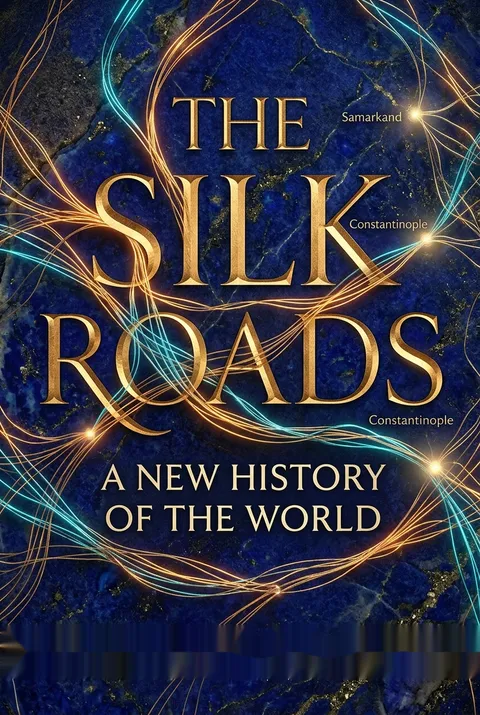


Key Takeaways
Put Central Asia back at the center of world history
The map changes the story. Frankopan shifts history’s usual focus from western Europe to the broad corridor between the Mediterranean and the Himalayas. This was no remote strip of land: Mesopotamian cities, the Indus civilizations, Persian empires, and Central Asian markets connected populations across continents. Baghdad, Merv, Samarkand, and Balkh were major centres of trade and scholarship when many familiar European capitals were smaller or less influential.
Connections made the region central. Goods, people, and ideas moved through overlapping routes, linking events thousands of miles apart. Chinese demand for horses affected steppe politics; Roman appetite for silk sent wealth east; upheaval in Central Asia could reshape distant societies. The familiar story of Europe’s rise, Frankopan argues, is incomplete unless the crossroads that connected it to the wider world are restored to view.
What's compelling is the shift in vantage point: the same events look different when the map is centred on the routes connecting them. This resembles network analysis, which explains influence through links and bottlenecks rather than through the importance of individual nodes alone. The approach corrects a Eurocentric blind spot, but a new centre can become a new distortion. Asia was not always the pivot, and no single geography explains every era. The strongest use of this perspective is as a corrective lens, not a replacement for one simplified master narrative with another.
Track the routes that carried faith, commerce, armies, and disease
Trade carried more than goods. The Silk Roads were networks of land and sea routes used by merchants, pilgrims, soldiers, and migrants. Sogdian traders helped move goods and Buddhist ideas between India, Central Asia, and China. Christianity spread through Mesopotamia and into Persia, Central Asia, and beyond, often through merchants and local communities. Religious art and language also borrowed across traditions: motifs such as the halo appeared in several faiths.
Exchange had a dark side. The same connections carried conquest and epidemic disease. The Black Death travelled along commercial routes linking Asia, Europe, and Africa; merchants and cargo helped spread it through port cities. These networks were not inherently peaceful or destructive. Their effects depended on what moved through them, who controlled access, and how local societies responded.
The network view makes a useful distinction between connection and cooperation. A route can carry useful knowledge and profitable goods while also transmitting disease, coercion, or conflict. That double character matters in modern debates about globalization, where efficiency is often measured by the speed of exchange rather than by who bears its risks. The account also usefully resists treating religions as sealed systems. Still, the evidence for how specific beliefs travelled is uneven, and shared imagery does not always prove direct borrowing. Cultural contact is a strong explanation, not a universal one.
Build durable empires by governing crossroads, not just conquering them
Administration made power last. The Persian Empire joined distant regions through roads, irrigation, record-keeping, and a bureaucracy able to govern diverse peoples. Its rulers borrowed customs and relied on local elites rather than trying to erase every difference. Alexander later adopted Persian practices and kept local administrators, recognising that winning territory was easier than holding it. Cities and fortified routes helped defend newly conquered lands against steppe raids.
Commerce rewarded order. Later empires also regulated markets, collected transit duties, and invested in water systems and towns. These measures generated revenue while making trade more reliable. The Mongols, despite their reputation for destruction, used low transit taxes and protected commercial routes across much of Eurasia. Their success came from combining military force with practical administration, political bargains, and rewards for service.
The contrast between conquest and governance is one of the book’s most useful political lessons. A state that secures routes, collects information, and accommodates local interests can convert force into durable authority. This resembles the modern idea of state capacity: institutions matter because they make rules predictable and services possible. Yet administrative efficiency is not the same as justice. Empires often made commerce safer for some while imposing taxes, displacement, or coercion on others. The question is not only whether a system works, but for whom it works and who pays for its stability.
See Islam’s rise within the wreckage of two exhausted empires
War weakened the old powers. Rome and Persia fought for decades, draining resources and damaging trade. Plague and political instability compounded the strain. In Arabia, disrupted commerce and the breakdown of imperial patronage helped create conditions in which Muhammad’s message of one God and a shared community gained force. His migration from Mecca to Yathrib, later Medina, in 622 became the hijra, the starting point of the Muslim calendar.
Faith and incentives reinforced each other. Muhammad united tribes, built alliances, and led a movement that spread rapidly as Persian and Roman authority faltered. Early Muslim rulers often left local officials and religious communities in place, while conquest brought new revenues and opportunities for followers. The result was not a purely religious expansion or a purely military one. Belief, political organisation, material rewards, and imperial collapse worked together.
This account avoids the convenient claim that a new faith alone explains a new empire. It instead shows how ideas gain reach when institutions weaken and people face material uncertainty. That is a valuable political-sociological insight: shared identity can organise groups that older powers have treated as divided clients. The framing also requires care. The early sources are contested, and later religious narratives can make a complicated transformation appear more unified or inevitable than it was. Material incentives matter, but they do not reduce sincere belief to a cover for self-interest.
Follow Europe’s search for Asian wealth to understand its expansion
Ambition followed trade. Northern Europeans were drawn into the eastern trade system through furs, slaves, and other goods. Viking Rus’ merchants travelled river routes south, while Italian city-states secured commercial privileges in the eastern Mediterranean during the Crusades. Religious conviction was real, but so were profits: Venice used its fleet and loans to win markets, tax exemptions, and footholds in ports. The sack of Constantinople in 1204 exposed how readily a campaign framed as sacred could serve commercial and political ambitions.
The Atlantic changed the balance. Columbus and Vasco da Gama opened routes that shifted Europe from a distant participant to a powerful intermediary. Conquest in the Americas brought enormous quantities of silver and devastating violence against Indigenous populations. Much of that silver then flowed to Asian markets, especially China, in exchange for goods Europe wanted but could not produce in comparable volume.
The story of European expansion becomes more intelligible when treated as a series of efforts to secure access, not as the inevitable unfolding of superior ideas. Trade creates incentives; naval and military power determines who can exploit them. The attention to slavery and colonial violence also prevents wealth from appearing self-generated. A further caution is that trade did not make every European state equally powerful, nor did it automatically produce industrialization. Institutions, geography, political choices, and local resistance all shaped the gains. The useful lesson is that prosperity can rest on systems whose costs are exported elsewhere.
The Mongols connected Eurasia’s markets and its paths of contagion
Conquest created a vast corridor. Mongol armies used force strategically: some cities that resisted were devastated, while others that submitted were rebuilt and supported. Their rulers incorporated administrators and skills from conquered peoples, protected long-distance trade, and kept transit taxes comparatively low. Merchants could travel across a more connected Eurasian world, carrying goods, techniques, and information between regions that had previously been harder to reach.
The network also spread disaster. Plague moved through the steppe’s ecology and along the commercial routes linking Asia with the Black Sea and Europe. In 1347, infected ships helped carry it into Mediterranean ports; within a few years, it had killed a vast share of Europe’s population and devastated communities elsewhere. In parts of Europe, the labour shortage that followed raised wages and altered the balance between workers and landlords, helping change later economic development.
The Mongol example clarifies a basic feature of infrastructure: systems built for movement do not select what moves. Trade routes can spread innovation and prosperity, but the same connectivity accelerates contagion. The aftermath also shows how shocks can redistribute bargaining power. A labour shortage can improve workers’ leverage, though it does not guarantee equal gains or lasting reform. The book’s account of the Black Death’s role in Europe’s later rise is persuasive as one contributing mechanism, but the long-term divergence between regions cannot be reduced to one epidemic.
Remember that Europe’s rise depended on violence, finance, and fuel
Power was built at sea and on land. European states faced repeated competition and warfare, which pushed investment in ships, guns, fortifications, and public finance. Northern European powers eventually used these advantages to reach Asian markets directly and expand overseas. Their claims of civilising or religious purpose often accompanied commercial self-interest and coercion. The wealth that transformed European cities and culture came with slavery, conquest, and the seizure of resources.
Oil changed the imperial stakes. Before the First World War, Britain’s leaders saw Persian oil as essential to a navy shifting from coal to oil. The government took control of a majority share in Anglo-Persian Oil, then used military and diplomatic power to secure oilfields, pipelines, and ports. After the war, British officials helped draw borders and install rulers across the region, often prioritising strategic access over local consent.
The book’s account usefully joins military technology to finance and resource access. Innovation is not a neutral force: states invest in tools that serve their strategic aims, and those aims shape the societies around them. The oil example also shows why infrastructure matters politically. A pipeline is not merely a means of transport; its route creates dependencies and concentrates leverage. Still, a focus on violence and extraction should not obscure the agency of local leaders, workers, and communities, who negotiated, resisted, and sometimes used foreign rivalries to pursue their own goals.
Oil and grain made Asia’s crossroads the hinge of modern war
Resources shaped strategy. British anxiety about Russian expansion through Persia and Central Asia helped drive alliances before the First World War. Oil then became a critical military resource, pulling Britain into Mesopotamia and influencing how the region was divided after the conflict. In the Second World War, Hitler’s invasion of the Soviet Union was also a resource campaign: Nazi planners aimed to seize Ukrainian grain and southern oil, treating millions in the population as expendable if supplies could not feed them.
The consequences were catastrophic. The German plan to extract food from a supposed surplus zone helped create famine and mass death, while the failure to secure the expected harvest intensified the regime’s murderous treatment of civilians and prisoners. The book connects this resource strategy to the Holocaust, showing how economic planning and racist ideology worked together. The region’s value was not a backdrop to European wars; it helped determine their aims and their human cost.
This is a forceful reminder that military history can be misread when it is confined to battlefields. Logistics, food supply, and energy shape what leaders think they can attempt, and what they are willing to sacrifice. The connection between resource seizure and genocide is especially important because it shows how abstract planning can become a machinery of death. Economic motives alone, however, do not explain Nazi mass murder. They interacted with an explicitly racist and anti-Semitic worldview that determined whose lives were treated as disposable.
Question interventions that empower the very forces they oppose
Cold War bargains had consequences. After Britain’s influence receded, the United States backed the Shah of Iran and supported the 1953 coup against Prime Minister Mossadegh, who had nationalised oil. The Shah received arms and aid, but repression and unequal access to oil revenues fed opposition. His fall in 1979 transformed Iran’s relationship with the west. Later, the United States supported Saddam Hussein against Iran, while also secretly supplying Iran with weapons, and armed Afghan resistance groups against the Soviet Union.
Short-term gains bred long-term costs. These policies helped shape a region where governments and movements distrusted American intentions. The invasion of Iraq in 2003 was justified partly by claims about weapons that were not found; Afghanistan and Iraq then became prolonged, costly conflicts. Frankopan’s recurring warning is that outsiders who treat countries as pieces on a strategic board often misread local politics and weaken their own credibility.
The pattern resembles a principal-agent problem: a powerful sponsor backs local actors to solve an immediate problem, but cannot reliably control what those actors want or become. That framework helps explain why support for a proxy or ruler can generate future hostility. The account also rightly distinguishes intention from consequence; intervention can be strategic without being effective. Yet outcomes are not wholly predetermined by earlier choices. Local actors make their own decisions, and attributing every later crisis to outside policy risks understating domestic conflicts and regional rivalries.
Trace today’s railways and pipelines to see power shifting east
The routes are being rebuilt. Frankopan closes by pointing to new pipelines, railways, airports, and communications networks linking China, Central Asia, the Gulf, and Europe. The Northern Distribution Network used roads and railways through Central Asia to supply coalition forces in Afghanistan. China has invested in transport and energy links across the region, while Russia uses its position as an energy supplier to influence neighbours. These are modern versions of old contests over routes, resources, and access.
Follow the dependencies. A disruption in the region can affect oil prices, grain markets, and the cost of manufactured goods far beyond it. The Silk Roads, in this telling, are not a lost trade route revived in exact form, but a changing web of connections. Their future depends on who builds the infrastructure, who controls its chokepoints, and whether cooperation can survive competition among states with very different aims.
The concluding lens is useful because infrastructure makes power visible: ports, railways, pipelines, and data cables reveal where states expect future dependence to lie. In contemporary political economy, control of a chokepoint can matter as much as control of a commodity. The analogy to earlier trade networks is illuminating, but continuity should not be overstated. Modern states, corporations, and global finance operate at a different scale, and a pipeline is not a camel caravan. The durable insight is simpler: routes are never just routes; they are choices about who connects, who pays, and who can exert pressure.
Analysis
The book’s central intervention is not simply to add neglected Asian history to a European story. It changes the organising question from “Which civilisation led?” to “Which routes connected people, resources, and power at a given moment?” That shift makes history more relational. Rome’s wealth depends on Asian trade; Islam’s expansion follows the exhaustion of Rome and Persia; Europe’s later ascendancy grows through maritime access, military competition, and extraction; modern wars repeatedly turn on oil, grain, and transport corridors. The same places can be central, peripheral, or contested as networks change.
This approach is strongest when it combines material systems with cultural exchange. The reader sees that a religious idea does not travel by itself: merchants, rulers, translators, monasteries, and political alliances carry it. Likewise, economic integration can enrich cities while accelerating disease, slavery, or imperial control. The narrative’s recurring reversals, especially the shift from the medieval east to Atlantic Europe and then to American and Soviet competition in Asia, make global history memorable without reducing it to a list of dynasties.
The framework also has limits. Geography can become destiny if the corridor is treated as an eternal centre rather than a changing set of political relationships. The book sometimes attributes large outcomes to trade and resources so strongly that ideology, institutions, and local agency risk becoming secondary. Its account of the Holocaust makes the connection between grain seizure and mass death visible, but economic strategy cannot substitute for explaining Nazi racial ideology. Likewise, a long view can make later events appear more inevitable than they were. The most productive reading treats the Silk Roads as an analytical map: powerful for revealing interdependence, but not a single cause that explains every change. The book’s lasting value is to make the reader ask what flows through a region, who controls the routes, and whose account of the past that control serves.
Review Summary
The Silk Roads receives mostly positive reviews for its ambitious scope and fresh perspective on world history. Readers appreciate Frankopan's focus on Central Asia and the Middle East as pivotal regions. The book is praised for its engaging writing style and thought-provoking insights. Some criticize it for not fully delivering on its promise of a "new history" and occasionally straying from its central theme. Despite these critiques, many find it an illuminating and comprehensive overview of global interconnections throughout history, offering a welcome alternative to Eurocentric narratives.
People Also Read

Glossary
Silk Roads
Eurasian exchange networksA web of land and maritime routes connecting East Asia, Central Asia, the Indian subcontinent, the Middle East, and Europe. The name was popularised in the nineteenth century, but the routes carried far more than silk: they moved commodities, people, technologies, religions, armies, and disease. Frankopan uses the term to recenter world history on the connections running across Asia.
umma
Community of believersAn Arabic term for a community, used in the Qur’an to describe a body of believers rather than a single ethnic group. In the account of early Islam, the umma offered a shared identity that could unite people from different tribes and backgrounds. Its political importance grew as Muhammad and his followers built a community with common religious commitments and mutual obligations.
hijra
Muhammad’s migration to MedinaThe migration of Muhammad and his followers from Mecca to Yathrib, later called Medina, in 622. Islamic tradition treats the event as a defining break and the beginning of the Muslim calendar. In Frankopan’s account, it also marks the shift from Muhammad’s preaching in Mecca to the formation of a community capable of political organisation and armed resistance.
dīwān
Office distributing spoilsAn administrative office established in the early Islamic community to record supporters and oversee the distribution of booty and other revenues. The system rewarded participation and loyalty, with earlier converts receiving larger shares. Frankopan presents it as one way religious commitment and material incentives reinforced one another during the rapid expansion of the early caliphate.
People of the Book
Jews and ChristiansA Qur’anic designation for Jews and Christians, whose scriptures and prophets Islam recognises as part of a shared religious inheritance. Early Muslim leaders could use this idea to reassure communities under new rule and distinguish them from polytheists. Frankopan emphasises that such recognition helped make early Islamic expansion more accommodating, though relations varied and tolerance was neither uniform nor permanent.
Northern Tier
US-backed southern Soviet borderA Cold War label for the belt of states running from Turkey through Iraq and Iran to Pakistan. US planners saw these countries as a strategic barrier against Soviet expansion, a means of protecting Gulf oil supplies, and a network of potential listening posts and military bases. The policy brought aid and alliances, but also tied local regimes to superpower competition.
Persian Corridor
Allied supply route through IranThe transport network that carried Allied equipment and supplies from Persian Gulf ports through Iran and northwards to the Soviet Union during the Second World War. Its roads, railways, ports, and other infrastructure made Iran strategically valuable to Britain, the United States, and the USSR. The corridor also exposed how military logistics could become a justification for occupying another country.
Red Line Agreement
Agreement dividing regional oil rightsA postwar arrangement between British and French interests that allocated oil assets across parts of the former Ottoman territories and restricted competition between participating companies. Its mapped boundaries reflected the effort to control petroleum resources through corporate agreements as well as political influence. The agreement illustrates how outside powers treated the region’s oil as a strategic prize to be divided.
Operation Ajax
1953 coup against MossadeghThe CIA’s name for the covert operation, carried out with British involvement, that helped remove Iranian Prime Minister Mohammed Mossadegh in 1953. Mossadegh had nationalised Iran’s oil industry, challenging British interests. The coup restored the Shah’s authority and secured Western influence in the short term, but became a lasting symbol in Iran of foreign interference and the gap between Western democratic rhetoric and practice.
OPEC
Oil-exporting states’ organisationThe Organisation of Petroleum Exporting Countries, founded in 1960 by Iran, Iraq, Kuwait, Saudi Arabia, and Venezuela. It coordinated member states’ policies to increase their influence over oil production and revenue. In Frankopan’s account, OPEC represented a shift in bargaining power from Western oil companies toward producing countries, whose control over supply could affect the global economy.
FAQ
What's The Silk Roads: A New History of the World by Peter Frankopan about?
- Historical Connections: The book explores the historical significance of the Silk Roads, emphasizing their role as trade routes that connected East and West. It argues that these routes were central to the development of civilizations and the exchange of goods, ideas, and cultures.
- Cultural Interactions: Frankopan highlights interactions between diverse cultures, such as the Persians, Greeks, and Romans, showcasing how these exchanges shaped the world. The narrative challenges Eurocentric views by placing the Middle East and Central Asia at the forefront.
- Trade and Society: The book discusses how trade along the Silk Roads influenced social, political, and economic structures across different regions, illustrating the interconnectedness of societies.
Why should I read The Silk Roads by Peter Frankopan?
- Broaden Historical Perspective: The book offers a fresh perspective on world history, moving beyond traditional Western narratives and emphasizing the importance of the East in shaping global events.
- Engaging Storytelling: Frankopan's narrative is rich with anecdotes and historical figures, making complex historical events accessible and interesting.
- Relevance to Modern Issues: Themes such as trade, cultural exchange, and conflict resonate with contemporary global issues, providing insights into current geopolitical dynamics.
What are the key takeaways of The Silk Roads by Peter Frankopan?
- Interconnected Civilizations: Civilizations have always been interconnected through trade and cultural exchange, shaping human history in profound ways.
- Geographical Influence: Geography played a crucial role in the rise and fall of empires, with the Silk Roads serving as vital links between East and West.
- Cultural Exchange: Cultures borrowed from one another, leading to the development of new ideas, religions, and technologies, essential for progress.
What are the best quotes from The Silk Roads by Peter Frankopan and what do they mean?
- “The bridge between east and west is the very crossroads of civilization.”: This quote encapsulates the book's thesis that the Silk Roads were central to the development of human civilization.
- “Understanding these connections allows us to understand how the world works.”: Emphasizes the importance of recognizing historical interconnections to grasp contemporary global issues.
- “The present has washed away the past.”: Reflects on how modern perceptions often overshadow historical significance, urging readers to look deeper into the past.
How does Peter Frankopan challenge traditional historical narratives in The Silk Roads?
- Critique of Eurocentrism: Frankopan argues that traditional histories often overlook the significance of the East in shaping global events, challenging the narrative of Western superiority.
- Alternative Perspectives: The book presents alternative viewpoints on key historical events, such as the Crusades, by examining them through the lens of the Silk Roads.
- Trade Focus: Frankopan places trade at the center of historical development, suggesting that economic factors often drive political and cultural changes.
What role did religion play along the Silk Roads according to The Silk Roads by Peter Frankopan?
- Spread of Religions: The Silk Roads were instrumental in the spread of major religions, including Buddhism, Christianity, and Islam, influencing cultures across vast distances.
- Cultural Syncretism: Interactions between different religious traditions often led to syncretism, resulting in unique cultural expressions and practices.
- Conflict and Cooperation: While facilitating religious exchange, the Silk Roads also became sites of conflict as different faiths vied for followers.
How did the geography of the Silk Roads influence trade and cultural exchange?
- Strategic Locations: Key locations such as mountain passes and river valleys served as natural conduits for trade, facilitating the movement of goods and people.
- Travel Challenges: Harsh terrain and climate posed significant challenges, requiring traders to adapt their methods and technologies.
- Cultural Interactions: Diverse environments fostered interactions between various cultures, leading to the exchange of ideas, technologies, and customs.
What impact did the Mongol Empire have on the Silk Roads?
- Trade Facilitation: The Mongol Empire unified vast territories, enhancing trade along the Silk Roads by allowing safer and more efficient movement of goods.
- Cultural Exchange: The Mongols promoted cultural exchange, facilitating the spread of ideas, technologies, and religions.
- Political Changes: Their rise altered the political landscape, leading to new alliances and conflicts, reshaping power dynamics in Eurasia.
How does The Silk Roads by Peter Frankopan relate to contemporary global issues?
- Understanding Globalization: The book draws parallels between historical trade networks and modern globalization, illustrating the enduring nature of interconnectedness.
- Geopolitical Dynamics: Historical events along the Silk Roads continue to influence contemporary geopolitical tensions, particularly in regions like the Middle East.
- Cultural Heritage: Emphasizes the importance of cultural heritage shaped by historical interactions, informing discussions about multiculturalism today.
How does Peter Frankopan redefine the concept of the Silk Roads?
- Beyond Trade Routes: Frankopan expands the definition to include cultural and intellectual exchanges that shaped civilizations.
- Eastern Focus: Shifts the narrative from a Eurocentric perspective to one recognizing the significance of Eastern civilizations.
- Interconnected Histories: Illustrates how histories of different regions are intertwined, emphasizing the importance of understanding these connections.
What role did minorities play in the trade along the Silk Roads?
- Trade Facilitators: Minorities like Jews and Armenians acted as intermediaries, facilitating commerce across diverse cultures.
- Cultural Brokers: They bridged cultural gaps, sharing customs and practices that enriched the trading experience.
- Credit Networks: Established credit systems that enabled long-distance trade, demonstrating their crucial role in economic networks.
How does The Silk Roads by Peter Frankopan address the impact of disease on trade?
- Disease Transmission: Movement along the Silk Roads facilitated the spread of diseases, notably the Black Death, affecting populations and economies.
- Historical Consequences: Disease outbreaks led to labor shortages and social upheaval, reshaping societies and altering history.
- Modern Lessons: Understanding historical pandemics provides insights into managing contemporary health crises, reflecting the interconnectedness of the world.
About the Author
Other books by Peter Frankopan
Download PDF
Download EPUB
.epub digital book format is ideal for reading ebooks on phones, tablets, and e-readers.








