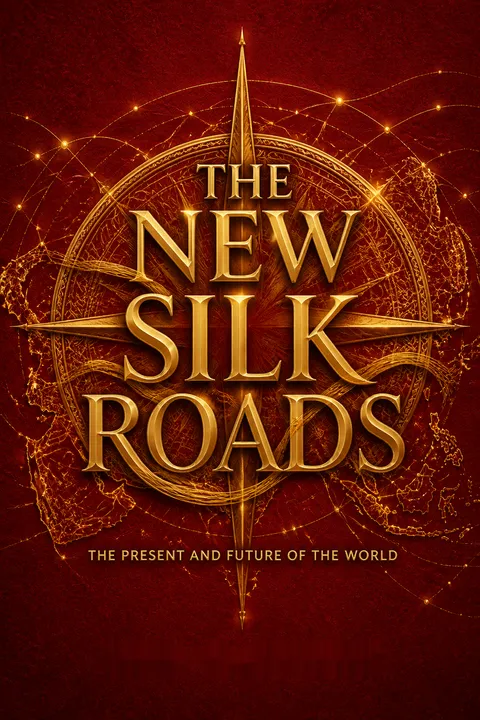


Key Takeaways
Read world history from the crossroads, not only from Europe
Change the map. Frankopan uses the Silk Roads as a broad name for the networks that linked Asia, Europe, and Africa, carrying people, goods, beliefs, and knowledge across land and sea. They were never a single paved route. The point is to see history as connected, rather than as separate regional stories with Europe always at the center.
Connections leave evidence. New satellite surveys have revealed caravan stops and water systems in Afghanistan and China. Isotope analysis of human remains helps distinguish the diets of settled communities from those of nomads, while seeds and genetic evidence trace how crops and people moved. These findings make exchange visible in landscapes, bodies, and everyday life, not just in chronicles of rulers and wars.
The lens is valuable because it changes the questions asked of history. Instead of asking only which empire ruled a place, it asks what passed through it, who benefited, and what traveled alongside trade. That is close to a network view of history: a region’s importance comes partly from its links, not simply its borders. The term’s breadth is also a limitation. A flexible label can connect distant events, but it can blur differences between local exchange, long-distance commerce, and state power. Each connection still needs to be demonstrated.
Asia's rise is already changing Western prices, brands, and jobs
Watch everyday effects. The book argues that the shift in economic weight toward Asia is not an abstract contest between governments. It shapes travel, property, retail, and business decisions across the world. Chinese spending abroad grew from about $500 million in 1990 to more than $250 billion in 2017. Airlines, hotels, and retailers adjusted to this expanding market, while Chinese buyers acquired businesses and property overseas.
Follow the consequences. Foreign investment helped push up London home prices, and Chinese demand for donkey-hide products drove sharp price increases in parts of Central Asia and Africa, where donkeys are important to farming and transport. Such examples show how a consumer choice in one country can affect livelihoods elsewhere. The gains are real, but so are distributional tensions and local costs.
This is a useful correction to the habit of treating global power shifts as a matter only for diplomats and generals. Supply, demand, and investment transmit those shifts into household budgets and local economies. The examples also suggest a practical test for globalization: ask who receives the new income, who pays higher costs, and which communities have little say in the exchange. Economic links can create opportunity without distributing it fairly. A rising aggregate market is not the same as a rising standard of life for everyone it touches.
Trace resources and routes to understand where power gathers
Follow essential supplies. Energy, food, water, minerals, and trade routes are central to the book’s account of geopolitical power. The Middle East, Russia, and Central Asia together held nearly 70 percent of proven global oil reserves and nearly 65 percent of proven gas reserves, according to the figures cited. China’s dominance in rare-earth production also mattered because these materials are used in electronics, batteries, and other technologies.
Notice the chokepoints. The South China Sea carries a large share of China’s trade, while the Strait of Malacca is a key route for its oil imports. That dependence helps explain why Beijing treats nearby sea lanes as a security concern. Likewise, Central Asian rivers cross national borders, so one government’s water decisions can affect farms and cities downstream.
A resource map often explains strategy more clearly than a leader’s rhetoric. States depend on flows, and the geography of a flow creates leverage: a port, pipeline, strait, or river can matter as much as a stockpile. This framework also helps connect environmental stress to foreign policy, since water scarcity can become a dispute over allocation rather than simply a technical problem. The caution is against reducing every conflict to resources. Identity, domestic politics, and historical grievances shape how scarcity is understood and acted upon.
Judge China's Belt and Road by its terms, not its slogans
Infrastructure serves strategy. The Belt and Road Initiative is China’s large program of overseas investment in transport, energy, and other infrastructure, using land and sea connections to link China with other regions. Frankopan identifies several motives: securing energy and food supplies, deploying construction capacity, opening markets for Chinese firms, and improving access to trade routes. The initiative was presented as a shared development project, and the World Bank estimated that it could reduce shipping times and trade costs for participating economies.
Projects are not interchangeable. A railway, port, or power plant can improve access and economic activity, but its value depends on demand, price, and who can use it. Rail freight between China and Europe is faster than sea transport, but can cost several times more. The promised network therefore needs to be assessed project by project, not accepted as a single coherent plan.
The distinction between infrastructure’s public value and its political value is essential. A new route may help local commerce while also increasing the investor’s influence over access, standards, or financing. Neither function cancels the other. The initiative’s loose definition makes simple verdicts especially unreliable: a broad umbrella can encompass useful projects, weak projects, and projects serving strategic purposes. Evaluating outcomes requires transparent contracts, credible demand estimates, and attention to who captures the gains, not only impressive totals of money pledged or track laid.
Treat infrastructure debt as a political risk, not just an accounting problem
Count the obligations. Large projects can leave recipient states with repayment burdens they cannot manage. The book describes Sri Lanka leasing Hambantota port to a Chinese company for 99 years after the port failed to meet expectations and the country struggled with its debt. In Kyrgyzstan, a major Chinese-funded upgrade to a power plant failed during severe winter weather, leaving roughly 200,000 homes without heat for several days.
Avoid blanket judgments. Frankopan notes that many Belt and Road projects proceeded without difficulty, and China also agreed to restructure or forgive some debts. The central question is how decisions are made when a project underperforms: whether repayment terms can change, whether the asset becomes collateral, and whether local people were consulted. A loan can build useful infrastructure and still expose a government to a costly loss of control.
Debt is not inherently a trap, and infrastructure borrowing can be rational when it raises future productive capacity. The danger arises when optimistic forecasts, opaque procurement, and concentrated political authority weaken a borrower’s ability to assess risk or negotiate fairly. The same scrutiny should apply to every lender, not only China. A strong evaluation asks whether expected public benefits can service the debt under less favorable conditions, and whether the contract leaves the borrower meaningful options if those expectations fail.
Look for practical cooperation beneath Asia's ceremonial language
Cooperation can be concrete. Across Central Asia, governments reopened crossings, improved rail links, increased trade, and negotiated border questions. Kazakhstan and Uzbekistan recorded a 31.2 percent increase in bilateral trade in 2017. Regional plans also included sharing electricity, building pipelines, and coordinating efforts against drug smuggling and terrorism. These efforts show that cooperation is not only a slogan: it can involve practical agreements that reduce friction between neighboring states.
Shared problems force negotiation. Water is a particularly difficult test. The Aral Sea nearly disappeared after Soviet-era river diversions, while drought threatened harvests and drinking-water supplies in several countries. Because major rivers cross borders, national decisions have downstream effects. Cooperation remains fragile, however. Some announced transport and energy projects stalled, and disputes over prices, financing, and political control continued.
This section resists the easy choice between declaring regional unity and dismissing it as public relations. Cooperation is often incremental: a border crossing becomes easier, trade rises, and officials acquire routines for working together. Those habits can matter even when political mistrust remains. Shared rivers make the underlying logic especially clear, because no country can fully solve a transboundary problem alone. Yet the existence of forums and agreements does not prove that power is shared fairly or that implementation will follow. Practical results are the strongest evidence.
Do not confuse regional integration with political freedom
Growth can coexist with repression. Frankopan describes a region investing in trade and technology while governments restrict journalists, activists, and online speech. Uzbekistan showed some openings under new leadership, including the release of jailed journalists, but rights groups warned that censorship, political imprisonment, and torture remained serious concerns. Saudi Arabia announced reforms affecting women and public life, yet activists were arrested and reports of abuse followed.
Connectivity is not a rights guarantee. China’s infrastructure ambitions and digital programs developed alongside extensive controls in Xinjiang, including mass detention of Uighurs, which the Chinese government denied describing as repression. The pattern matters: economic modernization, political liberalization, and individual rights are distinct processes. Progress in one does not automatically produce progress in the others.
Economic integration can broaden opportunity, but it does not by itself distribute political voice. That distinction prevents a common analytical mistake: treating rising income or new infrastructure as proof that citizens have gained more autonomy. The book’s examples make it necessary to ask who controls the new systems and who can challenge their use. At the same time, authoritarian states are not identical, and reform can be partial or uneven. A careful account tracks specific changes in rights and institutions rather than assigning a single label to an entire region.
Pressure campaigns can strengthen the rivals they aim to weaken
Policies create second-order effects. The United States withdrew from the Iran nuclear agreement despite international inspectors reporting Iranian compliance. Renewed sanctions damaged Iran’s economy, but also weakened moderate political voices, strengthened hardliners, and pushed Tehran toward closer ties with Moscow and Beijing. India’s trade and infrastructure plans involving Iran were affected as well, forcing Washington to make exceptions after initially insisting none would be granted.
Allies absorb the shock too. Tariffs intended to pressure China raised costs for American businesses and consumers, while sanctions on Russia contributed to higher prices for some materials and energy. Frankopan does not argue that every existing agreement is fair or beyond revision. His warning is about acting on one target at a time without accounting for the wider network of economic and diplomatic consequences.
This is a classic systems problem: an intervention changes incentives across a network, not only for the intended target. Sanctions can impose costs, but they can also encourage substitute suppliers, strengthen domestic hardliners, or make alternative partnerships more attractive. That does not mean pressure never works. It means its success should be judged by the political outcome, not simply by immediate economic pain. Clear goals, allied coordination, and credible off-ramps reduce the chance that coercion produces the opposite alignment.
Expect alliances to shift when interests overlap only temporarily
Partnerships are not permanent blocs. India, for example, welcomed closer ties with the United States but continued to rely heavily on Russian arms and sought pragmatic cooperation with China, including sharing river data. Russia and China coordinated diplomatically and militarily, yet their interests did not always align, including over territorial and maritime questions. Turkey, Iran, and Russia cooperated on some regional issues while competing elsewhere.
Read behavior, not labels. Governments may publicly describe one another as partners while hedging against dependence. Smaller states also try to balance larger powers: Kazakhstan maintained ties with Washington even as it worked with Russia and China. The book’s central lesson is not that alliances are meaningless, but that they are shaped by specific interests, perceived threats, and available alternatives.
A network view replaces the idea of fixed camps with overlapping relationships. States can cooperate on one issue, compete on another, and maintain options against a future change in power. This is not necessarily hypocrisy; it can be a rational response to uncertainty and asymmetry. It does, however, make confident predictions about permanent strategic alignments hazardous. Analysts should identify the concrete interest holding a partnership together, then ask what would happen if that interest changed.
Treat technology and supply chains as tomorrow's contested terrain
The contest is already digital. The book describes governments treating data as a security asset, controlling where user information is stored, restricting encrypted services, and monitoring online activity. China invested heavily in artificial intelligence, while Russia and other states developed cyber capabilities. Advances in drones and robotic weapons raised questions about systems that can identify and engage targets with limited human direction.
Innovation depends on material flows. Digital systems require minerals, components, energy, and access to international markets. Efforts to restrict technology exports may limit a rival, but they can also encourage that rival to build substitutes or seek new suppliers. This is why competition over data and advanced technology cannot be separated from trade routes, resources, and security policy.
The point is not that technology inevitably causes conflict, but that civilian infrastructure and strategic capability increasingly share the same foundations. Data networks, chips, energy supplies, and automated systems can support commerce while also enabling surveillance or military use. That dual-use character makes simple categories such as business versus security less reliable. The book’s account also invites a governance question: who is accountable when automated systems act, or when private platforms become part of state competition? Technical capacity advances faster than agreement about its limits.
Analysis
Frankopan’s central argument is geographical and relational: the world is becoming harder to understand when viewed mainly through the political capitals of Europe and North America. The Silk Roads offer an alternative vantage point, connecting the eastern Mediterranean to the Pacific through the movement of goods, energy, people, money, and ideas. From this perspective, Asia’s growing economic weight is not a distant forecast. It already affects consumer markets, investment, diplomacy, and the strategic calculations of states far beyond the region.
The book’s strongest explanatory move is to treat infrastructure and resource access as political forces. Ports, pipelines, railways, rivers, and narrow sea passages can generate prosperity while creating dependencies and leverage. China’s Belt and Road Initiative makes this tension visible. Its projects can address genuine infrastructure needs and expand trade, yet their financing, commercial logic, and political consequences vary widely. The same care is needed in assessing Western policy: sanctions and tariffs may be intended to compel rivals, but they can also injure allies, alter supply chains, and encourage alternative partnerships.
Frankopan also avoids presenting Asian cooperation as a simple success story. New regional links coexist with unresolved disputes, authoritarian government, environmental pressure, and acute insecurity. That tension is important because economic integration is not a synonym for political liberalization, and public language about partnership is not proof of equal benefit. The more revealing evidence is often practical: whether a border opens, a project works, water is shared, or a borrower can renegotiate its obligations.
The account is a snapshot shaped by information and events available in 2018. Its figures and forecasts should therefore be read as period-specific evidence and expectation, not as timeless measurements. Its enduring value lies less in predicting which state will dominate than in teaching a method: follow connections, identify dependencies, and trace the consequences of decisions beyond their stated target. That method makes global change legible without pretending that the future is settled or that any power’s language should be accepted at face value.
Review Summary
The New Silk Roads receives mixed reviews, with some praising its insightful analysis of China's global influence and the shifting balance of power, while others criticize its repetitive content and lack of depth. Reviewers appreciate Frankopan's examination of recent geopolitical events and the rise of Asian economies, but some find the book overly focused on current affairs rather than historical analysis. Critics note the absence of cultural shifts and migration issues. The book's timeliness is both a strength and weakness, as some information quickly becomes outdated.
People Also Read




Glossary
Silk Roads
Networks connecting continentsFrankopan uses this term for the broad, changing networks that linked Asia with Europe and Africa by land and sea. These routes carried far more than silk: people, religions, languages, technologies, food, and other goods moved through them. The term is a lens for understanding regions as connected rather than isolated.
Belt and Road Initiative
China's infrastructure programChina’s large international initiative to finance or develop transport, energy, and other infrastructure across land and sea. Announced under Xi Jinping, it draws on the historical Silk Roads as a model and a political narrative. The book describes it as serving several aims, including securing supplies, using Chinese construction capacity, opening markets, and extending connections.
Great Game
Competition for regional influenceA term associated with nineteenth-century rivalry between the British and Russian empires in Central Asia. Frankopan uses the idea to describe contemporary contests over influence, energy, natural resources, strategic position, and data across the region. The modern competition involves multiple states and overlapping economic, diplomatic, and military interests.
Malacca Dilemma
China's vulnerable oil routeA strategic concern arising from China’s dependence on the Strait of Malacca as a major route for imported oil and other trade. Because the strait connects the Indian and Pacific Oceans, disruption or hostile control could threaten supplies. The concept helps explain China’s interest in maritime security and alternative routes.
FAQ
What's The New Silk Roads about?
- Global Connections: The New Silk Roads by Peter Frankopan explores the historical and contemporary significance of the Silk Roads, focusing on their role in connecting cultures and economies over millennia.
- Geopolitical Landscape: The book examines the modern implications of these ancient trade routes, particularly in the context of rising powers like China and the shifting dynamics of global politics.
- Interconnected Regions: Frankopan illustrates how the Silk Roads are vital for understanding contemporary issues such as trade, migration, and cultural exchange, linking past and present.
Why should I read The New Silk Roads?
- Historical Context: The book provides a comprehensive overview of how historical trade routes have influenced modern geopolitics, offering a fresh perspective on global events.
- Modern Challenges: Frankopan connects historical narratives to current global challenges, making the book relevant to contemporary discussions on economic competition and cultural exchanges.
- Engaging Style: The author’s engaging prose makes complex topics accessible, appealing to both academic audiences and general readers interested in global affairs.
What are the key takeaways of The New Silk Roads?
- Shift in Power: The book highlights the shift of economic and political power from the West to the East, focusing on China’s Belt and Road Initiative as a modern Silk Road.
- Infrastructure's Role: Frankopan emphasizes infrastructure development as crucial for economic growth and connectivity, with the Belt and Road Initiative enhancing trade routes.
- Cultural Cooperation: The narrative underscores the importance of cultural exchange and cooperation among nations along the Silk Roads for greater understanding and peace.
What are the best quotes from The New Silk Roads and what do they mean?
- Enduring Significance: “The world’s past has been shaped by what happens along the Silk Roads; so too will its future.” This quote emphasizes the Silk Roads' lasting impact on global history and future developments.
- Asian Century: “We are living in the Asian century already.” This reflects the argument that Asia is becoming the focal point of global power, challenging Western dominance.
- Shift in Decision-Making: “The decisions being made in today’s world that really matter are not being made in Paris, London, Berlin or Rome—but in Beijing and Moscow.” This highlights the shift in global decision-making power to Eastern capitals.
How does Peter Frankopan define the Silk Roads in The New Silk Roads?
- Trade Networks: Frankopan defines the Silk Roads as interconnected trade routes facilitating the exchange of goods, ideas, and cultures between East and West.
- Cultural Exchange: The Silk Roads were about more than trade; they were crucial for the dissemination of knowledge, technology, and cultural practices.
- Modern Relevance: The concept remains relevant today, with initiatives like China’s Belt and Road echoing historical patterns of connectivity and exchange.
What role does the Belt and Road Initiative play in The New Silk Roads?
- Economic Strategy: The Belt and Road Initiative is a key component of China’s strategy to enhance its global economic influence by creating a network of trade routes.
- Infrastructure Development: It involves significant infrastructure projects designed to improve connectivity and stimulate economic growth in participating countries.
- Geopolitical Implications: The initiative represents a shift in global power dynamics, allowing China to assert its influence and reshape international relations.
How does The New Silk Roads address the concept of globalization?
- Historical Perspective: Frankopan traces globalization back to the ancient Silk Roads, illustrating historical connections between diverse regions.
- Modern Trends: The book discusses how contemporary globalization is influenced by initiatives like the Belt and Road, reshaping the global landscape.
- Globalization Challenges: Frankopan addresses challenges like economic disparities and cultural tensions, emphasizing cooperation and understanding among nations.
How does The New Silk Roads connect history to modern geopolitics?
- Historical Framework: Frankopan uses the Silk Roads' historical context to frame contemporary geopolitical dynamics, showing how past patterns influence current events.
- Lessons from History: The book draws parallels between past empires and modern states, suggesting historical lessons can inform current policy decisions.
- Trade Continuity: The resurgence of the Silk Roads reflects a continuity of trade as a driving force in shaping civilizations and international relations.
How does The New Silk Roads explore the US-China rivalry?
- Geopolitical Tensions: The book explores growing tensions between the US and China, particularly in trade and military presence in Asia.
- Impact on Stability: Frankopan suggests that US attempts to counter China’s influence may lead to regional instability and disrupt global trade.
- Call for Cooperation: Despite tensions, the book advocates for cooperation over confrontation to address global challenges.
What role does India play in The New Silk Roads?
- Strategic Partner: India is highlighted as a strategic partner for the US in countering China’s influence in Asia, balancing regional power dynamics.
- Economic Growth: The book discusses India’s economic growth and challenges, emphasizing the need for improved connectivity and trade relationships.
- Cultural Ties: Historical and cultural ties between India and other Silk Road nations are seen as opportunities for cooperation and mutual understanding.
What are the environmental implications discussed in The New Silk Roads?
- Infrastructure Challenges: Large-scale infrastructure projects under the Belt and Road Initiative pose environmental challenges like deforestation and increased emissions.
- Sustainability Concerns: Frankopan emphasizes sustainable practices in development to mitigate environmental impacts and ensure long-term viability.
- Global Responsibility: The narrative calls for collective responsibility among nations to address environmental issues, advocating for international cooperation.
How does The New Silk Roads envision the future of global trade?
- Emerging Routes: Frankopan predicts new trade routes will emerge as countries enhance connectivity and economic cooperation, with the Silk Roads playing a crucial role.
- Economic Power Shift: The balance of economic power is expected to continue shifting towards Asia, redefining global trade relationships.
- Adaptation Needs: Nations must adapt to these changes to remain competitive, with innovative approaches to trade and investment aligning with the evolving global landscape.
Download PDF
Download EPUB
.epub digital book format is ideal for reading ebooks on phones, tablets, and e-readers.








