

Key Takeaways
Look beyond climate disasters: small losses can add up across billions of lives
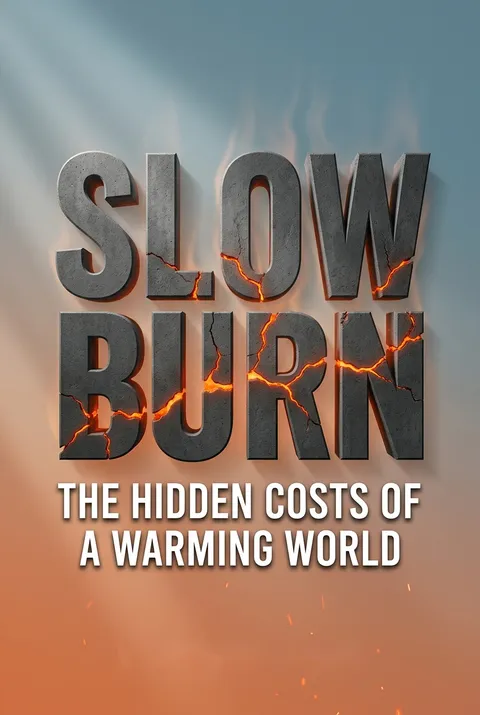
The quiet accumulation. Park contrasts Pompeii, destroyed in a sudden eruption, with Rome, whose influence faded through many gradual setbacks. Climate change is often pictured like Pompeii: a single, spectacular catastrophe. The book argues that a more revealing picture is the slow burn, meaning the dispersed, often hard-to-see damage that accumulates through ordinary life. Heat can quietly raise health risks, impede learning, reduce work output, and strain social relationships. Each effect may be small for one person or one day, yet extensive across populations and time.
Why the frame matters. This is not an argument that catastrophe is impossible or that emissions cuts can wait. It is a way to see that climate action has value even if civilization does not collapse. A chronic condition can be serious long before it becomes a headline emergency.
The slow-burn lens corrects a basic problem of attention: people and news systems notice vivid events more readily than dispersed changes in risk. Public health faces the same challenge when a widespread exposure raises the odds of many illnesses without producing one obvious outbreak. The frame also makes room for practical action between panic and indifference. Its limit is that cumulative costs can be difficult to aggregate, and small measured effects should not automatically be treated as equivalent to catastrophic risks. Both kinds of harm require attention, but they call for different evidence and different responses.
Count disrupted learning and health, not only damaged buildings
The invisible balance sheet. Physical damage is easy to photograph and price. Human capital, the knowledge, skills, and health that help people live and work, is harder to count. After Superstorm Sandy, New York City closed all 1,750 public schools for a week, disrupting learning for more than a million students. Those losses do not appear in the storm's commonly cited property-damage total.
Disruption compounds. Research on Hurricane Katrina found that evacuated students' test scores fell by 7 to 20 percent of a standard deviation the following spring. A broader US study estimated that disasters causing $10 to $100 in physical damage per resident were associated with about $41 per resident in human-capital losses, mainly through disrupted education. These are estimates, not precise invoices, but they show why disaster accounting centered on buildings can miss lasting harm.
The distinction between physical and human capital changes what recovery means. Replacing a bridge restores a visible asset; restoring educational continuity may require stable classrooms, transportation, and support for displaced families. This resembles accounting for depreciation in a machine: damage today can lower capacity for years. Yet monetizing schooling through future earnings captures only part of its value, and earnings estimates can confuse education with other advantages. The strongest lesson is not that every learning loss has a precise dollar price, but that recovery plans should track people and capabilities alongside structures.
Use repeated real-world comparisons to separate heat's effects from coincidence
The missing counterfactual. A hot basketball game may suggest that heat affected a player's performance, but no one can replay the same game under identical conditions except for the temperature. A quasi-experiment uses naturally occurring variation, such as weather, to approximate that comparison. Researchers can compare the same student's exam performance across different temperatures, or mortality in the same county across hotter and cooler years, while accounting for other factors.
Better evidence, not perfect certainty. In New York City, researchers linked millions of exam records to local temperatures and compared students with themselves across tests. This helps avoid mistaking persistent differences between schools or students for a temperature effect. The broader credibility revolution in economics brought more real-world data and stronger causal methods to questions once answered mainly through anecdotes or broad assumptions.
The method is powerful because it asks a disciplined question: what changes when the exposure changes while other conditions are held as constant as possible? That logic is shared by clinical trials and many natural experiments in the social sciences. Still, identifying a short-term effect does not automatically reveal what a permanently warmer climate will do. People, firms, and governments adapt, and future conditions may differ from the historical record. Causal estimates are best treated as evidence about mechanisms and vulnerable settings, not as exact forecasts of a future society.
Treat routine hot days as a health threat, not background weather
Deaths that go uncounted. Heat-related deaths are difficult to diagnose because heat can worsen heart and respiratory conditions without appearing as the official cause of death. The CDC counted roughly 700 to 800 US heat deaths annually in one period, while studies using changes in all-cause mortality find a much larger burden. Research on older Americans suggests that more than two-thirds of heat-related deaths may come from common hot days, not headline heat waves.
A larger projected risk. The Climate Impact Lab estimated that climate change could raise global mortality by 73 deaths per 100,000 people annually by century's end, even after accounting for expected income growth and adaptation. Without those adjustments, its estimate was 221. The projections cover about 55 percent of the world's population directly, and Africa is poorly represented in the underlying data. Cold-related deaths may decline in some regions, so net effects vary geographically.
This evidence highlights a familiar epidemiological problem: official categories often capture only cases where a cause is obvious, while population-level analysis can reveal deaths brought forward by a contributing exposure. The distinction matters for prevention, since ordinary hot days may warrant health protections even without a declared emergency. The estimates also depend on assumptions about future adaptation, data quality, and how heat interacts with existing illness. Their value lies less in a single definitive global tally than in showing that weak measurement can make a widespread health risk look negligible.
Treat heat as a performance hazard wherever people must think or work
Heat reaches indoors. Temperature affects more than outdoor labor. In New York City, students taking exams at 90°F were about 10 percent less likely to pass than they would have been at 70°F. Over time, researchers estimated that heat affected the passing marks on more than 500,000 exams and the on-time graduation prospects of at least 90,000 students. In factories, heat has also been linked to reduced output, including in manufacturing plants in the United States, Canada, India, and China.
People run institutions. The book also reviews evidence linking hotter conditions to more violent crime, harsher sentencing in some courts, and worse mental-health outcomes. These findings do not mean every hot day produces conflict or poor judgment. They suggest that climate can affect the human decisions on which workplaces, schools, and public systems depend.
The wider implication is that climate risk is partly a human-factors problem. Buildings and machines can be engineered for a range of conditions, but performance still depends on attention, fatigue, and judgment. This connects the climate question to occupational safety, education, and institutional reliability. The evidence is uneven across tasks and populations, so a uniform temperature threshold is unlikely to fit every setting. Still, the common policy mistake is to treat indoor spaces as automatically protected. A roof does not remove heat stress when cooling is absent, expensive, or unreliable.
Climate risk depends on exposure and resources, not weather alone
Three parts of risk. Park separates climate risk into hazard, exposure, and vulnerability. Hazard is the physical threat, such as heat or flooding. Exposure is how much of that threat a person encounters. Vulnerability is how likely exposure is to cause harm. These factors vary within countries as well as between them. In California, people in the lowest income group experienced about 70 days a year above 90°F, compared with 26 for the highest income group.
Markets sort people. Housing prices can push lower-income households toward hotter neighborhoods, while occupational sorting places many workers without college degrees in exposed jobs. In California, the risk of heat-related workplace injury was at least five times higher for workers in the bottom income quintile than for those at the top. The same weather can therefore produce very different consequences depending on where someone lives and works.
This framework is useful because it prevents a common analytical shortcut: treating a hazard map as a complete map of human risk. Exposure and vulnerability are shaped by housing, work, health, infrastructure, and the ability to move or recover. It also clarifies why national averages can conceal severe local burdens. Income is an informative signal, but not a full diagnosis. Two households with similar incomes may differ in health, housing quality, social support, and access to cooling. Effective policy needs to identify these pathways rather than assume that one demographic label captures them all.
Build adaptation around the financial and social shock absorbers people lack
Institutions can protect. Adaptation is not only a matter of air-conditioning, seawalls, or new crop varieties. It also depends on whether people can borrow, insure risks, reach markets, and maintain essential services after a shock. In India, researchers studied the expansion of rural bank branches from 1977 to 1990. Areas with improved banking access saw the mortality increase associated with hot days fall by roughly 75 percent, from 1.2 percent to 0.3 percent per day above 90°F.
Resilience has many forms. Credit and insurance can help farmers avoid selling assets or cutting essential spending after a poor harvest. Better market connections can reduce dependence on local crops when weather damages yields. Conversely, children may leave school to work during a good harvest, turning a temporary income gain into an educational setback. Social and economic systems can absorb climate shocks, or amplify them.
The striking insight is that a climate intervention need not look like climate policy to reduce climate harm. Financial access can help households smooth consumption, while schools and labor rules can protect children's long-term prospects during temporary economic pressure. This is consistent with resilience thinking in other fields, where redundancy and reliable support systems prevent one shock from becoming a cascade. Such interventions are not interchangeable, and a bank branch alone cannot solve heat exposure or poverty. The evidence points to a broader diagnostic question: which constraint turns a physical shock into lasting damage in this particular community?
Keep cutting emissions: every fraction of warming avoided has measurable value
Not an all-or-nothing choice. Climate change is a stock problem: emissions accumulate, so stopping some emissions reduces future warming even if it does not erase past emissions. Park argues that action remains worthwhile without a bright line separating a safe world from a ruined one. The estimated social cost of carbon, the present value of future harm caused by emitting one additional ton of carbon dioxide, has risen substantially as researchers add empirical evidence on health and other damages. A recent US estimate used about $190 per ton, compared with earlier estimates near $30 to $50.
A guide, not an oracle. Multiplying that estimate by current annual emissions suggests damages measured in trillions of dollars, but the calculation depends on assumptions about future emissions, adaptation, and discounting. Many losses, including learning, inequality, and ecosystem damage, remain incompletely represented.
The marginal framing is valuable because it keeps policy attention on degrees of improvement rather than a symbolic pass-fail target. It also makes the benefits of mitigation legible to decision-makers who need to compare investments. But the social cost of carbon is not a neutral description of reality: its result depends on discount rates, which harms are measured, and how unequal impacts are valued. A high estimate can sharpen the case for action, while a low one can conceal burdens that resist monetization. It should inform public judgment, not replace it.
Choose adaptation by evidence, not by the size of the seawall
Match the fix to the failure. Large defenses can be necessary, but adaptation also includes better risk information, safer building standards, healthcare, and support for households unable to afford protection. California building codes requiring fire-resistant materials made newer homes 16 percentage points, or about 40 percent, more likely to survive wildfire exposure. A fire-resistant home also reduced risk for nearby homes, evidence that private choices can create community-wide benefits.
Target public help. Research reviewed in the book found that community health clinics reduced the heat-mortality relationship by about 15 percent. Flood-risk disclosure laws also helped homebuyers account for risk more fully. These examples point toward government action when information is poor, private benefits spill over to neighbors, or vulnerable households cannot finance protection. The right response depends on local risks, costs, and who is likely to benefit.
Adaptation policy works best as diagnosis followed by a targeted intervention. A seawall addresses a particular flood pathway; it does little for a farm worker exposed to heat or a family unable to pay an electricity bill. The California building-code example is especially instructive because it captures spillovers: one property's protection can benefit its neighbors. Yet evidence from one place does not automatically travel to another, and even a cost-effective project may displace residents through rising housing prices. Local participation and distributional analysis matter as much as engineering performance.
Protect ecosystems by reducing local stress while global warming continues
Resilience is not binary. The Great Barrier Reef illustrates the book's closing argument. Warming oceans can trigger coral bleaching, and added acidity can slow coral growth. But reef health is also affected by overfishing, coastal pollution, tourism, and agricultural runoff. These local pressures can weaken reefs already facing climate stress.
Act on what can change. Marine protected areas, no-take fishing reserves, better watershed practices, and sustainable tourism can strengthen reef resilience, even though they cannot remove the underlying heat and acidification caused by greenhouse gases. The author recalls seeing the reef's intricate life firsthand, then challenges the assumption that caring about it requires choosing between certain extinction and perfect survival. Local protection and global emissions cuts are complementary, not competing, forms of action.
The reef example broadens the book's case beyond human economic losses without claiming that local stewardship can overpower planetary warming. It offers a useful ecological model: resilience depends on multiple pressures, some global and some locally manageable. Similar reasoning applies to social systems, where reducing background stress can make communities better able to withstand a larger shock. The nuance is essential. Adaptation can preserve options and reduce damage, but it cannot substitute for mitigation when the stressor is global and persistent. Hope here means having specific levers, not expecting a painless outcome.
Analysis
Park's central contribution is a shift in what counts as climate evidence. Instead of asking only whether an extreme event can be attributed to climate change, he follows the less visible pathways through which weather affects health, education, work, social behavior, and markets. The result is a more granular account of harm, and a stronger argument for treating climate policy as sustained risk management rather than a single emergency decision.
The empirical strategy is persuasive when it compares outcomes within the same people or places as temperatures vary. Such designs reduce confounding from durable differences between regions, schools, or workers. Their strength is also their boundary: historical weather variation can reveal short-run causal effects, but it cannot by itself settle how future technology, migration, institutions, or nonlinear climate processes will reshape those effects. A measured response to a hot day is not a complete forecast of life in a warmer world.
The book's economic lens makes neglected losses visible, particularly when conventional disaster accounting counts buildings but omits lost learning or health. Yet monetary valuation remains a partial language. Future earnings are not the whole value of education, and a dollar-based metric can assign less apparent weight to harms suffered by poorer people. Park recognizes these limits, but they remain central to interpreting the social cost of carbon and the case for adaptation.
The strongest policy implication is therefore methodological as much as prescriptive: measure who is exposed, identify the mechanism that turns exposure into harm, and test whether a proposed intervention changes that mechanism. This approach resists both fatalism and the promise of silver bullets. It also gives active hope a rigorous meaning: not confidence that damage can be eliminated, but evidence that its scale and distribution remain responsive to human choices.
People Also Read







Glossary
Slow burn
Cumulative hidden climate harmsPark's term for the dispersed, often overlooked damage of a warming world. It includes harms such as elevated health risks, reduced learning, lower workplace productivity, and pressure on livelihoods. Each effect may be modest in an individual case, but its reach across people, places, and time can make the total consequential.
Human capital
People's productive capacitiesThe skills, knowledge, health, and capacities that enable people to participate in economic and social life. In the book, schooling is a key form of human capital, but health and physical vitality matter too. Disasters can damage it by disrupting learning or well-being, even when buildings and infrastructure remain intact.
Quasi-experiment
Natural variation used causallyA research design that uses naturally occurring variation to approximate an experiment when researchers cannot randomly assign an exposure. For example, researchers can compare the same student's exam results under different temperatures. Careful controls help distinguish a possible causal effect from persistent differences between people or places.
Credibility revolution
Stronger causal empirical methodsA shift in empirical economics toward research designs that make causal claims more transparent and credible. The book connects this movement to greater use of detailed real-world data and quasi-experimental methods, helping researchers investigate how weather affects outcomes such as mortality, learning, crime, and productivity.
Hazard, exposure, and vulnerability
Three parts of climate riskA framework for understanding how climate risk becomes human harm. Hazard is the physical threat, such as heat or flooding. Exposure is how much of that threat a person or place encounters. Vulnerability is the likelihood that exposure will cause adverse outcomes. Income, work, housing, health, and institutions can affect these dimensions.
Social cost of carbon
Estimated harm per emitted tonAn estimate of the discounted future damages avoided by preventing one additional ton of carbon dioxide emissions today. Policymakers and firms use it to compare climate harms with the costs of regulations or investments. Its value depends on evidence about future damage, adaptation, discounting, and which effects are included.
First fundamental welfare theorem
Conditions for market efficiencyAn economic theorem stating that competitive markets allocate resources efficiently under specific conditions, including perfect information, no transaction costs, no market power, and no externalities. When these conditions fail, markets may not produce socially efficient outcomes. The book uses this logic to explain when government intervention in mitigation or adaptation may help.
Occupational sorting
Workers sorted across job risksThe process by which workers with different resources and options end up in different occupations and working conditions. The book uses the term to explain why climate hazards may be concentrated in lower-paid jobs. Workers with fewer safer alternatives may accept greater exposure, even when theory suggests hazardous jobs should pay a compensating wage premium.
Download PDF
Download EPUB
.epub digital book format is ideal for reading ebooks on phones, tablets, and e-readers.








