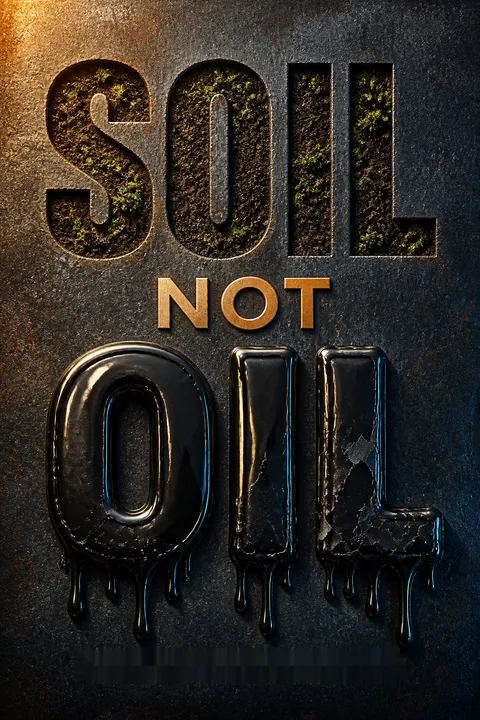


Key Takeaways
Treat climate, oil, and hunger as one crisis of land and power
Three crises share roots. Shiva connects climate disruption, the end of cheap oil, and food insecurity. Fossil-fuel agriculture and global trade, she argues, intensify emissions, weaken local livelihoods, and make food vulnerable to price shocks. Her 2008 account presents the food crisis as especially urgent for people already struggling to eat, while climate disasters hit communities that contributed least to the pollution.
Justice is the hinge. Her proposed response is not simply to replace one fuel with another. Earth Democracy, her term for a people-centered system that respects ecological limits and the rights of communities and other species, links climate action to food, land, and livelihood security. The book's central move from oil to soil means rebuilding economies around living ecosystems and local participation.
What's striking is the book's refusal to treat climate, energy, and food as separate policy departments. Systems thinking supports that approach: a change in fuel can alter land use, food prices, and who controls resources. The justice lens also asks a more useful question than whether a technology is low-carbon: who gains security, and who absorbs the disruption? The framework is strongest as a way to expose hidden connections, not as proof that every local arrangement is sustainable. Local production still needs ecological limits, fair access, and competent public institutions.
Judge climate fixes by who bears their full ecological and social costs
A clean label is not enough. Shiva calls corporate or wealthy-country responses that secure resources for powerful actors while shifting costs onto poorer communities eco-imperialism. She argues that carbon trading can grant pollution rights to historic emitters and let them buy offsets involving land in poorer regions. In her account, a project may cut one measured emission while damaging water, forests, or local livelihoods.
Count the whole chain. The book also challenges nuclear power assessed only by its direct carbon emissions, pointing to uranium mining, radioactive waste, and risks borne by nearby communities. It questions geoengineering proposals that intervene in the atmosphere or oceans without knowing their wider effects. The common test is whether a purported climate solution reduces harm across its full life cycle, rather than shifting harm out of sight.
The insistence on full-cost accounting anticipates a central problem in environmental economics: prices often omit health damage, lost access to land, and risks imposed on future generations. A market can help coordinate emissions cuts, but only if its rules prevent free pollution allowances, weak offsets, and the transfer of harms to less powerful communities. Likewise, examining nuclear power across its life cycle is more rigorous than judging it by smokestack emissions alone. The challenge is to compare real alternatives consistently, rather than assuming that any market instrument or any large technology is automatically defective.
Do not subsidize cars by making farmers, walkers, and villages pay
Cheap cars carry hidden bills. Shiva uses India's proposed low-cost Tata Nano as a symbol of the automobile-centered development model. At the time of writing, only about 7 people in every 1,000 in India owned a car, yet the industry sought a much larger market. The book argues that the car's price leaves out land taken for factories and roads, pollution, congestion, and the livelihoods disrupted by construction.
Design mobility for access. In Singur, farmers resisted the acquisition of fertile land for a Nano factory. Shiva contrasts that conflict with Freiburg, Germany, where investment in transit, cycling, walking, and traffic restrictions helped keep car trips nearly flat even as total trips rose. The lesson is not that mobility is unnecessary, but that public choices can make access less dependent on private cars.
The distinction between mobility and car ownership is crucial. Transport planning can prioritize reaching work, food, and services rather than maximizing vehicle speed or road capacity. That shifts attention toward transit, safe walking, and cycling, while exposing the land and health costs that vehicle prices conceal. Freiburg is an illustrative case, not a universal template: density, climate, income, and existing infrastructure shape what works elsewhere. The larger principle travels well, though: infrastructure is never neutral, because it allocates public space and determines whose movement is treated as normal.
Keep food crops out of fuel tanks when people need them to eat
Fuel crops create land pressure. Shiva distinguishes small-scale biomass used locally for cooking or biogas from industrial liquid biofuels grown to maintain car-dependent energy systems. When food crops or forests are turned into fuel, land and water are diverted from food production. The book reports that studies cited in 2008 estimated a carbon debt of 423 years for palm biodiesel on converted Southeast Asian rainforest and 319 years for soy biodiesel on converted Amazon rainforest. Carbon debt means the emissions from land conversion that must be offset before the fuel delivers a climate benefit.
Follow the incentives. Subsidies and fuel mandates can encourage monocultures, deforestation, and higher food prices. Shiva's alternative is decentralized bioenergy using diverse resources for local needs, provided it does not displace food, soil fertility, or community control.
This argument is a strong case for lifecycle analysis: a fuel's climate value depends on what the land was doing before the crop arrived, not just what comes out of an exhaust pipe. It also clarifies why the word renewable cannot settle the question. Waste materials or crops grown on genuinely low-conflict land may have different effects from clearing forests or replacing food. The book's warning is most useful as a demand for evidence and safeguards. A blanket rejection of all bioenergy would miss the distinctions its own local-versus-industrial comparison makes.
Rebuild soil fertility instead of buying it in fertilizer bags
Soil is a living system. Shiva challenges the idea that fertility can be manufactured mainly by supplying nitrogen, phosphorus, and potassium. Soil organisms, organic matter, roots, and recycled nutrients build the conditions crops need. In her account, repeated chemical inputs in Punjab were followed by depleted nutrients, contaminated water, and declining or unstable yields. She describes organic matter as essential to soil structure and moisture retention, both valuable during drought.
Count energy from field to plate. Industrial agriculture uses fossil fuels for machinery, irrigation, synthetic fertilizer, processing, packaging, and transport. The book cites an estimate that the US food chain uses about ten calories of energy to produce one calorie of food. Its proposed alternative is ecological farming that returns organic matter to the soil and reduces dependence on purchased inputs, while acknowledging that this requires knowledge and care, not merely substituting one product for another.
The soil argument connects agriculture to ecology's idea of nutrient cycling: fertility is maintained through relationships among organisms and materials, not just through deliveries of inputs. It also improves the accounting of efficiency by including energy, water, and pollution alongside crop yield. That broader measure can reveal why a high-output system may be costly overall. However, farming methods must be evaluated in their local conditions, and organic practices are not interchangeable or automatically sufficient. Farmers need reliable knowledge, markets, and support during any transition away from chemical dependence.
Preserve seed diversity as insurance against climate shocks
Diversity spreads risk. Shiva argues that monocultures leave farms exposed to a single disease, drought, flood, or shift in rainfall. Navdanya, the seed-saving and organic-farming movement she founded, maintains community seed banks and distributes farmers' varieties suited to different conditions. After the Orissa cyclone and the 2004 tsunami, the organization shared salt-tolerant rice seeds to help restore cultivation on flooded land.
Many crops can outperform one. The book describes a twelve-crop system at Navdanya that produced more food and more income than a corn monoculture. It also cites mixed farms in several Indian regions with higher net returns than single-crop farms. These examples support the book's claim that biodiversity is productive as well as protective. Seed commons matter because communities need access to a range of varieties to adapt, rather than relying on a narrow set of patented seeds.
Diversity works like a portfolio: when conditions are uncertain, a range of crops can reduce the chance that one shock ruins the whole harvest. Seed banks also preserve options that may have value before anyone can predict which trait will matter. This is a compelling argument for maintaining shared genetic resources and farmers' knowledge. Yet a diverse field is not guaranteed to outyield a monoculture in every place or season. The most defensible claim is about resilience and multiple forms of value, not a universal yield advantage. Communities also need practical access to seeds and markets.
Keep staple foods local, trading only what travels lightly
Food sovereignty means control over food systems. In Shiva's usage, it is the ability of communities to decide how food is grown, distributed, and consumed, rather than having those choices dictated by distant corporations or trade rules. She argues that export-first agriculture can displace local staples, increase dependence on imports, and direct land and water toward crops for wealthier consumers.
Shorter chains strengthen choice. The book contrasts local markets and fresh food with long-distance supply chains that require transport, processing, packaging, and supermarket distribution. It does not reject all trade: spices, which are valuable in small quantities and tied to particular growing conditions, are offered as a more fitting export than basic foods that communities can grow themselves. Localization, in this account, is about securing local needs first, not ending exchange.
The principle resembles subsidiarity: decisions should be made at the closest level capable of handling them, while larger institutions address problems that cross local boundaries. That can improve accountability and shorten the distance between producers and consumers. It also guards against treating every food as a generic commodity. But local is not automatically fair or low-impact. Communities differ in resources, and some depend on trade for foods or income. The useful test is whether trade complements local food security and ecological fit, or makes communities more vulnerable to distant price and policy shifts.
Let communities define development by whether life and livelihoods renew
Development from within. Shiva borrows the term autopoetic systems for living systems that organize, regulate, and renew themselves. She contrasts them with systems designed to depend on external inputs. Applied to society, this means development should be defined by communities, not imposed as a universal march toward industrialization. A tribal woman resisting a dam in the book says, in effect, that development should not require people to surrender their rights for someone else's gain.
Renewal is a better measure than machinery. A tree can respond to damage and continue growing; a machine depends on outside repair and replacement. Shiva uses the contrast to argue that resilient communities need local knowledge, ecological resources, and decision-making power. This does not mean rejecting every technology. It means asking whether a technology strengthens people's ability to meet needs or makes them more dependent on distant owners and systems.
The idea resonates with endogenous development, where communities shape change using their own priorities and capacities. It also makes resilience a political question: the ability to adapt depends partly on who controls land, knowledge, and decisions. Still, communities are not single-minded actors. Local elites can exclude women, landless workers, or minority groups, so self-determination requires inclusive institutions and rights protections. The contrast between living systems and machines is vivid, but society needs both ecological renewal and reliable infrastructure. The deeper point is that technology should serve locally chosen goals, rather than define them.
Power down fossil consumption while powering up meaningful human work
Work is part of the energy system. Shiva argues that replacing people with fossil-fuel machinery is counted as productivity even when it destroys livelihoods and increases pollution. She treats human creativity, animal power, and ecological processes as sources of useful energy that conventional economic measures often ignore. The book compares investment in transport: it cites an estimate that the same amount spent on bicycle rickshaws could support far more jobs than spending it on buses.
Transition is political, too. Shakti, a concept Shiva uses for the creative, self-renewing force of the universe, includes human capacity to organize and transform society. The move beyond oil therefore requires more than new energy equipment. It calls for reducing wasteful consumption while restoring dignified work, community control, and cooperation with living systems.
This account usefully challenges the assumption that labor-saving is always socially beneficial. A machine may reduce effort while also removing income, skill, and bargaining power, especially when displaced workers have no alternative. A just transition therefore measures not only emissions and output, but also access to dignified work and a voice in decisions. The caution is important: manual work can be exhausting or unsafe, and no one should be romanticized into hardship. The goal is not to preserve every task, but to ensure that efficiency gains improve lives rather than simply concentrate wealth.
Analysis
Soil Not Oil is best read as a political ecology argument, not a neutral catalogue of climate technologies. Its core claim is that climate policy cannot be separated from land ownership, food systems, labor, and democratic power. The book's strongest contribution is its insistence on tracing consequences across those boundaries. A fuel can appear low-carbon while shifting land costs onto food producers; a crop can appear productive while exhausting soil; a road can appear to connect a country while excluding people who cannot drive.
The title is a compressed theory of transition. Soil stands for renewable living systems, but also for local knowledge, work, and the ability of communities to govern resources. Oil stands for more than a fuel: it represents centralized infrastructure and an economic model that prizes throughput while hiding social and ecological costs. This is why the proposed change is cultural and institutional as much as technical.
The book is persuasive when it asks who bears costs omitted from market prices and when it illustrates the stakes through Indian farmers, tribal communities, and transport workers. Its claims are less secure when examples from particular farms or regions are treated as evidence for broad yield advantages. Likewise, local systems can be unjust, and labor-intensive production can impose real burdens. The argument is strongest when taken as a demand for comparison, participation, and ecological accounting, not as a universal rule that small is always better.
Its lasting value lies in changing the question from which technology replaces oil to which arrangements let people meet needs without degrading the systems that sustain them. That reframing links climate mitigation to adaptation and justice. It also makes the transition measurable in ordinary terms: whether communities retain access to food, land, work, and meaningful decisions, while reducing dependence on energy and resources they cannot renew.
Review Summary
Soil Not Oil by Vandana Shiva receives mostly positive reviews, with readers praising its insightful analysis of climate change, food security, and sustainable agriculture. Many appreciate Shiva's critique of industrial farming and globalization, as well as her advocacy for local, biodiverse farming practices. Some readers find the book dense and repetitive, while others wish for more detailed solutions. Overall, reviewers consider it an important work that challenges readers to rethink current economic and agricultural systems.
People Also Read










Glossary
Earth Democracy
Ecological rights and self-ruleShiva's framework for organizing society around ecological limits, social justice, and the rights of all beings to the resources needed for sustenance. It favors decentralized decision-making and community control over land, food, and energy. It treats the atmosphere and other shared ecological systems as commons, rather than resources to be enclosed for private gain.
Eco-imperialism
Environmental control by the powerfulShiva's term for responses to environmental crises that expand corporate or wealthy-country control over resources while transferring costs to poorer people and places. Examples in the book include resource extraction, carbon-offset projects that claim local land, and energy policies that displace communities. The term connects ecological harm to unequal political and economic power.
Food sovereignty
Community control of food systemsThe ability of communities and producers to shape how food is grown, distributed, and consumed. In the book, it includes control over seeds, land, farming practices, and local markets, with priority given to meeting local nutritional needs. It contrasts with systems in which distant corporations and trade rules determine production and access.
Carbon debt
Land conversion's emissions burdenThe greenhouse gas emissions released when land is cleared or disturbed to produce a biofuel crop. The debt must be balanced against the emissions avoided by replacing fossil fuel. If land conversion releases large amounts of stored carbon, that balance can take a long time, making the fuel more harmful than the fossil fuel it replaces during that period.
Autopoetic systems
Self-renewing living systemsA term Shiva draws from biologists Humberto Maturana and Francisco Varela for systems that organize, regulate, and renew themselves from within. The book uses living organisms and communities as examples, contrasting them with externally designed systems that depend on outside inputs. The concept supports a view of development rooted in local capacities and self-organization.
Shakti
Creative force of lifeA concept from Indian philosophy that Shiva uses for the generative, self-organizing power of the universe. It includes the creative capacities of nature and human beings, not merely mechanical energy from fuels. The book applies Shakti to the possibility of communities organizing and creating a society that sustains life rather than exhausting it.
FAQ
What's "Soil Not Oil: Environmental Justice in an Age of Climate Crisis" about?
- Triple Crisis: The book discusses the interconnected crises of climate change, peak oil, and food security, emphasizing how they threaten human survival and demand urgent action.
- Industrialization Critique: Vandana Shiva critiques the industrialized, globalized economy, which she argues is responsible for environmental degradation and social inequality.
- Sustainable Alternatives: The book advocates for a transition to sustainable, biodiverse, and localized food systems as a solution to these crises.
- Empowerment and Democracy: Shiva emphasizes the importance of empowering local communities and promoting Earth Democracy to achieve environmental justice.
Why should I read "Soil Not Oil"?
- Understanding Crises: It provides a comprehensive analysis of the current environmental and social crises, helping readers understand their root causes.
- Alternative Solutions: The book offers practical solutions and alternatives to the dominant industrial paradigm, focusing on sustainability and justice.
- Empowerment: It encourages readers to become active participants in creating change, emphasizing the power of local communities and individuals.
- Informed Perspective: Vandana Shiva's insights offer a unique perspective on global issues, informed by her extensive experience as an environmental activist.
What are the key takeaways of "Soil Not Oil"?
- Interconnected Crises: Climate change, peak oil, and food security are deeply interconnected and require holistic solutions.
- Critique of Industrialization: The industrialized, fossil fuel-based economy is unsustainable and exacerbates environmental and social issues.
- Sustainable Practices: Transitioning to biodiverse, organic, and localized food systems can mitigate climate change and enhance food security.
- Empowerment and Democracy: Empowering local communities and promoting Earth Democracy are crucial for achieving environmental justice.
How does Vandana Shiva define "Earth Democracy"?
- Interconnectedness: Earth Democracy recognizes the interconnectedness of all life forms and the need for sustainable living.
- Equity and Justice: It emphasizes social and ecological justice, ensuring that all beings have equal rights to resources.
- Local Empowerment: The concept promotes the empowerment of local communities to manage their resources and make decisions.
- Sustainability: Earth Democracy advocates for sustainable practices that respect the planet's ecological limits.
What is the "triple crisis" mentioned in "Soil Not Oil"?
- Climate Change: The book highlights the urgent threat of climate change, driven by CO2 emissions and fossil fuel dependency.
- Peak Oil: It discusses the concept of peak oil, where oil production reaches its maximum and begins to decline, leading to economic instability.
- Food Security: The food crisis is exacerbated by industrial agriculture and globalization, which threaten local food systems and increase hunger.
How does "Soil Not Oil" critique industrial agriculture?
- Fossil Fuel Dependency: Industrial agriculture relies heavily on fossil fuels for machinery, fertilizers, and transportation, contributing to climate change.
- Monocultures: The focus on monocultures reduces biodiversity, making crops more vulnerable to pests and climate variability.
- Soil Degradation: Chemical fertilizers and pesticides degrade soil health, reducing its fertility and resilience.
- Corporate Control: The book criticizes the control of food systems by large agribusinesses, which prioritize profit over sustainability and equity.
What solutions does Vandana Shiva propose in "Soil Not Oil"?
- Biodiverse Farming: She advocates for biodiverse, organic farming practices that enhance soil health and resilience to climate change.
- Local Food Systems: Promoting local food systems reduces food miles, supports local economies, and enhances food security.
- Empowering Communities: Empowering local communities to manage their resources and make decisions is crucial for sustainable development.
- Earth Democracy: Implementing Earth Democracy principles ensures social and ecological justice, fostering a sustainable future.
How does "Soil Not Oil" address the issue of biofuels?
- False Solution: Shiva argues that industrial biofuels are a false solution to climate change, as they often increase greenhouse gas emissions.
- Food vs. Fuel: The production of biofuels competes with food crops for land and resources, exacerbating food insecurity.
- Monocultures and Deforestation: Biofuel production promotes monocultures and deforestation, further degrading ecosystems.
- Sustainable Alternatives: The book advocates for decentralized, biodiverse bioenergy systems that do not compete with food production.
What role does "Soil Not Oil" assign to local communities in addressing climate change?
- Empowerment: Local communities are empowered to manage their resources and implement sustainable practices.
- Decentralization: Decentralized decision-making allows for more responsive and context-specific solutions to environmental challenges.
- Cultural Knowledge: Indigenous and local knowledge systems are valued for their sustainable practices and resilience.
- Community Resilience: Strengthening community resilience is key to adapting to climate change and ensuring food security.
What are the best quotes from "Soil Not Oil" and what do they mean?
- "We will either make a democratic transition from oil to soil or we will perish." This quote emphasizes the urgent need for a shift from fossil fuel dependency to sustainable, soil-based practices.
- "The age of oil symbolizes the rule of capital, of centralized control and coercive government." It critiques the centralized, profit-driven systems that dominate the current global economy.
- "Earth Democracy grows in the fertile soil shaped by the earth, the human imagination, and human action." This highlights the potential for a sustainable future through collective action and creativity.
How does "Soil Not Oil" connect climate change to social justice?
- Disproportionate Impact: The book highlights how climate change disproportionately affects the poor and marginalized, who are least responsible for emissions.
- Resource Inequality: It critiques the unequal distribution of resources and the exploitation of natural resources by powerful corporations.
- Empowerment for Justice: Empowering local communities and promoting Earth Democracy are seen as pathways to achieving social and ecological justice.
- Sustainable Solutions: Sustainable practices that prioritize equity and justice are essential for addressing both climate change and social inequality.
What is Vandana Shiva's vision for a post-oil future in "Soil Not Oil"?
- Biodiversity-Based Economy: A post-oil future is based on a biodiversity economy that respects ecological limits and promotes sustainability.
- Decentralized Systems: Decentralized, local systems of production and consumption reduce dependency on fossil fuels and enhance resilience.
- Cultural Shift: A cultural shift away from consumerism and towards valuing ecological and social well-being is essential.
- Empowered Communities: Empowered communities play a central role in managing resources and implementing sustainable practices for a just and equitable future.
About the Author

Download PDF
Download EPUB
.epub digital book format is ideal for reading ebooks on phones, tablets, and e-readers.








