

Key Takeaways
Ask who feeds people, then count nourishment rather than corporate output
The headline is contested. Shiva frames the food debate around a mismatch: the estimates she cites attribute about 70 percent of the food people eat to small-scale farms and 30 percent to large industrial farms, while assigning industrial methods a disproportionate share of ecological harm. She argues that conventional measures privilege saleable commodities and overlook subsistence harvests, nutrition, and the ecological work that makes future harvests possible. The answer to who feeds the world therefore depends on what counts as food and production.
Follow the whole web. Industrial agriculture treats seeds, soil, and crops as inputs in a profit-making chain. Agroecology, the book's alternative, understands food as the result of relationships among living soil, water, seeds, biodiversity, farmers, and eaters. Shiva's central claim is not simply that small farms matter, but that food production must renew the systems on which it depends and return value to the people who grow it.
The strongest move here is to challenge the accounting before arguing over the answer. A system can produce large volumes of grain while failing to provide varied diets, stable livelihoods, or healthy ecosystems. This resembles the broader economic critique that gross output is not the same as social welfare: unpaid care and environmental depletion disappear from standard ledgers. The 70/30 split is a book-cited estimate, not a universal constant; definitions of small farms, food output, and resource use differ across datasets. The useful question is therefore both who produces food and what the chosen measure leaves out.
Treat soil as a living food system, not a fertilizer container
Fertility is biological. Soil is not merely a surface holding plants upright. It is a community of organisms that break down organic matter, cycle nutrients, bind particles, and help water remain available to roots. Humus, the organic material formed through decomposition, acts like a sponge; the book says it can hold up to 90 percent of its weight in water. Chemical fertilizers supply selected nutrients, but do not replace this living structure.
Return what crops use. Shiva describes Navdanya's farm as land left sandy and depleted after eucalyptus planting. By growing diverse crops and returning organic matter, the farm rebuilt soil life and cut water use by about 70 percent, according to her account. This is the Law of Return in practice: replenish soil rather than treating fertility as a resource to extract and replace with purchased inputs.
Soil health links agriculture to hydrology, microbiology, and climate resilience. Organic matter and soil structure influence infiltration and water storage, so fertility is not just a question of feeding crops. This systems view also changes the time horizon: synthetic nutrients can support short-term growth while leaving degradation outside the farm's balance sheet. The Navdanya example is compelling as a demonstration, though a single farm cannot establish the same outcome everywhere. Soil type, rainfall, crops, and management all matter. The broader lesson is to monitor soil function, not fertilizer use alone.
Replace chemical pest warfare with biodiversity that recruits allies
Pests signal imbalance. Shiva argues that pesticide-based control often kills beneficial insects along with target pests, while repeated exposure selects for resistant survivors. The book reports that only about 1 percent of a sprayed pesticide reaches its intended target. Pollinators are also food producers: bees contribute to the reproduction of many crops, while predators such as ladybugs and spiders help limit pest populations.
Design cooperation into fields. In East Africa's push-pull system, farmers grow desmodium alongside maize. Its scent repels stem borers, while nearby grasses attract them; sticky grass stems trap some larvae. The method redirects pests rather than attempting to sterilize the field. Shiva presents this as one example of integrated pest management, where diverse plants and insects provide services that a monoculture must otherwise replace with chemicals.
The key insight is ecological substitution: instead of buying a chemical to perform one function, design the farm so living relationships perform several. This connects with integrated pest management, which combines monitoring, prevention, biological controls, and limited chemical use when necessary. The argument is strongest when it rejects routine, indiscriminate spraying, not when it implies that every pest outbreak can be solved by diversity alone. Farmers face real risks from crop losses, and ecological methods require knowledge, time, and local adaptation. The practical question is which interventions reduce harm while keeping yields reliable.
Measure farms by total nutrition and resilience, not one crop's yield
A single harvest can mislead. Industrial farming often reports the yield of one crop, while mixed farms also produce other foods, animal fodder, biomass, and soil benefits. Shiva points to the loss of thousands of crop varieties and the growing dependence on rice, wheat, and maize. A farm that produces more grain but less nutrition, straw, or resilience may look productive on paper while weakening the wider food system.
Count nutrients per acre. Navdanya compared diverse systems such as baranaaja, a traditional mixture of twelve crops, with monoculture cropping. Its report found baranaaja produced 73.5 percent more protein and 3,200 percent more vitamins per acre than the comparison system. These are the organization's reported findings, not a universal result. The central proposal is to assess food quality and ecological contributions alongside harvest weight.
Changing the metric changes what agricultural research optimizes. A narrow yield measure rewards a crop's marketable part; a nutrition measure asks whether production improves diets and whether it can withstand shocks. That is a valuable correction to single-output thinking. Yet nutrition-per-acre comparisons depend on crop selection, edible portions, nutrient measurement, and the diets being evaluated. They need transparent methods and replication across regions. A balanced assessment should retain yield data while adding nutrition, water use, soil condition, labor, and income. The goal is not to replace one simplistic score with another.
Protect small farms because they feed more with fewer external inputs
Scale can conceal waste. The book cites estimates that small-scale farmers produce about 70 percent of the world's food on less than 30 percent of its arable land. Shiva argues that diverse small farms use labor and ecological processes more intensively, while large monocultures often depend on purchased seed, fertilizer, pesticides, machinery, and fuel. A high harvest of one commodity can therefore coexist with high costs, debt, and damage to the land.
Count livelihoods as output. Shiva calls the belief that more inputs and larger farms automatically mean more food the myth of more. She contrasts commodity production with livelihoods: farmers' work sustains households, local economies, and ecosystems, even when it is not recorded as formal employment. The book also notes that much corn and soy is used for animal feed or fuel rather than directly feeding people.
The book usefully separates labor productivity from total system productivity. Replacing workers with machinery can raise output per worker without increasing food per unit of land, energy, or water. Small farms can also spread risk across crops and seasons, a form of portfolio diversification familiar from finance. But farm size alone does not determine performance: large farms can be efficient in particular contexts, and small farms may face severe labor or market constraints. Strong policy should protect farmers' access to land and markets while comparing systems by full costs, not romanticizing any scale.
Keep seeds reproducible, shareable, and governed as a commons
Seeds carry accumulated knowledge. Farmers have selected and saved varieties for taste, nutrition, resilience, and local conditions over generations. Shiva argues that commercial hybrids often require fresh purchases because their offspring do not reliably reproduce the same traits. Patents and seed laws can further restrict saving or exchanging seed, shifting control from farming communities to companies.
Freedom is practical, not abstract. Seed freedom means farmers can save, breed, exchange, and sell their varieties, while communities conserve seed as a shared resource. The book recounts the cases of Vernon Hugh Bowman, sued after planting patented soybeans acquired through a grain elevator, and Percy Schmeiser, whose canola was contaminated by patented crops. Navdanya's more than one hundred community seed banks offer a countermodel: locally held, accessible seed that farmers can use and share.
Seed governance sits at the intersection of innovation, property law, and food security. Patents may provide incentives for costly research, but broad control over reproducing life can impose costs on farmers whose practices predate those rights. The central policy question is how to reward useful breeding without turning ordinary saving and exchange into legal risk. Community seed banks also preserve options: genetic diversity can matter when pests, climate, or consumer needs change. Their effectiveness depends on sound conservation, farmer participation, and access to viable markets, not storage alone.
Put local food security ahead of trade that turns staples into bets
Trade rules shape diets. Shiva argues that liberalized markets expose local farmers to subsidized imports that can sell below their true production cost. In the book's account, India moved from exporting edible oils to importing them after trade barriers were removed. Indonesia, once able to supply its own soy market, came to import much of its soy; price spikes then raised the cost of tofu and tempeh, everyday foods.
Local does not mean closed. The proposed alternative is to prioritize domestic food production, direct links between farmers and eaters, and fair prices, while trading genuine surpluses and goods that cannot be produced locally. The book also criticizes food speculation and long supply chains, which can separate local need from global prices. Its distinction is between exchange that serves communities and a system where staples become financial assets.
The book's case is strongest against asymmetric trade: wealthy countries subsidize production while poorer countries are pressed to open markets and remove protections. That can undermine local capacity even when imported food appears cheap. Resilience research likewise treats diversified supply sources as a form of insurance against disruptions. Still, localization is not automatically fair or efficient. Cities depend on regional networks, and trade can spread food across seasons and ecological zones. The useful principle is subsidiarity: meet essential needs as locally as practical, while preserving trade for mutual benefit rather than making dependence the default.
Count women's farming knowledge before calling it unproductive
Much food work is invisible. Shiva argues that women contribute heavily to farming, seed selection, food processing, and household nutrition, yet national accounts often fail to count work done for family sustenance. The book cites examples of women cultivating dozens of plant species in home gardens, including 18 to 57 species in gardens in Nigeria. Such knowledge supports varied diets and makes use of plants that formal systems may label weeds.
Measure what sustains households. The book challenges an economic boundary that counts market sales as production but discounts food grown and consumed at home. It also describes women's seed choices as central to maintaining crop diversity. Recognizing this work means more than adding it to statistics: it requires access to land, seed, income, and decisions about what is grown and eaten.
This argument aligns with feminist economics, which shows how unpaid care and subsistence work can disappear from measures built around wages and markets. Better measurement can reveal who carries the work of feeding households and who controls productive resources. Recognition should not become a reason to preserve unequal burdens, however. Celebrating women's expertise while leaving unpaid labor and restricted land rights intact would reproduce the problem in flattering language. The important test is whether visibility translates into agency, income, time, and authority over farming decisions.
Build food democracy through institutions, not shopping choices alone
Alternatives need infrastructure. Shiva's Navdanya movement connects seed saving, organic farming, producer groups, direct sales, and farmer education. Its community seed banks make seeds available for use, while its Earth University teaches ecological methods. Producer groups set prices collectively, and urban gardens connect city residents with food growing. These projects turn a broad principle into institutions that support farmers and eaters.
Change the rules as well. The book's transition plan includes support for domestic food production, stable prices for farmers and consumers, public food reserves, land reform, and protection against dumping. It also calls for independent food safety oversight and the right to know what food contains. The purpose is not simply to buy better products, but to give communities meaningful control over seed, land, production, and distribution.
This is the book's most practical correction to consumer-only solutions. Individual purchasing can support producers, but it cannot by itself change land concentration, patent rules, public subsidies, or bargaining power. Cooperative markets and seed banks build capacity; regulation and public investment shape the conditions in which they operate. Local initiatives also need safeguards against exclusion, unstable supply, and excessive unpaid labor. Food democracy is credible when participation is paired with accountability and material access, especially for people with low incomes and little control over land.
Analysis
Who Really Feeds the World? is both a political argument and a systems-level account of food. Its organizing contrast is between an industrial model that treats nature as an input and an ecological model that treats food production as a web of reciprocal relationships. The recurring examples make that contrast tangible: degraded Punjab after the Green Revolution, living soil rebuilt at Navdanya, mixed cropping that manages pests, and seed banks that keep varieties in circulation. The book's central achievement is to make the hidden costs of agricultural production visible. A field's harvest is only one output; soil fertility, nutrition, water, farmer income, and future resilience also matter.
Its most generative analytical move is a critique of measurement. Conventional accounts can register commodity volume while excluding unpaid labor, household food, ecosystem services, and future damage. This connects the book to ecological economics and feminist economics, both of which ask what standard market measures leave outside the frame. It also clarifies why arguments over productivity often talk past each other: one side may mean grain per hectare, another total food, nutrition, or output per unit of energy and cost. The polemical framing has limits. The source text presents numerous statistics and causal claims, some based on particular studies, advocacy reports, or estimates that may not transfer across regions or remain current. Claims about health effects, GM crops, and the comparative performance of organic systems require careful evaluation against independent, replicated evidence. Likewise, ecological farming is not a single technique, and its labor demands, transition costs, and performance vary with climate, soil, crops, and access to markets. These qualifications do not erase the book's case; they make its strongest questions more rigorous. Who benefits, what is counted, and who bears the ecological and financial risk? Its lasting contribution is to insist that feeding people cannot be judged by commodity output alone. A defensible food system must nourish people while maintaining the conditions that allow food to be grown.
Review Summary
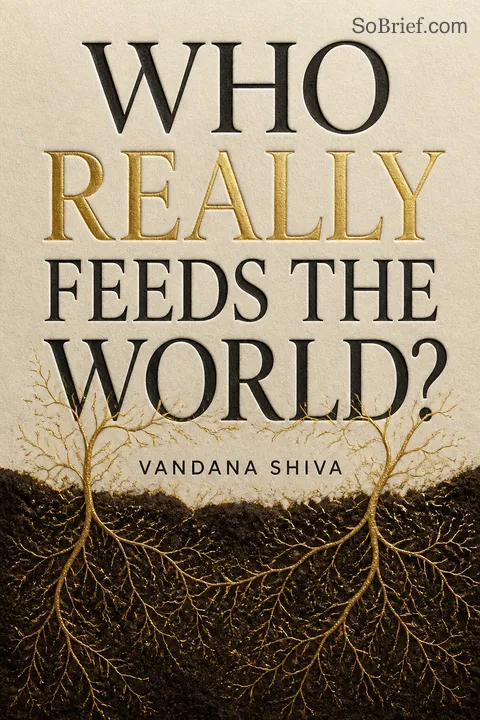
"Who Really Feeds the World?" presents Vandana Shiva's critique of industrial agriculture and advocacy for agroecology. While praised for its insightful analysis of food systems, biodiversity, and women's role in agriculture, many readers found the book repetitive. Shiva argues that small-scale farmers and traditional practices are more sustainable and productive than corporate agribusiness. She criticizes GMOs, chemical farming, and seed patents while promoting organic methods and local food systems. Despite some concerns about writing style and data presentation, the book is generally considered an important contribution to discussions on global food security and sustainability.
People Also Read







Glossary
Agroecology
Ecology applied to farmingAgroecology is the study and practice of applying ecological relationships to food and farming systems. In this book, it combines knowledge developed by farmers and communities with ecological science, and emphasizes biodiversity, living soil, seed diversity, and cooperation among organisms. Its purpose is to produce food while sustaining the systems that make production possible.
Law of Return
Give nutrients and value backThe Law of Return is Shiva's principle that sustainable production must replenish what it uses. In farming, organic matter and nutrients return to soil, seeds remain able to reproduce and circulate, and society gives farmers a fair share for their work. The principle extends across generations: fertility, knowledge, and diversity should be passed on rather than exhausted.
Law of Exploitation
Take without replenishingThe Law of Exploitation names the extractive logic Shiva associates with industrial agriculture and corporate economics. Nature, farmers, and communities are treated as resources for producing commodities and profit, while ecological damage and social costs are left uncounted. In the book, this logic contrasts with reciprocal systems that return nutrients, livelihood, and value.
Monocultures of the Mind
One worldview imposed on diversityMonocultures of the Mind is Shiva's term for a reductionist way of thinking that treats one kind of knowledge as authoritative and disregards diverse local, Indigenous, and practical expertise. She links this intellectual uniformity to agricultural monocultures: when complexity and cooperation are ignored, uniform crops and methods appear natural, while other ways of farming are dismissed.
Seed freedom
The right to save and share seedSeed freedom refers to the ability of seeds to evolve and reproduce without threats such as extinction, genetic contamination, or sterilizing technology, and to farmers' rights to save, breed, exchange, and sell their varieties. In Shiva's usage, it also includes community access to seed diversity and people's ability to choose food grown from seeds selected for local needs.
Seed sovereignty
Community control of seedSeed sovereignty is the collective capacity of farming communities to govern seed resources as a shared heritage. It involves saving and exchanging locally adapted varieties, setting community rules for their use, and resisting control through patents or restrictive seed laws. The term emphasizes self-government and responsibility for conserving seed diversity, not simply individual access to commercial seed.
Food democracy
Public control over food systemsFood democracy is the right and practical ability of farmers and citizens to shape how food is grown, distributed, and eaten. In the book, it includes farmers' freedom to save seed and use agroecological methods, and people's access to safe, nutritious, affordable, and culturally appropriate food. It also requires transparency and meaningful community influence over food policy.
Bio nullius
Life treated as unowned knowledgeBio nullius is Shiva's analogy to the colonial idea of terra nullius, the claim that land was empty and therefore available for appropriation. It describes a worldview in which the intelligence of living organisms and the breeding knowledge of farmers are treated as absent. That framing, she argues, allows corporations to claim seeds and living traits as inventions.
Myth of more
More inputs mistaken for more foodThe myth of more is Shiva's name for the belief that greater use of chemicals, capital, machinery, and large farms necessarily produces more food and prosperity. She argues that this reasoning often counts only a single marketable crop while overlooking input costs, ecological damage, diverse farm outputs, and farmer livelihoods. The apparent increase can conceal declining system productivity.
FAQ
What's "Who Really Feeds the World?" about?
- Focus on food systems: The book examines the failures of industrial agribusiness and highlights the potential of agroecology as a sustainable alternative.
- Critique of agribusiness: Vandana Shiva argues that industrial agriculture is inefficient, unsustainable, and harmful to both the environment and human health.
- Agroecology as a solution: The book advocates for agroecology, which emphasizes biodiversity, small-scale farming, and ecological balance, as a means to truly feed the world.
- Global food crisis: Shiva discusses the global food crisis, linking it to industrial agriculture and proposing agroecology as a way to address it.
Why should I read "Who Really Feeds the World?" by Vandana Shiva?
- Insightful critique: The book provides a critical analysis of the current global food system and its impact on the environment and society.
- Alternative perspective: It offers a compelling argument for agroecology as a sustainable and equitable alternative to industrial agriculture.
- Empowerment through knowledge: Readers gain an understanding of how small-scale farmers and biodiversity play crucial roles in feeding the world.
- Call to action: The book encourages readers to support sustainable food practices and policies that prioritize ecological health and social justice.
What are the key takeaways of "Who Really Feeds the World?"?
- Industrial agriculture's failures: The book highlights the inefficiencies and environmental damage caused by industrial agribusiness.
- Importance of biodiversity: Shiva emphasizes the role of biodiversity in creating resilient and productive food systems.
- Empowerment of small-scale farmers: The book argues that small-scale farmers are essential to global food security and should be supported.
- Agroecology as a solution: Agroecology is presented as a viable and sustainable alternative to industrial agriculture, capable of addressing the global food crisis.
How does Vandana Shiva define agroecology in "Who Really Feeds the World?"?
- Ecological principles: Agroecology is based on the interconnectedness of life and ecological processes, promoting biodiversity and sustainability.
- Integration with nature: It involves working with natural systems rather than against them, enhancing soil health and ecosystem services.
- Focus on small-scale farming: Agroecology supports small-scale farmers and local food systems, emphasizing the importance of traditional knowledge.
- Holistic approach: The method considers the social, economic, and environmental aspects of agriculture, aiming for a balanced and equitable food system.
What are the failures of agribusiness according to "Who Really Feeds the World?"?
- Environmental degradation: Industrial agriculture leads to soil erosion, water depletion, and loss of biodiversity.
- Health impacts: The use of chemicals and pesticides in agribusiness contributes to health problems like cancer and obesity.
- Economic inequality: Agribusiness prioritizes profits over people, often displacing small-scale farmers and increasing poverty.
- Food insecurity: Despite claims of feeding the world, industrial agriculture contributes to hunger and malnutrition by focusing on commodity crops.
How does "Who Really Feeds the World?" address the global food crisis?
- Critique of current systems: Shiva argues that the global food crisis is exacerbated by industrial agriculture and corporate control.
- Agroecology as a solution: The book proposes agroecology as a sustainable and equitable approach to addressing food insecurity.
- Empowerment of local communities: It emphasizes the importance of supporting small-scale farmers and local food systems to ensure food sovereignty.
- Policy recommendations: Shiva calls for a shift in agricultural policies to prioritize ecological health and social justice.
What role do small-scale farmers play in "Who Really Feeds the World?"?
- Major food producers: Small-scale farmers produce 70% of the world's food, despite using less than 30% of agricultural land.
- Biodiversity stewards: They maintain and enhance biodiversity, which is crucial for resilient and productive food systems.
- Economic contributors: Small-scale farming supports local economies and provides livelihoods for millions of people.
- Advocates for sustainability: The book argues that supporting small-scale farmers is essential for achieving sustainable and equitable food systems.
What are the best quotes from "Who Really Feeds the World?" and what do they mean?
- "Food is life, and it is created through living processes that sustain life." This quote emphasizes the interconnectedness of food systems and the importance of ecological balance.
- "Corporations do not grow food; they grow profits." Shiva critiques the profit-driven motives of agribusiness, highlighting the need for a focus on nourishment and sustainability.
- "Seed freedom is the freedom of the web of life to weave itself in integrity and resilience." This quote underscores the importance of biodiversity and the right to save and share seeds.
- "The future of food depends on remembering that the web of life is a food web." Shiva calls for a return to ecological principles and the recognition of food as a fundamental part of the natural world.
How does "Who Really Feeds the World?" view the relationship between food and globalization?
- Critique of globalization: The book argues that globalization has led to the commodification of food and increased corporate control over food systems.
- Impact on local economies: Globalization often displaces small-scale farmers and undermines local food systems, leading to food insecurity.
- Need for localization: Shiva advocates for localized food systems that prioritize ecological health and community well-being.
- Resistance to corporate control: The book encourages support for policies and practices that empower local communities and promote food sovereignty.
What is the significance of seed freedom in "Who Really Feeds the World?"?
- Right to save and share: Seed freedom involves the right of farmers to save, exchange, and breed seeds without corporate interference.
- Protection of biodiversity: It is essential for maintaining biodiversity and ensuring resilient and productive food systems.
- Resistance to patents: The book critiques the patenting of seeds by corporations, which undermines farmers' rights and food sovereignty.
- Empowerment of communities: Seed freedom empowers local communities to maintain control over their food systems and preserve traditional knowledge.
How does "Who Really Feeds the World?" address the role of women in agriculture?
- Primary food providers: Women are the main growers and providers of food in many societies, contributing significantly to food security.
- Knowledge of biodiversity: They possess extensive knowledge of seed, biodiversity, and nutrition, which is crucial for sustainable agriculture.
- Challenges from industrial agriculture: The book highlights how corporate control and industrial agriculture undermine women's roles and knowledge.
- Empowerment through agroecology: Shiva advocates for recognizing and supporting women's contributions to agriculture and food systems.
What are Vandana Shiva's recommendations for transitioning to sustainable food systems in "Who Really Feeds the World?"?
- Support for agroecology: Emphasize biodiversity, small-scale farming, and ecological balance as the foundation of sustainable food systems.
- Empowerment of local communities: Strengthen local food systems and support small-scale farmers to ensure food sovereignty and security.
- Policy changes: Advocate for agricultural policies that prioritize ecological health, social justice, and the rights of farmers and communities.
- Education and awareness: Promote awareness of the benefits of agroecology and the importance of sustainable food practices among consumers and policymakers.
About the Author
Other books by Vandana Shiva
Download PDF
Download EPUB
.epub digital book format is ideal for reading ebooks on phones, tablets, and e-readers.








