

Key Takeaways
Stop trying to win life; solve the seven problems your brain keeps reopening.
A map, not a ladder. Kenrick updates Maslow’s needs pyramid with seven overlapping motives: meeting immediate physical needs, self-protection, affiliation, status, finding a mate, keeping a mate, and parenting. These are recurring challenges, not rungs that can be climbed once and left behind. Hunger, safety, friendship, and family can all matter at once, and their priority shifts with circumstances. The point is not to maximize every motive, but to notice which one is steering a decision.
Fulfillment lives in the work. The authors argue that meaning is not a permanent prize at the top of life. It can come from meeting ordinary challenges and contributing to other people. That reframes self-actualization: creative achievement may feel personally rewarding, but it is often connected to relationships, respect, and family rather than separate from them.
The framework is useful because it replaces vague advice to pursue happiness with a diagnostic question: which human problem is active here? Its overlap model also fits the reality that people can seek security, belonging, and achievement simultaneously. Still, an evolutionary map explains why motives may exist, not which deserves priority in a particular life. Economic hardship, discrimination, disability, and personal values shape what choices are actually available. The pyramid works best as a lens for reflection, not as a universal schedule or moral ranking.
Make healthy behavior easier than resisting the ancient appetite for sugar and fat.
Old appetites, new abundance. An evolutionary mismatch occurs when an inherited response that worked in ancestral conditions causes trouble in today’s environment. For generations, seeking calorie-dense food and conserving energy helped people survive scarcity. In a world of processed snacks, desk jobs, and easy transport, those same tendencies can contribute to obesity and illness. Walter Hudson, who became so heavy he could not leave his bedroom, illustrates how abundance can turn a survival mechanism against its owner.
Rig the immediate rewards. Psychologist John Platt called a social trap a behavior that feels rewarding now but brings delayed harm, such as smoking or overeating. Exercise can be the reverse: effort comes first, benefits later. Make temptations less available, keep healthier choices close, set small milestones, and recruit a friend to help. In one weight-loss study, participants working with friends or relatives completed the program and maintained their losses more often than solo participants.
This is a strong application of behavioral science: decisions are shaped not only by intentions but by what is nearby, convenient, and immediately rewarding. Changing the setting can reduce the number of self-control battles a person must fight. The same logic supports safer defaults in public health, from food availability to walkable streets. Yet personal environment design cannot replace access to affordable nutritious food, safe places to exercise, or medical care. The practical lesson is not that people simply need better discipline, but that both households and institutions can make healthier choices easier.
Fear real threats proportionally, and organize against the quiet thieves.
Threat detectors have blind spots. Human attention evolved to notice immediate dangers, including violent strangers and dangerous animals. Modern people are generally safer from homicide than members of many small-scale societies studied by anthropologists, yet distant crimes arrive constantly through news and social media. That flood can make rare dangers feel commonplace. Meanwhile, quieter losses can escape notice: hidden fees, predatory lending, and other forms of financial exploitation. The authors call this technologically enhanced parasitism, when modern systems use familiar motives or habits to extract money or attention.
Pause before reacting. Avoid escalating conflicts, especially with angry young men, and resist treating members of another group as less than human. For financial exploitation, compare providers, challenge unexpected charges, and join others when a company or institution imposes unfair costs. The chapter’s distinction matters: acute violence calls for sensible caution, while diffuse exploitation often requires collective scrutiny rather than more fear.
The contrast between spectacular danger and routine extraction is a valuable correction to media-shaped intuition. Risk perception is not a neutral spreadsheet; vivid, repeated stories can dominate judgments even when the actual likelihood is low. The authors’ advice to organize against unfair practices also recognizes that individual vigilance has limits. One caution: calling institutions parasites can itself encourage an overly simple division between predators and victims. Stronger analysis asks which incentives produce the harm, who benefits, and which rules or consumer protections can change those incentives.
Build friendships through usefulness, shared ground, and attention, not contact lists.
Friendship is practical support. Among the Aché, foragers whose daily success at finding food varied, families shared much of what they gathered. Researchers found that a household kept roughly a quarter of its food and shared the rest, creating a safety net for bad luck and illness. Modern friends may not swap daily meals, but they still exchange help, information, and emotional support. Daniel Kahneman and Amos Tversky’s celebrated collaboration grew from shared intellectual interests, frequent time together, and the pleasure of working side by side.
Make connection tangible. People tend to form friendships with those nearby and with those who seem similar. Help with something useful, notice genuine common ground, thank people, and give them your attention. Be wary when a stranger imitates friendship through a small favor or manufactured familiarity to sell something. Digital contact can maintain ties, but it does not automatically provide the depth of face-to-face interaction or the dependable history of a trusted friend.
The chapter treats friendship as both affection and infrastructure. That perspective helps explain why social connection matters during illness, practical setbacks, and intellectual work, not only during leisure. It also points to a design principle: repeated, low-pressure contact makes relationships more likely to form. Similarity can ease trust, but it can also narrow social circles if treated as a requirement. Shared commitments and reciprocal attention can create common ground across background differences. A large online network is not worthless, but its size is a poor measure of dependable support.
Earn prestige through expertise and service, not dominance or screen-time busyness.
Choose a workable path. Bob Cialdini once had to choose between a slim chance at a professional baseball career and college. A scout urged him toward school; Cialdini became a leading psychologist of persuasion. The authors use his story to argue that ambition should be tested against both ability and opportunity. Career research also links satisfaction to fit between a person’s traits and the kind of work they do.
Lead by contribution. The book distinguishes dominance, rank won through intimidation, from prestige, respect freely granted to someone whose skills are worth learning. Expertise, fairness, reliability, and helping a team tend to build prestige. Hard work matters, but so does protecting attention: studies cited in the book find that workers and students lose substantial time to phones and online distractions. A skilled person who is always interrupted may be busy without making progress.
This section connects career choice, motivation, and leadership rather than treating success as a single climb up a status ladder. Prestige is especially useful as a model because it makes influence contingent on demonstrated value, not merely confidence or control. The emphasis on fit also counters the fantasy that passion alone guarantees a livelihood. Still, effort and personality fit do not erase unequal access to education, opportunity, or mentorship. The most complete application pairs personal focus with attention to whether workplaces reward genuine contribution or merely visible busyness.
Choose partners locally enough to verify, and deliberately choose the relationship you want.
More options, less context. For most of human history, people usually met potential partners through family, friends, or nearby communities. In the modern United States, the authors cite data showing that by 2020 about 40% of marriages began with people meeting online, and more than a quarter began in bars or restaurants. Dating platforms can expand choice, but they also make it easier to misrepresent age, appearance, intentions, or finances. The story of con artist Giovanni Vigliotto, who married more than a hundred women, is an extreme warning about charm without verification.
Know the trade-offs. Decide whether a relationship is meant to be casual or long-term, and make sure the other person shares that aim. For lasting partnerships, kindness, emotional stability, and conscientiousness matter. People also make trade-offs: the book describes research in which women tended to treat a man’s status as more necessary, while men treated a woman’s attractiveness as more necessary. These are broad tendencies, not rules for every person or orientation. Meeting through trusted networks can supply context that a profile cannot.
The advice to reduce the search and improve the evidence is a useful response to choice overload. A dating profile offers claims; mutual acquaintances and repeated interaction offer opportunities to check them. The book’s evolutionary account also helps explain why different traits can carry different weight, while its own evidence leaves room for individual variation and changing preferences. These findings should not be converted into a formula for sorting people. A partner is not a bundle of market attributes, and trust, compatibility, and mutual respect are built through interaction, not inferred from a swipe.
Protect commitment from biased accounting and frictionless temptations.
The mental ledger is crooked. People often remember their own contributions more readily than their partner’s. In one study of household chores, couples’ separate estimates of their shares added up to more than the total work available. Such self-serving accounting can turn ordinary imbalance into a lasting grievance. The authors suggest deliberately noticing what a partner contributes, expressing gratitude, and doing kind things without waiting for an exact return.
Make closeness easier. Physical affection can support bonding: research discussed in the book links frequent partner hugs with higher oxytocin and lower blood pressure and heart rate. At the same time, social media and dating apps make contact with former partners and alternatives unusually easy. Limit exposure to temptations that undermine a relationship, and practice direct, nondefensive communication. Repair is not always the right choice: when a relationship is harmful or relentlessly one-sided, leaving may be healthier than trying to earn affection through pressure.
The emphasis on biased memory is powerful because relationship conflict often concerns competing stories about fairness, not only the chores themselves. Gratitude can interrupt that cycle by making benefits visible. The attachment account adds a bodily dimension to connection, although the cited associations do not mean a hug can solve serious incompatibility or abuse. The section is strongest when commitment is understood as active care rather than obligation at any cost. Boundaries and safety matter alongside patience, especially where one partner’s behavior repeatedly harms the other.
Keep kin close, thank helpers, and verify emergencies before sending money.
Families are wider than households. In many ancestral societies, parents relied on grandparents, siblings, cousins, and other helpers to raise children. Anthropologists describe humans as cooperative breeders because care often extends beyond the mother and father. Grandmothers can improve children’s prospects, and fathers contribute resources and protection. Modern mobility and smaller households can leave relatives far apart, even though family motives remain powerful. In a study cited by the authors, 63% of kidney donors were relatives, showing how often kin provide costly help.
Love can be exploited. Scammers use public social media details to invent urgent stories about a grandchild in trouble and demand money before relatives can check the facts. Pause, call the person using a known number, and consult another family member. Do not take biological relatives, stepparents, or in-laws for granted. Thanking helpers recognizes their effort and strengthens ties that may matter in practical as well as emotional ways.
The extended-family view corrects the assumption that the isolated nuclear household is humanity’s timeless norm. It also makes caregiving visible as a shared system, not simply an individual parent’s private responsibility. Modern distance can be softened through regular contact, but digital access creates a parallel vulnerability: intimate details can make fraud unusually convincing. Family loyalty is a real source of resilience, yet it should not require unquestioning compliance. Verification protects both the person being impersonated and the relative whose generosity is being targeted.
Make kindness your default, with boundaries that prevent exploitation.
Cooperation is a survival skill. The book’s closing example is Osceola McCarty, a Mississippi laundress who saved much of a modest income and donated $150,000 to help Black students attend college. She had no children, yet her life became meaningful through work she valued and a gift that widened other people’s opportunities. Her story challenges the idea that evolutionary success or personal fulfillment must mean accumulating status, wealth, or descendants.
Be generous, not gullible. The authors recommend a reciprocal pattern: begin cooperatively, respond to exploitation firmly, then return to cooperation when the other person does. They also offer a practical correction for self-serving bias: give others somewhat more kindness than seems strictly owed, because people routinely overestimate their own contribution. This is not a demand to tolerate abuse. It is a way to make ordinary relationships more likely to become mutually helpful rather than trapped in retaliation.
McCarty’s example gives the evolutionary account an ethical dimension without claiming that biology dictates morality. Cooperation can be beneficial to individuals and groups, but it also matters because people can choose what kind of community to sustain. The reciprocal strategy is appealing precisely because it avoids both extremes: automatic hostility and limitless self-sacrifice. Its success depends on recognizing when the other party is genuinely reciprocating. In unequal or abusive relationships, safety and accountability must take priority over preserving harmony.
Analysis
This book’s central move is to replace a simple ladder of human needs with a set of overlapping problems shaped by evolutionary history. The shift matters. A person is not finished with safety after finding friends, nor does creativity sit outside bodily and social life. The seven motives offer a practical way to ask what a decision is serving, while the stories make the model legible: Walter Hudson’s abundance-driven appetite, Kahneman and Tversky’s productive friendship, Cialdini’s career pivot, and Osceola McCarty’s generosity each show motives in action.
The strongest contribution is its account of mismatch. Minds adapted to scarcity, local communities, and repeated face-to-face encounters now operate amid industrial food, digital attention, anonymous markets, and constant distant threat. This yields concrete interventions: reshape cues, seek supportive peers, verify claims, and choose environments that reinforce intended behavior. The focus on incentives and context is more useful than treating every failure as weak character.
The framework also has limits. Evolutionary explanations can be compelling after the fact, but an adaptive story is not automatically a demonstrated cause. Human behavior varies across cultures and individuals, and modern outcomes depend heavily on institutions, material resources, and histories of power. The book sometimes moves quickly from broad tendencies to personal advice, especially around gender and mating. Those claims are best read as population-level patterns, not prescriptions or predictions about any particular person.
Its ethical guardrail is therefore essential: inherited motives explain impulses but do not make them good. The argument culminates not in reproductive success or dominance, but in cooperative life. That conclusion is not merely sentimental. The book’s examples repeatedly show that human survival and achievement depend on support, trust, and shared effort. Its most durable use is to treat the pyramid as a map of pressures, then decide deliberately which ones deserve expression in a given situation.
Review Summary
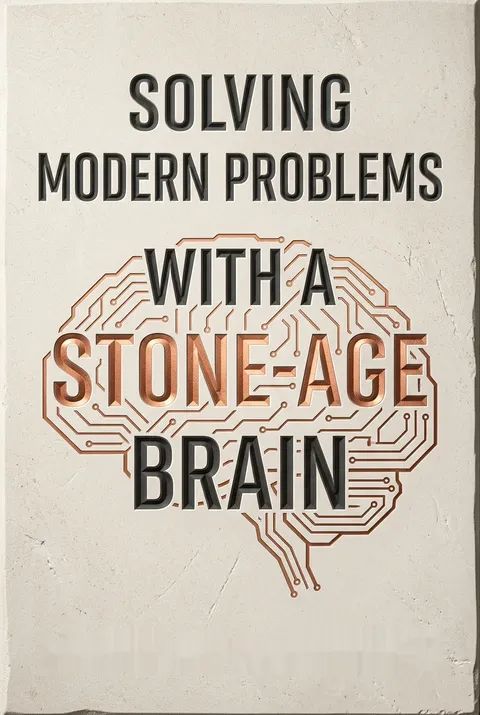
Solving Modern Problems With a Stone-Age Brain receives mixed reviews. Readers appreciate its scientific approach to evolutionary psychology and interesting insights on human behavior. Some find it thought-provoking and well-researched, offering new perspectives on modern issues. However, critics argue that the book oversimplifies complex problems and applies evolutionary theory too broadly. Some readers detect author biases and question the universal applicability of the solutions presented. Despite these criticisms, many find value in the book's ideas and extensive references for further exploration.
People Also Read







Glossary
New Pyramid of Human Motives
Map of seven motivesA model organizing seven recurring human motives: immediate physiological needs, self-protection, affiliation, status or esteem, mate acquisition, mate retention, and parenting. Unlike a strict hierarchy, its levels overlap and can operate at the same time. The model connects everyday goals to recurring survival, social, and family challenges faced across human history.
evolutionary mismatch
Old adaptations, new conditionsA condition in which psychological or bodily tendencies shaped in earlier environments do not fit the conditions people face now. For example, strong attraction to calorie-dense food helped ancestors cope with scarcity, but can become harmful where processed food is abundant and physical activity is limited.
Elvis Presley problem
Reward without ancestral effortThe authors’ label for a modern mismatch in which technology makes rewarding experiences, such as rich foods or stimulating substances, immediately available without the effort or scarcity that once accompanied them. The brain’s reward systems still respond strongly, while modern access can make overconsumption and harmful consequences more likely.
social traps
Immediate reward, delayed harmSituations in which an action is attractive because it offers an immediate reward, but its delayed consequences are harmful and difficult to avoid. Smoking and overeating are examples: the short-term pleasure arrives quickly, while health costs emerge much later. The concept explains why distant warnings often lose to immediate reinforcement.
countertraps
Immediate effort, delayed rewardThe reverse of a social trap: a behavior feels unpleasant or demanding at first, while its benefits arrive only after continued effort. Exercise is an example in the book. The term highlights why people may abandon worthwhile activities before delayed rewards become noticeable.
stimulus control
Manage cues and triggersA learning principle in which environmental cues become associated with expected rewards and can trigger behavior. To reduce an unwanted impulse, a person identifies and limits the cues that prompt it. Keeping tempting snacks out of reach, rather than relying on repeated resistance, is one example.
technologically enhanced parasitism
Technology exploits human motivesThe use of modern systems and technologies to take advantage of powerful human motives for someone else’s benefit. Examples include media that profits from threat-focused attention, digital services that encourage compulsive use, and businesses that use hidden charges. The term describes exploitation of a motive, not a biological classification of people.
naturalistic fallacy
Natural does not mean goodThe mistake of assuming that a behavior is morally good or worth copying simply because it is natural or has an evolutionary explanation. The authors use this distinction to separate explanations of human motives from ethical guidance. Evolution can help explain impulses without requiring people to obey them.
prestige versus dominance
Two routes to social rankA distinction between gaining influence through valued skill and knowledge, which earns freely granted respect, and gaining it through intimidation or coercion. Prestige can attract followers who want to learn from a person; dominance can compel compliance through fear. The book argues that expertise and service are generally better suited to modern leadership.
cooperative breeders
Shared care of youngA term for species in which young are cared for not only by their mother but also by other group members, often relatives. The authors apply it to humans, whose children have long periods of dependency and commonly receive help from fathers, grandparents, siblings, and other kin.
About the Author

Download PDF
Download EPUB
.epub digital book format is ideal for reading ebooks on phones, tablets, and e-readers.








