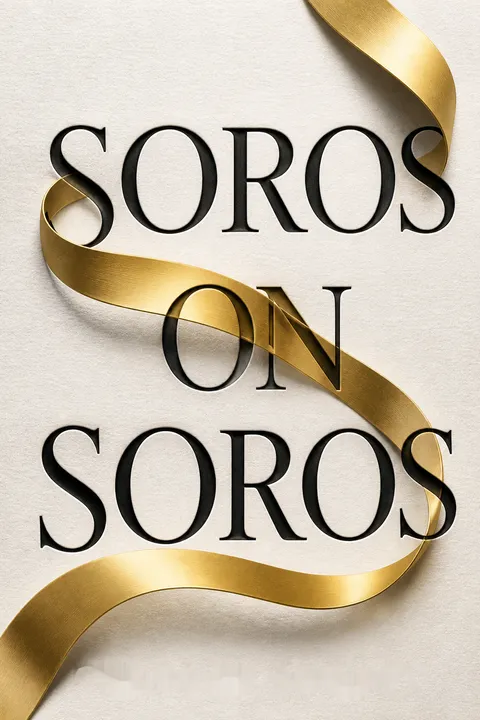


Key Takeaways
Treat prices as forces that can reshape the facts they claim to measure
Beliefs can change reality. Soros calls this interaction reflexivity: people form views about the world, act on those views, and thereby alter the world they are trying to understand. In markets, prices are not always passive summaries of underlying conditions. Sometimes they help change those conditions. For example, conglomerates used highly valued shares to buy companies, then presented the added earnings as evidence that the high share prices were justified. The valuation helped manufacture its own support.
Markets became his laboratory. Soros links this idea to his broader belief that people act with imperfect understanding. His experience of persecution and political upheaval sharpened his interest in how mistaken beliefs can shape events. Reflexivity, in his account, explains why market participants can be both observers and causes of a market's movement.
What's powerful here is the shift from asking whether a forecast is accurate to asking how belief in that forecast changes behavior. This is familiar in complex systems, where feedback can amplify small changes, and in social psychology, where expectations influence outcomes. The idea is especially useful when prices affect access to credit, corporate behavior, or political confidence. Its limit is practical: identifying feedback does not by itself reveal when it will dominate other forces. Reflexivity is a lens for noticing unstable conditions, not a reliable clock for predicting turning points.
Track the trend, then watch for the belief that can no longer sustain it
Booms feed on belief. Soros's boom/bust sequence describes a trend that begins before it is widely recognized, then gains force as people notice it and act accordingly. Their actions strengthen the trend, making the original belief seem increasingly convincing. Eventually, however, the gap between belief and conditions grows too large. Confidence stalls, the trend loses support, and reversal can accelerate into a crash.
Watch the changing phases. Soros describes an early reinforcing phase, acceleration, a moment when the prevailing belief is exposed, stagnation, a reversal, and then a possible crash. The stages are a diagnostic model, not a timetable. He also applies the pattern to the Soviet Union: a rigid system persisted after its governing dogma lost credibility, then reforms weakened the structures that had held it together.
The sequence resembles feedback models used to study bubbles, bank runs, and political cascades: a shared expectation changes behavior, and changed behavior appears to confirm the expectation. Its strength is that it makes a boom's social support part of the explanation, rather than treating collapse as an inexplicable shock. The caution is equally important. A rising trend is not proof of an imminent reversal, and many reinforcing processes fade without a crash. The model helps organize evidence, but treating each phase as obvious in real time invites hindsight bias.
Test your thesis against events instead of defending your first explanation
Make a thesis testable. Soros describes investing as forming a hypothesis about what will happen, then comparing that expectation with events. A mismatch is a reason to investigate, not an automatic order to sell. The investor should ask what changed, whether the original reasoning is still sound, and whether an outside factor explains the discrepancy. The thesis may need revision, or the position may need to be closed.
Do not explain away every loss. Soros says he was wary of rewriting a thesis merely to fit new facts. His mistaken view of the yen in 1994 shows why: the fund focused on U.S.-Japan trade tensions and missed a more basic source of yen strength. By contrast, his sterling position rested on an identifiable conflict inside the European exchange-rate system. A hypothesis creates a standard against which both errors and insight become visible.
This resembles disciplined scientific practice: a useful hypothesis exposes itself to evidence that could prove it wrong. It also resembles Bayesian updating, where confidence changes as new information arrives rather than snapping instantly from certainty to disbelief. Soros's insistence on investigating discrepancies is more sophisticated than a mechanical stop-loss rule, but it also demands strong self-scrutiny. Investors can always invent an external explanation for losses. A sound review therefore needs pre-stated reasons for holding a position, not only a persuasive story assembled after the market moves.
Choose the instrument that expresses your macro view most directly
Match the tool to the thesis. Soros's macro investing starts with a broad view of an economic or political trend, then selects positions across assets such as stocks, bonds, currencies, and futures. He prefers a direct expression of a view when possible. If the thesis is about bonds, he would rather buy bonds than use utility stocks as a proxy, unless he independently likes those companies. Leverage and short positions give the fund more ways to adjust exposure, but also magnify the consequences of error.
Scale changes the method. Soros says the fund's approach evolved over time, from individual securities toward macro positions and later industrial investments. He reports an average annual return of nearly 35 percent over 26 years, while also emphasizing substantial periods of loss. The record supports the importance of adapting strategy to conditions, not copying his leverage or assuming such returns are repeatable.
The principle of choosing a direct instrument is a form of model discipline: fewer intermediate assumptions mean fewer ways for a thesis to fail for reasons unrelated to its central claim. In portfolio construction, however, directness does not equal safety. A currency position can expose an investor to policy decisions, liquidity, and political events all at once. Soros's example is most valuable as a demand for clarity about what a position is meant to do. The extraordinary historical return is evidence of one career, not proof that leverage reliably improves outcomes.
Match investment incentives to shared downside, not just upside
Align manager and investor. Quantum Fund rewarded managers mainly through performance fees, rather than simply paying more as assets under management grew. Soros also kept much of his earned share invested in the fund, so management participated in losses as well as gains. He argued that this made the arrangement closer to a partnership and reduced the temptation to prioritize fund size over returns.
Authority needs boundaries. The fund's history also shows the cost of relying too heavily on one person. Soros describes a crisis in 1981, when the fund lost money and shrank after he struggled to manage its growth alone. He later built a team, gave Stanley Druckenmiller responsibility for macro decisions, and shifted toward a coach-like role. Delegation worked when decision rights and accountability were clear, not when the founder hovered over every call.
This is a principal-agent problem in practical form: when a manager earns fees from assets but bears little downside, the manager's incentives can diverge from clients' interests. Shared ownership can narrow that gap, while delegation can let skilled colleagues make decisions without becoming extensions of the founder. Yet skin in the game is not a complete safeguard. A manager can still take excessive risks, and shared losses can align everyone in the wrong direction. Incentives need to be paired with limits, oversight, and a culture where bad news can travel upward.
Build institutions that make error correction safer than enforced certainty
Fallibility has political consequences. Soros draws on philosopher Karl Popper to argue that no person or ideology possesses final truth. An open society accepts that beliefs can be wrong and creates ways to challenge them: democratic transfers of power, protection for minorities, the rule of law, and markets that provide feedback. A closed society, by contrast, treats an official doctrine as truth and suppresses alternatives.
Openness is not laissez-faire. Soros does not define freedom as the absence of government. He argues that open societies depend on laws and institutions, and that markets can produce destructive excesses when nothing is responsible for stability. People need room to disagree, but rules are needed to make disagreement survivable and to correct mistakes without coercion. For Soros, fallibility is not a reason to give up on values. It is a reason to prefer systems that permit revision.
The connection to scientific self-correction is compelling: knowledge improves when claims can be challenged, and political institutions can borrow that logic by protecting dissent and allowing peaceful changes of authority. This also clarifies why an open society requires more than individual liberty or market competition. Still, fallibility cannot settle every dispute about justice or the common good. Constitutional procedures and rights provide a framework for disagreement, but they do not guarantee wise decisions. The strength of the argument lies in making correction possible, not in promising that correction will always happen.
Fund local capacity, not a donor's fantasy of control
Let recipients shape the work. Soros's foundations aimed to support open societies by backing education, independent media, civil society, and cultural activity. In communist-era Hungary, a foundation supplied photocopiers to institutions that lacked access to them. The machines helped people circulate information beyond the Party's tight control. Local collaborators chose and carried out projects, while the foundation supplied resources and strategic support.
Money can distort its purpose. Soros recounts failures as well as successes. In South Africa, 80 scholarships did not increase black enrollment by the same number, because the university redirected some of its own resources. In Russia, a successful education program became vulnerable to corruption after its budget expanded sharply. These cases taught him that a funder must scrutinize results, preserve local autonomy, and avoid assuming that a larger grant automatically creates a larger public benefit.
This approach anticipates subsidiarity: decisions should sit as close as possible to the people who understand local conditions, while funders remain accountable for how resources are used. The Hungarian example shows how modest tools can unlock activity that outsiders could not design in advance. The failures are just as instructive. Autonomy without transparent procedures can invite misuse, while donor oversight can quietly become control. Effective philanthropy must balance local knowledge with audits, clear standards, and a willingness to stop funding programs that no longer serve their stated purpose.
A fallen regime needs institutions and economic support before a new order can hold
Collapse is not a transition plan. Soros argues that the Soviet system's disappearance did not automatically create a stable democracy or market economy. He believed Western governments missed opportunities to support reform before the old structures disintegrated. His preferred approach included practical aid, economic conditions, and a slower, more orderly transition. He supported the Shatalin Plan, which proposed shifting authority from the Soviet center to its republics while creating a new shared body for common responsibilities.
Build with partners on the ground. Soros describes more encouraging work in Ukraine, where local officials and outside advisers developed a reform program and pursued aid. He also warns that assistance designed around donors' procedures can miss recipients' needs. The foundations' guiding practice was to find trusted local partners, empower them to act, and retain financial oversight. Even with that approach, success remained uncertain and dependent on political conditions.
The distinction between removing a failed system and building a successor is central to political development. Institutions require skills, legitimacy, and workable incentives, none of which appear simply because an old authority disappears. Soros's emphasis on sequencing adds an important corrective to transition policies that focus narrowly on prices or elections. Yet outside assistance carries its own danger: it can substitute donor priorities for local consent, or make a fragile government dependent on external money. Support is most defensible when local actors set priorities and can refuse the donor's preferred design.
Protect the market system, not just each participant's chance to profit
Risk can move, not disappear. Soros argues that derivatives can transfer risk from an individual institution to the financial system. Dynamic hedging, for example, requires a trader to buy or sell as prices move against a position. If many participants must trade in the same direction, their efforts can amplify the original move. Soros links this mechanism to the 1987 stock-market crash, when portfolio-insurance strategies intensified selling.
Supervise carefully. He calls for regulators to gather more information about complex instruments and monitor the risks, while warning that blunt rules can drive activity into even less transparent products. In his view, financial markets are not reliably self-stabilizing, and public authorities have a role in protecting the system as a whole. That does not mean every speculative trade is harmful: Soros distinguishes market participants from the institutions and strategies that can concentrate risk.
The core insight is a classic externality: each institution may hedge sensibly for itself while collectively pushing the market toward a dangerous one-way trade. This is why systemic safety cannot be inferred from the apparent prudence of individual firms. Soros's distinction between supervision and regulation is useful because information can reveal concentrations before rules are imposed. But regulators face the same imperfect understanding he attributes to markets, and rules can redirect rather than remove risk. Resilient oversight therefore needs continual measurement, adaptable standards, and attention to how participants respond to regulation.
Analysis
The book's most durable contribution is not a prediction about a particular currency, country, or market cycle. It is a method for noticing when descriptions of reality have begun to change reality. Soros connects this feedback to investment practice, institutional design, and political change, giving the same intellectual premise a remarkably wide reach. The coherence is a strength: his market positions are experiments in judgment, while his philanthropy is an attempt to build environments where errors can be corrected without suppressing dissent.
That reach also creates a tension. Reflexivity is powerful as an interpretive framework, but it can become difficult to falsify. If a trend rises, feedback may explain its reinforcement; if it falls, feedback may explain its reversal. Soros partly guards against this by calling his market views hypotheses rather than scientific predictions. Readers should preserve that distinction. A framework that encourages close attention and revision is useful even when it cannot specify the timing or outcome of change.
The personal narrative grounds the abstractions. Soros's childhood under Nazi occupation, escape from communist Hungary, and later career as a fund manager help explain his suspicion of fixed rules and official certainties. But autobiography is not independent proof that the philosophy works universally. His extraordinary investing record and access to capital also make him an unusual case, a limitation he recognizes when questioning whether others can afford to act on abstract principles.
The strongest political implication is that freedom depends on institutions, not merely on the removal of constraint. Markets, elections, law, and civil society require stewardship, yet no steward is immune to error or self-interest. This is the book's unresolved challenge: how to protect shared systems without empowering authorities to define truth for everyone. Soros offers no final formula. He offers a discipline of suspicion toward certainty, including his own, and a practical preference for arrangements that keep correction possible. His 1994-95 political forecasts are best read as historically situated diagnoses, not timeless conclusions.
Review Summary
Soros on Soros receives generally positive reviews, with readers appreciating Soros's insights on investing, philanthropy, and philosophy. Many find his theory of reflexivity intriguing, though some struggle with its complexity. Readers value Soros's candid approach and self-reflection, particularly his emphasis on recognizing mistakes. The book's interview format is praised for its accessibility, though some find portions repetitive or dry. Overall, reviewers admire Soros's intellect and unique perspective, even if they don't always agree with his views.
People Also Read





Glossary
Reflexivity
Beliefs alter the worldA two-way interaction between people's understanding of a situation and the situation itself. People interpret conditions, act on those interpretations, and help change the conditions they are trying to understand. Soros treats reflexivity as a general feature of human affairs and as an occasional force that can drive markets or societies far from balance.
Cognitive function
Understanding what is happeningSoros's term for the way people try to understand reality. Their perceptions may be accurate or mistaken, and they can never fully capture a changing situation. The cognitive function interacts with the participating function: what people believe influences their actions, while events in turn alter what they believe.
Participating function
Actions that change realitySoros's term for the way people influence the world through decisions based on their perceptions. Since those decisions help shape the circumstances they are responding to, participants cannot simply observe a social or market process from outside it. The participating function interacts with the cognitive function to produce reflexive feedback.
Boom/bust sequence
Self-reinforcing trend and reversalA pattern in which an initial trend and a prevailing belief reinforce one another, pushing conditions farther from balance. As the gap between belief and reality grows, confidence can weaken, the trend can reverse, and selling or other reactions can accelerate. Soros presents the sequence as a possible pattern, not a deterministic forecast or fixed timetable.
Near-equilibrium conditions
Perceptions close to realityConditions in which people's views are not far from the actual state of affairs, and experience or social feedback tends to reduce the gap. Soros uses the term for situations where reflexive effects are relatively weak and can often be set aside. Near-equilibrium is a theoretical description, not a claim that a system is perfectly balanced.
Far-from-equilibrium conditions
Perceptions diverge from realityConditions in which participants' beliefs and the actual state of affairs are substantially separated, with no strong tendency to bring them back together. Soros distinguishes dynamic disequilibrium, where beliefs and events reinforce rapid change, from static disequilibrium, where rigid dogma persists alongside rigid social conditions.
Open society
Institutions permit correctionA form of social organization built on the recognition that no person or doctrine has final knowledge. It protects differing views through institutions such as democratic government, the rule of law, minority protections, and markets that provide feedback. For Soros, openness requires active support and shared commitments, not merely the absence of government control.
Closed society
Dogma suppresses alternativesA society in which an authority or governing doctrine claims to embody ultimate truth and subordinates individuals to the collective as defined by that authority. Alternative beliefs and criticism are restricted, sometimes through coercion. Soros uses the Soviet system as a major example and contrasts closed society with institutions that permit criticism and peaceful change.
Real-time experiment
Record decisions as they unfoldSoros's 1985 effort to document his investment reasoning while decisions were being made. He expected the act of recording and explaining his thinking to influence his own decisions, so the experiment could not provide a neutral scientific test of his theory. He considered it useful because writing imposed discipline and stimulated analysis.
Dynamic hedging
Trading to offset changing riskA strategy in which an institution adjusts its positions as market prices move, often buying after prices rise or selling after they fall to manage exposure. If many institutions follow the same strategy at once, their hedging can reinforce market movements rather than dampen them. Soros identifies this feedback as a possible source of sharp, discontinuous price changes.
FAQ
What is "Soros on Soros: Staying Ahead of the Curve" by George Soros about?
- Comprehensive life and work: The book is a reflective summary of George Soros’s life, career, and philosophy, structured as a series of interviews forming a Socratic dialogue.
- Beyond finance: While it covers his legendary investment career, it also delves into his political views, philanthropy, and personal background.
- Philosophical exploration: Soros uses financial markets as a laboratory to test his theories about human fallibility, reflexivity, and the open society.
- Wide audience appeal: The book is intended for readers interested in finance, politics, philosophy, and the broader human condition.
Why should I read "Soros on Soros: Staying Ahead of the Curve" by George Soros?
- Unique insider perspective: Readers gain direct insight into the mind and methods of one of the world’s most successful investors and philanthropists.
- Philosophy meets practice: The book bridges abstract philosophical concepts with real-world financial and political events, making complex ideas accessible.
- Lessons on fallibility: Soros’s emphasis on critical thinking, self-awareness, and the limits of knowledge is relevant for anyone making decisions under uncertainty.
- Broader societal relevance: The book’s discussions on open society, democracy, and global challenges are timely and thought-provoking for readers beyond finance.
What are the key takeaways from "Soros on Soros: Staying Ahead of the Curve"?
- Reflexivity in markets: Soros’s theory that market participants’ perceptions shape reality, creating feedback loops and instability.
- Open society advocacy: The importance of recognizing human fallibility, fostering critical thinking, and resisting dogmatic or authoritarian systems.
- Investment discipline: The value of risk-taking, intuition, and rapid self-correction in successful investing.
- Philanthropy with purpose: Soros’s approach to giving, focused on systemic change and empowering local actors rather than creating dependency.
What is George Soros’s theory of reflexivity as explained in "Soros on Soros"?
- Feedback loop concept: Reflexivity describes the two-way interaction where participants’ perceptions influence market realities, which in turn affect perceptions.
- Challenge to classical economics: This theory undermines the idea of perfect knowledge and equilibrium, showing that markets are inherently unstable.
- Three truth categories: Soros distinguishes between true, false, and reflexive statements, with reflexive truths being indeterminate because they affect the subject they describe.
- Real-world impact: Reflexivity explains boom/bust cycles and why financial markets often behave unpredictably.
How does George Soros define and promote the concept of "open society" in "Soros on Soros"?
- Recognition of fallibility: Open society is built on the acceptance that no one has ultimate truth and that critical thinking is essential.
- Democratic and legal foundations: It requires democracy, rule of law, protection of minorities, and a market economy that allows for feedback and correction.
- Personal and philosophical roots: Soros’s commitment to open society is shaped by his experiences under totalitarian regimes and influenced by Karl Popper’s philosophy.
- Philanthropic mission: Through his foundations, Soros works to foster open societies by supporting education, civil society, and independent media, especially in post-communist countries.
What is George Soros’s investment philosophy and method as described in "Soros on Soros"?
- Imperfect understanding: Soros believes that all market participants, including himself, operate with incomplete knowledge, making markets unpredictable.
- Reflexivity in investing: He uses the concept of reflexivity to identify self-reinforcing and self-defeating cycles in markets.
- Risk and intuition: Soros combines theoretical frameworks with intuition, emphasizing the importance of recognizing and correcting mistakes quickly.
- Contrarian but cautious: He is willing to go against prevailing trends but only when he sees clear evidence of an impending reversal.
How did George Soros build and manage the Quantum Fund according to "Soros on Soros"?
- Leverage and flexibility: The Quantum Fund used leverage and invested across multiple asset classes, allowing for greater flexibility and risk management.
- Team evolution: Soros initially managed the fund himself but later built a team, notably bringing in Stanley Druckenmiller for day-to-day operations.
- Performance-driven structure: The fund rewarded managers based on profits, with Soros and partners investing significant personal capital to align interests.
- Boom/bust navigation: The fund’s success and setbacks were closely tied to Soros’s ability to anticipate and respond to market cycles.
How does George Soros apply his theory of reflexivity to real-world financial events in "Soros on Soros"?
- Sterling crisis: Soros profited from the 1992 sterling crisis by recognizing the flawed structure of the European Exchange Rate Mechanism and anticipating a regime change.
- Japanese asset bubble: He identified the self-reinforcing nature of Japan’s 1980s bubble but mistimed the bust, learning from the experience.
- Emerging markets: Soros analyzed the Mexican peso crisis and other emerging market booms/busts as classic cases of reflexivity-driven cycles.
- Critical of responses: He critiques international institutions for slow and inadequate responses to crises, warning of systemic risks.
What role do intuition and critical thinking play in George Soros’s investment approach in "Soros on Soros"?
- Theory plus instinct: Soros forms investment hypotheses using his theoretical framework but relies on intuition to interpret market signals.
- Self-awareness: He calls himself an "insecurity analyst," always questioning his own assumptions and looking for signs of error.
- Rapid correction: Soros emphasizes the importance of recognizing and correcting mistakes quickly to stay ahead of the market.
- Disciplined contrarianism: He enjoys going against the herd but does so cautiously, only when convinced by evidence.
How does George Soros view the relationship between philanthropy and his investment career in "Soros on Soros"?
- Integrated identity: Soros initially separated his roles as investor and philanthropist but later saw both as integral to his identity.
- Strategic giving: His philanthropy aims for systemic change, supporting dissidents, education, and civil society, especially in Eastern Europe.
- Empowerment over dependency: Soros strives to keep his foundations lean and autonomous, empowering local actors rather than fostering reliance.
- Adaptive approach: He has evolved his philanthropic methods, delegating authority while maintaining strategic oversight.
What are the main challenges and risks George Soros identifies in financial markets and global economics in "Soros on Soros"?
- Inherent instability: Soros argues that financial markets are naturally volatile due to imperfect understanding and reflexivity.
- Amplified volatility: He warns that derivatives and dynamic hedging can exacerbate market swings, as seen in the 1987 crash.
- Multiple disequilibria: The global economy faces overlapping boom/bust cycles, increasing systemic risk and complicating management.
- Political consequences: Economic crises often lead to political instability, nationalism, and threats to open society principles.
What are George Soros’s views on nationalism, democracy, and the international order in "Soros on Soros"?
- Nationalism as a threat: Soros sees rising nationalism, especially in the Balkans and post-communist states, as the greatest danger to peace and open society.
- Critique of Western democracies: He argues that democracies lack shared values and are reluctant to defend open society ideals unless directly threatened.
- UN and global governance: Soros criticizes the United Nations for structural flaws and inefficiency, advocating for major reforms to restore its effectiveness.
- Need for universal principles: He stresses the importance of collective commitment to open society values to counteract the rise of closed, dogmatic systems.
What are the best quotes from "Soros on Soros: Staying Ahead of the Curve" by George Soros and what do they mean?
- "I am an insecurity analyst." This reflects Soros’s emphasis on self-doubt, critical thinking, and the constant questioning of one’s own assumptions in investing and life.
- "Markets are always wrong." Soros means that markets never perfectly reflect reality due to the reflexive interplay between perception and fundamentals.
- "Open society is a personal necessity." For Soros, the concept of open society is not just theoretical but rooted in his own experiences of persecution and the need for freedom.
- "Philanthropy is not about giving away money, but about changing systems." This highlights Soros’s strategic approach to philanthropy, aiming for lasting impact rather than charity for its own sake.
About the Author


Download PDF
Download EPUB
.epub digital book format is ideal for reading ebooks on phones, tablets, and e-readers.








