

Key Takeaways
Language communication consists of rule-governed acts, not strings alone
Words are only the surface. Searle’s central claim is that communication happens when people perform actions through language: they assert, ask, command, promise, refer, and describe. A sentence matters because a speaker produces it with an intention, in a context, under rules that let others recognize what is being done. This shifts the focus from isolated words and sentences to speech acts, the actions accomplished through utterances.
Fluency is a kind of skill. Speakers often know how to use their language without being able to state its rules. Searle compares this to knowing that a baseball runner heads for first base after a fair hit. That knowledge need not come from a survey of players; it comes from mastering the game. Linguistic judgments likewise express a speaker’s grasp of a rule-governed practice, though those judgments can be mistaken or dialect-specific.
The move from sentences to actions anticipates a practical problem in communication research: the same words can function differently depending on who says them, to whom, and under what circumstances. It also resembles the distinction between procedural knowledge, knowing how to do something, and declarative knowledge, being able to explain it. Searle’s appeal to native-speaker judgment is powerful as a starting point, but not a final court of appeal. Speakers disagree across dialects, and intuitions can be shaped by context or expectation.
Let intention guide meaning, but let shared rules constrain it
A private intention cannot rewrite a sentence. Searle considers a captured American soldier who knows little German but remembers a line from a poem. He recites it to Italian captors, hoping they will take him for a German soldier. He intends to deceive them, but the German words still mean what they conventionally mean, not that he is a German soldier. His plan may produce a mistaken belief, but that effect is different from the literal meaning of his utterance.
Meaning joins intention and convention. A speaker intends a hearer to recognize what act is being performed, and shared linguistic rules make that recognition possible. The principle of expressibility says that whatever a speaker means can, in principle, be put into some expression. A particular language may lack the needed words, but that limitation is not absolute.
This account improves on explanations that treat meaning as either private intention or a fixed code. Communication depends on both: intention explains why an utterance is made, while convention helps explain how another person can recognize its force. Contemporary pragmatics adds that listeners also infer unstated meanings from context, as when a remark indirectly functions as a request. That enriches Searle’s picture without making meaning limitless: inference can extend what an utterance conveys, but it does not erase the public conventions that make language learnable.
Separate a sentence's content from the act performed with it
One content, different actions. Searle separates the act of uttering words, the act of expressing a proposition, and the illocutionary act performed with that proposition. A speaker can present the same claim about Sam’s smoking as a report, a question, or a command. The content stays broadly constant, while the force changes. Reference and predication contribute to the proposition, while features such as word order, mood, stress, and context help signal what the speaker is doing.
Effects are another layer. A warning may frighten someone; an argument may persuade; a request may prompt action. These are perlocutionary effects, not the illocutionary act itself. A hearer can understand a warning without becoming afraid, just as a person can understand a request and refuse it. Keeping content, force, and effect distinct prevents the consequences of an utterance from being confused with its meaning.
This layered analysis is useful wherever communication is studied as more than information transfer. A system that recognizes sentence content but misses whether a speaker is warning, asking, or promising has captured only part of the interaction. The distinction also clarifies why success is not guaranteed: a hearer may understand an act yet resist its intended effect. The categories are analytical tools rather than neatly separated events, however. In ordinary conversation, tone, context, and uptake often help establish force together.
See language rules as machinery that creates social facts
Some rules make the activity possible. Regulative rules guide activities that already exist, such as rules of etiquette. Constitutive rules create or define an activity: in chess, for example, rules determine what counts as a legal move or checkmate. Searle argues that language also relies on constitutive rules. Under the right conditions, an utterance counts as a promise, a warning, or another speech act because shared rules give it that status.
Institutions turn events into facts. A baseball score, a marriage, a trial, or a banknote cannot be described fully as physical movements or marks on paper. Such institutional facts depend on rules that make certain events count as something more. By contrast, a person’s weight is a brute fact, even though language is needed to report it. The rules do not merely describe social practices; they help constitute them.
The distinction helps explain why social life cannot be reduced to observable behavior. A paper note is physically a piece of paper, yet its role as money depends on collective practices and recognition. This connects Searle’s account to social ontology, the study of how institutions create statuses and powers. A useful caution is that rules do not operate in a vacuum: authority, shared expectations, and enforcement affect whether a status is accepted. The framework explains how institutional facts are possible, not every dispute about which institutions deserve obedience.
A promise undertakes an obligation, even when the speaker is insincere
Promises have a structure. A successful, non-defective promise concerns a future act by the speaker. The hearer must prefer that act to its omission, and it must not already be obvious that the speaker will do it. A sincere promisor intends to perform it. The essential feature is the undertaking of an obligation, which distinguishes a promise from a prediction or a mere statement of intention.
Insincerity does not erase the act. Someone who promises without intending to follow through still presents themself as taking responsibility for that intention. Searle derives rules for the use of promising language from these conditions: the utterance must fit the promise’s content, circumstances, and commitment. Speakers need not always use an explicit formula. In context, a less direct utterance can still count as a promise if it clearly undertakes the obligation.
Treating a promise as a public commitment helps explain why it can change expectations even when the speaker later breaks it. The account also distinguishes an intention, which describes a plan, from an obligation, which gives another person a claim. That difference matters in contracts, trust, and everyday coordination. The analysis is strongest for clear, literal promises. Indirect assurances can be ambiguous, and what one person regards as a commitment may be heard by another as reassurance or prediction. Context is not an optional detail.
To refer successfully, give listeners a route to identify the thing
Reference must pick something out. A speaker who refers to a particular object must be able to distinguish it from others for the hearer. The expression may do this directly, as when a description uniquely fits one person, or the speaker may be able to supply identifying information if asked. Identification can combine descriptive words with context or demonstration. Saying the man may work if both people know which man is meant; without that shared footing, it leaves the target unclear.
Existence matters, but context matters too. A reference to a real-world object requires something that exists to be referred to. The book distinguishes ordinary speech from fictional discourse: Sherlock Holmes does not refer to a real person in ordinary factual talk, but the name can pick out a character within a story. This explains why a sentence can be meaningful in fiction without committing the speaker to the character’s real-world existence.
The identification principle highlights a cooperative dimension of reference: speakers rely on what their listeners can recognize, not merely on what is in the speaker’s mind. This is close to the idea of common ground, the information people treat as shared during a conversation. A pointing gesture can help, but even pointing needs interpretation: the target might be an object, its color, or a nearby feature. The theory captures the need for a route to identification, though real conversations often tolerate partial identification and repair it as they proceed.
Treat proper names as shared clues, not complete descriptions
Names refer without spelling everything out. A proper name is not simply an empty label: speakers must associate it with enough identifying information to know whom or what they mean. Yet it is not a full description either. People who use the same name may associate different facts with it. Their descriptions need not match exactly if they still converge on the same person or object.
The looseness is useful. A speaker might learn the name Aristotle alongside a claim about his connection to Alexander, then discover that some familiar detail was mistaken without abandoning the name. Searle’s view is that a name is tied to a loose cluster of descriptions, not one defining description. This lets speakers keep referring while revising beliefs. The name helps identify its bearer without requiring every conversation to settle the bearer’s complete identity conditions.
The account captures a familiar feature of shared knowledge: people can successfully use a name while knowing different things about its bearer. Proper names therefore act like stable handles across changing beliefs, which is useful in history, science, and public life. The challenge is that a loose cluster does not provide a crisp test for when reference has failed. Searle accepts that looseness rather than forcing a false precision. His position is most persuasive as an account of ordinary practice, not as a complete theory of identity.
Treat predicates as ways of applying properties, not names for entities
Predication is not another act of reference. In saying that a rose is red, the speaker applies a predicate to an identified object. Asking whether the rose is red or commanding someone to make it red changes the illocutionary force, not the basic predicate content. Searle treats predication as part of a complete speech act, rather than as a separate act that can stand alone.
Abstract nouns can mislead. The word redness may look like the name of an entity parallel to the rose, but Searle argues that the use of is red is conceptually prior. The abstract noun is a way of speaking about what red things share; it does not show that a predicate expression names a separate object. This rejects the idea that subject and predicate work symmetrically, while leaving open ordinary talk about properties and universals.
The distinction blocks a common slide from grammar to metaphysics: because a language turns an adjective into a noun, it does not follow that the world contains a matching object in the same sense as a rose. This is a valuable warning for philosophy and scientific modeling alike. Still, showing that predicate use is conceptually prior does not settle every question about whether properties exist independently. Searle’s account is strongest as an analysis of how sentences work, rather than as a final inventory of reality.
Separate evaluative force, sentence meaning, and assertion conditions
A word’s role is not its whole meaning. Calling something good can commend it, but that does not mean good means commend. The word can appear in a question, a doubt, or a conditional without performing that act. Likewise, the fact that an utterance is normally used to praise or endorse something does not settle the meaning of every sentence containing it. Searle calls the confusion between a word’s meaning and an act performed with it the speech act fallacy.
Odd statements need not reveal odd concepts. Saying that someone remembers their own name may sound pointless in ordinary circumstances. Searle argues that this is often because the assertion adds nothing, not because remembering excludes such a case. He calls that confusion the assertion fallacy. He also rejects the claim that descriptive premises can never entail evaluative conclusions, noting that facts about an argument can establish its validity under the relevant definition.
These distinctions are useful because ordinary language carries both semantic content and social force. A sentence may have a stable truth condition while functioning as praise, warning, or endorsement in a particular setting. The analysis also encourages caution when philosophers infer conceptual boundaries from what sounds natural to assert. A further nuance is that evaluative terms can remain contestable even when their use is not reducible to a speech act. Separating meaning from force clarifies the question; it does not make every evaluation objectively settled.
Derive obligation-relative ought from promises, not universal morality
Institutions connect facts to obligations. Searle’s example starts with a fact about Jones uttering words that, under the right circumstances, make a promise to Smith. Making a promise entails undertaking an obligation. At the time that obligation is undertaken, Jones is under it; as regards that obligation, he ought to do what he promised. The added steps rely on the meaning of promise and the rules of the institution, not on a separate moral principle.
The conclusion has limits. The argument establishes what follows from a promise, not what Jones ought to do all things considered. Another obligation, the harmfulness of the promised act, or an accepted excuse might change what he should ultimately do. Nor does the derivation prove that promising is a good institution. It shows how an institutional fact can carry normative consequences without turning the conclusion into a general moral law.
The argument’s lasting value is its distinction between normativity generated inside a practice and moral judgment about the practice itself. A promise can create a real claim on someone even if the institution of promising is criticized or a stronger duty overrides the commitment. This is familiar in law, where rules determine what counts as a valid agreement while separate standards assess its fairness. The derivation depends on accepting the institution’s rules and the meaning of obligation. It challenges a blanket ban on deriving ought from is, not every form of moral skepticism.
Analysis
Speech Acts is both a theory of language and an argument about where language belongs: not outside human action, but inside the practices through which people commit, identify, ask, and answer. Its most productive move is to separate layers that everyday conversation compresses. A sentence has propositional content, an utterance performs an illocutionary act, and that act may produce effects on a hearer. This makes it possible to discuss meaning without reducing communication either to dictionary definitions or to private intentions.
The method has a distinctive strength and a built-in vulnerability. Searle treats speakers’ linguistic judgments as evidence of tacit rule mastery, much as skilled action can outrun a person’s ability to explain it. That is a plausible account of why speakers can recognize errors without stating the rule. Yet the appeal to intuition risks treating one speaker’s dialect or philosophical vocabulary as more universal than it is. The proposed rules are best understood as analytical models that must be tested against varied speech communities and contexts.
The account of constitutive rules gives the book its reach beyond linguistics. It explains how conventions make actions such as promising possible, and how institutions turn physical events into statuses with consequences. The derivation from a promise to an obligation is strongest when read narrowly: it traces a commitment internal to an accepted practice. It does not establish that every obligation is moral, or that every institution deserves allegiance. That boundary is crucial, not a retreat.
Some classifications remain less settled than the framework suggests. Force, context, and inference interact, and a single utterance can perform several acts at once. Still, the book’s central insight survives such complexity: understanding language requires asking not only what an expression says, but what a speaker does with it, under which rules, and with what commitments.
Review Summary
Speech Acts receives mixed reviews, with an average rating of 3.88 out of 5. Readers appreciate Searle's contributions to speech act theory and analytic philosophy, praising his clear writing and thought-provoking ideas. However, some criticize his commitment to intentionality and disagree with his interpretations of other philosophers. The book is considered challenging but rewarding, offering insights into language use and communication. Many readers acknowledge its importance in the field of philosophy of language, despite some finding it dated or difficult to fully comprehend.
People Also Read









Glossary
Speech act
Action performed through languageA communicative action carried out by producing an utterance in a context. Asserting, asking, commanding, promising, referring, and predicating are examples. Searle treats speech acts, rather than words or sentences considered alone, as the basic units of linguistic communication because utterances work through speakers’ intentions and shared rules.
Illocutionary act
Utterance's communicative forceThe act a speaker performs in making an utterance, such as stating, questioning, requesting, warning, or promising. The illocutionary act is distinct from the proposition expressed and from effects the utterance may cause. A hearer can understand a warning, for example, without becoming frightened by it.
Propositional act
Referring and predicatingThe act of referring to an object and predicating something of it as part of a complete utterance. Propositional acts supply the content that can be asserted, questioned, or used in another illocutionary act. They cannot normally occur alone as complete acts of linguistic communication.
Perlocutionary act
Effect on a hearerAn effect an utterance produces on a hearer’s beliefs, feelings, or actions. Persuading, alarming, or getting someone to act can be perlocutionary effects. These differ from the illocutionary act itself: a speaker can successfully warn someone even if the hearer is not scared.
Constitutive rules
Rules that create activitiesRules that define or make possible an activity, rather than merely regulating an activity that exists independently. Rules of chess make moves count as legal or illegal moves; linguistic rules help make an utterance count as a promise or assertion. Such rules can create institutional facts when shared practices give actions a recognized status.
Principle of expressibility
Meaning can be put into wordsThe principle that anything a speaker can mean can, in principle, be formulated in some expression. A particular language may lack the vocabulary or structure needed to express a meaning, but that limit is contingent: speakers could enrich the language or use another one. The principle concerns expression, not guaranteed effects on hearers.
Principle of identification
Reference requires identificationThe principle that successful definite reference requires the speaker to identify, or be able to identify, the intended object for the hearer. Identification may rely on a uniquely fitting description, contextual information, demonstration, or a combination. If the original expression is insufficient, the speaker must be able to clarify which object is meant.
Brute facts
Facts independent of institutionsFacts whose existence does not depend on human institutions, such as a person’s weight. People need language and conventions of measurement to state such facts, but the fact itself is not created by those conventions. Searle contrasts them with institutional facts, which depend on rules that give events or objects a social status.
Institutional facts
Facts created by institutionsFacts that exist only within human institutions and their constitutive rules. A promise, marriage, trial outcome, or monetary value depends on shared practices that make certain words, actions, or objects count as having a recognized status. These facts are real, but unlike brute facts, they presuppose institutions.
FAQ
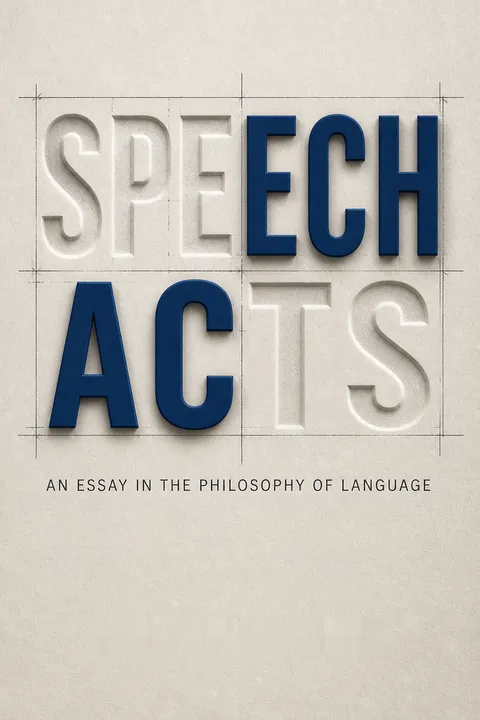
1. What is Speech Acts: An Essay in the Philosophy of Language by John Rogers Searle about?
- Philosophy of language focus: The book investigates how language functions not just to convey information, but to perform actions such as stating, questioning, promising, and commanding.
- Speech acts theory: Searle introduces and develops the concept of speech acts, emphasizing that speaking a language is engaging in rule-governed behavior.
- Analysis of meaning and communication: The work explores the nature of meaning, reference, truth, and the rules that underlie linguistic communication.
2. Why should I read Speech Acts by John Rogers Searle?
- Foundational in philosophy of language: The book is a landmark in understanding how language is used to perform actions, influencing linguistics, philosophy, and cognitive science.
- Clarifies key concepts: Searle provides clear distinctions between types of speech acts, reference, predication, and the rules governing language use.
- Challenges traditional theories: The book critiques and refines earlier theories by Frege, Russell, and others, offering a more nuanced account of how language works.
3. What are the key takeaways from Speech Acts by John Rogers Searle?
- Speech as action: Language is not just about stating facts but about performing actions governed by constitutive rules.
- Distinction of speech acts: Searle distinguishes between utterance acts, propositional acts, illocutionary acts, and perlocutionary acts.
- Role of rules and intentions: The meaning and force of speech acts depend on both linguistic conventions and the speaker’s intentions.
4. What are the main types of speech acts in Searle’s theory from Speech Acts?
- Utterance acts: Simply producing sounds or words.
- Propositional acts: Referring to and predicating about objects or states of affairs.
- Illocutionary acts: Performing actions like asserting, questioning, commanding, or promising, which carry illocutionary force.
- Perlocutionary acts: The effects or consequences of speech acts on the hearer, such as persuading or alarming.
5. How does Searle define illocutionary force and propositional content in Speech Acts?
- Illocutionary force: Refers to the kind of act performed (e.g., assertion, question, promise) and is marked by linguistic devices like word order or performative verbs.
- Propositional content: The actual content or proposition expressed, involving reference and predication.
- Logical distinction: The same proposition can be expressed with different illocutionary forces, and negation can apply to either the force or the content.
6. What is the principle of expressibility in Speech Acts by John Rogers Searle?
- Anything meant can be said: The principle states that any possible meaning or speech act can, in principle, be expressed in language.
- Language enrichment: If a language lacks the means to express something, it can be expanded with new terms or structures.
- Link to speech act rules: This principle allows the study of speech acts through the sentences that perform them, connecting meaning to linguistic expression.
7. What are constitutive and regulative rules in Searle’s Speech Acts?
- Regulative rules: Govern pre-existing forms of behavior, such as etiquette or traffic rules, typically telling us how to act.
- Constitutive rules: Create or define new forms of behavior, such as the rules of chess or language itself.
- Language as constitutive: Speaking a language involves following constitutive rules that make speech acts possible, similar to playing a game.
8. How does Searle analyze the act of promising in Speech Acts?
- Conditions for promising: Searle outlines necessary and sufficient conditions, including future-oriented content, the hearer’s preference, the speaker’s intention, and the undertaking of an obligation.
- Sincerity and insincerity: The analysis covers both sincere and insincere promises by focusing on the speaker’s responsibility for intending the act.
- Rule extraction: Searle derives rules for when and how promises can be made, based on these conditions.
9. How does Searle distinguish between reference and predication in Speech Acts?
- Reference: Involves identifying or picking out a particular object for the hearer, using expressions like names or descriptions.
- Predication: Ascribes properties or characteristics to the object referred to, using predicate expressions.
- Not separate acts: Predication is always part of an illocutionary act and is not independent of reference or illocutionary force.
10. What is Searle’s critique of Frege’s and Russell’s theories in Speech Acts?
- Frege’s contradiction: Searle argues that Frege’s claim that predicates refer to concepts (and that concepts are objects) leads to confusion and paradox.
- Predicates as ascriptions: Searle maintains that predicates ascribe properties rather than refer to objects called concepts.
- Russell’s descriptions: He critiques Russell’s analysis of definite descriptions for failing to integrate with a general theory of speech acts, especially outside assertions.
11. What is the “naturalistic fallacy fallacy” and the “speech act fallacy” in Searle’s Speech Acts?
- Naturalistic fallacy fallacy: Searle argues it is mistaken to claim that evaluative statements cannot be logically entailed by descriptive ones, especially within institutional contexts.
- Speech act fallacy: The error of equating the meaning of words like “good” or “true” with the speech acts they typically perform, which Searle refutes by showing their meaning is stable across different uses.
- Distinction of meaning and use: Searle emphasizes the difference between the semantic content of words and the illocutionary acts performed with them.
12. How does Searle’s theory of ontological commitment and universals differ from Quine’s and others in Speech Acts?
- Quine’s criterion critiqued: Searle challenges Quine’s view that ontological commitment is determined by the variables in a theory, showing that paraphrase and notation can obscure true commitments.
- Universals as linguistic entities: Searle argues that universals (properties) are part of our mode of representing the world, not objects in the world themselves.
- Commitment tied to assertion: Ontological commitments depend on what is actually asserted, not just on logical form or quantification.
About the Author



Download PDF
Download EPUB
.epub digital book format is ideal for reading ebooks on phones, tablets, and e-readers.








