

Key Takeaways
Treat emotion without judgment as sentimentality, not compassion.
A sharper definition. Dalrymple does not object to feeling deeply. He calls sentimentality the elevation of emotion above judgment: a response treated as self-justifying, regardless of whether it fits the facts or the situation. In private, a tearful reaction to a story may do little harm. In public life, emotional display can pressure others to agree, even when the claim behind it deserves scrutiny.
Feeling can become force. Public emotion, he argues, demands affirmation and escalates to attract attention. It can turn a person who withholds approval into a supposed villain, and offer politicians a show of concern in place of difficult decisions. His target is not compassion itself, but compassion detached from proportion, evidence, and responsibility.
The distinction is useful because it separates an emotion from the judgment made in its name. Compassion can motivate attention, while evidence helps determine what response will actually help. Social psychology also shows that vivid individual cases often command more concern than large but abstract harms, a pattern that can distort priorities without making the concern insincere. The caution cuts both ways: restraint is not automatically wiser, and visible grief is not automatically manipulative. Emotion varies across people and cultures. The strongest test is not how dramatically someone feels, but whether the response remains open to facts and considers its effects.
Teach children the tools of mastery instead of waiting for genius to bloom.
Guidance expands freedom. Dalrymple challenges educational theories that expect children to learn best through unstructured activity and spontaneous discovery. He argues that play and curiosity matter, but cannot replace explicit instruction in skills children may not discover alone. Reading is his central example: he criticizes whole-word approaches that expect children to infer spelling patterns, and argues that instruction in how letters represent sounds gives them a practical foothold.
Knowledge opens doors. He cites the 1937 Spens Report, which favored activity and experience over acquiring facts, and describes recently schooled patients who struggled with basic reading and arithmetic. He also notes that British education spending per person was four times its 1950 level, without a comparable improvement in literacy. These observations support his call for teaching, though his clinical sample cannot establish a national trend by itself.
This argument distinguishes active learning from leaving learners to fend for themselves. In cognitive science, explicit instruction can reduce the demands on working memory, giving beginners reliable procedures before they can reason independently. That is especially important for foundational skills, where gaps compound across subjects. The counterpoint is that instruction is not synonymous with rote drilling: well-designed teaching combines explanation, practice, feedback, and exploration. Dalrymple is strongest when defending the need for knowledge and correction, and less conclusive when attributing declining standards to a single educational philosophy. Outcomes require broader evidence than anecdotes or spending totals.
Teach children to tolerate frustration instead of treating every desire as a right.
Limits are part of care. Dalrymple argues that the romantic ideal of the naturally good child can make adults reluctant to correct, disappoint, or guide children. He describes parents who said they had given a troubled child everything, then named material goods such as the latest trainers or an iPod. In his account, gifts can substitute for attention, while satisfying every demand leaves children less practiced at accepting limits.
Family life has consequences. He connects permissive parenting and fragile adult relationships to neglect, instability, and conflict in children’s lives. His clinical examples include children with little contact with biological fathers and repeated changes in parental partners. These accounts illustrate his concern, but do not establish that every nontraditional family is harmful or that permissiveness alone explains youth aggression.
The practical insight is that care involves more than immediate comfort. Developmental research on self-regulation supports the value of helping children wait, recover from disappointment, and understand rules. Those capacities grow through consistent relationships, not through humiliation or arbitrary punishment. The book’s critique is most persuasive when aimed at indulgence replacing attention; it is less secure when family structure itself becomes an explanation for social disorder. A child’s security depends on the quality and reliability of care, not simply whether a household matches one preferred form. That distinction preserves the case for boundaries without stigmatizing families.
Do not mistake visible emotion for sincerity, guilt, or virtue.
Display is not evidence. After Madeleine McCann disappeared in Portugal, commentators criticized her parents for not showing enough grief on camera, and some treated their restraint as grounds for suspicion. Dalrymple also recounts how Linda Chamberlain was judged after her baby disappeared in Australia: her controlled public manner helped fuel suspicion, although later evidence supported her account that a dingo had taken the child. In both cases, an audience treated a performance of grief as a test of truth.
Public feeling can bully. After Princess Diana’s death, crowds demanded that the Queen visibly demonstrate grief. Dalrymple argues that the demand confused private feeling with public duty and made conformity seem like compassion. He sees a similar pressure on people to display emotion after trauma, regardless of temperament or circumstance.
The examples expose a basic error in reading people: emotional expression is an unreliable proxy for either inner experience or factual truth. A person may feel intensely and remain composed, or perform distress for reasons unrelated to grief. Contemporary understanding of trauma further cautions against expecting a single outward pattern of response. Public displays can create solidarity, but they can also turn a complex event into a test of whether someone performs the approved emotion. The ethical alternative is not suspicion of every display. It is to assess claims through evidence and avoid treating temperament as a verdict.
Judge the crime, not the victim's charm, family, or social standing.
Equal protection means equal worth. Dalrymple examines a family impact statement delivered after the murder of lawyer Tom ap Rhys Pryce. His fiancée described his kindness, talent, and future, then condemned his killers. The grief was genuine, but Dalrymple argues that these qualities should not determine how serious the murder was. Killing a lonely or unpopular person is no less a crime than killing a beloved professional with a promising career.
Courts need boundaries. In the system he describes, relatives could make statements after a verdict, before sentencing, while judges were instructed not to use them to set the sentence. Dalrymple worries that the emotional ceremony could still make judges appear callous if they imposed a sentence based on law rather than the statement. He sees a risk in making criminal justice serve as public therapy.
The principle here is a cornerstone of impartial law: the victim’s worth does not depend on popularity, biography, or the number of people mourning. At the same time, victim statements can give courts information about concrete harms and allow families to participate in a process that otherwise feels remote. Those purposes need not dictate culpability or punishment. A robust system can distinguish testimony about consequences from arguments about sentencing, and explain that distinction clearly. Dalrymple identifies a real tension, though the existence of emotional testimony does not by itself prove that legal fairness has been displaced.
Treat victim claims with compassion and corroboration, not automatic authority.
Suffering is not a credential. Dalrymple describes fabricated memoirs that gained attention by claiming extreme victimhood. Binjamin Wilkomirski presented an invented childhood in the Holocaust as memory; Margaret Seltzer wrote a false account of growing up amid gang violence. Their stories were acclaimed before evidence exposed the fabrications. Dalrymple argues that a culture eager to honor survivors can reward dramatic claims with attention and moral authority.
Separate care from certainty. He does not argue that suffering should be dismissed. His concern is that a person’s claim to victim status can become immune to questioning, while those who suffered less visibly receive less attention. He also argues that trauma does not automatically erase agency. His examples show the damage of accepting memoirs without verification, but cannot establish that false claims are typical of people who report harm.
A humane response to testimony need not choose between disbelief and unquestioning acceptance. Investigators can take a claim seriously, protect the person from immediate harm, and still seek corroboration before making factual or legal conclusions. This distinction also matters for public credibility: treating every unverified account as established can damage trust in people whose accounts are well supported. The reverse danger is equally real, since demands for proof can burden victims and reproduce institutional disbelief. Good practice therefore asks what evidence is appropriate to the claim and context, rather than treating either suffering or skepticism as conclusive.
Demand evidence that aid changes conditions, not just donors' feelings.
Good intentions need a causal test. Dalrymple questions campaigns that promise to end poverty through celebrity concerts and government transfers. He distinguishes severe material deprivation from relative poverty, a measure that can define people as poor simply because their income falls below a share of the national median. He argues that slogans can blur these meanings and make scrutiny seem heartless.
One case challenges easy answers. Tanzania achieved widespread literacy under Julius Nyerere, yet its economy declined during his rule despite substantial foreign aid. Dalrymple attributes this to policies that weakened farming and trade, and argues that education and aid alone do not produce prosperity. This case supports caution, not a universal verdict on aid. His broader claim is that assistance should be judged by its effects and incentives, not by the warmth of the motive.
The key question is counterfactual: what changed because resources were transferred, compared with what would have happened otherwise? That is the logic behind impact evaluation, which compares outcomes and examines unintended effects rather than counting money spent or people reached. The book is right that aid can be captured by elites or undermine local incentives. Yet Tanzania under one political system cannot settle the effectiveness of all aid, especially when interventions differ in design and purpose. Public compassion is a reason to investigate a program, not proof that it works or that it fails.
Ask what the denominator hides before reacting to a dramatic statistic.
Numbers need context. Dalrymple dissects a newspaper presentation of prison figures, including a rate of 148 prisoners per 100,000 people and a claim that 64 percent reoffended within two years. He says the latter figure concerned reconviction after short sentences of a year or less, a limitation absent from the headline presentation. He also argues that absolute counts, such as the number of prisoners from ethnic minorities, mean little without relevant comparisons.
A statistic is a question. The denominator and comparison group shape what a rate can show. Dalrymple argues that an imprisonment rate per general population does not alone establish whether sentencing is unjust, and that reconviction is not the same as every offense committed. His point is to demand definitions and comparisons before drawing policy conclusions, not to claim that any single alternative measure settles the issue.
This is a durable lesson in statistical literacy: every rate answers a specific question, and a change of denominator can change the story. But the proposed comparison must fit the decision. Rates per reported crime, for example, can be distorted by underreporting, differences in offense severity, and variation in police detection. A sound analysis should define the outcome, identify who is counted, show uncertainty, and compare like with like. Numbers do not remove judgment from policy. They make it possible to see which judgments the evidence can support and which it cannot.
Analysis
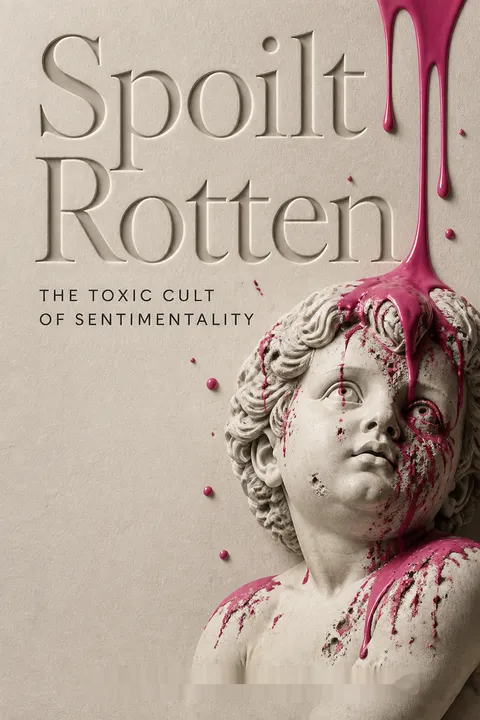
Spoilt Rotten is a polemical essay collection organized around one claim: public life becomes dangerous when emotional intensity is treated as proof of moral truth. Dalrymple carries that argument across schooling, family life, criminal justice, media, victimhood, and foreign aid. The recurring pattern is not simply that people feel too much. It is that a feeling becomes a credential, then a demand, and finally a substitute for deciding what is true or useful. His most memorable examples expose the gap between emotional performance and evidence: restrained grief mistaken for guilt, a victim’s biography used to measure a crime, or a headline statistic stripped of the context needed to interpret it.
The book’s strength is its insistence that compassion and judgment are not enemies. It asks readers to distinguish suffering from claims about its cause, good intentions from effective policy, and education from mere activity. That insistence remains valuable wherever institutions face pressure to affirm before investigating. Its weakness is the confidence with which it sometimes moves from vivid clinical encounters to sweeping explanations of social decline. The anecdotes make failures imaginable, but do not by themselves establish their frequency or prove a single cause. Some subjects, especially family structure, education, and aid, require comparative evidence and attention to context beyond the cases selected here.
The most useful reading is therefore neither agreement with every diagnosis nor rejection of the book as mere provocation. Its method can be turned back on its own claims: ask which evidence supports the generalization, what alternative explanations fit, and whether the proposed response would reduce harm. That approach preserves the central warning while guarding against an opposite mistake, treating skepticism as proof of wisdom. Feeling can alert people to suffering; judgment determines what follows from that alert. The book is at its best when it defends that distinction and demands that public compassion answer to reality.
Review Summary
Spoilt Rotten receives mixed reviews, with some praising Dalrymple's critique of sentimentality in modern society and others finding his arguments misguided or offensive. Supporters appreciate his analysis of how excessive emotion impacts public policy and personal behavior. Critics argue he oversimplifies complex issues and makes unsubstantiated claims. Many readers find the book thought-provoking, even if they disagree with some points. Dalrymple's writing style is described as witty and sharp, though some find it rambling or overly elaborate.
People Also Read








Glossary
Sentimentality
Emotion detached from judgmentDalrymple uses sentimentality to mean more than strong or tender feeling. It is emotion expressed or acted upon without judging whether it fits the facts, the situation, or the likely consequences. In public, such feeling can demand affirmation from observers and shape policy while discouraging scrutiny.
Family impact statement
A relative's account of harmA statement made by relatives of a murder or manslaughter victim about the effects of the crime on their family. In the British procedure discussed in the book, the statement could be presented after the verdict and before sentencing. Dalrymple questions whether this public expression of grief risks confusing emotional participation with the court's separate duty to impose a lawful sentence.
Spens Report
1937 English education reportA report on secondary education in England and Wales, published in 1937 by a government-appointed committee. Dalrymple focuses on its recommendation that curricula emphasize activity and experience rather than treating knowledge and stored facts as the primary aims. He presents it as an influential example of the educational romanticism he criticizes.
Cult of the Victim
Moral authority through victim statusDalrymple's name for a cultural tendency to treat victimhood as a source of automatic credibility, moral authority, or exemption from responsibility. He argues that the status can be claimed or amplified for personal and political advantage, while genuine suffering may receive less attention. The term does not mean that all victims exaggerate or that suffering should be ignored.
FAQ
What is "Spoilt Rotten: The Toxic Cult of Sentimentality" by Theodore Dalrymple about?
- Critique of Sentimentality: The book examines how excessive and misplaced sentimentality has come to dominate British public and private life, often with negative consequences.
- Analysis of Social Issues: Dalrymple explores how sentimentality affects areas such as education, crime, family, and public policy, arguing that it leads to poor decision-making and social dysfunction.
- Historical and Cultural Context: The author traces the roots of modern sentimentality to Romanticism and critiques its evolution through literature, media, and politics.
- Consequences of Sentimentality: The book contends that sentimentality, far from being harmless, is often the precursor to brutality, dishonesty, and the erosion of rational judgment in society.
Why should I read "Spoilt Rotten: The Toxic Cult of Sentimentality" by Theodore Dalrymple?
- Insightful Social Critique: The book offers a sharp, witty, and often provocative analysis of contemporary British culture and its pitfalls.
- Relevance to Current Events: Dalrymple’s arguments about the dangers of sentimentality are highly relevant to ongoing debates about education, crime, victimhood, and public emotion.
- Challenging Conventional Wisdom: Readers interested in questioning widely accepted social norms and policies will find the book intellectually stimulating.
- Engaging Writing Style: Dalrymple’s background as a doctor, psychiatrist, and essayist brings a unique, anecdotal, and accessible approach to complex topics.
What are the key takeaways from "Spoilt Rotten: The Toxic Cult of Sentimentality"?
- Sentimentality is Harmful: Excessive emotion, when untempered by judgment, can lead to poor policy, social breakdown, and even violence.
- Public Displays of Emotion: The demand for public emotional expression has become coercive and often substitutes for real action or rational debate.
- Victimhood and Responsibility: The cult of the victim undermines personal responsibility and distorts justice, often privileging feelings over facts.
- Education and Family: Sentimental ideas about childhood and family have led to educational decline and the weakening of family structures, with negative consequences for children and society.
How does Theodore Dalrymple define "sentimentality" in "Spoilt Rotten"?
- Excess of Emotion: Sentimentality is described as an excess of emotion that is false, mawkish, and overvalued compared to reason.
- Public and Coercive: Dalrymple emphasizes that modern sentimentality is often public, demanding affirmation and participation from others.
- Emotion Without Judgment: Sentimentality is the expression of emotion without the necessary exercise of judgment or proportion.
- Self-Indulgent and Manipulative: It is self-regarding, often more about the person expressing the emotion than about the object of that emotion, and can be used to manipulate others.
What are some examples of sentimentality in British society according to "Spoilt Rotten"?
- Education Policy: The shift towards "child-centered" education, where discipline and knowledge are downplayed in favor of self-esteem and emotional expression.
- Crime and Justice: The use of family impact statements in court, which focus on the feelings of victims’ families rather than the facts of the case or principles of justice.
- Public Mourning: The mass outpouring of public grief after Princess Diana’s death, and the expectation that public figures must display emotion.
- Victim Narratives: The proliferation of "tragic life stories" in media and literature, where suffering is valorized and often exaggerated for emotional effect.
How does "Spoilt Rotten" link sentimentality to negative outcomes like brutality or dishonesty?
- Sentimentality Breeds Brutality: Dalrymple argues that sentimentality, by suspending judgment and encouraging emotional excess, can quickly turn into aggression or mob justice (e.g., paedophile hysteria).
- Manipulation and Dishonesty: Public displays of emotion can be used to manipulate opinion, obscure facts, and justify dishonest or irrational policies.
- Undermining Law and Order: Sentimentality in the justice system can erode the rule of law, leading to decisions based on emotion rather than evidence or principle.
- Victimhood as Excuse: The cult of victimhood allows individuals to evade responsibility for their actions, sometimes even excusing criminal or destructive behavior.
What does Theodore Dalrymple say about the impact of sentimentality on education in "Spoilt Rotten"?
- Decline in Standards: Sentimental educational theories have led to a decline in literacy and numeracy, as traditional methods are abandoned in favor of "discovery learning" and self-expression.
- Child-Centered Approach Critiqued: Dalrymple criticizes the idea that children are inherently good and should be left to develop naturally, arguing that this neglects the need for discipline and knowledge.
- False Equality: The belief that all children have equal talents and should never be criticized undermines achievement and mastery.
- Long-Term Harm: The result is a generation less equipped for adult life, with limited skills and a sense of entitlement.
How does "Spoilt Rotten" address the concept of victimhood and its cultural significance?
- Victimhood as Moral Authority: Dalrymple observes that being a victim now confers moral authority and social status, often regardless of the facts.
- Subjective Definition: The book critiques the trend of defining victimhood by personal perception rather than objective evidence.
- Encouragement of Self-Pity: The culture of victimhood encourages self-pity, exaggeration, and the blurring of lines between genuine and manufactured suffering.
- Legal and Social Consequences: This shift affects everything from legal definitions of crime to the allocation of social resources, often to the detriment of justice and fairness.
What role does public emotion and its display play in "Spoilt Rotten"?
- Demand for Public Grief: Dalrymple discusses how society now expects, even demands, public displays of emotion, especially after tragedies.
- Coercive Conformity: Those who do not display the "appropriate" emotions are often suspected or ostracized, as seen in high-profile cases like the McCanns or Princess Diana’s death.
- Media Amplification: The media plays a significant role in amplifying and shaping these emotional responses, often at the expense of reasoned debate.
- Erosion of Privacy and Dignity: The expectation of public emotion undermines personal dignity and the value of private grief or fortitude.
How does "Spoilt Rotten" critique the influence of sentimentality on public policy and government action?
- Policy Based on Feeling: Dalrymple argues that many policies are now justified by emotional appeal rather than evidence or rational analysis (e.g., foreign aid, criminal justice reform).
- Superficial Solutions: Sentimentality leads to symbolic gestures (like family impact statements or wristbands for missing children) rather than substantive solutions.
- Manipulation by Elites: Politicians and elites use sentimentality to appear compassionate and to manipulate public opinion, often while pursuing their own interests.
- Undermining of Responsibility: The focus on feeling over reason can result in policies that are ineffective or even harmful, as they ignore complex realities.
What are some of the best quotes from "Spoilt Rotten" and what do they mean?
- "Sentimentality is the progenitor, the godparent, the midwife of brutality." – Dalrymple warns that unchecked emotion can quickly turn into violence or cruelty.
- "Sentimentality is the expression of emotion without judgment." – This encapsulates the book’s central thesis that emotion must be tempered by reason.
- "A sentimentalist is simply one who desires to have the luxury of an emotion without paying for it." (Oscar Wilde, quoted) – Highlights the self-indulgent nature of sentimentality.
- "The cult of feeling destroys the ability to think, or even the awareness that it is necessary to think." – Dalrymple’s warning about the broader intellectual consequences of a sentimental culture.
What practical advice or methods does "Spoilt Rotten" by Theodore Dalrymple offer for resisting the dangers of sentimentality?
- Value Judgment and Reason: Dalrymple advocates for the exercise of judgment and rational analysis in both private and public life, rather than being led by emotion alone.
- Recognize Manipulation: Be aware of how public displays of emotion can be used to manipulate opinion and policy, and question the motives behind them.
- Encourage Fortitude and Privacy: The book suggests that private grief, self-control, and fortitude are virtues worth preserving against the tide of public emotionalism.
- Demand Evidence-Based Policy: Support policies and social interventions that are grounded in evidence and reason, not just in emotional appeal or sentiment.
Download PDF
Download EPUB
.epub digital book format is ideal for reading ebooks on phones, tablets, and e-readers.








