

Key Takeaways
Teach craft; talent, persistence, and luck determine what practice can become.
Practice can be taught. After receiving a bruising critique at the Milford Conference, Kate Wilhelm realized that professional writers had treated her work seriously, and that their analysis could shorten her learning curve. Milford’s critique circle became a model for Clarion, the intensive six-week workshop organized by Robin Scott Wilson. Wilhelm and Damon Knight found that craft could be taught, even if no teacher could guarantee publication. Their complementary strengths helped: Knight often noticed the prose, while Wilhelm looked beneath it for the story.
A qualified yes. Clarion’s instructors did more than announce that a story failed. They explained why, offered ways to revise, and looked for recurring problems writers could learn to recognize themselves. That distinction matters: instruction can improve technique, but persistence and the ability to absorb feedback remain the writer’s responsibility.
The useful distinction is between teaching outcomes and teaching skills. No workshop can promise a career, but it can make craft more visible and feedback more usable. This resembles apprenticeship in fields such as music, where coached practice helps learners notice errors that solitary repetition can reinforce. The method also depends on the quality of the coach: bluntness alone is not expertise. Wilhelm’s account suggests that honest critique works when it is specific, grounded in the work, and paired with a route toward improvement.
Make something change, even when the plot barely moves.
A story has motion. Wilhelm calls the decisive shift a “moment of truth”: a change in the character’s situation or in the reader’s understanding. In a plotted story, events alter the situation. In a quieter story, the outer circumstances may remain still while the reader discovers what they mean. Either way, a character merely walking through a beautiful park, or a sequence of repetitive battles, does not become a story just because the prose is polished.
Two routes work. A story can develop through visible actions and consequences, or by deepening the meaning of a situation until the reader sees it differently. In one Clarion story, a mother teaching household skills to her daughter seemed ordinary until a small moment involving blood made the scene about mortality and what one generation passes to another.
This distinction makes room for both suspense and revelation without treating one as the proper form. It also offers a practical diagnostic: what is different at the end, for a character or for the reader? That question echoes narrative theory’s interest in change, while avoiding the assumption that change must mean a dramatic event. The risk is that “something happens” can become an overly rigid test. A story’s shift may be subtle, but it still needs to be legible enough that readers can feel its consequence.
Give readers a person and a place before demanding suspense.
Ground the opening. Wilhelm’s basic test is whether readers can identify who is involved and where they are before the story asks them to care about danger. The other journalistic questions, what is happening, when, and why, can be answered gradually. A dramatic opening without a recognizable person or setting often creates confusion rather than curiosity.
The first page counts. Wilhelm marked the point where an editor might stop reading with what she called “The Red Line of Death.” One opening she discusses introduced several people, a storm, a cat, and a power failure before clarifying their relationships or location. The story itself had promise, but the opening withheld basic orientation. Her advice is to establish tone, viewpoint, and a tangible scene, then let suspense grow from what readers understand.
Orientation is a form of readerly trust. Once readers know whose perceptions matter and what kind of place they inhabit, they can tolerate ambiguity about motive or outcome. This is similar to wayfinding: people explore more freely when they have a reliable sense of location. Yet clarity does not require exhaustive explanation. The strongest openings give enough anchors to prevent disorientation, while leaving meaningful questions open. The distinction is between productive uncertainty about the story and accidental uncertainty about what the sentences mean.
Make choices costly, and let a character’s hidden life supply stakes.
People need pressure. In one weak story, a pleasant family faced a move that brought little sacrifice whichever option they chose. The premise lacked conflict because nothing important was at risk. A difficult choice changes that: each option closes a door or carries an emotional or practical cost. Wilhelm points to the scene in Butch Cassidy and the Sundance Kid where fleeing outlaws must choose between surrender, a gunfight, and a dangerous jump into a river.
Build from emotional truth. Characters become more than types when pressure exposes the private feelings beneath their public behavior. Wilhelm urged writers to draw on emotions they know, then transform the circumstances rather than reproduce autobiography. A student whose fluent stories lacked human conflict wrote a more affecting one after exploring a son’s concealed anger toward his father.
A costly choice makes character visible because preference alone is cheap; commitment reveals what someone values. This connects to moral psychology, where trade-offs expose priorities more clearly than stated beliefs. The advice to draw on emotional experience is powerful, but it need not mean treating personal pain as a requirement for good writing. Imagination, observation, and research can also produce emotional credibility. The essential point is not autobiography, but specificity: a character’s feelings should arise from a life that feels particular rather than preassembled.
Build the world beyond the scene, then reveal only what matters.
A scene needs foundations. Wilhelm describes a story’s setting as more than the room or landscape where action occurs. The immediate location rests within a broader world, with its own culture, history, and level of technology. Readers do not need an encyclopedia, but the writer must know enough to make the visible details feel connected and credible.
Imagination needs consistency. Clarion students sometimes placed settlers on strange planets, gave local plants and animals unfamiliar names, and then had the settlers grow familiar Earth crops without considering the alien conditions. The problem was not invention; it was unexplored consequence. Wilhelm recommends research from primary sources where possible, and insists that even an invented world must follow its own rules. One accurate detail can establish more than a page of general description.
Worldbuilding works best as a system of consequences, not a catalogue of curiosities. A setting becomes convincing when geography shapes labor, culture shapes choices, and technology carries limits. This is close to systems thinking: changing one part of a world should affect others. The caution is useful for speculative fiction, but it applies equally to realistic settings. A familiar city can feel as false as an imaginary planet if it exists only as scenery. Research supplies material; the writer’s task is to select details that matter to the people living there.
Strip prose to its load-bearing words, then restore only what earns space.
Revision is diagnosis. Wilhelm and Knight treated stories as works in progress, examining both the sentence and the structure underneath it. Their exercises included reading one sentence at a time for unintended meaning, removing overloaded modifiers, and summarizing each paragraph to see whether the story kept repeating setting or character description instead of developing.
Surface errors matter. They marked shifts in viewpoint, tense and number errors, repeated sentence patterns, awkward sound echoes, and actions that could not happen simultaneously. A “plot loop,” an interruption by a scene unrelated to the central problem, can often be removed without loss. Still, the instructors disagreed about emphasis: Wilhelm could tolerate imperfect prose when a powerful story lay beneath it, while Knight was more skeptical that a strong story could survive badly controlled language.
These exercises turn vague judgments such as “the story feels slow” into observable questions: what does each paragraph contribute, and what happens if it disappears? That is a form of deliberate practice, because revision trains attention as well as improving the current draft. The standard of economy should not become an excuse for sterile prose. A repeated image or elaborate sentence can carry meaning when it is intentional. The test is not whether language is decorative, but whether its effect justifies the space and attention it takes.
Shape private images into coherent stories instead of transcribing their dream logic.
Images are raw material. Wilhelm calls the mind’s nonverbal store of memories, feelings, and impressions a “silent partner.” In her account, it can supply vivid scenes, but it cannot organize them into a clear story or explain their meaning. That work belongs to the writer’s deliberate judgment.
Question before explaining. A student wrote about a frightened boy beside a river and dark woods, then added crocodiles to explain the fear. The new detail weakened the scene because it replaced an unsettling emotional mystery with an implausible, ordinary threat. Wilhelm’s alternative is to examine the image: who is present, what surrounds them, and what emotion drives the moment? More images may emerge over days. The writer then arranges, alters, and connects them until the emotional force becomes comprehensible to a reader.
This model respects the way creative work can begin without pretending that intuition is already a finished draft. Its practical strength is the division of labor: welcome material from association, then apply conscious structure and judgment. That resembles creative processes in which incubation follows sustained attention, although Wilhelm presents the “silent partner” as a teaching metaphor, not a demonstrated brain mechanism. The metaphor also cautions against overexplaining an image too soon. At the same time, intuition is not automatically profound; the writer still has to decide whether an image belongs in the story.
Use honest peer critique to shorten the apprenticeship, not flatter the ego.
A workshop is a practice environment. At Clarion, writers read one another’s stories and critiqued them in a circle, with the writer listening before responding. The instructors judged the work, not the writer, and asked students to explain what failed rather than offer empty reassurance. The aim was to replace months of unexplained rejection with faster, more useful feedback, not to guarantee publication.
Community needs release valves. The six-week program was intense: students wrote, read, and discussed stories while sharing crowded facilities and limited distractions. Wilhelm and Knight introduced water guns and superballs after finding the group tense and miserable. The playful chaos helped relieve pressure, but boundaries remained, especially around manuscripts. Over time, students also learned to critique one another, a skill Wilhelm considered valuable in its own right.
The workshop joins standards with belonging. Critique is easier to use when a group can distinguish a flawed draft from a flawed person, and shared effort makes demanding work less isolating. The playful rituals matter because sustained concentration has social and emotional costs. Still, the format is not automatically fair: a circle can reward confident voices or make minority viewpoints harder to express. Clear procedures, attentive facilitation, and the right to disagree are crucial. Honest feedback helps most when it is both rigorous and psychologically safe.
Protect writing time as a recurring appointment, not leftover leisure.
Time must be claimed. Wilhelm’s advice to writers returning from Clarion was plain: choose regular hours for writing and defend them against other demands. Loved ones may offer welcome invitations when writing looks lonely or unproductive, making it hard to refuse without guilt. Yet waiting for a convenient stretch of free time often means waiting indefinitely.
Start with a workable rhythm. The commitment need not be daily. Wilhelm suggests setting aside several sessions a week, or even one, if that is what circumstances allow. When a session is not spent drafting, writers can revise an old story or study how another story works. The point is continuity, not matching another writer’s speed. Some writers finish quickly; others need much longer. A sustainable practice beats an impressive schedule that collapses.
This advice treats writing as work that requires boundaries, not merely inspiration. A recurring appointment lowers the daily cost of deciding whether to begin, while also making the commitment visible to others. The approach is especially useful because it scales: people with jobs, families, or care responsibilities can adapt frequency without abandoning the practice. Its limitation is that time alone does not solve every obstacle. Access to quiet, health, money, and safety is uneven. A realistic writing routine must account for those conditions rather than moralize productivity.
Build a writing life without assuming publication will pay the bills.
Success is not a salary. Wilhelm warns that publication may not provide a living, particularly for short-story writers. Editors are not writing teachers, agents may have little reason to represent low-paying short fiction, and rejection can take months without explaining what went wrong. Her practical advice includes keeping a day job, tracking expenses and submissions, and being cautious about anyone charging fees to improve or represent a manuscript.
Protect future choices. One young novelist became trapped by a cycle of spending each advance before finishing the current book, then signing another contract to cover expenses. Wilhelm’s lesson is to understand contracts and avoid letting financial pressure dictate every next project. Finish work where possible, seek competent advice before signing, and keep copies of editorial notes, contracts, and submissions.
The book’s publishing advice counters the romantic image of the writer who simply quits everything and trusts the market. Financial stability can protect creative autonomy, because desperation narrows the range of projects a writer can afford to pursue. This is a structural issue, not a test of artistic seriousness: low pay and long editorial timelines shape who can remain in the profession. The counsel to keep records and scrutinize contracts is therefore more than caution. It helps writers preserve bargaining power and make career decisions with evidence rather than fantasy.
Analysis
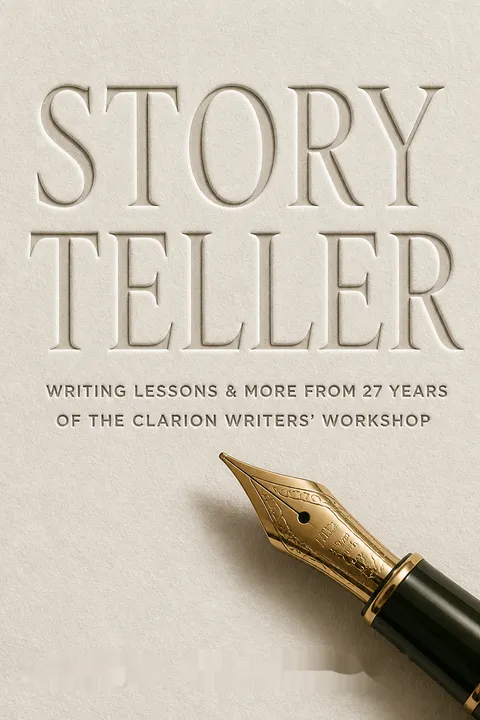
Storyteller is a hybrid of workshop history, teaching memoir, and practical manual, but its central subject is apprenticeship: how writers learn to see what their own drafts are doing. Clarion’s six-week format provides the narrative frame. Wilhelm recalls its origins in the Milford Conference, its unstable institutional homes, the labor of sustaining it, and the unruly fellowship of writers who endured it. The water-gun fights are not incidental color. They show that a demanding learning environment also needs play, trust, and relief from pressure.
The book’s strongest craft argument is that revision begins with diagnosis. A writer must know whether a story lacks movement, whether its opening has failed to orient readers, whether an apparent threat carries real stakes, or whether beautiful sentences conceal repetition. Wilhelm’s lessons repeatedly convert taste into questions that can be tested: what changes, whose perspective governs this scene, what does each paragraph contribute, and what does the character stand to lose? This does not make writing mechanical. It makes the choices more visible.
The method also contains productive tensions. Wilhelm praises explicit rules for beginners, yet defends stories that move through revelation rather than conventional plot. She insists on sentence-level control, while acknowledging that strong stories can outweigh imperfect prose. She values personal emotional knowledge, but warns against merely transcribing private experience. These are not contradictions to eliminate; they describe craft as a negotiation between structure and discovery.
Clarion’s anecdotal success cannot establish that workshops cause publication. There is no comparison group, and participants arrive with different talent, resources, and opportunities. Yet the book offers a persuasive account of what workshops can plausibly provide: rapid feedback, a vocabulary for analysis, exposure to different artistic judgments, and relief from isolation. Its lasting value is not a recipe for a writing career. It is a way to make the next draft more deliberate, and the next critique more useful.
Review Summary
Storyteller receives mixed reviews, with an average rating of 3.92 out of 5. Many readers appreciate Wilhelm's insights into writing and the Clarion workshop, finding her advice valuable for aspiring authors. Some enjoy the blend of memoir and writing tips, while others feel the book is repetitive or outdated. Critics note the focus on short stories may not appeal to all writers. Overall, readers value Wilhelm's experience and practical advice, though some find the anecdotes less engaging than the writing guidance.
People Also Read





Glossary
Milford method
Circle-based story critiqueA workshop format in which participants read a story before gathering in a circle to discuss it. Each person offers a critique while the writer listens, then the writer responds after the group has finished. Clarion adapted this approach for beginning writers, adding explicit explanations of craft problems rather than assuming participants already knew how to revise.
moment of truth
A story's revealing shiftThe point at which a story makes something important newly visible. The shift may change a character’s circumstances, or it may change the reader’s understanding while the characters and situation remain much the same. Wilhelm treats this revelation as essential to short fiction, whether the story is driven by external events or by a quieter discovery.
The Red Line of Death
Mark of a failed openingA red line Wilhelm drew on a manuscript to represent where a busy editor might stop reading and move to another submission. In the workshop, the line became a teaching signal: the instructor would still read the full story, then explain what had made the opening lose the reader’s attention or trust.
plot loop
An irrelevant story detourA passage that leaves the central action to follow material unrelated to the story’s main problem, then returns without having changed the situation. Wilhelm argues that such detours often weaken suspense and can be removed without loss. A transition or brief indication that time has passed is usually more effective than introducing an unnecessary subplot.
silent partner
Nonverbal source of imagesWilhelm’s metaphor for the nonverbal mental activity that supplies memories, feelings, images, and unexpected associations to a writer. It can provide emotionally vivid raw material, but does not arrange that material into a coherent story or explain what it means. The writer’s deliberate judgment must shape, revise, and connect what emerges.
vertical development
Deepening a story's meaningA way of developing a story by exploring the implications of its situation rather than relying chiefly on visible actions and consequences. The external circumstances may stay nearly unchanged, while readers gain a deeper understanding of the characters or their world. Wilhelm contrasts this with lateral development, in which events visibly alter the situation.
visualizers
Writers who picture scenesWilhelm’s label for writers who readily form mental images while composing. They may need to select a few precise details from a vivid internal scene so readers can construct a similar setting. The term describes a working tendency, not a measure of talent or a requirement for writing fiction.
constructionists
Writers who build scenes verballyWilhelm’s label for writers who do not begin with clear mental pictures and instead assemble a scene through deliberate choices and language. They may create the location, person, and surrounding details one at a time, then connect them. The term describes an alternative process to visualizing, not an inferior approach.
Download PDF
Download EPUB
.epub digital book format is ideal for reading ebooks on phones, tablets, and e-readers.








