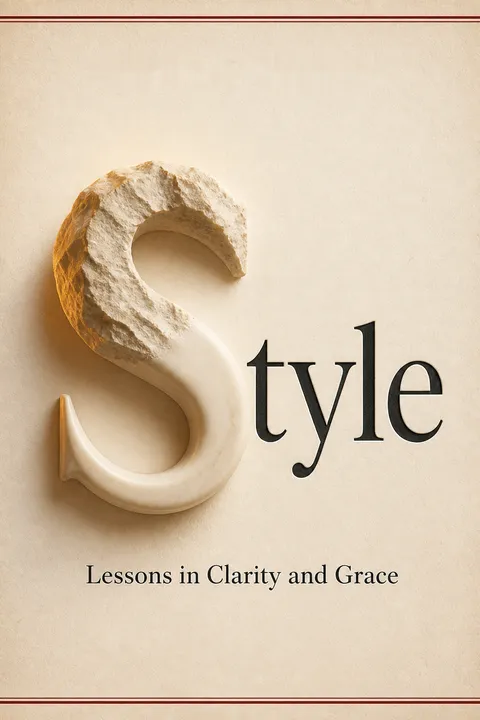


Key Takeaways
Judge a sentence by the work a reader must do to understand it.
Clarity is an experience. Williams asks writers to look beyond word counts and grammar labels. Readers call prose unclear when they have to struggle to identify who did what, follow the order of events, or decode unfamiliar technical terms. These are different problems, so they need different revisions. A sentence can be clear to a specialist and bewildering to someone new to the subject.
Expertise can mislead. Writers know their subject so well that they often underestimate what readers need explained. The book’s practical method is to reread a draft from the position of someone who lacks that background, then revise where the reader has to guess. The goal is not to simplify every idea, but to make its complexity easier to follow.
What's useful here is the distinction between difficulty in the subject and difficulty created by the prose. Cognitive science describes comprehension as a process of connecting new information to knowledge already in memory. That makes audience awareness more than courtesy: it affects what readers can actually understand. The caveat is that no text can anticipate every reader's knowledge. Writers need a defined audience, not an imaginary universal novice, and should preserve technical language when it carries necessary precision.
Turn action-nouns back into verbs, then put their actors in subject position.
Restore the action. A nominalization is a noun formed from a verb or adjective, such as a noun meaning a decision where a sentence could say someone decided. Nominalizations can hide both the action and the person responsible for it. A committee’s certification of a product’s safety, for instance, can become the committee certifies that the product is safe. The second version gives the reader an actor, an action, and an object.
Revise the sentence’s cast. Find the people, institutions, or concepts involved, then make important actors the subjects and their actions the verbs. This often cuts empty phrases, clarifies sequence, and reduces unnecessary prepositions. It is not a ban on nouns or abstract ideas. A concept that recurs throughout a discussion may be easier to handle as a noun than to explain afresh in every sentence.
This advice has a consequence beyond style: grammar can distribute responsibility. A sentence that says a mistake occurred leaves its source obscure, while a sentence naming the decision-maker makes accountability visible. That connection matters in law, government, and organizational communication, where passive or abstract phrasing can soften blame. Yet agency is not always individual. Some events have distributed causes, and forcing a single person into the subject position can distort the evidence. Clear prose should reveal agency, not invent it.
Begin with what readers know; end with what they need to notice.
Orient, then advance. A topic is the idea announced near the beginning of a sentence, often its grammatical subject. A stress is the sentence’s ending, where readers tend to place emphasis. Williams recommends using the topic to connect with something already familiar, then putting important new information in the stress. This gives readers a foothold before asking them to absorb the next idea.
Choose voice for continuity. Active sentences often put the actor first, but a passive sentence can be clearer when it keeps the current subject in view. If a paragraph is about black holes, for example, making a black hole the subject of a sentence may connect better to the preceding discussion than naming the star that formed it. The choice depends on how the sentence fits its neighbors, not on a blanket rule against passive voice.
This pattern resembles how people navigate unfamiliar material: they use known information to orient themselves before integrating a new claim. It also explains why a sentence can be grammatically sound yet feel abrupt when its opening introduces an unexpected subject. The book's qualification about passive voice is important because it replaces a moralized rule with a functional choice. Still, familiarity is audience-dependent. A repeated topic may orient experts but leave newcomers confused if the writer never explains what the topic means.
Hold paragraphs together with recurring topics and a small vocabulary of themes.
Give ideas a track. A topic string is a sequence of related subjects or concepts that guides attention through a paragraph. A thematic string is a set of conceptually related words that gives the paragraph a recognizable center. In a passage about fossil research, references to the researchers, species, evolutionary change, and time can make separate sentences feel like parts of one account. The words need not be identical, but their relationships should be apparent.
Make the opening promise. A paragraph about Romanov rulers initially announces revolt, then spends much of its space on succession rules and disputed heirs. Readers can feel the paragraph drift because its opening points toward a different subject than its discussion develops. Revising the opening to signal turmoil over succession makes the later details feel connected. Writers should repeat useful concepts rather than vary terms for variety’s sake.
Recurring language acts like a set of landmarks: readers can recognize where a paragraph is going without reconstructing its purpose from scratch in every sentence. The point is not mechanical repetition, but dependable conceptual continuity. This is especially useful in technical writing, where excessive synonym variation may imply distinctions the writer does not intend. The risk runs the other way too: repeating a central term can flatten meaningful differences. Writers must keep the thread visible while still naming distinct ideas accurately.
Give each paragraph a claim, near its opening or at its close.
Name the point. The book uses POINT for the specific sentence that states a paragraph’s main claim, not simply the writer’s private intention. An issue is the opening segment that introduces what the paragraph will address; the discussion develops it. Readers usually expect the POINT near the end of the issue, or at the end of the discussion. A paragraph about the risks of choosing one business partner, for example, should eventually state the recommendation its details support.
Choose placement deliberately. Professional reports usually make the main claim early, after enough context to orient the reader. A writer may delay it when the argument itself is meant to create discovery, or when convention supports a gradual reveal. Even then, an opening should prepare readers for the subjects and themes ahead. A draft that discovers its main claim only in the conclusion often needs restructuring, not just proofreading.
A clearly stated claim reduces the interpretive burden on readers and gives them a way to judge whether the evidence matters. It also helps writers test whether their supporting material actually supports anything. But early claims are not automatically superior in every genre. A legal memo and a literary essay make different promises to their audiences, and suspense can be part of an essay's reasoning. The practical standard is whether the delay serves the reader's understanding, rather than merely recording the writer's path to a conclusion.
Diagnose why prose turns dense before prescribing a cure.
History leaves fingerprints. English combines everyday words with many words borrowed from French and Latin. The Norman Conquest and Renaissance scholarship expanded that vocabulary, but also made it tempting to use formal, abstract language to signal learning or authority. The book traces this impulse from early “inkhorn” writing to professional prose that can bury simple actions under elaborate nouns. Difficult language can also protect status or knowledge from outsiders.
Not every failure has the same cause. Some writers are anxious about errors; others are trying to sound authoritative. Beginners in a new field may be juggling unfamiliar ideas, arguments, and professional conventions all at once. Williams describes a successful anthropologist who struggled to write clearly when she entered law school. Such cognitive overload is different from deliberate obscurity, so criticism should identify the problem before demanding a fix.
The book treats style as both a craft and a social practice. That dual view helps explain why people imitate the dense prose of a profession even when it obscures meaning: the style can serve as a badge of membership. Sociolinguistics similarly distinguishes a language form's communicative function from the prestige society attaches to it. The caution is that specialized vocabulary can carry real distinctions, not just social weight. Editing should remove needless barriers without treating every professional convention as empty posturing.
Cut what readers can infer, not the context they need.
Remove verbal padding. Concision means more than using fewer words. Writers can delete modifiers that repeat a noun’s meaning, replace an empty verb plus noun with a direct verb, and trade inflated wording for a more ordinary equivalent. A phrase that says an investigation was conducted can often become a verb saying who investigated. The test is whether the cut preserves the information the reader needs.
Allow useful rehearsal. A novice may repeat basic facts while learning the assumptions of a field. The book’s first-year law student, for example, explained several principles that trained lawyers already knew. To an expert, the paragraph seemed padded; to the student, writing out the principles may have helped him gain command of them. Concision depends on shared knowledge, so editors should distinguish avoidable repetition from context a reader actually lacks.
The distinction between redundancy and scaffolding is important in education. Learners often need to articulate and rehearse ideas before they can manipulate them confidently, even when experts find the explanation obvious. In final communication, however, the writer's learning process is not automatically useful to the reader. The hard editorial question is whose task the sentence serves. A concise text saves attention, but excessive compression shifts explanatory work onto readers and can make beginners mistake missing context for their own failure.
Let sentences lengthen only when their grammatical connections stay visible.
Length needs structure. A long sentence can remain clear when readers can quickly connect subjects to verbs and verbs to their objects. Williams recommends coordinating related ideas after the subject, where the sentence can expand without making readers wait too long for its main action. When several clauses bury those links or make a coordination hard to follow, split the sentence or move a long modifier to the beginning.
Extend without losing the thread. A resumptive modifier repeats a key word near a clause’s end, then adds a relative clause that develops it. A summative modifier names the preceding idea in a noun phrase before adding more information. Both can extend a sentence while giving readers a moment to reconnect. These techniques are options, not decorations: if the reader must backtrack to understand what modifies what, the sentence has grown past its useful shape.
The deeper principle is not shortness but manageable dependency. Readers can process intricate syntax when its relationships remain easy to track, much as a well-designed diagram can contain many parts without obscuring their connections. This supports a more flexible view than sentence-length limits. Still, syntactic elegance can become a trap: a writer may preserve one overloaded sentence because its structure seems clever. A useful revision test is whether each clause adds a necessary relation, rather than merely extending the performance.
Use rhythm and metaphor to make an idea vivid, not grandiose.
Clarity can have cadence. Once a sentence is clear, writers can shape its emphasis with balanced clauses, parallel structures, and strong endings. The book contrasts a flat paraphrase of Walter Lippmann with his carefully balanced argument about political power. In another example, E. B. White’s controlled rhythms make a personal account of losing a pig feel elegiac rather than merely comic. Form changes how readers experience the thought.
Metaphor must earn its place. A metaphor can explain an unfamiliar idea, intensify an argument, or reveal a similarity readers had not noticed. Alan Watts uses music to make a claim about knowing when pleasure should end. But mixed or careless metaphors can scramble the logic they are meant to clarify. Elegance is not a layer of ornament added to any sentence; it comes from choosing a form that makes the meaning more memorable.
Rhetorical form is part of reasoning, not just its packaging. A balanced sentence can make competing forces feel genuinely balanced, while a metaphor can transfer a familiar structure to an unfamiliar problem. That makes style intellectually consequential. It also makes style risky: a vivid image can persuade before its analogy has been tested. Readers should enjoy a metaphor's illumination while asking where the comparison stops being accurate. Elegance earns trust when its music reinforces the claim instead of concealing a weak one.
Treat usage rules as social conventions, and choose them deliberately.
Separate kinds of rules. Some rules describe basic English grammar; others distinguish standard from nonstandard dialects; still others are disputed preferences among educated writers. Williams argues that many familiar prohibitions, such as beginning a sentence with “and” or splitting an infinitive, are regularly ignored by respected writers. He traces a number of such prescriptions to eighteenth-century grammarians who tried to codify refined usage, often by analogy with Latin.
Notice the social stakes. Standard written English can help people communicate across regions, but judgments about correctness can also mark status and exclude speakers. The book notes that expressions such as “between you and I” have persisted for centuries despite predictions of linguistic decline. Writers should learn which conventions matter to their audience, especially in formal settings, without treating every disputed usage as proof of intelligence or character.
This account anticipates a central distinction in sociolinguistics: a dialect can be structurally systematic while still receiving less institutional prestige. That distinction makes it possible to teach standard forms as practical tools without portraying other varieties as defective minds. The nuance is that convention still has consequences. A writer applying for a job or addressing a formal institution may reasonably follow audience expectations, even when those expectations are historically arbitrary. The aim is informed choice, not pretending that social judgments have disappeared.
Analysis
Williams's central contribution is to turn style advice into a reader-centered method of diagnosis. Instead of treating clarity as a virtue writers either possess or lack, the book links comprehension to visible choices: who appears as a sentence's subject, where familiar information occurs, how key concepts recur, and where a paragraph states its claim. The method moves from sentence mechanics to paragraph architecture, then to concision, rhythm, and usage. This progression makes the book unusually usable: an editor can locate a reader's likely difficulty and revise toward a specific remedy.
Its strongest insight is that style distributes attention and agency. Abstract nouns can conceal actors, while topic choices can assign responsibility or shift it onto institutions and ideas. A paragraph's opening can establish expectations that its later sentences either satisfy or violate. These are not merely aesthetic effects. In law, policy, science, and organizational life, the way information is arranged affects what readers notice, remember, and regard as accountable.
The framework is most powerful when treated as a set of reader predictions rather than laws. A passive construction may improve continuity; a technical term may be exactly right for specialists; a delayed claim may suit an essay whose purpose is discovery. The book recognizes such choices, though its preference for directness can still tempt readers to treat familiar prose as universally superior. Audience, genre, expertise, and purpose shape what counts as helpful.
The lasting practical lesson is therefore not to make every sentence resemble a story or every paragraph announce its claim immediately. It is to revise with a question: what must this reader know at this point to follow the next move? That question makes clarity compatible with complexity, precision, and individual voice. It also helps separate genuine difficulty in an idea from needless difficulty imposed by its presentation.
People Also Read



Glossary
nominalization
action turned into a nounA noun formed from a verb or adjective, such as a noun meaning an investigation formed from investigate. Nominalizations let writers name abstract concepts compactly, but they can also hide the person or thing performing an action. Williams recommends turning them back into verbs when doing so makes agents, actions, and their relationships clearer.
metadiscourse
language about the writingWords and phrases that refer to the act or structure of communicating rather than directly to the subject. Examples include announcing what a paper will show, marking a transition, or signaling uncertainty. Metadiscourse helps guide readers, but too much can bury the claim beneath commentary about the claim.
topic
sentence's announced ideaThe idea introduced near the beginning of a sentence that the rest of the sentence comments on. It often appears as the grammatical subject, but it can also be an object moved to the front or a phrase introducing the sentence. A sequence of topics shapes the reader's sense of continuity and point of view.
stress
sentence's emphatic endingThe concluding part of a sentence that receives emphasis through ordinary speech rhythm and often carries its most important new information. Placing a key concept in this position can highlight it and prepare readers for its development in the next sentence. An ending filled with secondary or repeated information may feel weak.
topic strings
related sentence openingsSequences of related topics across a paragraph or larger passage. They guide a reader's attention through a consistent set of people, objects, or ideas. The topics need not repeat the same word, but their relationship should be clear enough that readers can see how each sentence connects to the larger subject.
thematic strings
connected idea vocabularySets of conceptually related words that recur through a paragraph or passage and make its central concerns recognizable. Unlike a topic string, which concerns what sentences announce near their beginnings, a thematic string can appear anywhere. Clear thematic connections help readers understand what the paragraph is developing.
issue
opening segment of a discussionThe introductory portion of a paragraph, section, or document that prepares the reader for what follows. It can consist of one or several sentences. Its ending should signal the topics and themes the discussion will develop, and it often contains the paragraph's main claim.
POINT
sentence stating the main claimWilliams's term for the sentence that explicitly states the central claim, observation, or request of a passage. It is more specific than the writer's general intention or a reader's summary. A POINT often appears near the end of a paragraph's opening segment, or at the end when the writer deliberately delays the claim.
resumptive modifier
repeated word extends a clauseA construction that repeats a key word near the end of a clause and then continues with a relative clause that develops the thought. The repeated word gives readers a brief point of reconnection before the sentence continues. It can extend a sentence without leaving the relationship between ideas implicit.
summative modifier
noun summarizes preceding thoughtA construction that names or summarizes the idea just expressed, usually with a noun phrase, and then adds a relative clause about it. It clarifies what the added information refers to and allows a sentence to continue. This can be more precise than attaching a vague pronoun such as which to a long preceding clause.

Download PDF
Download EPUB
.epub digital book format is ideal for reading ebooks on phones, tablets, and e-readers.








