

Key Takeaways
The perfect magic bullet is a mirage: every effective drug carries risk.
The promise has a price. Hager opens with a striking measure of modern medicine: a low estimate puts the average American lifetime at more than 50,000 pills. These drugs can prevent infection, ease pain, and extend life, but their power comes with risks because they act inside the body, not at a safe distance from it.
Enthusiasm comes in waves. The book describes the Seige cycle: a new medicine arrives amid excitement and rapid adoption, reports of harm accumulate, and public opinion eventually settles into a more balanced view. That pattern is a warning against treating early success as proof of perfection. It also cautions against letting later alarm erase a drug’s real benefits.
What's striking is that a medicine's reputation is not a fixed property of its chemistry. It also depends on when evidence is gathered, which harms are noticed, and how benefits are communicated. The cycle resembles the way new technologies are first celebrated for solving a visible problem, then scrutinized for costs that were initially overlooked. The useful response is neither reflexive trust nor blanket suspicion, but proportionate judgment. A celebrated drug may be genuinely valuable while still requiring surveillance, restraint, and honest communication about uncertainty.
When pain relief also rewards the brain, dependence is a predictable cost.
Opium offered a rare bargain. For thousands of years, poppy sap eased pain, quieted coughs, helped people sleep, and lifted their spirits. Those effects made it a powerful medical tool, but also a tempting route to dependence. Ancient healers recognized both overdose and addiction, long before they understood how the drug worked.
Purification amplified the stakes. In 1806, Friedrich Sertürner isolated morphine, a concentrated opium ingredient roughly ten times as potent by weight. The syringe made it possible to deliver morphine quickly and accurately, but also made a rapid, powerful effect easier to seek. Later, Bayer marketed heroin as a supposedly safer substitute for morphine. It proved addictive too. The repeated pattern is not that medicine failed to find a strong painkiller, but that strength did not remove the underlying risk.
The opium story makes clear why a drug can be both a medical breakthrough and a source of social harm. Relief and pleasure are not incidental features here. They help explain why patients may continue taking a drug after the original pain changes or disappears. That distinction matters for care: dependence should not be reduced to a character flaw when medical treatment, dose escalation, and the drug's effects can all contribute. At the same time, the history does not make pain relief suspect in itself. It makes careful prescribing and sustained support essential.
Let observed protection challenge medical authority, but demand ethical safeguards before scaling it.
A traveler carried evidence home. After surviving smallpox and losing a brother to it, Lady Mary Wortley Montagu encountered Turkish inoculation, called engrafting in her account. Practitioners introduced a small amount of material from a mild smallpox case through a scratch, inducing a less dangerous illness that could protect against a later infection. Montagu had her son inoculated and then arranged a public demonstration for her daughter.
Prevention changed the odds. In early English tests, 17 deaths followed 897 inoculations, far below the roughly one-in-four mortality risk of natural smallpox described in the book. Edward Jenner later developed a safer approach using cowpox. Vaccination helped make global eradication possible. The history also exposes a moral cost: early human tests relied on prisoners and orphans, people with little power to refuse.
This episode joins two questions that are often separated: Does an intervention work, and was it tested justly? Montagu's observations challenged inherited medical theory, while subsequent trials helped build confidence in prevention. Yet the use of captive or vulnerable subjects shows how easily scientific value can be pursued at someone else's expense. Modern standards of consent are not bureaucratic obstacles to discovery; they protect the people whose participation makes evidence possible. The story also shows why public trust matters: a sound intervention still needs credible evidence and responsible practice to spread.
Turn lucky discoveries into rigorous pipelines rather than trusting lone genius.
Discovery became organized work. At Bayer, physician Gerhard Domagk built a system to screen large numbers of chemicals against infections in mice. After years of failures, chemist Josef Klarer found that attaching a sulfa component to a dye produced a compound that protected mice from strep. The discovery depended on a prepared research system, persistent chemical work, and a surprising result that someone recognized as worth testing again.
A lucky result still needs proof. The red dye Prontosil led researchers to sulfanilamide, its active ingredient. In 1936, the drug helped save Franklin Roosevelt Jr. from a dangerous infection, bringing public attention to its power. The episode captures drug discovery as a partnership between chance and method: an accident or hunch can open a door, but repeatable tests are what establish whether it leads somewhere.
The most useful lesson is not that luck can be engineered, but that institutions can become better at noticing and investigating it. Domagk's testing system made it possible to compare candidates systematically, while collaboration between chemists, physicians, and animal-test staff gave unexpected results a route to further scrutiny. The model also has limits: screening can generate many failures, and a measurable effect in animals does not guarantee safe or effective human treatment. Discovery pipelines are powerful when they are built to challenge their own promising results, not merely celebrate them.
Require safety evidence before a new drug reaches mass use.
Disasters exposed the gap. Chloral hydrate was widely used as a sleeping drug and sometimes slipped into drinks to incapacitate people. In 1900, seventeen-year-old Jennie Bosschieter died after being drugged with chloral and assaulted. Decades later, Massengill marketed a sweet liquid sulfa medicine dissolved in diethylene glycol, a poisonous chemical used in antifreeze. Dozens of people died before the danger was recognized.
Rules followed the casualties. The 1937 poisoning helped spur the 1938 Federal Food, Drug, and Cosmetic Act, which required new medicines to be shown safe before sale and required active ingredients to appear on labels. Earlier narcotic laws took another path: the Harrison Act restricted access and helped push some addicted patients toward illegal markets. Regulation can prevent harm, but its design determines whether it protects patients or simply criminalizes them.
The contrast between safety rules and punitive drug control is important. Requiring evidence before mass distribution addresses a preventable danger at its source. Treating dependence mainly as a crime, by contrast, can make it harder for patients to obtain care and can strengthen illicit supply. Regulation is therefore not a single switch labeled strict or permissive. Its effects depend on what it governs, whom it protects, and whether it makes treatment more accessible. A credible system needs both safeguards against unsafe products and pathways for people harmed by them.
A psychiatric drug can free patients while changing what society calls illness.
Chlorpromazine altered the asylum. Henri Laborit first explored the compound, known in the lab as RP-4560, to calm surgical patients. At Sainte-Anne hospital in Paris, psychiatrists Jean Delay and Pierre Deniker tested it on people with severe agitation and psychosis. Some patients who had been difficult to reach became calmer, more coherent, and able to speak with staff. The drug helped make discharge from long-term institutions possible.
Symptom control was not a cure. Chlorpromazine could also cause serious side effects, including persistent involuntary movements in some long-term users. Meanwhile, the move toward community care was not always matched by adequate support. The drug changed psychiatric practice and helped empty institutions, but it also encouraged a view of mental distress as something that chemistry could manage, sometimes with less attention to the patient's living conditions or continued care.
The story resists a simple choice between liberation and control. A patient who can communicate, leave confinement, and participate in daily life may gain real agency. But medication can also become a means of making care settings easier to manage, especially when staff and community resources are scarce. The distinction is not whether drugs or social support matter more. It is whether treatment expands a person's options or merely makes symptoms less disruptive to others. The drug's genuine benefits make that question more consequential, not less.
The Pill separated sex from pregnancy and widened women's educational and career choices.
Research met activism. Margaret Sanger and Katharine McCormick backed Gregory Pincus's effort to develop a reliable oral contraceptive. Researchers used progesterone-related hormones to suppress ovulation, then addressed problems with absorption and bleeding by developing an orally active formulation with an estrogen-like component. Because contraception was restricted by law in many parts of the United States, early trials took place in Puerto Rico.
The result reshaped life choices. The Pill made pregnancy more controllable and helped women delay marriage and pursue education and professional work. One study cited in the book found that the share of lawyers and judges who were women rose from 5 percent in 1970 to nearly 30 percent in 2000. The trials also raise an ethical warning: participants received inadequate information about risks, and reports of side effects were sometimes dismissed.
The Pill illustrates how a medical tool can change the structure of opportunity, not merely treat a symptom. Control over pregnancy affected decisions about schooling, work, and marriage, with consequences beyond the clinic. That social value should not obscure how the research was conducted. The Puerto Rico trials treated informed consent too lightly, showing that a beneficial outcome does not retroactively make every method acceptable. Scientific progress is strongest when the people expected to benefit also have meaningful power over the risks they are asked to bear.
Judge a preventive drug by absolute benefit, not its largest advertised percentage.
The denominator changes the story. A Lipitor advertisement described a roughly one-third reduction in heart attacks. The underlying example was 3 percent of placebo patients having an attack compared with 2 percent of those taking the statin. That is a large relative reduction among the small number of people who had an event, but a 1 percentage point absolute reduction across the full groups.
Baseline risk matters. Statins are clear tools for many people who have already had heart problems or face very high risk. For lower-risk people taking them to prevent a first event, the benefit is smaller and the balance with side effects becomes more personal. The book estimates that, among people like its author, 100 to 200 people might need five years of treatment to prevent one fatal heart attack. That estimate is not a universal prediction; it illustrates why risk and benefit need context.
Absolute and relative risk answer different questions, and both can be mathematically correct. Relative change helps compare effects; absolute change gives a clearer sense of how many people may actually benefit. Preventive medicine makes this distinction especially important because most people in a trial may remain well whether or not they take the drug. A small population benefit can still matter enormously, but it should not be presented as though every individual receives the same gain. Shared decisions work best when the baseline risk, likely benefit, and possible harms are visible together.
Use opioid maintenance to reduce harm instead of promising instant abstinence.
Maintenance can stabilize a life. Methadone was initially promoted as a less addictive painkiller, but it too can cause dependence. Researchers Vincent Dole, Marie Nyswander, and Mary Jeanne Kreek found that a supervised daily dose could ease heroin withdrawal and craving without the same cycle of frequent injections. Some patients could stay active and work while receiving treatment. This approach became known as Methadone Maintenance Treatment, or MMT.
Success depends on the measure. The book describes lower illicit drug use, crime, and needle-related disease among people receiving well-run treatment. Yet programs have been criticized when they expanded without adequate oversight, and many patients return to opioid use after leaving treatment. If success means never taking an opioid again, the book reports low long-term rates. That narrow measure can obscure gains in survival and stability during treatment.
Maintenance treatment reframes recovery as reducing danger and restoring ordinary capacities, rather than demanding immediate drug-free status as the only acceptable outcome. That is a useful distinction for any chronic condition: a treatment can be valuable even when it manages rather than eliminates the underlying vulnerability. The evidence described here also argues against treating methadone as a magic fix. Program quality, continuity, and patient choice matter. Judging treatment only by abstinence can undervalue fewer overdoses, safer behavior, and the ability to rebuild daily life.
Watch a side effect become a market when medicine expands the diagnosis.
Viagra began as a different experiment. Pfizer researchers were seeking a treatment for angina, chest pain caused by reduced blood flow. Their experimental drug, sildenafil, did not work well enough for that purpose, but it unexpectedly improved erections in some male trial participants. Researchers followed the effect and developed the drug now known as Viagra.
The category grew with the product. In 1992, the medical definition of erectile dysfunction expanded beyond complete inability to achieve an erection to include difficulty adequate for satisfactory sex. The change made many more men potential patients. Viagra could help blood flow, but it did not create desire or solve relationship problems. Its success shows how a real symptom, a useful medicine, and a broader diagnostic definition can combine to create a vast new market.
A broadened diagnosis can make neglected suffering visible and give patients access to a useful treatment. It can also enlarge the market for a drug, so medical need and commercial opportunity may grow together. The critical question is not whether erectile difficulties are real. It is whether a treatment addresses the problem a patient actually has. Viagra's mechanism can support erection, but sexual well-being also involves context, desire, and relationships. A biomedical solution can be effective within its domain without being a complete account of the human problem.
Targeted antibodies approach magic bullets, but their prices ration who benefits.
Researchers refined the immune system's aim. In 1975, César Milstein and Georges Köhler fused antibody-producing cells with cancer cells that could keep growing. The resulting hybridomas produced large quantities of one precisely targeted antibody. Their work enabled monoclonal antibodies, medicines that can bind a chosen target rather than activating a broad response. The researchers published their method instead of patenting it, allowing other laboratories to build on the discovery.
Precision still has constraints. Monoclonal drugs now treat some cancers and inflammatory diseases, but they are expensive to develop and can cost tens of thousands of dollars per year. They also cannot reach every target, including many inside cells or across the blood-brain barrier. Genomics, computational design, and biological research may sharpen future treatments, but scientific precision does not guarantee affordable access.
Monoclonal antibodies mark a significant change in drug-making: instead of mainly screening small chemicals, researchers can design large biological medicines around specific targets. The discovery also offers a counterexample to the idea that every breakthrough must begin as private intellectual property. Yet the later commercial value of the technique reveals a tension between open knowledge and expensive development. Precision can reduce unwanted effects, but it can also produce highly priced therapies available to only some patients. The measure of progress is therefore not just whether a target can be hit, but whether people who need the treatment can obtain it.
Analysis
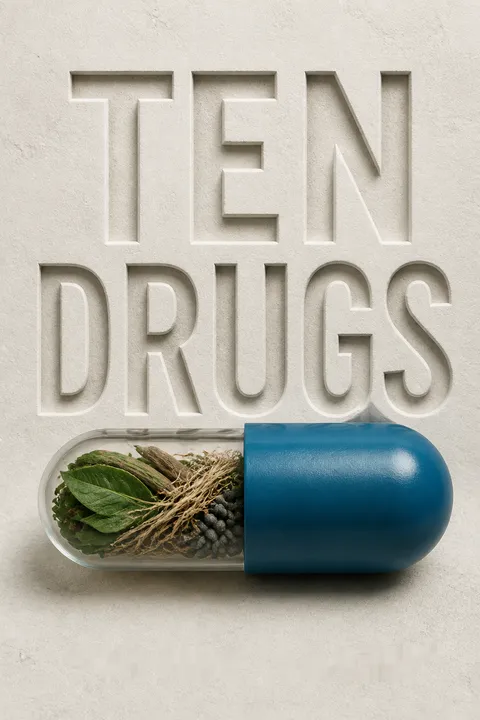
Ten Drugs is a history of medicines, but its deeper subject is how societies decide what counts as progress. Its stories move from poppy sap and smallpox inoculation to laboratory chemistry, psychiatric drugs, contraceptives, statins, and engineered antibodies. Across these cases, the same sequence recurs: a need creates demand, observation or experimentation produces a candidate, institutions determine whether it is tested and distributed, and consequences revise public judgment.
The book is strongest when it separates discoveries that are often collapsed into one heroic moment. Sulfa depended on a corporate testing system as well as chemical ingenuity. Vaccination grew from observation and advocacy before its biological explanation was understood. Chlorpromazine changed psychiatric care, but its benefits did not erase side effects or the need for community support. These stories show that a drug's impact is never only molecular. It is also shaped by law, economics, clinical practice, and social expectations.
The recurring promise of a magic bullet is especially revealing. It expresses a scientific ambition to target disease precisely, but it can also encourage the belief that complicated problems have one chemical answer. The book's examples suggest a more realistic model: medicines can intervene powerfully in biological processes, while the meaning of treatment and the distribution of its benefits remain social questions. A drug can reduce a symptom, prevent a disease, or make a life more manageable without solving every cause around it.
The narrative approach makes the history vivid, though dramatic cases can make exceptional discoveries seem typical. The book acknowledges that its selection is not a complete history. Its most durable contribution is the habit of asking three questions together: What does the medicine do? What risks or incentives accompany it? Who gains access, and who bears the cost? That is a more trustworthy standard for judging pharmaceutical progress than either celebration or condemnation alone.
Review Summary
Ten Drugs explores the history and impact of ten influential medications, from opium to antibiotics. Readers praise Hager's engaging writing style and thorough research, making complex topics accessible. The book covers drug development, societal effects, and ethical concerns in the pharmaceutical industry. Many found it enlightening and enjoyable, though some felt certain drugs received disproportionate attention. Critics appreciated the historical context and balanced perspective on benefits and risks. Overall, it's considered an informative and thought-provoking read for those interested in medicine and its cultural implications.
People Also Read



Glossary
Seige cycle
A drug's public reputation cycleA recurring pattern in which a new drug is first embraced with intense enthusiasm, then criticized as reports of harms accumulate, and finally viewed more soberly as its benefits and risks become clearer. The book uses the term to encourage caution during both the initial wave of excitement and the later wave of alarm.
magic bullet drugs
Medicines aimed at specific targetsA concept associated with Paul Ehrlich's effort to create medicines that selectively attack disease-causing organisms while sparing healthy tissue. His dye-based drug Salvarsan offered an early, imperfect example. The idea remains a powerful goal in drug development, although the book stresses that no treatment is entirely free of risks or unintended effects.
engrafting
Early smallpox inoculationThe term Lady Mary Wortley Montagu used for the Turkish practice of introducing a small amount of material from a mild smallpox case through a deliberate scratch. The procedure aimed to produce a limited illness and protect the recipient from a more dangerous natural infection. It preceded Jenner's later use of cowpox vaccination.
hybridoma
An antibody-producing cell hybridA cell created by fusing an antibody-producing white blood cell with a myeloma, or cancer, cell. The white blood cell contributes the ability to make a particular antibody, while the cancer cell allows the hybrid to keep multiplying. Researchers can grow the resulting cell line to produce large quantities of the same antibody.
monoclonal antibodies
Identical antibodies for one targetAntibodies produced by descendants of a single antibody-producing cell, so that the resulting molecules are identical and recognize the same target. Researchers can design or select them to bind a specific part of a disease process. They are used in treatments for conditions including some cancers and inflammatory diseases, though they remain costly and cannot reach every biological target.
Methadone Maintenance Treatment (MMT)
Ongoing methadone treatment for dependenceA treatment approach in which a person with opioid dependence receives a supervised, regular dose of methadone over an extended period. The aim is to suppress withdrawal and craving, reduce reliance on illicit opioids, and support safer daily functioning. The book presents maintenance as a harm-reduction strategy, not as a guaranteed route to complete abstinence.
relative risk
Change relative to a comparison groupA measure comparing the rate of an outcome in one group with the rate in another. If an outcome falls from 3 percent to 2 percent, the relative reduction is about one-third. This can sound large because it describes the change among events, not the percentage-point change across everyone who took part.
absolute risk
An outcome's rate in the full groupThe proportion of all people in a group who experience an outcome. In the book's example, a change from 3 percent of placebo patients having a heart attack to 2 percent of statin patients means an absolute reduction of 1 percentage point. It helps show how many people may benefit across the entire treated population.
FAQ
What's Ten Drugs: How Plants, Powders, and Pills Have Shaped the History of Medicine about?
- Exploration of drug history: The book by Thomas Hager delves into the history of ten significant drugs that have shaped medicine, from opium to modern pharmaceuticals.
- Cultural and medical implications: It examines how these drugs influenced cultural attitudes towards health, illness, and treatment.
- Interconnected narratives: Hager weaves stories of scientists, patients, and societal contexts, making the book engaging and informative.
Why should I read Ten Drugs by Thomas Hager?
- Engaging storytelling: Hager presents the history of medicine through vivid narratives and mini-biographies, making complex topics accessible.
- Insightful historical context: The book provides a comprehensive understanding of how specific drugs have transformed medical practices and societal norms.
- Relevance to current issues: It addresses ongoing debates in medicine, such as the opioid crisis and the commercialization of healthcare.
What are the key takeaways of Ten Drugs by Thomas Hager?
- Drugs are dual-edged: Every effective drug has potential side effects and risks, emphasizing the dual nature of pharmaceuticals.
- Impact on society: Drugs can change individual lives and societal structures, as seen with antipsychotics revolutionizing mental health care.
- Complexity of drug development: Drug discovery is often unpredictable, filled with serendipity and scientific trial and error.
What are the best quotes from Ten Drugs by Thomas Hager and what do they mean?
- “We are the People of the Pill.” Reflects the modern reliance on pharmaceuticals in American society.
- “Every effective drug, without exception, also comes with potentially dangerous side effects.” Reminds readers of the inherent risks associated with drug use.
- “For good or ill, CPZ changed it all.” Highlights the profound impact of chlorpromazine on mental health treatment.
How did opium influence medicine according to Ten Drugs by Thomas Hager?
- Historical significance: Opium is described as “the most important drug humans have ever found,” with a history that spans thousands of years.
- Cultural associations: It was revered in ancient cultures but also led to addiction and societal issues.
- Evolution of use: The transition from opium as a common medicine to recognizing its addictive properties influenced modern drug regulation.
How did the introduction of chlorpromazine (CPZ) change mental health care?
- Revolutionized treatment options: CPZ allowed patients with severe mental illnesses to manage their symptoms effectively.
- Deinstitutionalization movement: It led to a significant reduction in the number of patients housed in asylums.
- Cultural shift in perception: The success of CPZ helped change societal attitudes towards mental illness.
What role did the pharmaceutical industry play in the development of statins?
- Commercialization of health: The industry recognized the potential market for statins as cholesterol became linked to heart disease.
- Influence on medical guidelines: Financial support for research often shaped the narrative around statins.
- Profit-driven motives: The success of statins highlighted the profitability of chronic disease management.
How does Ten Drugs by Thomas Hager address the opioid crisis?
- Historical context of opioids: Hager traces the history of opiates and their evolving role in medicine.
- Impact of synthetic opioids: The book highlights the emergence of synthetic opioids, such as fentanyl.
- Call for better understanding: Hager advocates for a nuanced understanding of addiction and comprehensive approaches to treatment.
What are the implications of the discovery of monoclonal antibodies according to Ten Drugs?
- Targeted therapies: Monoclonal antibodies allow for highly specific treatments for various diseases.
- Biotechnology revolution: They have spurred a new era in biotechnology, shifting focus to biologics.
- Economic impact: The commercialization of monoclonal antibodies has created a lucrative market.
How does Ten Drugs by Thomas Hager explore the relationship between drugs and culture?
- Cultural shifts: Hager examines how the introduction of certain drugs has led to significant cultural changes.
- Public perception of mental health: The development of antipsychotic medications changed the public’s understanding of mental illness.
- Ethical considerations: Hager raises questions about the ethics of drug marketing and the responsibilities of pharmaceutical companies.
What is the significance of the Harrison Act of 1914 in Ten Drugs by Thomas Hager?
- First federal drug law: The Harrison Act marked a pivotal moment in U.S. drug policy.
- Shift in perception: It reflected a growing recognition of addiction as a public health issue.
- Long-term effects: The act set the stage for future drug legislation and shaped the landscape of drug regulation.
What challenges in drug development are discussed in Ten Drugs by Thomas Hager?
- Rising costs and complexity: The pharmaceutical industry faces increasing costs associated with drug development.
- Market saturation: Finding new blockbuster drugs is becoming more challenging.
- Public scrutiny and trust: Companies must balance profit motives with ethical responsibilities to maintain trust.
Download PDF
Download EPUB
.epub digital book format is ideal for reading ebooks on phones, tablets, and e-readers.








