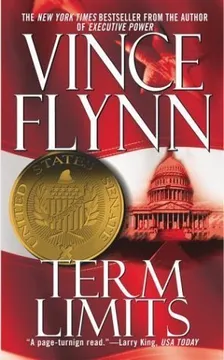


Plot Summary
The Freshman Says No
As Congress prepares to vote on President Stevens's8 deficit-heavy budget, freshman Representative Michael O'Rourke1 refuses to support it unless funding for the obsolete Rural Electrification Administration is cut.
Stevens8 phones to coax him, then committee chairman Jack Koslowski16 sends aide Anthony Vanelli to threaten his career and district. O'Rourke1 records Vanelli's threat and physically forces him to back down, making clear that pressure will not change his vote.
His refusal grows from more than policy: after drunk driving killed his parents, and a released criminal later killed his closest friend, he has come to see Washington's spending choices as matters of life and death. Meanwhile, a former government assassin2 destroys his surveillance files and prepares to strike on American soil.
The opening makes political conviction tangible by attaching it to O'Rourke's bereavements and to a specific budget line. He is not simply a principled outsider: he believes government priorities have consequences that outlast elections, because he has watched them reach into his own family. His physical resistance to Vanelli also establishes a contrast between two kinds of power. Vanelli relies on access, threats, and patronage; O'Rourke relies on a recording and the willingness to face the threat openly. The assassin's preparations complicate this moral clarity before the violence begins. Reform is about to be pursued by people who reject the democratic process they claim to defend.
Three Targets Before Dawn
The assassins exploit the routines of three powerful lawmakers. They kill Senator Daniel Fitzgerald15 inside his home, shoot Koslowski16 from across the street, and execute Senator Robert Downs17 on his morning dog walk.
They drug Koslowski's16 neighbor and his German shepherd rather than kill them, leaving no obvious witnesses and little evidence. A letter mailed before the attacks claims responsibility and accuses Washington of runaway debt, obsolete spending, and broken promises.
It demands a balanced budget, spending cuts, changes to entitlement programs, a crime bill, and a sales tax devoted to debt reduction. The timing is precise: the lawmakers are in Washington for Stevens's8 budget vote. By morning, three political leaders are dead, the budget's passage is imperiled, and the President8 is threatened.
The operation's discipline is part of its argument. The killers distinguish between political targets and civilians, treating restraint as evidence of legitimacy. Yet their precision does not make the killings democratic; it makes coercion more efficient. The letter tries to convert murder into a public mandate by invoking popular frustrations with debt and political self-interest. Its demands may resonate, but the means remove the public's ability to choose them freely. The opening therefore sets up the novel's central contradiction: a group claims to defend representative government by substituting its own judgment for representation, while the politicians it targets have already weakened public trust through manipulation.
McMahon Reads the Crime Scenes
FBI director Brian Roach19 puts veteran investigator Skip McMahon5 in charge of the case, despite the political pressure gathering around it. At the White House briefing, McMahon5 describes three carefully planned killings, while CIA terrorism specialist Irene Kennedy6 argues that the killers resemble trained commandos more than terrorists: they avoided civilian casualties and even left Koslowski's16 neighbor alive.
Former Delta Force instructor Gus Mitchell reconstructs the teams' timing and concludes that the vote date gave them a rare chance to find all three targets in town.
McMahon's5 investigators also find that the letter was mailed before the murders, undermining the suggestion that it was opportunistic misdirection. The evidence points toward a professional operation, but neither its members nor their full motive is yet known.
McMahon's methodical attention to sequence counters the administration's appetite for immediate certainty. He treats the crime scenes as evidence rather than as raw material for a political story. Kennedy's distinction between commando training and terrorist tactics is useful but morally unstable: restraint can reveal discipline without proving that a cause is just. Mitchell adds operational logic, showing how the calendar itself becomes part of the crime. The investigators are trying to identify perpetrators, while the White House is already trying to define them. That difference in purpose becomes a source of conflict, and the investigation's dependence on military expertise foreshadows how difficult it will be to separate law enforcement from national security secrecy.
The White House Rewrites Reality
Chief of staff Stu Garret9 pushes President Stevens8 to present the killings as a threat to democracy and to hint that the letter may be a diversion. The President8 delivers a carefully staged national address praising the dead lawmakers, although some were deeply compromised, and promises that the killers will be caught.
Garret9 then seeds reports claiming the FBI suspects a conspiracy against Stevens's8 budget, despite having no basis for that claim. McMahon5 rejects the false account publicly, and Garret9 plans to use the disagreement to discredit Roach.19
At a bar, O'Rourke1 tells his girlfriend, Washington Reader journalist Liz Scarlatti,3 that he believes the killers may force overdue reform. Liz3 challenges the danger in his thinking, while their love and his political disillusionment pull them in opposite directions.
The administration does not merely conceal facts; it manufactures a story meant to make the President look protective and the killers look politically illegitimate. Garret understands public attention as a resource to be managed, and Stevens accepts performance as a substitute for knowledge. McMahon's refusal to repeat the lie establishes an institutional counterweight, though one vulnerable to retaliation. O'Rourke and Liz embody a related conflict between moral anger and professional restraint. He sees political failure through personal loss, while she knows that public judgment depends on verifiable information. Their disagreement makes the reader confront how easily a righteous motive can become permission to excuse violence.
Basset Falls on Live Television
Speaker of the House Thomas Basset18 refuses protection advice and goes to a CNN interview. Assassins posing as utility workers release smoke inside the building, trigger the fire alarm, and shoot him as the guards react to the evacuation.
Basset18 dies in front of his security detail, and the attackers escape through a prepared route. A recorded call to a television station says he was killed because the government ignored the original demands. The group denies trying to topple Stevens8 and sets a cease-fire through the funerals.
The attack exposes the failure of the precautions meant to protect lawmakers and hardens public fear. At the White House, Garret9 blames the security team, while agent Harry Dorrell refuses to accept responsibility for Basset's18 choice to appear publicly.
Basset's death changes the threat from a hidden operation into a spectacle the government cannot control. The assassins exploit both security procedure and its human weakness: a fire alarm makes trained guards look away at exactly the wrong moment. Their public explanation insists that the violence is conditional, but each new killing makes that claim less persuasive. Dorrell's confrontation with Garret exposes the administration's reflex to assign blame downward while preserving its own authority. The attack also alters the political calculation. Legislators who had treated the first killings as someone else's problem now have to imagine themselves as targets, and fear begins to do the work that argument could not.
Olson Walks Alone
At the Capitol funeral for Fitzgerald,15 Downs,17 Koslowski,16 and Basset,18 Senator Erik Olson12 defies security advice and walks behind the caissons. O'Rourke1 joins him after recalling how Olson12 and his wife helped raise him and his siblings after their parents died.
The President8 later invites Olson12 into a bipartisan coalition, presenting unity as the answer to the assassins. O'Rourke1 distrusts the arrangement, especially after he learns that Stevens8 and Garret9 are using accounting tricks to advertise budget cuts that do not actually reduce spending.
Olson12 promises the President8 only temporary silence, then tells O'Rourke1 he will expose the sham if it continues. O'Rourke1 has also confided to former SEAL Scott Coleman2 that Fitzgerald's15 loose talk caused the deaths of Coleman's2 men.
Olson's walk is a public gesture of courage, but it also marks his trust in institutions that are already failing him. O'Rourke follows out of loyalty to a man who became family, even though he despises the politicians whose coffins they accompany. That tension is the section's emotional hinge: private gratitude competes with public judgment. Meanwhile, the supposed coalition converts an emergency into a political opportunity. Olson's willingness to challenge its false accounting sets him against the President, while O'Rourke's earlier disclosure to Coleman quietly links the personal and political plots. The story's violence is no longer only about abstract reform; it is beginning to circle through relationships and old grievances.
A Bomb at Lunch
After the Camp David summit, Olson12 tells O'Rourke1 and his grandfather Seamus4 that the promised budget cuts are a sham. O'Rourke1 had already warned Olson12 not to join the President's8 coalition, but could not persuade him to abandon his attempt to preserve democratic unity.
As Olson12 leaves their lunch meeting, a motorcyclist throws a bomb onto his limousine. The blast kills the Senator12 and four Secret Service agents, while Seamus4 is injured and O'Rourke1 escapes with a head wound.
Soon afterward, assassins kill Congressman Burt Turnquist and four U.S. marshals guarding him. The killings are far bloodier than the earlier attacks and claim law-enforcement officers as well as politicians. O'Rourke1 and Seamus4 suspect a new force is at work, but Scott Coleman2 denies responsibility.
Olson's death turns O'Rourke's political disagreement into immediate grief and guilt. He had identified the danger of the coalition, but his warning could not protect the man he loved as a mentor. The bomb's civilian and security casualties also fracture the moral framework the first assassins used to distinguish themselves. The simultaneous pattern of Olson and Turnquist's deaths points toward a second operation, one that deliberately blurs the line between political targets and protectors. Coleman denies involvement, forcing O'Rourke to confront a possibility more frightening than a single conspiracy: several groups may be using the same crisis, each with its own justification and its own appetite for violence.
Two Groups, One Capital
A disguised caller contacts McMahon5 and insists that the group responsible for the first four assassinations did not kill Olson,12 Turnquist, or the eight guards who died with them. He argues that his own group would never deliberately kill law-enforcement officers and points to the earlier spared neighbor as evidence.
McMahon5 cannot accept the claim on trust, but it fits the stark change in tactics. At the same time, President Stevens8 declares martial law around the Capitol and White House, brings in military units, and offers lawmakers refuge at Fort Meade.
McMahon5 sees that the FBI's investigation is being constrained by the White House and the NSA, which resist access to Special Forces records. To identify the first group, he negotiates a restricted review with Kennedy6 and General Heaney.21
The anonymous call forces McMahon to distinguish between evidence and self-serving claims without dismissing either. The first group's appeal to its own restraint is credible enough to investigate, but it cannot erase its earlier murders. Meanwhile, Stevens's security response changes the setting of the conflict: military force now surrounds the institutions the assassins claim to be saving. McMahon's struggle for access to military files reveals that government agencies protect not only the public but also their own secrets. The limited review panel is a compromise between investigative need and institutional fear. It also demonstrates how the pursuit of truth in this case depends on cooperation among people who do not fully trust one another.
The Leaked Mission
McMahon,5 Kennedy,6 and Heaney21 examine former commandos, initially focusing on a Black suspect seen near Downs's17 murder. Kennedy6 questions that clue and broadens the search, suspecting the disguise was planted to misdirect investigators toward Black commandos.
The search leads back to Scott Coleman,2 an elite former SEAL who requested early discharge after Operation Snatch Back failed in Libya. Coleman2 had ordered a second team into the mission; a helicopter was destroyed and ten men died.
The FBI later traced the leak to Fitzgerald,15 who had carelessly revealed the operation to a bartender he mistook for a safe confidant. O'Rourke1 had passed that information to Coleman2 during a hunting trip. The military investigation gives Coleman2 a powerful personal grievance, though the FBI still lacks proof of his role in the killings.
The investigation makes motive legible without making it exculpatory. Coleman did not lose men in an abstract policy dispute; he ordered them into an operation that had been compromised by a politician's indiscretion. O'Rourke's disclosure was meant to give a bereaved commander the truth, but it also supplied the grievance that may have turned into vengeance. Kennedy's suspicion about the planted racial description is crucial because it shows how evidence can be designed to shape an investigation rather than simply record events. The episode asks whether professional loyalty and honest anger become dangerous when a trained killer believes he alone can administer justice.
Higgins's Old Secret
Seeking an explanation for the second group's reach, O'Rourke1 and Seamus4 fly to Georgia to consult Augie Jackson,14 Seamus's4 retired CIA friend. Augie14 recalls that Arthur Higgins11 once directed covert assassinations abroad and was later passed over for CIA director after Olson12 opposed his appointment.
He suspects Higgins11 killed Olson for revenge and Turnquist to confuse investigators. Augie14 gives them a classified profile of Higgins's11 Maryland estate, including security weaknesses and guard routines. Coleman2 recognizes that Higgins11 has continued operating through mercenaries and may be involved in illegal arms trafficking.
He, O'Rourke,1 and two former SEAL teammates scout the estate, confirm Higgins's11 habit of smoking cigars outside, and identify a route through a neighboring property. They prepare to seize him and learn what he and Nance10 are planning.
Augie's account widens the story from political violence to the hidden continuity of state power. Higgins's past work was protected by secrecy when it served official goals, then treated as a liability when his ambitions threatened the Agency. His alleged revenge is not simply personal; it grows from a system that allowed covert authority to escape ordinary oversight. The reconnaissance scene turns that institutional history into physical risk, with fences, guards, and habits replacing abstract policy. O'Rourke's involvement deepens his complicity: he is no longer merely a grieving observer or a source of information, but an active participant in an unlawful plan to confront a man the government cannot easily reach.
A Confession at Garret's Gate
Coleman2 and O'Rourke1 capture Higgins11 during a night raid on his guarded estate. They take him to O'Rourke's1 house and use sodium pentothal to record his account. Higgins11 admits that he ordered Olson's12 and Turnquist's murders, with national security adviser Mike Nance10 and chief of staff Stu Garret9 involved.
He says Olson's12 opposition blocked his path to the CIA directorship, while the other killings were meant to confuse investigators and undermine support for the first assassins. Coleman2 kills Higgins11 after the questioning.
O'Rourke1 rejects releasing the confession publicly, fearing it would destroy the CIA and damage the country, but uses it to demand Nance's10 resignation, Garret's9 removal, and genuine budget reform. They leave Higgins's11 body at Garret's9 home and alert newsrooms.
The confession makes the competing accounts of patriotism collapse into a chain of personal ambition. Higgins used national security as cover for revenge, and Nance and Garret treated political violence as a way to preserve their own positions. Yet the evidence that could expose them is itself obtained through abduction, drugging, and murder. O'Rourke's choice not to publish the tape is therefore not a clean ethical victory; it is a calculation that the truth may cause wider harm than concealment. The body at Garret's home turns the private crime into a public warning, while the secret recording becomes leverage that can neither safely disappear nor safely be revealed.
O'Rourke Taken Alive
After O'Rourke1 uses Higgins's confession to confront the White House, Nance10 hires a former intelligence operative22 to abduct him from his own home. The attacker shocks O'Rourke1 with a Taser, drugs him, and carries him to Nance's10 Maryland ranch. Liz3 returns to find the entry table broken and Michael1 gone; she calls Seamus4 and then warns CIA director Thomas Stansfield7 that the tape may become public unless O'Rourke1 is returned.
At the ranch, Nance10 orders his hired man, Jarod,22 to beat O'Rourke1 and threatens him with an interrogation drug. O'Rourke1 refuses to identify the assassins, taunts Nance10 and Garret,9 and buys time. Seamus4 alerts Coleman,2 who realizes the FBI is already following him and races to intervene.
Nance's kidnapping strips away the distinction he claims to defend between state security and private coercion. He uses the tools of intelligence work against a civilian lawmaker because the confession threatens his own survival. O'Rourke's refusal is not a display of invulnerability: he is injured, drugged, and trying to delay an interrogation that could expose others. Liz's rapid decision to threaten disclosure shows how her journalism and her love have become inseparable under pressure. She does not solve the crisis herself, but she gives Stansfield a deadline and turns the hidden tape into an active force in the rescue.
Langley Breaks In
Stansfield7 uses a reconnaissance satellite to monitor Nance's10 ranch, then sends two CIA tactical teams after confirming several people inside. When Nance10 refuses to answer Stansfield's7 call and continues preparing to drug O'Rourke,1 the director orders the assault.
The team shoots the guard dogs, enters through the French doors, and kills Jarod22 when he fires on them. O'Rourke1 is freed before Nance10 can administer the interrogation drug. Stansfield7 confronts Nance10 and Garret,9 while Nance10 claims he was protecting national security and Garret9 tries to distance himself from the scheme.
Coleman2 contacts Stansfield7 and demands a private meeting with Nance10 and O'Rourke,1 promising no further threat to the director. Stansfield7 agrees to go, bringing only the Congressman1 and Nance.10
The rescue is an institutional reversal: the CIA, whose secrecy helped create the crisis, uses its covert capabilities to stop a national security official from committing another crime. Stansfield acts only after ordinary channels have failed, making the intervention effective but legally and politically compromised. Nance's language of duty no longer persuades because his conduct has exposed its private motive. Coleman then insists on a meeting outside any official venue, forcing Stansfield to choose between controlling the situation and accepting its uncertainty. The scene does not restore lawful order; it creates a narrow opening in which rival actors can negotiate before the evidence and the violence escape them.
The Sandbar Reckoning
On a Chesapeake sandbar, Coleman2 identifies himself as the commander behind the first four assassinations and confirms that O'Rourke1 knew nothing of them until the confession surfaced. He explains that his men acted to punish politicians they considered dangerous to the country, while Nance10 and Higgins11 used the same crisis for revenge and power.
Nance10 promises to resign, but Coleman2 does not trust him and breaks his neck. Stansfield7 and Roach19 accept the cover-up to prevent the confession from becoming public; Nance's10 death is announced as a fatal horse accident.
Garret9 is expected to resign and leave public life, while Stevens8 must pursue real budget reforms to preserve his political future. Before their flight to Olson's12 funeral, O'Rourke1 and Liz3 promise silence, knowing the official story conceals both justice and crime.
The final confrontation refuses a simple restoration. Coleman identifies his cause as national service, yet answers political murder with another deliberate killing. Stansfield and Roach choose concealment not because they mistake it for justice, but because disclosure could discredit institutions and expose their own compromises. O'Rourke's silence protects Liz and the country as he understands it, while also denying the public the truth needed to judge its leaders. The novel ends with political consequences promised rather than fully secured. Its title's demand for limits applies uneasily to officeholders and assassins alike: both groups claim that someone else must be restrained, while neither accepts a dependable authority to restrain itself.
Analysis
Term Limits builds its thriller around a question that its characters keep answering too confidently: who gets to decide when a political system has failed badly enough to justify force? The assassins point to debt, corruption, and broken promises, complaints the book gives concrete weight through O'Rourke's1 family history and the consequences of failed criminal policy. Their operational restraint distinguishes them from indiscriminate terrorists, but it cannot make their killings representative. They impose their judgment on citizens who never consented to their methods.
The opposing officials do not offer an uncomplicated defense of democracy. Garret9 manipulates the press, Stevens8 initially values the appearance of leadership, and Nance10 treats public institutions as tools for private advancement. Higgins's confession reveals that covert violence did not begin with the current crisis; the intelligence state has long preserved secrecy by making accountability difficult. The second assassination campaign sharpens this indictment while also showing how quickly a political cause can become cover for personal revenge.
Michael's1 position is deliberately uncomfortable. His losses explain his impatience with compromise, and his disclosures help expose the people behind the killings. Yet his anger makes him receptive to violence as a corrective, and he participates in concealing evidence rather than trusting the public with it. Liz's3 insistence on truth confronts that choice, while her final promise of silence shows how intimate loyalty can become part of political concealment.
The ending offers consequences, not a clean cure. Nance10 is killed, Garret9 is expected to leave public life, and Stevens8 must deliver reforms, but the public never learns what happened. The book's bleakest implication is not that democracy is useless, but that institutions become most vulnerable when citizens and officials alike decide that their own certainty is a better safeguard than shared accountability.
Review Summary
Term Limits receives strong praise from most readers as a fast-paced, relevant political thriller, earning 4.34/5 stars. Many appreciate its timely themes of government corruption and its connections to the Mitch Rapp universe. Fans highlight the engaging plot, realistic military details, and compelling characters like Scott Coleman and Michael O'Rourke. Critics note thin characterization, weak dialogue, and a morally questionable premise that some find troubling. Despite mixed views on its politics, most agree it's an entertaining, thought-provoking read.
People Also Read





Characters
Michael O'Rourke
The unwilling insiderA freshman Minnesota congressman, former Marine recon leader, and principled opponent of wasteful government spending, Michael O'Rourke distrusts Washington because its decisions have touched his life directly. A drunk driver killed his parents, and a repeat offender later killed his closest friend. Those losses make him impatient with political compromises that treat public safety as secondary to patronage. He is physically capable, blunt, and uncomfortable with publicity, but not emotionally detached: his loyalty to his grandfather4, his former mentor Erik Olson12, and journalist Liz Scarlatti3 gives him strong ties to the people around him. Michael wants to leave Washington, yet his conscience repeatedly draws him back into its conflicts.
Scott Coleman
The wounded commanderA former commander of Navy SEAL Team Six, Scott Coleman is disciplined, perceptive, and shaped by years of missions in which other people's decisions could determine who came home. He has a close connection to Michael1 through the death of his younger brother, Mark, and he trusts the O'Rourkes1 enough to speak frankly with them. Coleman is highly skilled but not invulnerable to grief or anger; his professional belief in planning and restraint exists beside a deep suspicion of political leadership. His military identity makes him both a protector and a potential threat, especially when he believes conventional institutions have failed the people they were meant to serve.
Liz Scarlatti
The unsparing journalistA reporter for the Washington Reader, Liz Scarlatti is intelligent, ambitious, and willing to challenge powerful people in public. Her relationship with Michael1 is serious, but their different careers create friction: she needs facts, while he often withholds information because he fears for her safety. Liz sees the danger in romanticizing political violence and presses Michael1 to consider its human cost. At the same time, she is no passive observer; she uses her position and judgment when the people she loves are in danger. Her work makes her sensitive to the gap between official accounts and lived events, while her attachment to Michael1 tests where professional independence ends and personal loyalty begins.
Seamus O'Rourke
The unsentimental patriarchMichael's1 grandfather and head of the O'Rourke Timber Company, Seamus helped raise Michael1 and his siblings after their parents died. A former Marine with a long memory of military service, he sees political dysfunction not as an abstract debate but as a betrayal of people who sacrificed for the country. He is affectionate with his family, direct with friends, and skeptical of the polished language used by politicians. Seamus's past support for Irish self-rule has given him a complicated understanding of political violence: he distinguishes disciplined resistance from attacks on civilians, but his confidence in that distinction can make him dangerously certain of his own judgment.
Skip McMahon
The stubborn investigatorThe FBI's East Coast Quick Response Team leader, Skip McMahon is a highly experienced homicide investigator who prefers fieldwork to promotion. He trusts patient observation, visualization, and the careful comparison of evidence, and he resists pressure to adopt a political theory before the facts support it. His bluntness repeatedly puts him at odds with Garret9, but it also earns the confidence of Director Roach19. McMahon is not immune to personal anger, especially when law-enforcement officers become targets, yet he works to keep that anger from distorting the investigation. He represents the disciplined pursuit of truth inside an institution being pulled toward secrecy and political expediency.
Irene Kennedy
The analytic counterweightA CIA terrorism specialist fluent in Arabic and trained to read militant groups through their methods, Irene Kennedy brings intellectual precision to the investigation. She is a single mother who loves her young son, Tommy, and the strain of crisis work repeatedly competes with her family life. Kennedy is confident in her expertise but willing to revise a theory when evidence may have been planted to mislead investigators. She works effectively with McMahon5 because she can translate between intelligence analysis and criminal investigation without pretending the agencies share the same priorities.
Thomas Stansfield
The guarded CIA directorThe CIA director is a career intelligence officer who rose through human intelligence work rather than politics or military command. He is careful, reserved, and deeply aware that information can endanger sources and entire operations. The death of his wife has made him more private, while his professional responsibilities keep him close to the machinery of secrecy. Stansfield values the Agency but recognizes that its independence can become a danger when old operatives act beyond its control. His measured manner masks difficult calculations about when protecting the institution is compatible with protecting the country.
President Jim Stevens
The polished incumbentPresident Stevens is a practiced politician whose instinct is to rely on advisers, polling, and carefully staged public appearances. He depends heavily on Garret9 and initially treats the budget fight and the assassinations as problems of presentation as much as governance. Stevens wants reelection and fears losing control of events, but he is not portrayed as fully informed about every scheme undertaken in his name. His responses reveal how a leader can confuse looking decisive with making sound decisions, especially when frightened and surrounded by people who manage information for him.
Stu Garret
The ruthless chief of staffStevens's8 chief of staff, Stu Garret treats politics as a contest in which results justify pressure, deception, and personal intimidation. He manages the President's8 image, works votes through threats and favors, and regards criticism from law-enforcement professionals as an obstacle to control. Garret is ambitious and quick to blame subordinates when a plan goes wrong. Unlike the quieter intelligence officials around him, he struggles to conceal fear and anger when events escape his management. His belief that public opinion can be engineered gives him influence, but his dependence on manipulation leaves him exposed when the lies become harder to contain.
Mike Nance
The calculating adviserThe President's8 national security adviser is a former intelligence professional who thinks in terms of leverage, access, and controlled risk. Nance is composed in meetings and skilled at keeping others uncertain, which makes his private ambitions difficult to detect. He is willing to bend rules when he believes the outcome benefits the administration, and he views political survival as inseparable from national security. His partnership with Garret9 is built on mutual advantage rather than trust. Nance's calm manner can make his choices appear pragmatic even when they serve personal power.
Arthur Higgins
The vanished spymasterA former director of the CIA's most secretive operations, Arthur Higgins has spent decades working where official policy and deniable violence meet. He is wealthy, guarded, and protected by elaborate security at his Maryland estate. Higgins believes that his experience makes him indispensable and that secrecy gives him room to act without ordinary oversight. His career has made him feared within intelligence circles, while his removal from the Agency leaves his loyalties and current ambitions uncertain to outsiders.
Erik Olson
Michael's political mentorA senior Minnesota senator and Michael's1 former employer, Erik Olson is a historian, a political ally of Michael's1 family, and one of the adults who helped guide Michael1 after his parents died. Olson believes democracy must be defended through its institutions, even when those institutions disappoint him. He is brave enough to make public gestures of resolve, yet cautious about endorsing reforms imposed by violence. His affection for Michael1 is paternal, though the two disagree sharply over what the immediate crisis requires.
Tim O'Rourke
Michael's steady brotherMichael's1 younger brother and chief of staff, Tim is more pragmatic than his older sibling and more attentive to the consequences of political exposure. He understands Michael's1 convictions but worries that blunt statements and risky choices may damage the people working for him. Tim is loyal to the family and remains a practical source of support as the crisis draws them into danger.
Augie Jackson
The retired intelligence guideA former CIA analyst and covert-operations planner, Augie Jackson is an old friend of Seamus4 who has spent much of his life weighing political decisions against their hidden consequences. He speaks cautiously about what he knows, aware that disclosure can put people at risk. Augie understands how intelligence agencies preserve deniability and how a past operation can echo into present events. His affection for Seamus4 makes him willing to offer help, though he remains wary of becoming directly involved.
Daniel Fitzgerald
The entrenched senatorA long-serving Senate Finance Committee chairman, Fitzgerald has spent decades protecting his position and relying on political deals. His personal life is marked by addiction and estrangement from his family, while his influence remains considerable. He embodies the old political order that younger lawmakers resent.
Jack Koslowski
The feared vote brokerChairman of the House Appropriations Committee, Koslowski is known for forcing party loyalty through control of federal spending. He is a formidable operator in budget fights and a symbol of the patronage system Michael1 opposes.
Robert Downs
The prince of porkA powerful senator who chairs the Banking Committee, Downs is associated with expansive spending and the exchange of political support for benefits to his allies. His daily routine makes him an accessible target.
Thomas Basset
The embattled SpeakerThe House Speaker is an experienced party leader who has spent decades working alongside the lawmakers at the center of the crisis. He values political continuity and looks to the President8 for direction. His willingness to keep public appearances despite security concerns reflects both his confidence in the institution and the habits of a leader accustomed to operating in public.
Brian Roach
The political FBI directorDirector of the FBI and a longtime friend of Skip McMahon5, Brian Roach has moved from field investigation into the political demands of running a federal agency. He trusts McMahon's5 judgment and tries to shield him from pressure, while knowing that his own position requires negotiation with the White House. Roach's loyalty to the Bureau competes with his personal concern for his friend.
Jack Lortch
The President's protectorThe Secret Service agent in charge of the President's8 detail, Jack Lortch is practical, security-minded, and increasingly frustrated by political interference in his work. He understands that protection depends on the protectee accepting limits, a principle that Garret9 and Stevens8 repeatedly resist. Lortch is willing to confront powerful people when their decisions put others at risk.
General Heaney
The Special Forces gatekeeperA Marine general overseeing access to Special Forces personnel records, Heaney understands both the investigative need and the risks of exposing covert missions. He respects the commandos he has served with and helps McMahon5 and Kennedy6 navigate the military's guarded culture.
Jarod
Nance's hired operativeA former intelligence operative hired for discreet work, Jarod is efficient, physically skilled, and comfortable using force for money. He performs assignments without asking many questions, reflecting the dangerous market in which specialized government skills can be sold privately.
Plot Devices
The Reform Demands
A coercive political programThe assassins' letter demands a balanced budget, cuts to unnecessary programs, changes to Social Security and Medicare, a national crime bill, and a dedicated sales tax to reduce the debt. These proposals give the killings a political purpose and make the public debate the substance of the message, not only the violence. The demands also create a test for Stevens8: he can reject coercion in principle, but doing so without addressing the underlying public frustration makes his position look self-serving. The program is both a genuine argument about government and a mechanism for threatening lawmakers into compliance.
Operation Snatch Back
A concealed motiveThe failed Libya mission cost Scott Coleman2 ten men after information about the operation leaked to a bartender and reached a former KGB agent. Daniel Fitzgerald15 was the source of the leak, though he did not understand who was receiving the information. Michael1 learns this through his political connections and later tells Coleman2. The operation supplies the personal grievance behind the first assassinations and explains why the date of the budget vote matters to the killers. It also shows how casual political indiscretion can have lethal consequences far from Washington.
The Two Assassination Campaigns
Competing forms of violenceThe first campaign targets four lawmakers with military precision and claims to avoid civilian casualties. A second campaign kills Erik Olson12, Burt Turnquist, and eight security officers to create confusion and weaken public sympathy for the first group. The contrast in methods gives McMahon5 a reason to distrust the assumption that every attack comes from one organization. It also makes the central conflict more than a hunt for one team: each group uses the same political crisis to pursue different aims, and each claims to be acting for the country's good.
Higgins's Confession Tape
Leverage against the White HouseO'Rourke1 and Coleman2 record Arthur Higgins's11 confession while he is under the influence of sodium pentothal. Higgins11 identifies himself as the architect of the Olson12 and Turnquist murders and names Mike Nance10 and Stu Garret9 as participants. The tape also exposes a past CIA operation that killed French politicians. Releasing it could bring down political careers, damage the CIA, and undermine public trust in government. Keeping it secret, however, protects those same institutions from accountability. The recording becomes the bargaining instrument that drives the climax and forces McMahon5, Roach19, and Stansfield7 to choose between disclosure and containment.
The False Missile Trap
A warning without a strikeThe assassins place radar devices around Washington and remotely trigger them as Marine One leaves for Camp David. The helicopters receive fire-control warnings, and flares make the pilots believe missiles are approaching. The pilots evade into the Potomac valley, where another staged threat scatters the escort formation. No missile is fired, but the operation proves that the President8 can be reached and exposes vulnerabilities in the security plan. It is a carefully calibrated demonstration of capability, meant to frighten the administration without killing the Marines and agents on board.
Download PDF
Download EPUB
.epub digital book format is ideal for reading ebooks on phones, tablets, and e-readers.








