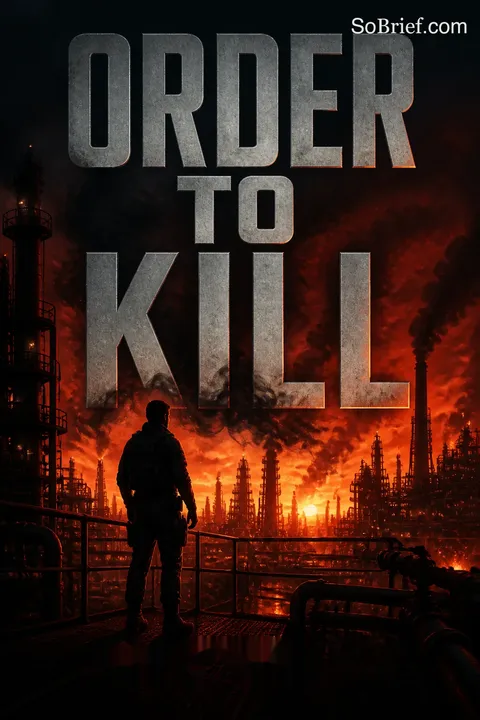


Plot Summary
Prologue
In a ruined Siberian oil town, Russian operative Grisha Azarov meets Dmitry Utkin, an oligarch who has begun openly challenging President Maxim Krupin. Utkin argues that economic collapse is weakening the president, but Azarov has come to silence him. He kills Utkin and orders the dead man’s empire divided among the remaining oligarchs, then warns Krupin that murder may frighten them into unpredictability.
The president dismisses the concern and reports that a separate plan to draw CIA agent Mitch Rapp away from Pakistan is already underway. Azarov feels the danger in Krupin’s confidence, though he does not yet know how large the coming disaster will be.
The opening makes political violence feel less like a breach of order than its governing instrument. Utkin condemns corruption while benefiting from it, and Azarov recognizes the hypocrisy without mistaking it for innocence. His warning to Krupin is strategic, but it also reveals an emerging moral distance: he can still perform the president’s violence, yet no longer fully believes the stories that justify it. The parallel operation against Rapp links domestic Russian power struggles to the international plot, while establishing that both men are being moved by a ruler who treats people as expendable parts.
The Sniper Above Franschhoek
After killing Pakistan’s intelligence chief, Rapp has been tracking the chaos around General Umar Shirani, who is moving nuclear weapons beyond civilian control. He leaves Scott Coleman in charge of the search and flies to South Africa after learning that someone may be targeting Claudia Dufort, the widow of assassin Louis Gould, and her daughter, Anna.
Rapp helped give them new identities and a protected home, but he cannot treat the threat as a routine security problem. He climbs the mountains above their property, finds a sniper aiming toward the road, and takes the shooter alive. The man’s position confirms that an attack is already being prepared, though Rapp does not yet know that the assault is meant to pull him away from Pakistan.
The scene turns Rapp’s personal attachment into an operational vulnerability without making the attachment sentimental. His past with Claudia is rooted in violence and guilt, and his wish to protect her is partly an attempt to manage consequences he cannot undo. Meanwhile, Pakistan’s unstable arsenal remains the larger danger he has delegated to others. The contrast exposes a recurring problem in Rapp’s self-conception: he believes personal intervention is a form of responsibility, even when it leaves an immense responsibility understaffed. The sniper makes that conflict physical before he understands its strategic purpose.
The Mortuary Capture
The sniper, American contractor Kent Black, triggers a rockslide that knocks Rapp unconscious. Meanwhile, Claudia and Anna are rammed into a cargo truck and seized by armed men. Black’s employer, Russian criminal Ilya Gusev, takes the captives to a mortuary in Lesotho, where Rapp is bound and interrogated.
Rapp learns that Claudia’s kidnapping was designed to draw him away from Pakistan and keep him chasing them for days. Black recognizes Claudia as Gould’s wife and understands that Rapp will eventually come after him, so he switches sides.
While Rapp frees himself, a wounded attacker reopens fire and Gusev dies in the exchange. Rapp gets Claudia and Anna out, then heads back toward Pakistan with the knowledge that a Russian operation is exploiting his absence.
The episode exposes how thoroughly Rapp’s enemies understand his emotional habits. They do not need to defeat him directly if they can make him choose the wrong battlefield. Black’s betrayal of Gusev is pragmatic rather than noble, a reminder that even among professional killers, loyalty has limits when self-preservation becomes immediate. Claudia’s fear for Anna gives the kidnapping real human stakes, while her old complicity prevents the scene from reducing her to helplessness. Rapp’s escape restores his agency, but not his lost time. The strategic damage has already been done.
A Warhead in the Crate
Back in Faisalabad, Rapp joins Coleman’s team after trusted informant Redstone reports that al Badr plans to seize a nuclear warhead moving through the city. The produce truck diverts to a warehouse, where Coleman spots men unloading a long crate and enters before Rapp can reach him.
A highly trained attacker ambushes Coleman, shooting and stabbing him until he can barely fight. Rapp arrives from a rooftop position, helps drive the attacker away, and kills the men guarding the shipment.
The team finds the warhead and winches it into a helicopter while Pakistani forces close in. Rapp carries the gravely wounded Coleman out under fire. The attacker escapes, leaving Rapp with a stolen weapon secured and his closest teammate hovering between life and death.
Coleman’s injury overturns the familiar division of labor between the two men. Rapp is accustomed to relying on his friend’s judgment and steadiness; now he must make decisions while watching Coleman become a casualty. The attacker’s discipline hints that the operation has a stronger hand behind it than al Badr, but the immediate emotional pressure makes that larger mystery difficult to pursue. The warhead becomes a concrete burden, not an abstract strategic asset: it must be moved, protected, and understood while Rapp carries the consequences of the fight with him.
Krupin’s Oil Gambit
While Rapp’s team struggles in Pakistan, Krupin faces a challenge from Russia’s wealthiest oligarchs. They blame his policies for worsening the economic crisis and demand sanctions relief, freer markets, and limits on presidential power.
Krupin answers with a plan to cripple Saudi oil production, drive energy prices sharply upward, and use the resulting revenue to restore Russian power. In Islamabad, Azarov receives the failed operation’s plans from Krupin’s adviser Marius Postan.
Postan insults him and underestimates the danger, so Azarov kills him before studying the files. Krupin then orders Azarov personally to confront Rapp. The oligarchs’ challenge and the assassination of Postan show that the president is tightening control even as his strategy grows more reckless.
This section binds the Russian plot to the physical crisis in Pakistan. The president’s economic desperation gives the stolen nuclear material a possible purpose, while the oligarchs’ dissent explains why he is willing to gamble on catastrophic disruption. Azarov’s role is not simply to execute orders; he is also an observer capable of understanding how badly the plan may fail. His competence makes him valuable to Krupin, but that value deepens his captivity. The regime rewards usefulness without granting autonomy, turning its most capable servant into another instrument of the ruler’s fear.
The Canister Is Empty
At a CIA facility in Virginia, nuclear specialist Craig Bailer dismantles the recovered weapon and finds that its fissile-material canister is a convincing fake. Whoever made the replacement worked quickly and knew the weapon’s design. Rapp realizes the men at the warehouse could have removed the real canister while his team focused on the entire warhead.
Meanwhile, Coleman’s condition worsens after surgery, and doctors fear he will not survive. Rapp urges the CIA to investigate the rest of Pakistan’s arsenal rather than assume the theft was isolated. The discovery changes the search: the danger is no longer only a large weapon in motion, but small, removable quantities of nuclear fuel that can vanish inside ordinary cargo.
Bailer’s technical finding also clarifies why Rapp’s usual strengths are insufficient. Brute force can seize a truck, but it cannot reveal what was quietly removed before the truck arrived. The missing canister makes intelligence, engineering, and political access as consequential as combat skill. At the same time, Coleman’s failing condition leaves Rapp with less emotional support just as the crisis becomes more diffuse. The section’s central anxiety is therefore epistemic: the weapon appears present, the container appears intact, and yet the essential danger has already escaped.
Jesem’s Borrowed Face
Rapp returns the weapon to Pakistan and confronts President Saad Chutani and General Umar Shirani. He exposes the fake canister, forces Shirani to admit that six warheads have been compromised, and learns that the army is investigating at a hidden missile facility. There, Rapp finds Eric Jesem, an American ISIS member captured after an attempted seizure.
Rapp kills Jesem, then has Joe Maslick beat and disguise him to match the prisoner’s injuries. Maslick sends Rapp away in a transfer van under Jesem’s identity. ISIS fighters ambush the convoy and carry him into Iraq, believing they have rescued one of their own. Rapp’s choice trades immediate safety for access to the people directing the stolen material.
The disguise marks a point of no return because Rapp cannot ask for ordinary support without exposing himself. His bodily transformation is not cosmetic suspense; it narrows his margin for error. The beat also brings the state-level conflict down to a face-to-face encounter with a captured American who has chosen ISIS. Rapp’s mission requires him to erase that man and then become him, forcing the reader to distinguish identity from allegiance. The same physical resemblance that helps him infiltrate also makes his own body a tool he is willing to damage.
The Girl at Auction
Four days after his capture, Rapp wakes in an ISIS-held Iraqi town and is brought before former Iraqi general Ali Mustafa. Mustafa believes he is Jesem and praises his refusal to cooperate with Americans. At a slave auction, Rapp sees two girls sold and then watches a third, Laleh, fight the man trying to expose her.
Mustafa offers her to Rapp as a reward, and Rapp claims her to prevent her immediate abuse. Laleh resists him, but he makes clear that he will not harm her. Her brothers later come to retrieve her, and Rapp learns that they know of a training site outside town where Mustafa’s men prepare an operation. Laleh becomes both a person he must protect and his route into the plan.
Rapp’s relationship with Laleh begins in a morally compromised transaction. He can save her from one immediate fate only by accepting a role inside the system that has enslaved her. That tension is sharpened by the disguise: Mustafa sees Jesem’s devotion, while Laleh reads the gap between the man’s supposed identity and his conduct. Her brothers’ information gives Rapp a practical path forward, but the scene’s deeper force comes from her agency. She is not simply rescued into safety; she evaluates the rescuer and chooses whether to assist him.
The School Becomes a Trap
Laleh’s brothers guide Rapp and a small, inexperienced group to the former girls’ school where Mustafa’s men train and hold children. Rapp rejects lengthy planning and assigns the brothers roles based on what each can manage.
He enters with Mohammed, kills the gate guard, and pretends to belong among the militants. When a nervous ally fires too soon, Rapp improvises, warning the building that Americans are attacking. The ISIS fighters rush toward the entrance while frightened girls flood the corridors.
Rapp and the others use the confusion to kill several gunmen and help the children escape. Some militants survive, preserving Mustafa’s operation. Mustafa later reinstates Rapp as a backup member of the Saudi-bound team, still believing that Jesem is loyal.
Rapp’s work here depends on controlling violence rather than maximizing it. If he kills everyone, Mustafa may abandon the operation; if he kills too few, the children remain in danger. The staged American attack lets him exploit the militants’ expectations, while the crowd of girls makes precise combat impossible. His success therefore comes with compromised outcomes: several captives escape, but the organization remains intact and the mission continues. The section tests whether Rapp can accept an incomplete rescue without losing sight of the larger threat.
Laleh’s Last Resistance
Mustafa comes to Rapp’s apartment and announces that Laleh will be sold to the man she injured at the auction. Laleh stabs the general with a kitchen knife as his men seize her. Rapp faces a choice between breaking cover and losing access to the operation, or appearing to remain Jesem. He shoots Laleh in front of Mustafa’s followers, killing the woman he had tried to protect.
Then he uses Mustafa’s injury to assert authority and persuades the remaining men that the general is dead and their work must continue. Rapp is assigned to the backup team traveling to Saudi Arabia that night. His cover holds, but the decision leaves him carrying a death he could not turn into a rescue.
The scene closes the personal thread opened when Rapp chose Laleh at the auction, but closure does not mean relief. Her death exposes the limits of his familiar rescue logic: he can intervene, redirect danger, and manipulate opponents, yet cannot always create a safe future for the person in front of him. The choice also demonstrates how thoroughly the false identity has trapped him. To remain useful against the wider plot, he must perform the role of a man who would kill her. The mission proceeds, but at a cost his professional language cannot contain.
Six Crates Toward the Gulf
Krupin tells Azarov the full purpose of the theft: six dirty bombs will be placed near Saudi oil production, contaminating the fields and helping ISIS destabilize the region. The president promises Azarov wealth or power afterward, but Azarov asks instead to be released from his service.
He accepts the assignment only after Krupin leaves that possibility open. The stolen material is moved through Pakistan disguised among ordinary cargo, hidden beneath a dhow, and transferred to a fishing boat off Saudi Arabia.
A Coast Guard inspection, including a radiation detector and divers, fails to find the submerged crates. Azarov’s teams then carry the fuel inland, while he secretly replaces the detonator assigned to his own bomb so he will not have to die with it.
The dirty-bomb plan gives geopolitical abstraction a material route: a missing canister becomes a crate, a crate becomes cargo, and cargo becomes a threat to the world’s energy system. Azarov understands the operation’s mechanics well enough to see its fragility, but he has spent years believing that survival requires obedience. His private modification is a small act of self-ownership, not a rebellion that can yet be spoken aloud. Krupin offers him everything except the one thing he now values, and that mismatch exposes the poverty of the president’s idea of human motivation.
Rapp Takes the Desert Command
Rapp reaches Saudi Arabia with Mustafa’s backup team and learns that the operation is already moving. He kills one member who tries to deny him water, then takes the group’s satellite-connected laptop and uses it to contact CIA headquarters. The device tracks the six teams, allowing Irene Kennedy to match their routes to likely oil-field targets.
At a Riyadh hotel, Saudi security chief Colonel Wasem tries to seize control of the intelligence and push an immediate attack. Rapp insists that all teams must be located before any strike, since an early attack could trigger premature detonations. When Wasem threatens the plan from a helicopter, Rapp throws him from the aircraft and puts Captain Bazzi in command.
The section tests Rapp’s leadership in a form unlike combat with an enemy. He must persuade allies to delay action, then use force when persuasion fails. His decision to throw Wasem from the helicopter risks political consequences, yet it follows a clear operational logic: no strike until the teams are identified and coordinated. Bazzi’s willingness to take over shows that competence can emerge from unexpected ranks when hierarchy stops obstructing it. Rapp’s authority here is earned less by title than by the accuracy of his assessment and his readiness to accept responsibility.
The Oil Fields Ignite
A Saudi helicopter loses control in the storm, but the remaining teams move toward their targets and Bazzi coordinates the attacks. Rapp reaches the abandoned production facility where Azarov is directing the operation.
He kills the ISIS guards and hunts the Russian through the maze of pipes, ladders, and tanks. Both men use the structure’s height and blind corners to outmaneuver the other; Rapp survives a dangerous fall and wounds Azarov, while Azarov draws him away from an explosive charge.
The remaining Saudi teams stop the other bombers, but Azarov detonates the device at the facility and escapes into the sand. The blast contaminates the site and damages oil production, yet the coordinated attack is prevented from spreading across the fields.
Rapp and Azarov are presented as near mirrors, but their differences emerge in what they are trying to preserve. Azarov’s tactical brilliance has been cultivated in service of Krupin; Rapp’s improvisation is tied to people and institutions he may distrust but continues to defend. The storm erases tracks and degrades communication, reducing both men to bodies navigating heat, steel, and risk. The ending of the fight is deliberately incomplete: Azarov survives, the facility is damaged, and the broader attack is halted. Victory is measured as containment, not triumph.
A House With Windows Within
After the operation, Rapp refuses to stay for the Saudi debrief and heads back to Virginia, battered and exhausted. He expects to go to his old apartment, but Irene Kennedy tells him it has been cleared and that Claudia is waiting at the newly completed house. Claudia has furnished the place and prepared dinner, while Anna and Scott Coleman are together in the guest room.
Coleman is alive and beginning a long recovery; Rapp finds him weak but alert, with his humor and loyalty intact. When Coleman warns him not to pursue Azarov for revenge, Rapp gives no firm promise. He does, however, let himself enter the life Claudia has prepared rather than immediately returning to the next operation.
The resolution gives Rapp a fragile domestic foothold rather than a cure for his grief. The completed house represents a future shaped by other people’s decisions, especially Claudia’s, and his embarrassment about its cost is less important than his willingness to inhabit it. Coleman’s recovery returns the possibility of shared work, but his request about Azarov introduces an ethical limit that Rapp may or may not honor. The closing movement is toward attachment: Rapp stays for dinner, faces Anna, and lets the people around him define an evening that is not an operation.
Epilogue
Six months later, Azarov is living quietly in Costa Rica with Cara, the surf instructor whose warmth has begun to displace his old isolation. Krupin has not contacted him, and the Saudi attack has been blamed on ISIS, with limited damage to world oil prices. Then a sniper’s laser appears on Azarov’s chest.
Rapp has found him, but he does not shoot. He asks whether Azarov has truly severed ties with Krupin and warns that the Russian president remains a danger. Azarov says he is prepared to kill Krupin if necessary. Rapp leaves him alive, and their unfinished contest becomes an uneasy truce.
The epilogue refuses the clean satisfaction of an executed enemy. Rapp recognizes that Azarov’s protection of Cara, and his apparent break with Krupin, complicate the category of disposable adversary. That recognition does not make Azarov innocent; it makes judgment more difficult. Their exchange also leaves the political crisis unresolved: Krupin remains in power, while Rapp chooses not to turn private vengeance into another destabilizing act. The final restraint echoes the novel’s larger distinction between violence as a tool and violence as appetite. Rapp’s decision is not forgiveness, but a decision to wait for evidence and consequence.
Analysis
Order to Kill treats political power as a system that feeds on the conversion of people into instruments. Krupin uses oligarchs, operatives, terrorists, and even national populations as pieces in a plan to revive Russian influence. Rapp works within a similar world of coercion, but the novel distinguishes him through the attachments he cannot fully suppress. His loyalty to Coleman, concern for Claudia and Anna, and attempt to protect Laleh repeatedly interrupt the logic of pure utility. Those attachments make him vulnerable, yet they also give his violence a moral direction that Krupin’s lacks.
The plot’s most consequential object is not the warhead itself but its missing fuel canister. The false container dramatizes a central problem of intelligence: institutions can be misled by what appears complete. Rapp’s physical victories matter only when they are joined to Bailer’s technical analysis, Kennedy’s political judgment, and the coordination of people who do not share the same authority. No single heroic skill can contain the crisis. The novel’s suspense emerges from the gaps between what each character knows and what the larger system needs them to understand.
Azarov provides the sharpest counterpoint to Rapp. Both men are disciplined, physically formidable, and shaped by violence, but Azarov has been trained to treat survival and excellence as ends in themselves. His growing desire for an ordinary life challenges that conditioning without absolving him of his work. Rapp’s decision to leave him alive recognizes this change as relevant, though not conclusive. The novel ends not by resolving the political danger or the moral status of its antagonist, but by choosing restraint over a final execution. Its final question is whether a person formed by violence can still choose a life beyond the role imposed on him.
Review Summary
Order to Kill is highly praised as an excellent continuation of the Mitch Rapp series by Kyle Mills. Readers appreciate Mills' ability to maintain Flynn's vision while adding his own touch. The book features intense action, a formidable new villain in Grisha Azarov, and deeper character development for Rapp. Many consider it one of the best in the series, with a compelling plot involving stolen nuclear weapons and Russian interference. Some critics note a change in Rapp's character, but most fans are satisfied with Mills' direction.
People Also Read





Characters
Mitch Rapp
The CIA’s relentless field agentRapp is a CIA operative whose talent for close combat and improvisation has made him indispensable in crises that formal institutions cannot contain. He carries deep grief from the deaths of his wife and unborn child, and his connections to Claudia and Anna awaken a protective instinct he distrusts as much as he values. He tends to equate personal responsibility with personal intervention, which can make him effective and dangerously easy to divert. His loyalty to colleagues such as Scott Coleman is profound, but he often expresses care through action rather than vulnerability. Beneath his brutal professional certainty is a persistent desire to recover a life that is not defined entirely by killing.
Grisha Azarov
Krupin’s engineered enforcerAzarov is a Russian operative shaped by elite athletic training, special operations, and years of service to President Krupin. He approaches violence as a technical discipline, studying terrain, timing, and physical performance with obsessive care. His polished cover as an energy consultant lets him cross borders and move among powerful people without appearing to be a soldier. He has been rewarded with wealth and comfort, yet increasingly experiences those rewards as a form of confinement. His growing attention to ordinary pleasures and to people who live outside his political world unsettles the identity he has built around competence and obedience.
Maxim Krupin
Russia’s cornered presidentKrupin is a Russian president who maintains power through patronage, intimidation, nationalism, and a carefully managed image of strength. He understands the symbolic needs of a population facing economic decline, but treats those needs as instruments rather than genuine human concerns. His authority depends on oligarchs whose wealth he helped create, yet their growing independence makes him increasingly suspicious. Krupin’s political imagination is grand and ruthless: he is prepared to risk international catastrophe if it can restore Russia’s leverage and secure his rule. He values loyalty, but primarily as a resource he can purchase or punish.
Irene Kennedy
The CIA’s political strategistKennedy directs the CIA and serves as Rapp’s closest institutional counterpart. She works through intelligence, diplomacy, and political pressure, balancing the demands of national security against the limits imposed by governments and allies. Her long partnership with Rapp allows her to anticipate his instincts, though she cannot always restrain them. She values efficiency and candor, especially when lives are at stake, and is accustomed to carrying consequences that remain invisible to the people making public decisions. Her care for colleagues is disciplined rather than demonstrative, but her willingness to remain beside the injured and the uncertain reveals a deep personal commitment.
Claudia Dufort
A survivor remaking her lifeClaudia is the widow of contract killer Louis Gould and mother of Anna. She once handled logistics for her husband’s work, giving her practical knowledge of aliases, money, and the criminal world that continues to threaten her. Now living under a new identity in South Africa, she is trying to build a life that gives her daughter safety without reducing herself to a protected dependent. Her history leaves her with guilt, but also with skills and judgment that Rapp respects. Claudia understands his violence more clearly than he would like, and her wish to contribute to the world around her reflects a desire to make responsibility mean more than survival.
Scott Coleman
Rapp’s steadfast SEAL partnerColeman is a former Navy SEAL who leads the private team that backs Rapp in deniable operations. Patriotic, capable, and fiercely loyal, he tempers Rapp’s solitary instincts with the discipline of a teammate who understands what a mission costs. He is an accomplished fighter, but his defining quality is steadiness rather than aggression. Coleman has retained a humane center in work that repeatedly rewards emotional hardness, and his friendship with Rapp rests on years of shared danger, candid humor, and mutual trust.
Laleh
A defiant Iraqi survivorLaleh is a young Iraqi woman whose life has been constrained by ISIS rule and the collapse of ordinary protections. She responds to danger with defiance, striking back when a captor tries to humiliate her and refusing to mistake a stranger’s power for automatic trustworthiness. Her intelligence and courage make her an active participant in Rapp’s effort to understand Mustafa’s operation. She weighs risks not only to herself but to her brothers, showing a protective loyalty shaped by life under occupation. Laleh’s choices are made within brutal limits, but the limits do not erase her agency.
Joe Maslick
The dependable Delta veteranMaslick is a former Delta operator and one of Coleman’s most capable men. Physically powerful and direct, he is more comfortable with action than negotiation, but he follows difficult orders even when they conflict with his instincts. His loyalty to Rapp is tested when he must help create the disguise that sends Rapp into ISIS territory. Maslick’s bluntness and occasional humor conceal a serious understanding of the risks his team accepts. He is not merely muscle; he is a reliable soldier who knows that obedience sometimes means carrying out a plan he would never have chosen for himself.
Anna
Claudia’s resilient daughterAnna is Claudia’s seven-year-old daughter, still trying to understand her father’s death and the upheaval of a new country, home, and identity. She is adaptable and observant, but the violence surrounding her has left her frightened of Rapp despite his efforts to protect her. Her questions force adults to confront how little certainty they can offer a child in a dangerous world. Anna’s attachment to ordinary pleasures and new friendships gives Claudia a reason to build beyond mere concealment, and gives Rapp a glimpse of a life whose stakes are not measured in missions.
Ali Mustafa
The Iraqi operation’s commanderMustafa is a former Iraqi general who has joined ISIS and directs the operation that draws Rapp into Iraq. He combines military authority with a willingness to exploit women and children, treating people as assets in a hierarchy of power. His approval can provide Rapp access to the network, but it is rooted in a false understanding of the man he believes he is dealing with. Mustafa’s control relies on fear and opportunism, making even his subordinates vulnerable to sudden shifts in favor.
Saad Chutani
Pakistan’s embattled presidentChutani is Pakistan’s civilian president, struggling to retain authority while General Shirani competes for control of the army and nuclear arsenal. He is willing to cooperate with the United States when it serves his government, but his political position makes every concession risky. Chutani is neither a simple ally nor a stable partner; he must weigh national security against the possibility that rivals will use his choices to weaken him. His caution reflects the dangerous fragility of civilian power in a country where military command controls the most consequential weapons.
Umar Shirani
Pakistan’s ambitious army chiefShirani is the head of Pakistan’s army and a central rival to President Chutani. He claims that moving the nuclear arsenal is necessary to protect it, while his actions undermine civilian oversight and sharpen the country’s political crisis. A former soldier with a taste for authority, he has become accustomed to being obeyed and is quick to frame challenges as insults to national sovereignty. His willingness to work around conventional channels makes him dangerous, even as his pride and fear of public humiliation can be exploited.
Ilya Gusev
The criminal middlemanGusev is a powerful Russian criminal who manages the South African kidnapping operation. He is ambitious enough to accept a job with unclear origins, but anxious about the unpredictable men he has been forced to use. His confidence depends on controlling information and keeping everyone else subordinate. When Rapp reaches him, Gusev’s self-interest becomes more visible than any professional discipline.
Kent Black
The American contract sniperBlack, whose birth name is Steve Thompson, is an American contractor with military experience and a reputation for patience behind a rifle. He is talented, technically adept, and wary of conventional authority, but his independence shades into a dangerous self-interest. He takes the South African assignment without understanding all its political consequences. His ability to assess risk quickly makes him unpredictable, particularly when the people around him prove more powerful or better informed than expected.
Craig Bailer
The CIA’s rogue engineerBailer is a brilliant nuclear and engineering specialist whom the CIA keeps outside normal office life because he works best on his own terms. His rough, irreverent manner contrasts with his exceptional technical knowledge. He examines the captured Pakistani weapon and identifies the substituted canister, giving Rapp’s team a crucial understanding of what was stolen. Bailer is happiest in a workshop or machine shop, where complex problems can be handled without bureaucratic ceremony.
Eric Jesem
The identity Rapp stealsJesem is an American who joins ISIS and becomes a member of Mustafa’s network. His background and appearance make him a useful cover for Rapp, but his role also forces Rapp to confront the difference between American citizenship and moral allegiance. Jesem’s identity is credible to the people who knew him because his actions matched the brutality they expect from an ISIS recruit.
Tarben Chkalov
The oligarchs’ elder voiceChkalov is an elderly and influential Russian oligarch who has distanced himself from the state’s patronage system more successfully than his peers. He speaks cautiously but directly about Russia’s economic decline and Krupin’s increasingly rash decisions. His authority comes less from wealth than from the respect he commands among the other oligarchs. Chkalov represents a rival center of power that the president cannot simply dismiss.
Plot Devices
Pakistan’s moving arsenal
A nuclear crisis in motionPakistan’s political struggle between civilian leaders and the army places numerous warheads in transit, often with limited oversight. The weapons create the novel’s urgent public danger and pull Rapp’s team into a search across cities, roads, and military facilities. The apparent mobility of whole warheads also misdirects investigators: the thieves need not remove an entire weapon if they can extract its fissile-material canister. This device turns a national power struggle into a practical intelligence problem, where every transfer creates opportunities for theft, concealment, and misreading.
The false fuel canister
A convincing absenceThe stolen nuclear fuel is replaced with a convincing empty canister, making a captured warhead appear intact until Craig Bailer dismantles it. The decoy conceals the theft long enough for the material to move through other channels and forces the CIA to revise its assumptions about what it must track. The device is both physical evidence and a narrative misdirection: the weapon is present, but its essential capacity is gone. Its discovery reveals that the operation requires technical knowledge and preparation beyond what the initially blamed terrorist group appears capable of.
Jesem’s stolen identity
An enemy’s face as coverRapp takes the place of captured American ISIS member Eric Jesem after Maslick alters his appearance to resemble the battered prisoner. The disguise gives Rapp access to Mustafa’s network, but it also limits his freedom to communicate or behave like himself. He must perform Jesem’s expected fanaticism while quietly gathering information and protecting people where possible. The device makes identity a tactical vulnerability: Rapp can enter the organization only by allowing others to believe he is someone whose values and actions he abhors.
The satellite-linked laptop
A map of scattered threatsThe laptop carried by Mustafa’s team tracks the movements of the six ISIS units and connects their local operation to a larger command network. Rapp steals access to it after turning against the group, then uses the data to help Kennedy and the Saudi forces identify likely targets. Its function is not simply to provide information; it allows the defenders to coordinate action without alerting the bomb teams too early. The laptop translates a dispersed, hard-to-see threat into a map, while still leaving the humans on the ground responsible for decisions under dangerous conditions.
Krupin’s dirty bombs
Oil fields as leverageKrupin intends to use stolen fissile material in dirty bombs against Saudi oil production, contaminating key fields and destabilizing the regional energy order. He expects the resulting disruption to drive oil prices upward, strengthen Russia’s economy, and restore his political leverage. The plan depends on ISIS operatives, covert transport, favorable weather, and the assumption that the United States will not identify the Russian hand behind the attack in time. It makes energy infrastructure a strategic hostage and shows how a ruler can turn economic vulnerability into a rationale for mass danger.
Mitch Rapp Series Series











About the Author

Download PDF
Download EPUB
.epub digital book format is ideal for reading ebooks on phones, tablets, and e-readers.








