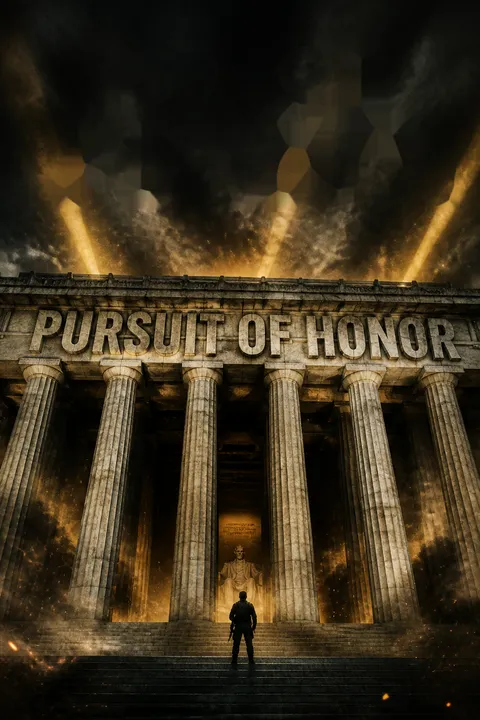


Plot Summary
Dinner Beneath the Rain
Six days after explosions kill 185 people in Washington, CIA operative Mitch Rapp watches Inspector General Glen Adams dine in New York with lawyer Kenny Urness.
Adams has spent years condemning the CIA's covert methods, but hidden microphones catch him offering classified operational information in exchange for help publishing a lucrative exposé. Rapp waits until Adams has crossed from abstract complaints into specific secrets, then arranges for a decoy driver to collect him.
When Adams enters the wrong Lincoln Town Car, Rapp climbs beside him, confiscates his phone, and knocks him unconscious. The attack is not a routine arrest. Rapp has decided that Adams may be a traitor, and the details of the dinner leave him only a narrow path to find out.
The opening places Rapp's certainty in tension with the need for evidence. He distrusts Adams, but he waits until the man exposes an actual transaction rather than acting on personal contempt alone. That restraint matters because the novel's political conflict repeatedly turns on who gets to define legality and necessity. Adams sees himself as a principled watchdog; Rapp sees a compromised official whose moral language masks self-interest. The rainbound surveillance scene makes betrayal intimate: the danger comes not from an outsider breaching the government, but from a senior insider using its secrets as private currency.
A Farmhouse in Iowa
While Rapp pursues Adams, Moroccan militant Hakim watches the news from a secluded Iowa farmhouse with Karim, his childhood friend and fellow attacker. The men fled the Washington bombings to wait out the nationwide search, but Hakim is already uneasy with Karim's appetite for the coverage and his tally of the dead.
Karim celebrates the secondary blast that killed rescuers and civilians, while Hakim sees the tactic as dishonorable and strategically foolish. He also suspects the reported casualty figures from their assault on the National Counterterrorism Center are far below the truth.
Their arguments reveal a widening divide: Karim treats violence and publicity as proof of strength, while Hakim clings to private memories, books, and a faith he can no longer reconcile with the men claiming to serve it.
Hakim's doubts are not yet a clean moral conversion. He remains part of the cell and still thinks in terms of escape, secrecy, and survival, but his attention has shifted from the operation's success to its human cost. Karim's casualty notebook turns suffering into a scoreboard, a way to keep emotional distance while feeding his own importance. Hakim's remembered marlin and his discomfort with the deaths expose a different psychological strategy: he preserves the capacity to imagine life beyond violence. Their friendship is therefore more than a personal bond. It is the last place where Karim might be challenged, and where Hakim's buried conscience can still speak.
The Hunters at the Door
Ted White arrives at the farmhouse with his teenage son, Hayden, hoping to hunt along the river as he has on the property before. Hakim recognizes the orange vests, understands the visitors are hunters, and gives them permission to pass through.
Karim emerges with his pistol raised, convinced the pair may be police, and shoots both men. When Hayden reaches for his phone, Karim kills him with another shot. Hakim refuses Karim's order to execute Ted, and the argument turns physical: Karim beats his friend unconscious, then forces Ahmed to help burn the farmhouse and conceal the bodies.
The men flee in their RV, leaving supplies behind and abandoning Hakim's carefully prepared escape routes. Karim's paranoia has transformed a refuge into a crime scene and placed the fugitives on a far more dangerous road.
This is the decisive fracture between Hakim's abstract unease and an immediate ethical refusal. The hunters pose no demonstrated threat; Karim's choice is driven by suspicion and command, not necessity. Hakim's resistance costs him his physical safety, but it also makes plain that obedience is no longer the price he is willing to pay for belonging. Karim answers dissent by recasting it as insubordination, a familiar mechanism in authoritarian relationships: disagreement becomes evidence of treachery. The murder also reverses the fugitives' tactical advantage. A safe house designed to disappear into the landscape now generates witnesses, missing-person reports, and a trail of hurried mistakes.
Hurley's Last Warning
At Stan Hurley's concealed Lake Anna facility, Rapp faces the question of what to do with Adams. Hurley, the retired operative who trained Rapp and knew Adams's father, believes the inspector general's betrayal deserves death.
Mike Nash objects that the CIA has no authority to execute a fellow American, and Hurley angrily rejects the challenge. After psychologist Thomas Lewis describes Adams's narcissism and lack of empathy, Hurley confronts him personally. Adams claims he is pursuing justice and threatens to expose Rapp.
When Hurley presses a pistol to Adams's head and fires, Rapp deflects the shot at the last instant. The bullet scars the wall. Adams collapses in terror, and Rapp recognizes that the failed execution has created a rare opportunity to learn what Adams knows.
Hurley's anger is not merely institutional. Adams is the son of his closest friend, so the decision to kill him binds professional judgment to grief and shame. Hurley believes he failed Adams long ago by protecting an unsuitable trainee, and his near-fatal act is an attempt to close that old account with a single irreversible answer. Rapp's intervention is pragmatic, but it also marks a limit: killing Adams now would destroy the chance to discover the source of the leak. Nash's legal objection, meanwhile, foreshadows his own strain. The argument is not a simple contest between conscience and brutality; each man is trying to prevent a different kind of catastrophe.
The Therapist's Hidden Wire
Rapp gives Adams a moment to recover, then returns to question him. Adams first insists he has done nothing wrong, but when Hurley prepares to finish the execution, he offers information in exchange for his life.
He admits that he leaked the CIA's covert mosque operation to reporter Barreiro, exposing the infiltration and contributing to agent Chris Johnson's capture and death. Adams learned about the operation by paying former security officer Max Johnson to bug therapist Thomas Lewis's office, where Kathy O'Brien, wife of the National Clandestine Service director, discussed classified matters.
The wiretap had no warrant. Lewis warns that Adams is too self-protective to trust, but Rapp orders the team to keep him alive and extract the full scope of the damage.
Adams's confession collapses the moral identity he has built for himself. He condemns Rapp for violating legal boundaries, yet secretly commits a more intimate breach by recording private therapy sessions without authorization. The contradiction is psychologically precise: he treats rules as weapons against people he resents, while granting himself exemptions when his ambitions are at stake. The revelation also makes the leak concrete. It did not merely embarrass the agency; it exposed a field operative whose work depended on secrecy. Rapp's decision to preserve Adams is therefore both tactical and diagnostic. The question becomes not whether Adams is innocent, but how much harm his vanity has already set in motion.
Nash Breaks Formation
The week of bombings has left Nash exhausted and haunted by colleagues killed at the Counterterrorism Center. During the drive to a presidential meeting, he condemns Rapp's treatment of Adams and refuses to treat an American as an enemy.
Rapp pulls over, strikes Nash when he continues arguing, and orders him to take time away or resign. At Langley, political fixer Gabriel Dickerson offers to turn the operatives' heroism into a public-relations shield, but Rapp refuses to become a public figure.
Senator Barbara Lonsdale, grieving her chief of staff and newly aware that her campaign against the CIA may have helped weaken security, changes sides. At a Judiciary hearing, Rapp publicly dismantles Senator Carol Ogden's moral attack, leaving the committee less willing to pursue him.
Nash's collapse is not a sudden conversion into pacifism. It is the delayed cost of combat, grief, and the effort to move between a covert identity and family life. Rapp reads his condition as operational danger, but responds with the blunt authority that also makes him difficult to trust. Washington's politicians mirror that instability: Lonsdale revises her position after personal loss, while Ogden keeps defending a fixed ideological frame. Dickerson offers visibility as protection, yet Rapp refuses because public acclaim would compromise the work. The section asks whether institutions can acknowledge sacrifice without turning the people who make it into instruments of political messaging.
Three Cells, One Survivor
Rapp meets British intelligence chief George Butler and French operative Catherine Cheval on Santa Maria Island because political pressure has made secure information-sharing more difficult. Their interrogations of captured attackers suggest three separate cells were assigned to New York, Los Angeles, and Washington.
One Moroccan, Ahmed Abdel Lah, appears to have survived the assault on the Counterterrorism Center, and a message to his brother confirms he is alive.
Butler links the third cell to a stolen cocaine shipment taken from a Brazilian cartel, then transferred through Cuba with help from General Manuel Ramirez. The route explains how the cell gained money and access to the region. Cheval also identifies the advance organizer as Hakim al Harbi, a Saudi who left the fighting before the attack.
The international conspiracy is assembled through fragments rather than a single authoritative briefing. The allies know pieces because they have different sources, different legal cultures, and different willingness to hide their methods from elected officials. That fragmentation mirrors the novel's larger distrust of bureaucratic neatness: the attack has outrun the institutions designed to explain it. The cocaine trail is especially revealing because it converts ideology into logistics. The terrorists do not operate outside the global economy; they exploit its illicit routes, financial secrecy, and political intermediaries. Rapp's dependence on Butler and Cheval also exposes the cost of American distrust among allies, whose cooperation is valuable precisely because it cannot be treated as uncomplicated.
A Russian's Useful Traitor
Rapp and former Navy SEAL Scott Coleman locate Max Johnson at a Washington nightclub frequented by Russian financier Peter Sidorov. When a Russian bouncer blocks them, Rapp disables him and pushes through to the private section, where Johnson tries to hide behind Sidorov's protection.
Rapp removes him from the club and takes him to a disused CIA facility. Under pressure, Johnson admits he has been selling surveillance expertise to Sidorov and helping Adams gather information. He confirms that the therapist's office was monitored remotely and that copies of the recordings exist.
Rapp threatens him, wounds his foot, then offers a conditional chance to work for the CIA if he tells the whole truth. Johnson begins documenting his illegal dealings, giving Rapp a possible source inside Sidorov's network.
Max Johnson's capture extends the book's concern with expertise detached from responsibility. He has technical skill and institutional knowledge, but treats both as marketable assets rather than obligations to the public. Sidorov's wealth gives him the appearance of legitimacy, while Johnson's presence demonstrates how readily private influence can purchase access to state secrets. Rapp's methods are deliberately coercive, yet he offers Johnson a path toward usefulness rather than immediate punishment. This is not a clean moral redemption; it is an intelligence calculation built on the possibility that fear can be redirected into cooperation. The scene also shows how Rapp's informal power grows when legal institutions cannot act at the speed he believes the threat demands.
The Lion's Second Home
After Karim burns the Iowa farmhouse, he ignores Hakim's route instructions and loses hours on rural roads. The men reach a Missouri safe house, but Karim's choices leave them without reliable navigation or fuel.
At another property in Arkansas, he shoots the retired owner, Dan Stewart, and then kills Stewart's sleeping wife. Hakim sees the bodies and can no longer pretend that Karim's violence is a tactical necessity. Ahmed, who has been tending Hakim's injuries, secretly helps him escape in the owners' Cadillac, placing Hakim's packed bag in the car.
Hakim drives south toward New Orleans, using a false identity and a phone to taunt Karim. He then travels to Nassau, where a hidden bank account and safety-deposit box offer him a chance to vanish.
The repeated killings make Karim's language of necessity increasingly untenable. At Iowa, his fear could still be mistaken for a panicked response; in Arkansas, the murders of an elderly couple reveal a pattern of domination and convenience. Hakim's escape depends on Ahmed, the follower who once claimed he had no right to question orders. His small act of assistance is morally significant because it turns private doubt into action. Hakim, meanwhile, does not become an uncomplicated hero. He has helped build the network and now seeks safety, but his refusal to keep enabling Karim is a real break from the role assigned to him.
A Banker in Nassau
Rapp travels to Nassau and confronts General Ramirez, who helped the attackers move cocaine through Cuba. Ramirez demands a million dollars for information; Rapp instead threatens to expose him to the cartel whose shipment was stolen.
The general gives up the name of the intermediary and the bank holding the money. At First Caribbean, Rapp's team tracks Hakim as he opens his safety-deposit box and retrieves cash and bearer bonds for a planned escape. Rapp's men tranquilize and seize him outside the bank.
In the van, Rapp finds Karim's furious voice messages, including a warning that he is still in America and intends to continue his mission. Hakim's capture supplies the missing personal connection to the surviving attackers, but the message makes clear that the threat is still moving toward Washington.
The Nassau operation brings competing systems of power into one narrow space: cartel violence, Cuban corruption, offshore finance, and clandestine counterterrorism. Ramirez believes every problem has a price, while Rapp refuses to treat payment as a substitute for control. Hakim's attempted withdrawal makes his transition tangible. He has planned a life beyond the cell, but his escape remains entangled in the same secret economy that financed the attack. The voice messages transform him from a captured suspect into a source with intimate knowledge of Karim. Rapp's success is therefore incomplete: he has the organizer, but Karim's message announces that personal revenge has replaced strategic retreat.
The Medal Becomes Bait
To pull Nash away from covert work and toward his wife and children, Rapp arranges an unannounced medal ceremony in the Oval Office. Nash is stunned to find Maggie, their children, the president, and senior officials waiting for him.
The ceremony recognizes his role in stopping the Counterterrorism Center assault, and reporters record the event despite his nonofficial cover. Karim watches the broadcast from a stolen house in Virginia. He cannot bear the public praise given to Nash or the president's account of the attack, and he decides to strike Washington himself.
Using online records, Karim studies Nash's home, family, and routines. He and Ahmed then raid a Saudi Aramco residence, kill the owner and a woman with him, and take a vehicle to pursue Nash's family.
Rapp's protective plan succeeds emotionally and fails tactically. Nash receives public recognition and his family sees the work that had been hidden from them, but the exposure also gives Karim a target map. The same publicity intended to strengthen morale supplies the attacker with names, photographs, and routines. This is not an argument that recognition is inherently dangerous; it is a collision between a human need to acknowledge sacrifice and a security culture that depends on anonymity. Karim's response also shows how thoroughly he confuses reputation with spiritual worth. He treats Nash's medal as a personal insult and makes violence the instrument by which he hopes to restore his imagined stature.
The Family in the Crosshairs
While Nash and Maggie are out for dinner, their fifteen-year-old daughter Shannon takes the family minivan around the block. Karim and Ahmed intercept her, pull her from the vehicle, and drive away in a black Suburban. Nash returns to find the police speaking with a witness, who reports the abduction.
Karim calls from Shannon's phone and demands Nash in exchange for her life, promising to announce the meeting through television stations. Nash agrees, then calls Rapp. Rapp brings him, Hakim, Lewis, and a small team to the Lincoln Memorial, where police and cameras have gathered.
Nash insists on trading himself for Shannon, but Rapp recognizes that Karim wants a public execution as much as a hostage exchange. The hostage's location and Karim's need for spectacle make delay dangerous.
The kidnapping strips away the arguments that had kept Nash at a professional distance. He is no longer debating a hypothetical moral boundary; he is a father deciding whether to enter a trap because his child is inside it. Karim exploits that attachment with calculated theatricality, choosing a place where the hostage's suffering can become a performance. The family information he gathered online has turned public visibility into an operational vulnerability. Rapp's role shifts from commander to friend: he must protect Nash from the impulse to sacrifice himself without dismissing the reason that impulse exists. Hakim's presence offers a rare advantage, since Karim's personal grievances may make him less controlled than his military posture suggests.
The Lincoln Memorial Siege
At the memorial, Nash moves toward the exchange despite FBI and police commanders trying to hold him back. Rapp buys time by asking him to call Maggie, then injects him with a sedative before he can walk into Karim's line of fire. Karim is on the north side of the monument; Ahmed has taken a rooftop position with a sniper rifle. Rapp gives Hakim the phone and directs him to provoke Karim.
When Karim responds, CIA marksman Wicker shoots Ahmed from a nearby roof. Rapp and Reavers enter the memorial and find Karim holding no visible hostage. Rapp spots Shannon in the shadows, then fires into Karim's body armor and kills him with a final shot to the head. Shannon is alive, and the attacker's planned spectacle ends in sudden silence.
The climax resolves the conflict between Rapp's tactical judgment and Nash's parental desperation through an action that is both protective and coercive. Rapp sedates his friend without consent because he believes Nash's sacrifice would hand Karim the exact image he wants. Hakim's words are used as an instrument, but they also turn Karim's obsession with reputation against him. The two threats are divided across the space: Wicker neutralizes Ahmed at distance, while Rapp enters the monument to confront Karim at close range. The rescue is successful, yet it does not erase the costs of Rapp's authority. He saves Nash's family by overriding Nash, preserving the friendship only because the danger leaves no time for negotiation.
Lake Anna Reckoning
Kennedy evacuates the Nash family from their besieged neighborhood to Lake Anna, where Shannon recovers under Lewis's care. Maggie thanks Rapp for bringing her husband and daughter back, and Nash admits that he would have been killed if Rapp had let him make the exchange. Around the fire, Nash breaks down over how close he came to losing Shannon, then accepts comfort from Rapp, Hurley, and Coleman.
The men discuss Max Johnson's possible value as a recruit and the need to examine Hakim's role in the attacks. Hurley asks Nash to decide Adams's fate, but Nash says he is not stable enough to make that judgment and chooses to return to his wife and children instead. Rapp and Hurley take responsibility for what remains unresolved.
The final movement is deliberately quieter than the rescue, shifting from operational success to emotional aftermath. Nash's tears acknowledge a vulnerability that his public medal could not express. His decision to leave Adams's fate to Rapp and Hurley is not an endorsement of their methods; it is an admission that his family needs him outside the machinery of covert violence. Rapp's earlier plan to redirect Nash toward home has worked, but the cost is that Rapp remains inside the moral burden he hoped to share. The fire gathers the men into familiar banter, a fragile ritual of belonging after catastrophe. The questions of justice, accountability, and trust remain open rather than neatly settled.
Analysis
Pursuit of Honor places national security inside a conflict over who is allowed to act, who must answer for the consequences, and what counts as honor when the rules are under pressure. Its political debate is made concrete through characters who apply principles unevenly. Adams invokes legality while secretly violating privacy; Ogden condemns coercion while resisting evidence that the threat is immediate; Rapp defends force while knowing that his methods can damage the institutions he serves. None of these positions remains purely abstract because each produces a body, a leak, a compromised source, or a family in danger.
The novel's strongest psychological counterpoint is between Rapp and Nash. Rapp experiences competence as a duty to absorb risk and make decisions for others. Nash's family gives him a daily measure of what that duty can destroy. Their conflict is not resolved by proving one man right. Rapp saves Nash's daughter by overriding him, while Nash's final withdrawal from the decision about Adams protects his family and acknowledges his own compromised judgment. The friendship survives because both men understand the cost of the other's choice.
Hakim and Karim offer a parallel study in how violence reshapes friendship. Karim's battlefield success feeds a public identity that cannot tolerate correction; he increasingly mistakes control for faith and acclaim for proof of righteousness. Hakim's moral break is gradual and costly, made credible by his earlier complicity and his continuing desire to survive. Ahmed's hesitation shows that even within a rigid command structure, obedience is a choice that can be interrupted.
The medal ceremony crystallizes the novel's central paradox. Public recognition restores a measure of dignity to covert service, but it also exposes Nash and his family. The story's answer is not that secrecy or publicity is always preferable. It is that institutions must recognize human sacrifice without pretending that recognition is harmless, and that honor depends less on a public label than on what people do when loyalty, law, and survival pull in different directions.
Review Summary
Pursuit of Honor received mostly positive reviews, with an average rating of 4.36/5. Readers praised the fast-paced action, character development, and continuation of the previous book's storyline. Many enjoyed Mitch Rapp's character and the political intrigue. Some criticized the right-wing ideology and repetitive plot elements. The book was noted for its exploration of moral dilemmas in counterterrorism. While some found it thrilling and thought-provoking, others felt the series had become predictable.
People Also Read



Characters
Mitch Rapp
Relentless covert operativeRapp is the CIA's most feared counterterrorism operative, trained to make decisions under pressure and unwilling to let political caution become paralysis. He relies on observation, physical discipline, and an instinct for finding the point where an opponent's confidence will fail. His certainty can look like cruelty, especially when he uses violence against people he considers dangerous, but it is bound to a deep sense of responsibility for preventing further deaths. The loss of his wife, Anna, has left him convinced that ordinary domestic happiness is no longer available to him. His loyalty to Nash and Maggie shows that this belief is not emotional indifference. He cares intensely, then tries to protect others by taking the risks and decisions onto himself.
Mike Nash
Wounded Marine turned operativeNash is a former Marine officer and CIA operative, a capable leader whose combat discipline is tested by the deaths of colleagues at the Counterterrorism Center. Unlike Rapp, he has a wife and four children whose everyday needs keep the costs of covert work in view. His conscience is not abstract: he questions what the team may do to a fellow American and struggles to reconcile secrecy with the example he wants to set at home. Nash's loyalty makes him brave, but also vulnerable to taking responsibility for everyone around him. He and Rapp share trust forged in dangerous operations, yet their different temperaments create friction whenever Rapp's decisiveness seems to leave no room for moral doubt.
Hakim al Harbi
Restless militantHakim is a Saudi-trained organizer who has spent years moving between cultures, countries, and militant networks. He is more reflective than his companions, drawn to American literature and fishing as well as the practical demands of clandestine work. His faith remains important to him, but he has grown suspicious of leaders who claim unquestionable access to religious truth. Hakim values patience and planning, qualities that put him at odds with Karim's appetite for dramatic action. He is neither naïve nor untouched by violence; he has participated in the cause and understands its methods. His struggle centers on whether loyalty to an old friend can survive the widening gap between shared history and present conduct.
Karim
Self-crowned commanderKarim is a skilled militant commander whose battlefield confidence has hardened into a need for obedience and acclaim. He prizes discipline when it serves his authority, but reacts to disagreement as a personal betrayal. His self-image as a heroic leader is fed by the attention given to the attacks and by his imagined place in a larger religious struggle. This makes him effective at planning violence and dangerously poor at recognizing when pride has replaced strategy. His bond with Hakim goes back to childhood, which gives their conflict unusual force: Karim expects the friend who knows him best to validate the identity he has built, while Hakim's independent judgment threatens that identity.
Glen Adams
Self-appointed watchdogAdams is the CIA's inspector general, a former prosecutor who sees himself as an advocate for constitutional limits and accountability. His family history in the agency gives his appointment personal weight, especially because he hopes it might repair a damaged relationship with his father. He is intelligent, ambitious, and highly sensitive to disrespect, traits that shape how he interprets criticism from field operatives. Adams's conviction that he is uniquely qualified to expose institutional wrongdoing makes him vulnerable to rationalizing methods he would condemn in others. His role brings the novel's central political dispute into one person: the difference between genuine oversight and the use of principle to protect ego or advance private ambition.
Stan Hurley
Hard-bitten mentorHurley is a retired CIA operative who trained Rapp and remains a forceful presence in the clandestine world. He trusts experience over theory and has little patience for people who criticize dangerous work without having carried it out. Beneath his abrasive manner lies an old loyalty to Adams's father, which makes the younger man's conduct a source of personal shame as well as anger. Hurley often treats severity as the only language that will penetrate self-deception. His bond with Rapp is shaped by respect, challenge, and a shared understanding that their work leaves few clean choices.
Irene Kennedy
Strategic CIA directorKennedy leads the CIA while managing the distance between covert operations and the political officials who demand answers from them. She knows Rapp's strengths and his liabilities, and often has to contain the consequences of his independent decisions without undermining the work he does. Her authority rests on judgment rather than spectacle. She is willing to hear uncomfortable arguments about national security, but she also understands that secrecy, sources, and allied trust can be damaged by careless disclosure. Kennedy's friendship with Rapp gives their professional disagreements emotional depth, while her position requires her to translate his world into terms that institutions can survive.
Mike Nash's family
Home beyond the missionMaggie Nash and the couple's four children give Nash a life that cannot be reduced to operational duty. Maggie works in public relations and understands Washington's image-making machinery, but she resists the danger and secrecy that come with her husband's career. She is loving without being passive, and her concern for the children makes the costs of covert service concrete. Shannon, Rory, Jack, and Charlie represent different ages and needs, from teenage independence to toddler dependence. Together they are not simply a motive for Nash's bravery. They are the daily relationships he must return to if his professional identity is not to consume every other part of him.
Thomas Lewis
Trusted agency therapistLewis is a clinical psychologist trusted by people at Langley who rarely discuss their private distress. He offers a professional language for patterns that operatives tend to frame as discipline, weakness, or insubordination. His work becomes entangled with the agency's security culture because clients share sensitive information in a setting they believe is private. Lewis is both a clinician and a participant in a world where confidentiality can conflict with operational necessity. He tries to protect his patients while recognizing that a compromised office may put many more people at risk.
Ahmed Abdel Lah
Uneasy sniperAhmed is a Moroccan member of Karim's cell, trained as a sniper and accustomed to following the chain of command. He often appears slow to understand, but his hesitation around unnecessary violence suggests a more complicated inner life than Karim assumes. He tends the injured Hakim and faces the difference between obedience and judgment without the confidence to resolve it quickly. Ahmed's position is precarious: he respects Karim's battlefield ability, yet he can see the damage caused by the commander's personal vendettas. His divided loyalties make him a revealing counterpoint to Karim's insistence that discipline means unquestioning compliance.
Max Johnson
Surveillance specialistJohnson is a former CIA security officer whose technical knowledge and long institutional experience make him useful to people seeking access to secrets. He is observant and capable, but his sense of professional identity has become entangled with resentment toward field operatives who disregard rules he was hired to enforce. He believes his work can be justified by the importance of the target, a rationalization that blurs the line between oversight and intrusion. Under pressure, Johnson reveals a mixture of fear, self-pity, and practical adaptability. His technical skill creates the possibility of cooperation, but it does not automatically make him trustworthy.
Barbara Lonsdale
Grieving Senate allyLonsdale is a senior senator and former critic of the CIA whose chief of staff is killed in the Washington attack. She is accustomed to using oversight as a tool of political accountability, but grief forces her to reconsider whether her campaign against the agency has served the public good. Her change of position is not effortless or free of self-doubt. She remains a skilled political operator who understands how committee alliances and public narratives work. By choosing to support the agency more openly, she accepts the political risk of being attacked by former allies.
Carol Ogden
Unyielding CIA criticOgden is a senior senator who believes the CIA's covert methods threaten the country's legal and moral commitments. She is articulate, disciplined, and accustomed to pressing her position even when colleagues find it politically inconvenient. Her certainty allows her to resist public pressure, but it can also make her slow to reconsider whether the facts have changed. She sees Rapp as a symbol of institutional excess and uses hearings to challenge his authority. Her conflict with him is ideological as well as personal, though each believes the other's actions endanger the country.
Gabriel Dickerson
Presidential political fixerDickerson is an experienced Washington strategist who understands how reputation, access, and deniability shape political power. He can read people quickly and uses charm as effectively as pressure. His proposed public-relations campaign is rooted in a pragmatic belief that the CIA needs political protection, not merely operational success. He respects Rapp's abilities but approaches him as a potential public asset, creating friction with an operative who values anonymity. Dickerson's polished manner conceals a hard understanding of how officials protect themselves when consequences approach.
Peter Sidorov
Russian financierSidorov is a wealthy Russian investor whose business reach extends into Washington and Cuba. Educated, calculating, and accustomed to being protected by money, he treats risk as something that can be managed through relationships. His interest in Max Johnson shows how commercial ambition can intersect with intelligence and political influence. Sidorov is neither a straightforward ally nor an obvious enemy to Rapp. He evaluates people according to usefulness, while Rapp tries to determine whether their interests can briefly align without creating a larger threat.
Scott Coleman
Rapp's field partnerColeman is a retired Navy SEAL who supports Rapp with surveillance, logistics, and direct action. He is disciplined enough to question an impulsive plan but experienced enough to recognize when debate will not change Rapp's decision. His loyalty is practical rather than theatrical: he prepares contingencies, monitors risks, and speaks plainly when a situation looks wrong. Coleman often acts as a stabilizing presence around Rapp, though he shares the same willingness to work outside ordinary procedures when he believes the threat requires it.
George Butler
British intelligence partnerButler heads British counterterrorism work and shares sensitive intelligence with Rapp when American political and legal channels become difficult to use. He is cautious about protecting sources, yet willing to travel and act quickly when the threat is urgent. His relationship with Rapp is marked by professional trust and dry humor, alongside recurring concern that Rapp's methods may create diplomatic consequences. Butler's value lies not only in what he knows, but in his ability to assess what information can safely be passed across borders.
Catherine Cheval
French intelligence chiefCheval leads French intelligence work on the militant network and is an old professional ally of Kennedy and Rapp. She is careful with sources and skeptical of information that cannot be independently checked. Her teams' interrogations provide crucial pieces of the larger plot, but she understands that sharing them may expose people who cannot be replaced. Cheval respects Rapp's effectiveness while recognizing the strain his style places on those responsible for him. Her cautious judgment balances his appetite for immediate action.
Chris Johnson
Lost undercover agentChris Johnson is an Army veteran recruited by Nash to infiltrate a radical mosque. His work is designed to remain invisible, making his eventual loss especially painful to the colleagues who relied on him. He represents the human cost hidden behind arguments about surveillance and oversight: a field operative whose safety depends on information remaining secret.
Anna Rapp
Rapp's absent wifeAnna was Rapp's wife, and her death left him with a lasting sense of guilt over bringing danger into their life together. In memory, she represents the ordinary future he believed he could maintain alongside covert work. Rapp's reflections on her reveal the private cost beneath his controlled manner and his reluctance to imagine a new family life.
President Alexander
Executive under pressurePresident Alexander must respond to a mass-casualty attack while facing demands for results and political scrutiny. He recognizes the value of Rapp and Nash's work, yet keeps distance from actions that could become politically damaging. His decisions reveal the gap between the executive's authority and the covert risks carried by operatives.
Manuel Ramirez
Cuban military brokerRamirez is a Cuban general who uses his position to facilitate illicit business and expects payment for information. He is confident that foreign officials will bargain rather than threaten him, reflecting a political world where influence and money often substitute for trust.
Plot Devices
The Secret Farmhouse
A refuge that becomes evidenceHakim purchases an isolated Iowa property through a conservancy trust and stocks it with weapons, food, cash, and escape supplies. The location seems ideal because it is remote and difficult to find, but its weaknesses emerge when local hunters arrive and Karim reacts violently. The subsequent fire and abandoned provisions give law enforcement a trail to investigate. The farmhouse embodies the difference between a sound plan and the people executing it: Hakim anticipates contingencies, while Karim's suspicion destroys the conditions that made the refuge useful.
The Therapist's Recordings
Private speech becomes exposureMax Johnson installs remote surveillance aimed at Thomas Lewis's office, where CIA personnel and their families discuss private matters. Adams uses the recordings to identify covert operations and leaks information about an undercover mosque mission. The device turns therapy into a vulnerability and links institutional oversight to personal betrayal. Its existence also creates a chain of secondary threats: other clients may be exposed, copies may circulate, and even a trusted therapist cannot assume that a private room is secure.
Cocaine and Offshore Accounts
Crime finances the attackThe terrorist cell steals a large cocaine shipment from a Brazilian cartel, moves part of it through Cuba, and uses the proceeds to support its American operation. General Ramirez helps facilitate the transfer in return for a share. Money is hidden in offshore accounts and bearer bonds, allowing Hakim to attempt an escape through Nassau. The financial trail links terrorism to organized crime and corrupt state actors, while giving Rapp leverage when traditional intelligence leads prove inadequate.
The Public Medal
Recognition exposes a familyThe White House awards Nash a medal in a ceremony that reveals his covert identity and puts his family into public view. Rapp intends the recognition to honor Nash and help draw him away from field work, but Karim watches the broadcast and uses public information to identify Nash's children and home. The ceremony demonstrates the double edge of public acknowledgment: it can repair secrecy's emotional damage, yet it can also give an attacker names, images, and a reason to target the person being celebrated.
Burner Phone Messages
A feud becomes a tracking leadHakim and Karim use prepaid phones to communicate after their escape plans collapse. Their bitter messages expose Karim's continued presence in the United States and reveal his intent to keep pursuing the mission. When Rapp captures Hakim, he uses the stored messages and phone activity to verify Hakim's account and narrow the search for Karim. The same communications meant to preserve contact become evidence of the cell's growing internal fracture.
Mitch Rapp Series Series





About the Author
Download PDF
Download EPUB
.epub digital book format is ideal for reading ebooks on phones, tablets, and e-readers.








