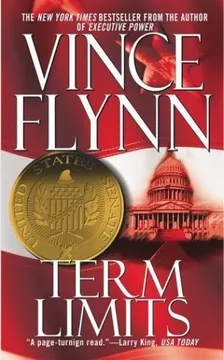


Plot Summary
Prologue
In a cabin outside Washington, a former government assassin2 burns months of surveillance records after studying the routines of his targets. He has spent his career killing people abroad in the name of American security.
Now he is preparing to strike on American soil, convinced that the politicians he has watched are responsible for the deaths of his closest friends. By the next day, his carefully planned operation will overturn the capital’s political order.
The opening makes the coming violence legible without yet making it just. Its assassin is neither an abstract terrorist nor a faceless criminal: he is a trained instrument of state power who has turned his expertise against the institutions that employed him. Burning the records closes the gap between preparation and action, while his belief that his victims are culpable gives political murder the shape of personal justice. That framing invites sympathy, then places the reader under pressure to distinguish a compelling grievance from a legitimate authority to kill.
The Freshman Says No
Freshman Congressman Michael O’Rourke1 has already decided not to seek another term, and he refuses to support President Stevens’s10 budget unless it ends funding for the Rural Electrification Administration.
Stevens10 tries to persuade him; party enforcer Jack Koslowski17 sends aide Anthony Vanelli21 to threaten his career and district funding. O’Rourke1 records Vanelli’s21 threat, twists his wrist when he lunges for the recorder, and warns him that the tape can reach the FBI and the press.
Meanwhile, White House chief of staff Stu Garret9 pushes the President10 to secure votes through pressure and favors. O’Rourke’s1 defiance makes him a target in Washington’s vote-counting machine, but also marks him as a man unwilling to trade principle for a political future.
O’Rourke’s refusal is more than a policy disagreement: his demand to eliminate a program that has outlived its purpose exposes the gap between public justification and private political use. The recording makes his resistance unusually concrete. He does not merely condemn coercion; he preserves evidence and turns physical training against a representative of the machine. Yet his decision not to seek reelection complicates the posture of the principled outsider. He is not building a career on dissent. He is trying to leave before Washington teaches him to accept its methods.
Three Targets Before Dawn
The operation begins with Senator Daniel Fitzgerald,16 found dead in his home after an intruder enters and kills him by hand. Hours later, a shooter kills Koslowski17 from a neighboring house, after drugging the homeowner and his German shepherd rather than harming them.
Senator Robert Downs18 is shot at close range on his morning dog walk. The separate methods and carefully chosen moments point to extensive planning, while the survival of the bystanders suggests the killers are trained to limit casualties.
FBI agent Skip McMahon5 takes charge of the investigation before the city has finished absorbing the news. The deaths also remove three powerful figures from the budget fight, making the timing impossible to separate from the political crisis already underway.
The killings establish the thriller’s central moral distinction through method as well as motive. The attackers show a disciplined concern for bystanders, but that restraint cannot make assassination lawful or democratic. Meanwhile, each victim belongs to the same political structure, and each death disrupts a particular channel of power. The sequence is designed to be read as both tactical execution and political message. McMahon’s early involvement grounds the story in investigation, even as the precision of the crimes hints that ordinary evidence may not be enough.
A Letter Sets Terms
A letter mailed before the murders reaches a television newsroom and claims responsibility. Its authors cite the national debt, deficit spending, and obsolete government programs, and demand a balanced budget, spending cuts, limits on entitlement growth, a crime bill, and a national sales tax dedicated to the debt.
The letter threatens further killings if officials refuse. At the White House, Garret9 urges Stevens10 to describe the message as a possible diversion, though the FBI has not reached that conclusion.
McMahon5 instead treats the threat as credible and begins coordinating protection for lawmakers. The public hears a demand for political change; the administration hears a threat to its authority and tries to control the story before the investigators can establish what is true.
The letter turns murder into a contest over interpretation. Its authors claim to defend representative government by bypassing representation, and the administration claims to defend democracy while manipulating information about the investigation. Neither side can monopolize the language of public service. The specific policy demands keep the conflict from becoming a vague revolt, but their delivery by threat makes agreement ethically unstable. The letter’s prior mailing gives investigators a strong authenticity clue, while the White House’s haste to call it disinformation reveals that preserving political advantage may matter more than establishing facts.
The Speaker Falls
Stevens10 addresses the nation by praising the murdered politicians and portraying their killers as enemies of democracy. Garret9 and communications director Ted Hopkinson shape the speech for its effect on viewers, while secretly encouraging reports that the letter may be false.
Public opinion remains divided, and House Speaker Thomas Basset19 refuses to suspend his public schedule. During a televised appearance, an attacker uses smoke and a planted rifle position to kill Basset19 despite his Secret Service detail.
The assassins then call a network to explain that he was killed because officials ignored their warning. His death demonstrates that a visible security ring cannot protect a target whose movements are predictable, and it forces frightened lawmakers to reconsider the threat.
Basset’s death converts the administration’s media strategy into a security failure. Officials treat visibility as a source of legitimacy and reassurance, but the attacker turns the scheduled appearance into a map of the target’s movements. The attack also intensifies the divide between political theater and physical responsibility: Stevens’s carefully managed speech can shape a public image, yet it cannot make the capital safe. Basset’s refusal to withdraw is not simple vanity, since public leadership matters in a crisis, but his choice exposes the limits of symbolic courage when protection is inadequate.
One Senator Walks
At the Capitol funeral for Fitzgerald,16 Downs,18 Koslowski,17 and Basset,19 Senator Erik Olson11 decides to walk behind the caissons despite the security warning. He asks O’Rourke1 to accompany him. O’Rourke1 initially resists because he despises the dead men’s political record, but memories of Olson’s11 support after his parents died bring him to the procession.
The two Minnesotans walk past the watching crowd while other lawmakers remain protected indoors. O’Rourke’s1 choice also unsettles Liz Scarlatti,4 his journalist girlfriend,4 who learns of his participation from television and fears he has put his life at risk without telling her. Their conflict reveals the human cost of his secrecy and the personal stakes behind his public defiance.
The procession gives public courage a personal rather than rhetorical measure. O’Rourke does not suddenly admire the politicians being honored. He walks because Olson has served as a substitute father and because gratitude can demand action even when judgment remains critical. His silence toward Liz shows the cost of treating danger as a private burden: he protects her from information while denying her the ability to share the risk. The scene therefore complicates his self-image as a principled man. Loyalty, love, and political conviction pull him in different directions, and none can simply cancel the others.
The Coalition Turns
President Stevens10 and Olson11 try to form a bipartisan front after Basset’s19 murder. At Camp David, Garret9 proposes accounting tricks that make the budget appear leaner without cutting the underlying spending.
Olson11 agrees to keep the plan quiet briefly, then tells the President10 he will expose the deception unless genuine reductions follow. He also tells O’Rourke1 that the proposed savings are a sham. Before the promised deadline, a bomb destroys Olson’s11 limousine, killing him and four Secret Service agents while O’Rourke1 and Seamus O’Rourke3 are nearby.
The blast leaves Seamus3 injured and turns the reform dispute into a second, more personal emergency. O’Rourke1 now has reason to fear that someone is killing honest lawmakers as well as political targets.
Olson’s shift from cautious coalition-builder to reluctant critic makes his death a consequence of political choice, not mere circumstance. He recognizes that a unity performance can conceal continuity in the very spending practices the crisis is meant to confront. His ultimatum is an attempt to reclaim public accountability from behind closed doors. The bombing destroys not only a person but the possibility of gradual reform through trusted negotiation. For O’Rourke, the loss also collapses the boundary between Washington’s institutional crisis and his private circle of loyalty.
A Second Hand Strikes
Congressman Burt Turnquist20 is killed at home with four U.S. marshals assigned to protect him. The attack is swift and professionally executed, but it differs sharply from the earlier killings because it deliberately takes the lives of law enforcement officers.
An anonymous caller reaches McMahon5 and says the group responsible for the first four assassinations did not kill Olson11 or Turnquist;20 the caller cites the spared homeowner and the earlier warning about protecting agents as proof.
McMahon5 cannot accept the claim without evidence, but the distinction fits the different tactics. President Stevens10 responds by suspending legislative business and declaring martial law around the Capitol and White House. The investigation now has to consider a second group, even as military forces fill the streets.
The anonymous call introduces a crucial ethical and investigative fracture: the perpetrators who spared civilians may not be the ones killing protectors and lawmakers now. McMahon’s task is to resist both easy certainty and political pressure, since a false conclusion could direct force at the wrong people. Martial law offers an image of control but also raises the stakes by placing armed authority in public space. The contrast between groups makes method a form of evidence, while also warning that similar political violence can conceal different motives.
The SEAL Trail
McMahon5 and CIA analyst Irene Kennedy6 investigate whether former American commandos carried out the first attacks. A search of military files points toward Scott Coleman,2 a retired Navy SEAL commander granted an unusual early discharge after Operation Snatch Back failed in Libya and eight of his men died.
The mission had been compromised by Senator Fitzgerald,16 who inadvertently revealed it while speaking to a bartender. O’Rourke1 learned Fitzgerald’s16 role through Olson11 and later told Coleman,2 who had lost his brother and team members.
Meanwhile, Seamus3 and O’Rourke1 consult retired CIA analyst Augie Jackson,14 who identifies Arthur Higgins12 as a likely architect of the separate attacks on Olson11 and Turnquist.20 The clues now connect private grief, classified failures, and a former intelligence officer with powerful old grudges.
The investigation discovers that institutional secrecy can preserve both legitimate operations and lethal resentments. Fitzgerald’s careless disclosure is not a deliberate betrayal, yet its consequences are irreversible for Coleman and his men. O’Rourke’s disclosure to Coleman comes from loyalty and a soldier’s instinct that the bereaved deserve the truth, but it also helps set violence in motion. The emerging suspects are therefore not driven by abstract ideology alone. Their motives grow from losses that the political system concealed or failed to repair, making moral certainty especially dangerous.
Higgins Comes Out
With Augie’s14 intelligence on Higgins’s12 estate, Coleman,2 O’Rourke,1 and two former SEALs reconnoiter the property and wait for Higgins’s12 nightly cigar. They cross the wall, kill the guards who block them, disable the cameras, and carry Higgins12 away in a fast boat. The team plants a decoy boat and clothing to mislead the CIA’s tracking system, then brings Higgins12 to O’Rourke’s1 home.
There, Coleman2 uses sodium pentothal while O’Rourke1 records the interrogation. Higgins12 admits he arranged the killings of Olson11 and Turnquist20 with Nance8 and Garret,9 hoping to remove Olson11 as an obstacle and regain influence at the CIA. Coleman2 then kills Higgins,12 and the men place his body at Garret’s9 house to make the connection impossible to ignore.
The capture is a tactical triumph that also exposes the ethical instability of the protagonists’ methods. Coleman’s team uses the same planning, surveillance, and lethal force that once served the state, now in an unauthorized operation against a former state operative. The confession confirms that the second wave of murders was not a continuation of the reform campaign but a private power play concealed by its public cause. Yet extracting truth through drugs and then killing the source leaves the evidence morally and legally compromised, foreshadowing the institution-wide bargain that will follow.
The Tape Changes Everything
The recording and a written ultimatum reach O’Rourke,1 who takes them to McMahon5 and Stansfield.7 Higgins’s confession implicates Nance8 and Garret9 in Olson’s11 and Turnquist’s20 murders, and reveals that the old CIA operation in France also involved assassinating elected officials.
The letter demands Nance’s8 resignation, Garret’s9 departure from public life, compensation for the families of the dead agents, and political reforms; it threatens to release the tape if officials refuse.
At the White House, O’Rourke1 confronts Nance8 and Garret,9 then strikes Nance8 and forces Garret9 to admit his part. Stevens10 is shocked and appears unaware of the plot. Stansfield7 and FBI director Brian Roach15 agree to suppress prosecution and negotiate, fearing that publication would shatter public trust and cripple the CIA.
The tape changes the conflict from a hunt for killers into a crisis of institutional legitimacy. Its contents implicate not only individual officials but the state’s history of covert violence, making disclosure potentially more destructive than the crimes themselves. The protagonists’ demand for accountability is consequently compromised by blackmail, while the FBI and CIA choose secrecy to prevent a larger rupture. O’Rourke’s physical assault of Nance is emotionally understandable after Olson’s death, but it mirrors the coercion he opposed in Vanelli. The story refuses to let righteous anger remain morally clean.
The Congressman Taken
Although the officials appear ready to accept the ultimatum, Nance8 refuses to surrender control. He hires a former intelligence operative22 who uses a Taser and muscle relaxant to abduct O’Rourke1 from his home while Liz4 is out buying groceries.
When Liz4 returns, she finds a broken table and no Michael.1 She alerts Seamus3 and Tim,13 then calls Stansfield7 and threatens to publish what she knows unless O’Rourke1 is returned. Seamus3 concludes that Nance8 and Garret9 are responsible and contacts Coleman2 through their coded pager system.
Coleman2 realizes the FBI is already following him, but leaves his apartment with equipment and calls Stansfield.7 Nance’s8 kidnapping converts a political bargain into an immediate rescue crisis and puts O’Rourke’s1 life in danger.
Nance’s abduction shows how a compromised official responds when institutional pressure removes his usual tools: he turns to private violence. Liz’s ultimatum reverses the familiar division between reporter and source. She uses the threat of publication not to chase a story but to protect the person she loves, even though public disclosure could endanger him further. Seamus and Coleman’s coded communications reveal the infrastructure of trust that makes their secret campaign possible. The same secrecy that once protected their operation now becomes the only means of locating O’Rourke.
The CIA Breaks In
Stansfield7 tracks Nance’s8 ranch by satellite and arrives with two CIA tactical teams. Inside, Nance8 has beaten O’Rourke1 and prepares a syringe of truth serum, while Garret9 tries to withdraw from the scheme. Stansfield7 calls Nance,8 receives no cooperation, and orders the assault. One team kills the guard dogs and enters through French doors; a gunfight kills Jarod,22 Nance’s hired operative,22 and wounds one of the rescuers.
The agents secure the room before Nance8 can inject O’Rourke.1 Stansfield7 frees the Congressman1 and confronts Nance,8 who claims he acted for national security and says he will resign. O’Rourke1 survives, but the rescue does not settle what should happen to Nance8 or how the tape’s threat can be contained.
The rescue shifts the balance of power from covert maneuver to direct state intervention. Stansfield’s use of satellite surveillance and an armed team reflects the same exceptional authority that has enabled secret abuses, but here it prevents a further crime. The scene keeps the distinction between lawful and unlawful force unsettled: the CIA operates domestically, and the rescue itself produces a death. Nance’s claim that he acted for security cannot erase his motives, yet his willingness to resign still tempts the others with an orderly exit. Survival is secured before justice is decided.
The Sandbar Verdict
Coleman2 arranges a private meeting on a Chesapeake Bay sandbar with Stansfield,7 Nance,8 and the injured O’Rourke.1 He identifies himself as the commander behind the first four assassinations and confirms that O’Rourke1 knew nothing of the operation until recently. He explains that the killings were meant to punish corrupt leaders and force reforms, while Nance’s8 violence was a separate attempt to protect his position.
Nance8 insists he deserves a peaceful retirement, but Coleman2 rejects his promise and judges that he would continue meddling or retaliate. O’Rourke1 holds Nance8 long enough for Coleman2 to kill him by breaking his neck. Stansfield7 accepts the act rather than arrest Coleman,2 choosing containment over public trial.
The sandbar functions as a tribunal outside any recognized court, where the men judge one another according to competing codes: public law, intelligence secrecy, military loyalty, and personal retribution. Coleman’s reasons are clear, but clarity does not make his execution a legitimate verdict. Stansfield’s decision to permit it reveals how far institutional officials will go to prevent exposure, while O’Rourke’s participation binds him more tightly to the violence he once only suspected. The scene delivers emotional closure through punishment, yet its justice depends on secrecy and power rather than public accountability.
A Funeral, A Cover Story
Stansfield7 and Roach15 keep the investigation officially open but agree to conceal the identities of the assassins and the full contents of Higgins’s confession. They arrange to speak with Coleman,2 O’Rourke,1 Seamus,3 Tim,13 and Liz,4 while the public is told Nance8 died after being thrown from a horse at his Maryland ranch.
Garret9 is expected to leave public life under the secret agreement, and Stevens10 faces the promised pressure to pursue a balanced budget and other reforms. Before flying to Minnesota for Olson’s11 funeral, O’Rourke1 and Liz4 assure the officials they will remain silent. Their relationship survives, but their return to ordinary life depends on a cover story that protects the country from scandal by denying its citizens the truth.
The ending resolves the immediate threat without restoring transparent government. Nance is removed, Garret is pressed toward withdrawal, and the President faces reform commitments, but the public receives a fabricated account of the national security adviser’s death. O’Rourke and Liz choose silence, not because they believe secrecy is harmless, but because they fear the consequences of disclosure and want to preserve their future together. The resolution therefore trades legal accountability for political stability. Its calm surface is uneasy: the country may change, but citizens cannot judge the bargain that is changing it.
Analysis
Term Limits builds its political thriller around a conflict that cannot be reduced to good officials versus bad assassins. The first killers have grievances with substance: wasteful spending, criminal justice failures, and political leaders who expose military missions without bearing their costs. Yet their decision to impose reform through murder substitutes private judgment for public consent. The novel makes their restraint toward civilians morally relevant, but not morally exculpatory.
Michael O’Rourke1 is the story’s hinge because he understands both sides of this contradiction. His parents and friend died through failures he associates with political choices, and his Marine experience gives him respect for sacrifice and operational discipline. His sympathy for Coleman2 therefore grows from lived loss, not abstract admiration. But his own actions, including withholding information from Liz4 and striking Nance,8 show how easily resistance can borrow the coercive habits it condemns.
The second conspiracy sharpens the critique. Higgins,12 Nance,8 and Garret9 exploit the reform killings as cover for a separate struggle over power, revenge, and influence. Their actions make the assassins’ public explanation partly true while revealing that the crisis contains several motives at once. McMahon’s5 investigation, Kennedy’s6 analytical revisions, and Stansfield’s7 institutional calculations all show how difficult it is to know the truth when agencies control evidence and officials control the story.
The ending offers stability rather than democratic repair. Nance8 is removed, Garret9 is pressured out, and the President10 faces reform demands, but the public receives a fabricated account and the FBI suppresses prosecution. The novel’s deepest irony is that a society may be protected from immediate collapse by decisions that further weaken its citizens’ ability to judge their leaders. The book does not simply endorse violent reform. It dramatizes why people come to desire it, then leaves the reader with the cost of making justice depend on secrecy.
Review Summary
Term Limits receives an overall strong reception, with readers praising its fast-paced political intrigue, detailed military tactics, and eerily relevant themes about government corruption. Many fans appreciate its connection to the Mitch Rapp universe through recurring characters. Critical reviews cite thin characterization, weak dialogue, and moral concerns about glorifying political assassination. Several readers note the book's 1997 warnings about national debt feel prophetic today. Despite mixed opinions on its politics, most agree it is a compelling, difficult-to-put-down thriller.
People Also Read





Characters
Michael O'Rourke
Reluctant reformerA freshman Minnesota Congressman and former Marine, Michael O’Rourke distrusts the political machinery he has entered and refuses to treat public money as a tool for reelection. The deaths of his parents in a drunk-driving crash and his friend Mark Coleman’s murder by a repeat offender sharpen his belief that government choices have intimate human consequences. He is physically confident, emotionally guarded, and prone to bluntness, particularly when he sees cowardice disguised as compromise. His affection for Liz4 and his gratitude to Erik Olson11 pull against his wish to escape Washington. Michael’s moral difficulty is that he recognizes real corruption but can be drawn toward extralegal remedies when grief makes institutional patience feel like complicity.
Scott Coleman
Retired SEAL commanderScott Coleman is a highly trained former Navy SEAL commander whose professional life has required discipline, secrecy, and an acceptance of lethal force. The loss of men under his command leaves him distrustful of politicians who expose missions and then evade responsibility. He is controlled rather than emotionless: his restraint comes from years of training and loyalty to fellow servicemen. Coleman’s closeness to Michael1, whose friendship with his late brother survives that loss, makes him both protective and dangerous. He sees himself as an instrument correcting failures of leadership, but his confidence in his own judgment places him in conflict with the democratic limits he claims to defend.
Seamus O'Rourke
Family patriarchMichael’s1 grandfather, Seamus O’Rourke built a major timber company after returning from World War II and became a steady parental presence for Michael1 and his siblings after their parents died. His experience as a Marine and his history of supporting Irish independence give him a soldier’s respect for disciplined resistance, though his political judgment is fierce and unforgiving. Seamus believes that a government can become so compromised that force may seem like the only language it understands. His love for his grandchildren makes him protective, but it does not make him cautious. He can mistake certainty of purpose for certainty of justice, especially when the people he opposes have harmed those he loves.
Liz Scarlatti
Reporter and partnerLiz Scarlatti is a sharp Washington journalist whose questions challenge the President’s10 budget claims and whose professional instincts make secrecy difficult for her to accept. She loves Michael1, but she refuses to treat his danger as something he can decide on her behalf. Her courage is expressed through direct confrontation and the willingness to use her reporting power when he disappears. Liz’s central tension is not between career and romance so much as between public duty and personal loyalty. She believes citizens deserve to know what their leaders do, yet she also understands that publishing everything may expose Michael1 and destabilize the country. Her willingness to keep a secret is a deliberate compromise, not a surrender of her principles.
Skip McMahon
FBI lead investigatorSkip McMahon leads the FBI investigation into the political killings. He is a seasoned homicide investigator who trusts careful observation, physical evidence, and professional candor more than political theories offered for convenience. McMahon’s lack of ambition keeps him close to the work, but also puts him at odds with officials who expect investigators to protect an administration’s image. He takes the killers’ tactical discipline seriously without accepting their political claims as justification. His investigation repeatedly encounters limits imposed by national security and the White House. McMahon’s conflict is institutional: he wants to identify and arrest the responsible people, yet he may have to abandon prosecution to prevent a wider public crisis.
Irene Kennedy
CIA terrorism analystIrene Kennedy is a highly intelligent CIA analyst specializing in terrorism, with deep knowledge of military operations and political violence. Her ability to read operational choices helps the FBI distinguish trained commandos from groups that target civilians indiscriminately. She is confident in her expertise but willing to revise a theory when a clue no longer fits, an intellectual flexibility that becomes crucial to the investigation. Kennedy is also a divorced mother whose punishing work schedule strains time with her young son. She brings analytical rigor to a room often dominated by political ego, while remaining aware that intelligence work can intrude upon privacy and civil liberties.
Thomas Stansfield
CIA directorThomas Stansfield is the veteran director of the CIA, a career intelligence officer who values human intelligence, institutional continuity, and disciplined judgment. Personal bereavement has made him more private, but not less attentive to the costs of state action. He recognizes that covert operations can be necessary while understanding how secrecy can shelter people who have become unaccountable. In the crisis, he must protect the Agency from damaging disclosures, cooperate with the FBI, and decide how to respond when political officials abuse intelligence resources. Stansfield is neither an uncomplicated defender of the institution nor an outsider to its compromises. His pragmatism is shaped by the belief that preventing catastrophe may require choices that cannot withstand public scrutiny.
Mike Nance
National security adviserMike Nance is the President’s10 national security adviser, a former intelligence professional who is comfortable converting access and information into political leverage. He is composed, strategic, and skilled at managing other people’s uncertainty, qualities that make him useful in crisis and difficult to trust. Nance thinks in terms of national security and institutional survival, but his idea of responsibility can blur into a license to act without oversight. He is less emotionally volatile than Garret9, though no less ambitious. His relationship with the White House depends on being the person who can arrange what others will not openly authorize. The character exposes the danger of expertise when it becomes detached from accountability.
Stu Garret
President's chief of staffStu Garret is President Stevens’s10 chief of staff and a relentless political operator who measures success in votes, favorable coverage, and the President’s10 prospects for reelection. His impatience and temper make him less controlled than Nance8, but he is skilled at press management and political pressure. Garret treats public perception as something to engineer rather than a judgment to earn, and he often reduces colleagues to obstacles or instruments. His desire for influence makes him receptive to compromises that he would prefer to keep deniable. Garret represents the ordinary mechanics of political manipulation, made dangerous by proximity to executive power and by his conviction that winning excuses the means.
President Stevens
Image-conscious presidentPresident Stevens is a practiced politician whose public warmth and private dependence on advisers shape his response to crisis. He wants his budget passed and his administration to appear steady, often accepting Garret’s9 guidance on messaging. The assassinations expose his vulnerability, but also his concern with how events affect his presidency. He is capable of changing course when evidence becomes undeniable, though he initially prefers reassurance and political control to uncomfortable facts. His position makes him both the symbol of democratic authority and a man tempted to confuse a successful public performance with effective leadership.
Erik Olson
O'Rourke's political mentorSenator Erik Olson is Michael’s1 former employer, a trusted family friend, and one of the few senior politicians Michael1 respects. A historian by training, Olson values democratic procedure and fears that political violence will create a precedent future generations can use. He is cautious and experienced, yet increasingly troubled by the national debt and the evasions of his colleagues. His instinct is to build coalitions rather than break institutions, even when that strategy risks becoming accommodation. Olson’s relationship with Michael1 combines mentorship with genuine family affection, giving their political disagreements a personal depth.
Arthur Higgins
Former covert operatorArthur Higgins is a former CIA black-operations director whose long career has made him powerful, secretive, and feared within intelligence circles. He believes emotion clouds judgment and treats deniability as a practical necessity. His private network and experience in covert action let him operate beyond the ordinary oversight expected of government officials. Higgins is not simply a relic of an earlier intelligence era: he remains connected to current political actors and capable of influencing events. His character embodies the danger of expertise accumulated without transparent limits.
Tim O'Rourke
Michael's younger brotherTim O’Rourke is Michael’s1 younger brother and chief of staff. He is practical, politically aware, and more attentive than Michael1 to the costs of public controversy for the people around them. Tim understands his brother’s convictions but worries that blunt remarks and personal risks can damage their office and staff. He provides a family counterweight to Michael’s1 instinct to act alone.
Augie Jackson
Retired CIA analystAugie Jackson is Seamus’s3 old friend, a former CIA analyst and covert-operations planner who now lives quietly in Georgia. His knowledge of the Agency’s history helps connect present violence to older clandestine practices. Augie is frank about his own complicity in morally compromised work, and his advice is shaped by experience rather than institutional loyalty. He knows that useful information can also make its possessor a target.
Brian Roach
FBI directorBrian Roach is McMahon’s5 longtime friend and the director of the FBI. Having risen from field work into leadership, he understands both the demands of investigation and the political pressures surrounding it. Roach tries to protect McMahon’s5 independence while navigating White House interference. His loyalty to the Bureau and to his friend often requires him to choose between public process and quiet containment.
Daniel Fitzgerald
Powerful Senate chairmanDaniel Fitzgerald is a long-serving senator whose influence rests on his position in the Senate Finance Committee and his ability to survive Washington’s changing alliances. Alcohol, failed relationships, and decades of political maneuvering have left him isolated, though he remains attached to the power his office provides. His career connects personal moral neglect with institutional endurance.
Jack Koslowski
House power brokerJack Koslowski chairs the House Appropriations Committee and is known for enforcing party discipline through control of federal funding. He represents the older political order that treats district money and legislative power as instruments for maintaining loyalty. His influence makes him central to the budget struggle.
Robert Downs
Senate spending championRobert Downs chairs the Senate Banking Committee and has a reputation for securing federal spending. His regular morning walk and public familiarity make him a visible figure in the capital. He belongs to the senior political establishment whose practices the assassins condemn.
Thomas Basset
House SpeakerThomas Basset is Speaker of the House and a veteran party leader who sees himself as responsible for keeping government functioning. He relies on political alliances and public appearances to maintain authority, even when security advisers urge caution. His close relationships with other senior lawmakers make their shared political world visible.
Burt Turnquist
Reform-minded congressmanBurt Turnquist is a long-serving Congressman who has worked with Olson11 to find common ground between the parties. He sees Olson11 as a trusted friend and values patient reform, even while recognizing the failures of the political establishment. The threat against lawmakers leaves him guarded and isolated.
Anthony Vanelli
Koslowski's enforcerAnthony Vanelli is an aide to Jack Koslowski17, sent to pressure O’Rourke1 into supporting the President’s10 budget. He uses intimidation and personal insults to make political coercion seem like ordinary business.
Jarod
Hired intelligence operativeJarod is a former intelligence operative hired for discreet, violent assignments. He is efficient in close quarters and treats a kidnapping as a paid task rather than a moral decision.
Plot Devices
The assassins' letter
Turns murder into policy pressureMailed before the first killings, the letter claims responsibility and lays out a program of spending cuts, a balanced budget, entitlement controls, a national crime bill, and a sales tax dedicated to reducing the debt. Its advance mailing helps McMahon5 argue that it is genuine, while the White House’s effort to label it disinformation redirects the investigation. The document functions as a manifesto, threat, and public-relations weapon at once. It gives readers a concrete political agenda but also makes the central contradiction unavoidable: the authors invoke democratic reform while threatening elected officials with death.
Operation Snatch Back
Connects a leak to private vengeanceThe failed Libya mission killed eight members of Scott Coleman’s2 SEAL team after information about the operation reached the enemy. Senator Fitzgerald16 had inadvertently disclosed details, and Coleman2 later learned his identity through Michael O’Rourke1. This mission supplies the personal history behind Coleman’s2 anger and helps McMahon5 understand why a former commando might target senior politicians. It also shows how a careless political conversation can turn classified planning into a fatal exposure. The operation’s significance emerges gradually through personnel files, old relationships, and the investigators’ search for motive.
Higgins's confession tape
Makes secrecy the final leverageO’Rourke1 records Arthur Higgins’s12 drug-assisted confession after Coleman’s2 team captures him. Higgins12 connects Nance8 and Garret9 to the killings of Olson11 and Turnquist20, admits to an earlier CIA assassination operation in France, and describes his own motives. The tape gives the assassins leverage over officials who fear public exposure could destroy the CIA and damage the presidency. It also carries its own ethical problem: the confession was obtained through coercion, and its release could reveal sensitive operations as well as crimes. The recording therefore shifts the conflict from investigation toward a secret bargain.
False security signals
Turns protection into a trapThe attackers exploit habits, schedules, security routines, and the systems meant to protect their targets. They study when politicians return home, manipulate a news van’s live feed, plant radar devices that drive Marine One into a narrow flight path, and use disguises and decoys to evade investigators. The fake missile attack demonstrates that a convincing threat signal can force trained pilots to break formation without an actual missile being fired. These tactics make security a contest of observation and prediction, while showing that powerful protection systems can be manipulated by anyone who understands their assumptions.
Download PDF
Download EPUB
.epub digital book format is ideal for reading ebooks on phones, tablets, and e-readers.








