


Key Takeaways
Find the smallest intervention that moves a number you actually care about
Start with the dose. Ferriss builds the book around the minimum effective dose, or MED: the smallest input that produces a desired result. Like heating water only until it boils, extra effort may consume resources without improving the outcome. He applies this idea to food, supplements, and training, arguing that a brief, targeted stimulus can sometimes outperform long, unfocused workouts. In one example, he describes a shoulder exercise lasting about 80 seconds as a sufficient growth signal. That is a hypothesis for a particular method, not a universal prescription.
Name the result first. Fat loss, muscle growth, sleep quality, and sprint speed need different measures and interventions. The practical sequence is to choose a specific outcome, test a small change, and see whether the measure moves. Stop treating exhaustion as proof that a workout worked.
What's striking is the book's shift from effort as virtue to effort as an input that should be calibrated. This resembles dose-finding in medicine and engineering, where the goal is a reliable threshold, not maximum consumption. The framing can also protect motivation: a smaller intervention is easier to repeat and evaluate. Its limit is that biological responses vary, and the true minimum dose may change with training history, health, and context. MED is best understood as a question to investigate, not a magic number to copy.
Measure the body you are changing, not just the weight you lose
The scale can mislead. Ferriss tells how his father became stronger while scale loss slowed. Added muscle may have concealed ongoing fat loss, so judging progress by weight alone risked ending a successful effort. The book recommends recording waist, hips, arms, and thighs, along with body-fat estimates, before starting. It calls this baseline a Physical GPS: a set of repeatable measures that shows whether the body is moving toward a target.
Consistency beats false precision. Ferriss found readings ranging from 7% to more than 16% body fat across different devices in one day. His point is not that measurement is useless, but that unlike instruments should not be compared as if interchangeable. Use the same method, conditions, and timing for follow-ups, and consider strength, clothing fit, or circumference when interpreting a stubborn scale.
This is a lesson in construct validity: a measure is only useful when it represents the thing being changed. Weight is easy to record, but it combines fat, muscle, water, and food in the digestive tract. Multiple indicators can make the picture more informative, although they also create opportunities to cherry-pick whichever number looks best. A simple precommitment helps: decide which measures count before seeing results, and keep measurement conditions stable. Data should correct self-deception, not become another arena for it.
Make follow-through easier than relying on resolve
Motivation needs a trigger. The book calls a decisive personal reason a Harajuku Moment. Programmer Chad Fowler had spent years feeling powerless about his fitness. A moment of hearing himself describe his body as unchangeable made the problem personal and actionable. He began with manageable food and exercise changes, then used data to see progress. The turning point was not a perfect plan; it was a reason to begin and evidence that the effort mattered.
Design for human weakness. Ferriss describes photographs taken before meals, public progress tracking, friendly wagers, and small, temporary commitments. A coworker who missed a gym session paid a dollar, but the modest stake made the promise harder to ignore. The book also cites Nike runners who became more likely to continue after logging several runs. The point is to make action visible, social, and small enough to start.
The strongest behavioral insight here is that commitment can be scaffolded rather than summoned. Public goals, reminders, and modest stakes change the immediate consequences of a choice, a principle shared by behavioral economics and implementation-intention research. But accountability is not automatically helpful: public exposure can produce shame, conceal setbacks, or push someone to exercise through injury. Effective commitment devices should fit the person and leave room to revise a plan when circumstances change. Structure should support agency, not punish imperfection.
Use the Slow-carb template as a test, not a dietary law
Simplify the weekly menu. Ferriss's Slow-carb Diet emphasizes repeating a small set of meals built around protein, legumes, and vegetables, while avoiding many refined starches, caloric drinks, and most fruit on ordinary days. It also includes a planned flexible day. Repetition reduces shopping and decision-making, while the scheduled break is intended to make the restrictive pattern easier to sustain. Readers reported notable weight loss, and a survey of 194 followers found that 58% said it was the first diet they had been able to stick with.
The evidence has limits. Those followers volunteered to respond, so people with poor results may be undercounted. The book's broad rules, especially its bans on fruit and its claims about a weekly binge resetting metabolism, should not be treated as established for everyone. Its durable lesson is to test a simple, livable eating pattern and monitor outcomes, not to assume one menu is biologically mandatory.
The diet's most persuasive mechanism may be behavioral simplicity: familiar meals reduce the number of daily decisions and make deviations easier to notice. This connects to choice architecture, where changing the default can matter more than providing more information. Yet the book sometimes turns personal observations into sweeping physiological explanations. A follower survey cannot establish that the diet caused every reported change, and self-selected respondents create survivorship bias. The template is most useful as a structured experiment, with individual medical needs and nutritional adequacy taking priority over rigid compliance.
Lift briefly, progressively, and leave room for recovery
Stimulus is not volume. Ferriss presents Occam's Protocol as a minimalist muscle-building approach: a few large exercises, slow controlled repetitions, substantial effort, and increasing rest as strength and size rise. The premise is that a training session creates a signal, while recovery and adequate food support adaptation. In the story of author Neil Strauss, a previously underweight beginner gained about 10 pounds in four weeks while following a short, structured routine and eating more consistently.
Results need context. Ferriss also reports gaining 34 pounds of fat-free mass in 28 days with about four total hours of gym time. That extraordinary self-experiment is not a dependable expectation for ordinary trainees; short-term changes in water, glycogen, measurement, and training status complicate interpretation. The usable principle is to progress with a plan, keep records, eat enough for the goal, and recover rather than adding exercise whenever progress feels slow.
Minimalist training challenges the assumption that a longer workout must be a better one. Strength research and coaching practice both recognize that adaptation depends on the interaction of stimulus, skill, nutrition, and recovery, not simply minutes spent in a gym. The protocol's most transferable feature is standardization: repeat comparable movements and loads so progress can be assessed. Its more extreme results deserve skepticism, especially when based on a short, uncontrolled trial. Beginners should not confuse training to exhaustion with good technique or a suitable dose.
Practice movement mechanics before piling on mileage or force
Performance is partly a skill. At Joe DeFranco's gym, Ferriss improved his measured vertical jump by three inches in one session after correcting arm drive, stance, and timing. The next day, coaching on his sprint start helped reduce his 40-yard time by about a third of a second, though he also felt a hamstring strain and stopped. In swimming, he used Total Immersion, a technique-focused method that prioritizes balance, alignment, and a longer stroke. He reported cutting his strokes per pool length from more than 25 to about 11.
Practice before conditioning. These stories suggest that poor mechanics can make effort wasteful and exhausting. A useful test is whether better instructions or feedback improve performance before adding volume. Slow-motion video, a coach, or a simple count can expose errors. The gains described are individual results, not guarantees, and sprinting or swimming hard without appropriate preparation can cause injury.
This section treats athletic movement as a learnable coordination problem, not merely a capacity problem. Motor-learning research supports the value of focused feedback and repeated practice, especially when a task has clear cues and measurable outcomes. A single session can improve a test through better technique, familiarity, or greater confidence, which is meaningful but different from a lasting physiological change. The sprint injury is an important reminder: a newly improved performance can exceed tissue readiness. Skill gains should be consolidated gradually rather than immediately converted into maximal effort.
Correct movement asymmetries before training them into stronger patterns
Screen before loading. Ferriss draws on coach Gray Cook's Functional Movement Screen, a set of movement tests used to identify imbalances and control problems. The book argues that strength in a lift does not guarantee stable movement in sport or daily life. Cook's core approach uses coordinated patterns, including chopping and lifting motions, Turkish get-ups, and single-leg deadlifts, to reveal differences between sides and build control.
Do not confuse screening with diagnosis. The screen can flag a reason to investigate, but it cannot prove what caused pain or guarantee injury prevention. Ferriss shares examples of athletes whose weaknesses were not where they felt discomfort, reinforcing the value of qualified assessment rather than guessing from symptoms. The practical lesson is to notice left-right differences, use controlled movements, and seek professional guidance when pain, instability, or injury is involved.
The chapter's useful distinction is between producing force and controlling force. A person may be strong in a predictable gym movement yet poorly coordinated in a changing environment. That idea aligns with ecological approaches to motor control, which emphasize the body-task-environment relationship. Still, movement screens have limits: a score is not a diagnosis, and screening does not prove that a particular corrective drill prevents injury. Their best role is to guide questions and training choices, especially when combined with symptoms, history, and expert judgment.
Protect sleep instead of borrowing hours from it
Track rest as an outcome. Ferriss used sleep devices, food logs, and subjective morning ratings to investigate insomnia. He reports that bedroom temperature, morning light exposure, and the timing of alcohol or food appeared to affect his own sleep. The important method is to change a limited number of conditions and observe whether sleep onset, awakenings, or next-day function improve, rather than assuming that total hours tell the whole story.
Do not copy sleep deprivation. The book also discusses polyphasic schedules that divide sleep into repeated short naps, including an extreme plan claiming roughly two hours of sleep a day. The chapter describes strict timing and a difficult adjustment period, and Ferriss says he reserved the most extreme version for emergency deadlines. This is not a safe shortcut to recommend broadly. Persistent insomnia, daytime impairment, or suspected sleep disorders merit clinical assessment.
Sleep is an area where measurement can clarify patterns, but consumer devices estimate sleep stages and should not be mistaken for clinical tests. The book's self-tracking approach is more defensible than its suggestion that extreme schedules can reliably preserve alertness. Contemporary sleep science treats adequate sleep as essential to attention, mood, and physical recovery, not as disposable time. A diary of habits and symptoms can help identify patterns, but deliberately restricting sleep risks impairing the very performance the experiment is meant to improve.
Take pressure out of sex, and let communication lead technique
Attention can matter more than performance. In the book's account of female orgasm, a participant who had never explored masturbation had also learned to regard sexual pleasure as embarrassing or unimportant. Private self-exploration and candid conversation helped her approach sexuality with greater comfort. Ferriss also describes a structured, non-goal-oriented practice intended to reduce pressure and focus attention on sensation rather than on producing a specific outcome.
Technique is not a guarantee. The chapter's claims about universal success and specific anatomical targets come from small, informal experiences, not a representative clinical trial. Bodies, preferences, and responses vary. The broadly useful advice is to ask what feels comfortable, use clear consent, and treat pleasure as collaborative rather than as a test of competence. Pain, distress, or persistent sexual difficulties may call for a qualified health professional.
The section's most valuable contribution is psychological: expectation can interfere with attention, and performance pressure can make intimacy feel like an exam. This is consistent with broader work on sexual communication and mindfulness, where present-focused awareness can support satisfaction. The framing becomes less sound when one technique is presented as broadly reliable or when orgasm is treated as the required endpoint. Sexual wellbeing is individual, relational, and shaped by health and context. Consent and open feedback are more generalizable than any precise mechanical recipe.
Changing a diet means planning what replaces the food, not merely removing it
Substitution determines success. Nutrition coach John Berardi tested an almost entirely plant-based diet for 28 days while aiming to gain muscle. He reported gaining about 3.1 kilograms, including roughly 2.2 kilograms of lean mass, while relying on planned meals, protein sources, and supplements such as vitamin B-12 and vitamin D. He also described digestive discomfort from the large amounts of fiber and legumes in his menu. His experience makes a practical point: removing animal foods without replacing their calories and nutrients can leave a person underfed or poorly prepared.
One experiment is not a verdict. Berardi's short trial shows that a carefully planned plant-based diet can support weight gain for one person; it does not establish that it is best for everyone. The book recommends attention to protein, micronutrients, food preparation, and tolerance. A diet change is strongest when it adds an intentional pattern, not when it merely creates a list of forbidden foods.
This is a useful corrective to debates framed as meat versus plants. Nutritional adequacy depends on what a person eats in place of an excluded food, and the burden of planning can be substantial when calorie or protein needs are high. Berardi's case study demonstrates feasibility, not universal ease or long-term safety. A fuller evaluation would require larger, longer studies and outcomes beyond body composition. For an individual, the relevant question is whether the replacement diet is nutritionally complete, tolerable, affordable, and sustainable.
Treat every health protocol as a hypothesis, especially supplements
Use evidence in layers. Ferriss urges readers to distinguish correlation from causation, ask whether a study reports absolute effects or only percentages, and check whether participants were randomized and outcomes measured consistently. He favors small personal experiments because they can reveal whether a change is worth pursuing for one person. Yet a single before-and-after result can also reflect expectation, natural fluctuation, or another change happening at the same time.
Supplements are biologically active. The book presents PAGG, a combination of policosanol, alpha-lipoic acid, green tea extract, and garlic, as an experimental fat-loss aid. It also describes warnings and possible medication interactions. The sound takeaway is not to copy the stack, but to recognize that labels such as natural, supplement, or over-the-counter do not establish safety or effectiveness. Discuss medical conditions, drugs, and risky interventions with a qualified clinician.
The book is at its best when it teaches readers how to interrogate claims, and at its riskiest when its own informal experiments become confident physiological explanations. The distinction matters: a result can be useful to its discoverer without proving a mechanism or generalizing to others. Modern evidence appraisal also asks about preregistration, independent replication, effect size, and conflicts of interest. Self-experimentation can generate hypotheses, but it cannot reliably detect rare harms or replace controlled trials and medical care.
Analysis
The book's unifying argument is methodological: treat the body as a system that can be measured, tested, and adjusted, rather than as a fixed identity or a project requiring endless effort. Its strongest ideas are the minimum effective dose, measurement beyond body weight, attention to adherence, and the distinction between a plausible hypothesis and a demonstrated cause. Those ideas travel well beyond fitness. They echo experimental design, behavioral economics, and motor learning, where useful progress comes from isolating variables, making feedback visible, and refining performance through practice.
The book's form is deliberately unruly. It is part memoir, part manual, part anthology of coaches and researchers, and part record of Ferriss's self-experiments. Stories make technical ideas memorable, from Chad Fowler's turning point to Neil Strauss's weight-gain trial and Ferriss's own failed injury interventions. The buffet structure suits readers with distinct goals, but it also obscures a hierarchy of evidence. Anecdotes, small uncontrolled tests, survey data, and published studies sit close together, sometimes giving unlike evidence similar rhetorical force.
That tension defines how the book should be read. Its practical systems often offer sensible questions: What is the target? What can be measured consistently? What is the smallest manageable change? Its specific dietary rules, supplement stacks, cold protocols, sleep schedules, and dramatic transformation claims require much more caution. A personal result can inspire a test, but cannot establish safety, mechanism, or general effectiveness. In health, the cost of a false positive can exceed wasted time, especially when drugs, injuries, pregnancy, or chronic illness are involved.
The lasting value is therefore not a universal body plan. It is a disciplined experimental attitude, bounded by skepticism and clinical judgment. The body may be adaptable, but the evidence about any particular intervention remains uneven. Ferriss's best challenge is to stop confusing conventional wisdom with certainty. His necessary counterweight is to avoid confusing personal certainty with science.
Review Summary
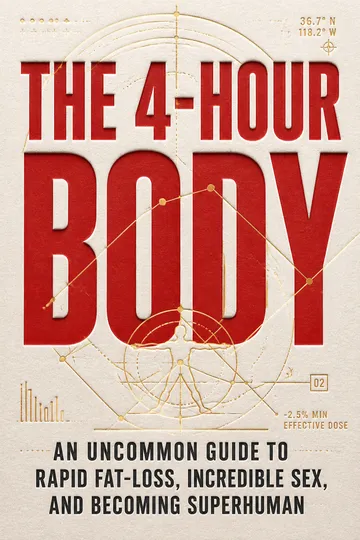
The 4-Hour Body receives mixed reviews, with some praising its innovative approaches to health and fitness, while others criticize its extreme methods and lack of scientific rigor. Readers appreciate Ferriss's engaging writing style and the book's wide range of topics, including weight loss, muscle gain, and sleep optimization. Many find the actionable advice useful, but some warn against the potentially dangerous recommendations. Critics argue that Ferriss oversimplifies complex health issues and makes exaggerated claims. Overall, the book is seen as thought-provoking but controversial, appealing to those interested in unconventional self-improvement techniques.
People Also Read










Glossary
Minimum Effective Dose
Smallest useful inputThe minimum effective dose, or MED, is the smallest amount of an intervention that produces a desired result. Ferriss applies the idea to training, diet, and other bodily inputs, arguing that additional effort can be wasteful or counterproductive. The dose depends on the goal and person, so the term is best used as a question to test, not a universal prescription.
Harajuku Moment
Personal trigger for changeA Harajuku Moment is a personal realization that turns a vague wish into a compelling reason to act. Ferriss uses programmer Chad Fowler's recognition of his own helpless self-talk as an example. The concept emphasizes that instructions alone may not create change; a meaningful motive and visible feedback can make action feel possible and worth sustaining.
Physical GPS
Repeatable progress measuresPhysical GPS is Ferriss's metaphor for a consistent set of measurements that shows whether body composition is moving toward a goal. It includes measures such as circumferences, body-fat estimates, and weight. Because different devices can produce different readings, the method depends on using the same tool and conditions over time rather than treating one measurement as absolute truth.
Slow-carb Diet
Simple repeated-meal dietThe Slow-carb Diet is Ferriss's eating template built around repeating a small number of meals, emphasizing protein, legumes, and vegetables, limiting many refined starches and caloric drinks, and allowing a planned weekly flexible day. Ferriss presents it as easy to follow and effective for fat loss. Its strict exclusions and metabolic explanations are author-specific claims, not universal medical guidance.
Occam's Protocol
Minimalist muscle-building routineOccam's Protocol is Ferriss's low-volume strength plan for gaining muscle. It uses a small number of compound exercises, controlled repetitions, progressive increases in load, and recovery periods that lengthen when progress stalls. The plan also emphasizes eating enough to support growth. Its unusually large reported gains come from individual cases and should not be assumed typical.
Functional Movement Screen
Movement asymmetry screenThe Functional Movement Screen, developed by coach Gray Cook, is a series of movement tests used to identify asymmetries and limitations in basic movement patterns. Ferriss describes a simplified version for self-observation and corrective training. A screen can help identify areas for further assessment, but it is not a medical diagnosis and cannot guarantee that an injury will be prevented.
Total Immersion
Technique-focused swim methodTotal Immersion is a swimming approach associated with coach Terry Laughlin that emphasizes body alignment, balance, rotation, and efficient stroke length. Ferriss credits it with helping him move from struggling through a few pool lengths to swimming much farther with fewer strokes. The method's core emphasis is on learning coordinated technique rather than simply kicking harder or adding distance.
PAGG
Experimental supplement combinationPAGG is Ferriss's name for a supplement combination of policosanol, alpha-lipoic acid, green tea extract, and garlic extract, which he investigated for fat loss. He describes it as a non-stimulant alternative to an earlier stimulant combination and includes warnings about interactions and medical conditions. The book's personal results do not establish that the stack is safe or effective for general use.
FAQ
What's The 4-Hour Body about?
- Comprehensive Health Guide: The 4-Hour Body by Timothy Ferriss is a detailed guide focused on achieving rapid body transformation with minimal effort. It covers fat loss, muscle gain, improved sleep, and enhanced sexual performance.
- Minimal Effective Dose: The book introduces the concept of the "Minimum Effective Dose" (MED), which is the smallest amount of effort needed to achieve a desired outcome, applied across diet, exercise, and more.
- Personal Experimentation: Ferriss shares insights from over a decade of personal experimentation, drawing on elite athletes and medical professionals to provide actionable advice.
Why should I read The 4-Hour Body?
- Immediate Results: The book promises immediate results, emphasizing a practical approach to body transformation with the claim, "DO NOT READ THIS BOOK UNLESS YOU WANT IMMEDIATE RESULTS."
- Unique Insights: Ferriss challenges conventional wisdom, encouraging readers to rethink traditional approaches to diet and exercise with statements like, "Everything popular is wrong."
- Comprehensive Approach: It covers a wide range of topics, making it suitable for anyone looking to improve their physical health, whether through fat loss, muscle gain, or enhancing sexual performance.
What are the key takeaways of The 4-Hour Body?
- Slow-Carb Diet: The book outlines the Slow-Carb Diet, focusing on simple dietary changes that can lead to rapid fat loss without calorie counting.
- Importance of Measurement: Ferriss emphasizes tracking progress, stating, "What gets measured gets managed," applying this to weight, body fat percentage, and food intake.
- Minimalist Training: Ferriss advocates for minimalist training methods, suggesting significant muscle gains can be achieved with minimal time investment.
What is the Slow-Carb Diet in The 4-Hour Body?
- Five Simple Rules: The diet consists of five rules: avoid white carbohydrates, eat the same few meals repeatedly, don’t drink calories, don’t eat fruit, and take one day off per week to binge.
- Focus on Protein: Emphasizes high protein intake to support muscle retention and fat loss, making it effective for weight loss.
- Simplicity and Sustainability: By limiting food choices and focusing on staple meals, the diet is designed to be easy to follow and sustainable long-term.
How can I lose fat quickly with the Slow-Carb Diet from The 4-Hour Body?
- Adhere to the Diet: Following the Slow-Carb Diet is the primary method for rapid fat loss, with claims of losing 2% body fat in two weeks.
- Incorporate PAGG Stack: The book introduces the PAGG stack (Policosanol, Alpha-lipoic acid, Green tea flavanols, Garlic extract) to enhance fat loss by improving insulin sensitivity and promoting fat oxidation.
- Minimal Exercise: Ferriss emphasizes that significant fat loss can occur with minimal exercise, highlighting the efficiency of targeted workouts.
What is the Minimum Effective Dose (MED) in The 4-Hour Body?
- Definition of MED: The Minimum Effective Dose is the smallest dose that will produce a desired outcome, crucial for optimizing exercise and dietary interventions.
- Application in Exercise: Ferriss explains that minimal effort, like 80 seconds of tension using 23kg once every seven days, can yield significant results.
- Avoiding Overtraining: The MED principle helps prevent overtraining by focusing on the least amount of effort needed to achieve goals, allowing for recovery and sustained progress.
What are the Four Horsemen of Fat Loss in The 4-Hour Body?
- PAGG Stack: The Four Horsemen of Fat Loss refers to the PAGG stack, designed to enhance fat loss and improve metabolic health.
- Mechanisms of Action: Each component improves insulin sensitivity and promotes fat oxidation, helping to direct nutrients to muscle instead of fat.
- Supplementation Schedule: Ferriss recommends taking the PAGG stack before meals and at bedtime to maximize its effects on fat loss.
How does temperature affect weight loss according to The 4-Hour Body?
- Cold Exposure Benefits: Ferriss discusses how cold exposure stimulates BAT to burn fat and glucose as heat, enhancing metabolic rate.
- Practical Applications: Simple methods like cold showers or ice packs on the neck can increase calorie expenditure without significant effort.
- Thermal Load: Emphasizes that the body's response to temperature changes can significantly impact weight loss, highlighting the importance of considering heat in weight management.
What is Occam's Protocol in The 4-Hour Body?
- Minimalist Muscle Gain: Occam's Protocol focuses on achieving maximum muscle gain with minimal effort, suggesting just two workouts per week.
- One Set to Failure: Emphasizes performing one set to failure for each exercise, maximizing muscle engagement.
- Recovery Focus: Highlights the importance of recovery time, suggesting that as muscle size increases, workout frequency should decrease.
How does The 4-Hour Body address sleep optimization?
- Optimal Temperature: Recommends keeping the bedroom temperature between 19°C and 21°C for better sleep quality.
- Light Exposure: Using light cues, like the Philips goLITE, can help regulate sleep patterns and improve mood and energy levels.
- Pre-Bedtime Routine: Suggests avoiding screens and consuming a small, protein-rich snack to stabilize blood sugar levels overnight.
What are some recommended supplements in The 4-Hour Body?
- Creatine Monohydrate: Suggested for enhancing strength and muscle gains, with a recommended daily dose of 3.5 grams.
- L-Glutamine: Recommended for tissue repair and recovery, particularly after intense workouts.
- Cod Liver Oil: Advocated for overall health and hormonal balance, combined with vitamin-rich butter fat.
What are the best quotes from The 4-Hour Body and what do they mean?
- "It is vain to do with more what can be done with less.": Emphasizes efficiency in training and diet, advocating for minimalism in achieving health goals.
- "You can’t out-exercise a bad diet.": Highlights the importance of nutrition in any fitness regimen, suggesting diet plays a crucial role in achieving desired body composition.
- "The goal is to reduce injury potential first, and to increase performance second.": Underscores the importance of safety in training, advocating for injury prevention as a priority over performance enhancement.
About the Author




Download PDF
Download EPUB
.epub digital book format is ideal for reading ebooks on phones, tablets, and e-readers.








