

Key Takeaways
Treat recurring work dread as a task-fit clue, not a character flaw.
The work changed shape. In the book’s fable, Bull Brooks struggles through banking jobs despite effort, decent managers, and respectable pay. Advertising brings relief, especially when he helps invent campaigns. But promotion shifts him toward keeping colleagues motivated and projects moving. He can do that work, yet it drains him. As the burden grows, his irritability returns, even though he likes his company and coworkers.
The key discovery is that liking a field does not mean enjoying every activity inside it. Bull thrives when inventing ideas and judging which ones have promise. He becomes depleted when he spends too much time rallying people. His Sunday dread and later irritability are clues about the tasks he is doing, not proof that he is lazy or ungrateful.
The distinction between a job’s subject matter and its daily activities is useful because career decisions often focus too heavily on industry, title, or salary. A person may love healthcare, education, or design while disliking the recurring tasks attached to a particular role. Bull’s experience also shows why distress can surface indirectly, as irritability or dread, rather than as a clear statement of what is wrong. The model offers a practical prompt: identify which activities precede the energy drop. It cannot, by itself, distinguish poor task fit from excessive workload, conflict, or burnout, so those causes still deserve examination.
Match the six kinds of contribution to the work's full journey.
Work needs six contributions. The Working Genius model describes six kinds of activity that combine to move a project forward: Wonder spots questions or untapped potential; Invention creates a possible solution; Discernment assesses and refines it; Galvanizing rallies people to act; Enablement provides needed help; and Tenacity pushes the work to completion. The pattern is useful whether a group is launching a product, organizing a community event, or planning a family trip.
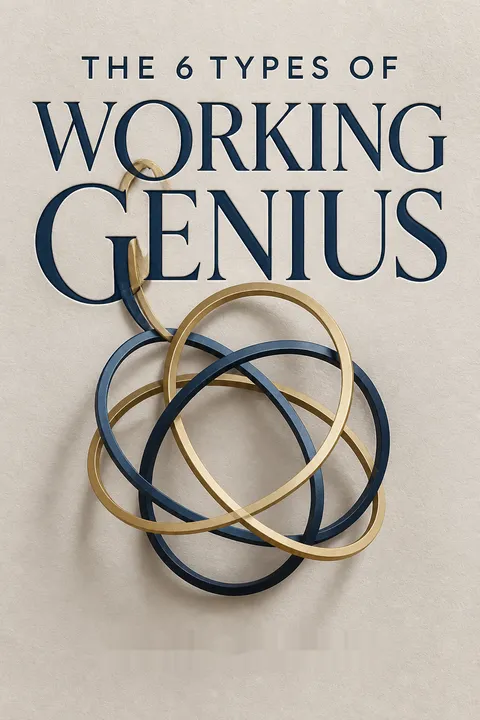
The book groups these activities into three broad phases: Ideation, which includes Wonder and Invention; Activation, which includes Discernment and Galvanizing; and Implementation, which includes Enablement and Tenacity. The gears image captures the central point: the contributions depend on one another. Projects do not always proceed in a tidy line, but all six activities must be accounted for.
This framework shifts attention from personality labels to the work a team must actually perform. That makes it easier to diagnose a stalled project: perhaps the team has ideas but no one tests them, or has a plan but no one takes responsibility for finishing it. The sequence is best treated as a map, not a rigid production line. Real work loops back when new information appears, and the same person may contribute at several points. Its value lies less in predicting behavior than in making overlooked work visible and discussable.
Protect your energizing strengths, and name the work that drains you.
Three kinds of fit. Working Genius refers to the activities that give someone energy and joy, and that person is often good at doing them. Working Competency describes work someone can perform adequately, sometimes very well, but cannot sustain indefinitely without weariness. Working Frustration names activities that drain energy and are often difficult. The model proposes that people generally have two of each across its six types.
The book compares the categories to coffee: a sealed thermos stays hot, an open cup cools, and a leaking cup loses its contents quickly. Bull’s assessment places Invention and Discernment among his geniuses, Galvanizing and Wonder among his competencies, and Enablement and Tenacity among his frustrations. The forty-two-question assessment takes about ten minutes, but its results are meant to be reviewed against real experience.
The categories make a valuable distinction between capability and sustainable motivation. Being able to perform a task is not evidence that it is a good long-term assignment, a point that can help people describe strain without moralizing it. The profile is most useful as a hypothesis to test against repeated experience, not as a verdict about identity. Self-report tools can be affected by mood, current responsibilities, and how questions are interpreted. A team should therefore combine profiles with observation and conversation, rather than treating a two-by-two-by-two pattern as a precise map of a person’s limits.
Do not skip the judgment and buy-in between ideas and execution.
The overlooked middle. Activation is the part of work between proposing an idea and carrying it out. It consists of Discernment, which tests and improves a proposal, and Galvanizing, which builds commitment to act. In Bull’s agency, he and others could generate ideas, but no one besides Bull wanted to keep the team rallied and moving. He had mistaken his ability to do that job for enjoyment of it. A colleague who liked Galvanizing took on more of the role, freeing Bull for work that energized him.
When teams jump directly from brainstorming to execution, ideas may be poorly tested, and implementers may not understand or support what they are being asked to do. Ideators then blame execution; implementers blame the quality of the plan. Deliberate evaluation and shared commitment can interrupt that cycle.
Activation highlights two forms of work that are easy to compress into a vague instruction to “get aligned.” A proposal needs both intellectual scrutiny and social commitment. The first asks whether the idea is sound; the second helps people understand why it merits effort. Separating those questions can improve discussions, especially when dissent is mistaken for resistance or enthusiasm is mistaken for evidence. Still, buy-in should not become a demand for artificial unanimity. A team needs enough commitment to proceed, while retaining clear ways to surface risks and revise a plan when reality contradicts it.
Staff projects for missing geniuses, not just familiar job titles.
Look at the whole team. A Team Map displays where a group has Working Genius and Working Frustration, helping leaders see which contributions are abundant or missing. In the fable, junior employee Max is strong in Invention and Discernment but frustrated by Tenacity. His role, however, repeatedly demands careful follow-through. His colleagues also lack much Tenacity, so the team’s arrangement magnifies his difficulty. Instead of labeling Max careless or dismissing him, the leaders reconsider how projects are staffed and where his strengths can contribute.
The map can guide project assignments, redistribution of tasks, or hiring. A technology leadership team described in the book had no one with Wonder as a genius and identified that gap as relevant to its weak product innovation. A team can also borrow a colleague with a missing strength or temporarily rely on someone’s competency, though the latter can create strain if it becomes permanent.
The map turns a vague performance problem into a question about both the person and the system around them. That is a constructive move: individual accountability remains, but managers also examine whether work has been designed to make success unnecessarily difficult. The method is particularly strong for project teams, where complementary contributions matter more than identical profiles. Its limit is that a profile cannot create missing capacity by itself. If a team lacks time, expertise, authority, or staff, rearranging labels will not solve the operational shortage. The map should inform resource decisions, not substitute for them.
Keep meetings at the right altitude for the decision in front of you.
Name the conversation. The book distinguishes four kinds of work meeting: brainstorming explores questions and ideas; decision-making evaluates a proposal; launch builds commitment and organizes initial action; status review and problem-solving track execution. Each calls for different contributions. A brainstorming session can lose focus if participants rush to assignments, while a team near a deadline can be thrown off when someone reopens the entire idea without a clear reason.
The model also uses elevation as a metaphor for the distance between abstract thought and concrete execution. Wonder happens high above the practical details; Tenacity works closest to completion. Sudden jumps between these levels create what the book describes as turbulence. Naming a meeting’s purpose helps participants contribute at the appropriate level and makes it easier to notice when a discussion genuinely needs to change direction.
Meeting friction often comes from mismatched expectations: one person thinks the group is exploring, while another believes a decision is due. Naming the conversation is a low-cost way to make those expectations explicit. The altitude metaphor adds a helpful language for shifts between strategy and tactics, which otherwise can feel like interruptions or resistance. Yet an agenda should not silence a legitimate concern simply because it belongs to another phase. The useful practice is to capture the concern, decide whether it changes the present decision, and either address it now or assign a clear route for returning to it.
Treat support and completion as strategic work, not lesser contributions.
Quiet work counts. The model distinguishes responsive geniuses, which answer a situation or another person’s need, from disruptive geniuses, which initiate or push change. Wonder, Discernment, and Enablement are responsive; Invention, Galvanizing, and Tenacity are disruptive. The book warns that visible novelty and forceful action can attract more status, even though responsive contributions are equally necessary.
Enablement is not merely being agreeable. It means providing the assistance a person or project needs to move forward. Tenacity is not the same as motivating people; it means staying with the work until it meets its requirements. In the fable, Jasper and Quinn are valued for stepping in to help, while Chris enjoys rallying people and finishing tasks. Their different contributions make the group more capable than any single person trying to cover everything.
Organizations often celebrate what is easy to see: the bold idea, the persuasive presentation, the decisive launch. Support and completion can appear less glamorous, even though projects depend on them. Naming these contributions can correct a status bias and help teams distribute recognition more fairly. The distinction between responsive and disruptive work also helps explain why a careful question or a practical offer of help is not automatically a lack of initiative. Still, responsiveness should not be romanticized into limitless availability. People who are naturally helpful need boundaries, and completion work needs realistic workloads and authority.
Use a talent profile to build empathy, not excuse poor performance.
Explanation is not exemption. The model aims to reduce unnecessary guilt and judgment by showing that people can struggle because a task clashes with their natural strengths, not because they lack effort or character. In one example, Heath interprets his wife’s criticism of his ideas as rejection; their profiles suggest that his Invention and her Discernment are complementary. Her feedback is an effort to assess and improve his proposals, not simply shut them down.
Bull and his wife also recognize that both find Tenacity draining, which helps explain recurring household problems with details and deadlines. Their response is to consider different ways of sharing or arranging that work, not to pretend it does not matter. The book’s distinction is important: knowing a frustration can guide role design, but it does not erase commitments, standards, or the need to address repeated mistakes.
A shared vocabulary can change the interpretation of behavior before it changes the behavior itself. That matters in relationships, where people often read a partner’s different style as hostility or indifference. The framework encourages a more charitable question: what useful function might this person be performing? It also preserves accountability by separating an explanation from a free pass. A further caution is that labels should not harden into scripts. People learn, adapt, and respond to context; partners and managers should use profiles to start a conversation, not to decide in advance what someone can never do.
Analysis
The book’s strongest move is to connect individual fulfillment with the anatomy of collective work. Its fable begins with a familiar puzzle: Bull likes his colleagues and his field, yet his work repeatedly becomes intolerable. The answer is not a wholesale career change but a mismatch between his most energizing contributions and the tasks that occupy his time. That story gives the model emotional force before the taxonomy supplies vocabulary.
The six types are most persuasive as a process diagnostic. Wonder and Invention help a group notice and imagine; Discernment and Galvanizing test and mobilize; Enablement and Tenacity carry action into completion. This arrangement makes neglected labor visible and explains why teams can fight over ideas versus execution when they omit evaluation and commitment. The model also usefully distinguishes natural enthusiasm from competence, resisting the assumption that whoever performs a task well should own it indefinitely.
Its practical promise depends on how cautiously leaders use it. The assessment is self-report, and the claim that people generally have two geniuses, two competencies, and two frustrations is a simplifying pattern, not proof that human capacity divides neatly. Profiles can also become convenient excuses or rigid staffing categories. Strong management still requires observing actual performance, skills, interests, constraints, and development goals. A person’s frustration with a task does not establish that the task can be ignored, and a team cannot compensate for inadequate staffing merely by naming its gaps.
The most durable contribution is therefore not a fixed personality label but a repeatable set of questions: What work gives this person energy? What drains them? Which required contribution is missing from the team? What kind of conversation is happening now? Used as prompts rather than verdicts, those questions can turn self-knowledge into better role design, clearer meetings, and more generous interpretations of colleagues.
Review Summary
The 6 Types of Working Genius received mixed reviews, with an average rating of 4.16 out of 5. Many readers found the model insightful and practical for understanding work dynamics. However, criticisms focused on the lengthy fable section, which some found unnecessary or poorly written. The actual explanation of the model was generally well-received, but some readers were disappointed that the assessment tool was not included and required an additional purchase. Overall, opinions varied on the book's effectiveness in presenting the Working Genius concept.
People Also Read







Glossary
Working Genius
Energizing work contributionThe model’s name for a person’s natural, energizing way of contributing to work. It also refers to the framework that identifies six kinds of contribution needed across a project: Wonder, Invention, Discernment, Galvanizing, Enablement, and Tenacity. The model groups each person’s relationship to those activities as geniuses, competencies, or frustrations.
Wonder
Questions untapped potentialA Working Genius involving reflection on how things are, what may be wrong, and whether greater potential is being missed. People strong in Wonder notice conditions and ask questions that can prompt further thought or action. In the model, Wonder is responsive because it attends to the surrounding situation rather than necessarily initiating a solution.
Invention
Creates new solutionsA Working Genius involving the creation of new ideas, plans, or solutions, often with limited direction. People strong in Invention are drawn to origination and can generate possibilities in response to a need or question. In the model, Invention is disruptive because a new proposal can challenge existing approaches and initiate change.
Discernment
Judges and refines ideasA Working Genius involving instinctive assessment of ideas, proposals, or situations. People strong in Discernment use judgment, pattern recognition, and intuition to identify what seems promising or what needs revision, sometimes without extensive data or specialized expertise. The model treats it as responsive because it evaluates something already presented.
Galvanizing
Rallies people to actA Working Genius involving the effort to mobilize, motivate, and enlist people around an idea or initiative. People strong in Galvanizing are willing to call for action and help a group maintain momentum. The model treats it as disruptive because rallying people asks them to shift attention, priorities, or effort toward a course of action.
Enablement
Provides needed supportA Working Genius involving responsive assistance that helps another person or project move forward. People strong in Enablement are inclined to offer practical help and respond to needs, sometimes before those needs are fully articulated. It is not simply agreeableness or general kindness; in the model, it is a contribution that helps turn a call to action into workable progress.
Tenacity
Carries work to completionA Working Genius involving persistence in completing work to the required standard. People strong in Tenacity gain satisfaction from pushing through obstacles, attending to details, and bringing a project across the finish line. The model distinguishes it from Galvanizing: Tenacity pushes the work itself toward completion, while Galvanizing rallies people to act.
Working Competency
Sustainable for a whileOne of the three categories in the Working Genius model. A Working Competency is an activity a person can perform reasonably well and does not find deeply draining, but that does not provide the sustained energy associated with a genius. Someone may handle competency work effectively for a time and still grow weary if it dominates their responsibilities.
Working Frustration
Drains energy and joyOne of the three categories in the Working Genius model. A Working Frustration is an activity that tends to drain a person’s energy and joy and may also be difficult for them. The model does not suggest that people can avoid every frustrating task. It proposes that extended or substantial exposure to such work can undermine fulfillment and performance.
Ideation
Identifies needs and ideasThe first broad phase in the model’s account of work. Ideation includes Wonder, which identifies questions, needs, or unrealized potential, and Invention, which proposes ideas or solutions. It describes the work of noticing an opportunity and imagining a possible response, rather than deciding whether the response is sound or carrying it out.
Activation
Tests ideas, builds commitmentThe middle phase in the model’s account of work, composed of Discernment and Galvanizing. Discernment assesses and improves an idea; Galvanizing rallies people to act on a proposal judged worth pursuing. Activation is meant to prevent teams from moving directly from generating ideas to execution without scrutiny or sufficient commitment.
Implementation
Turns plans into resultsThe final broad phase in the model’s account of work, composed of Enablement and Tenacity. Enablement provides assistance that helps work get underway, while Tenacity follows through until it is completed to the required standard. Implementation concerns the practical effort that turns an evaluated and supported plan into finished work.
Team Map
Displays team strengths and gapsA visual summary of a group’s Working Geniuses and Working Frustrations. By showing which contributions are well represented and which are scarce, a Team Map can prompt changes to project staffing, task distribution, or hiring plans. It is intended to reveal patterns in the group, not to determine an individual’s overall value or potential.
Responsive and disruptive geniuses
Two ways to contributeThe model’s distinction between geniuses that primarily respond to an existing stimulus and those that tend to initiate or provoke change. Wonder, Discernment, and Enablement are classified as responsive; Invention, Galvanizing, and Tenacity as disruptive. The distinction is used to explain different work styles and to emphasize that both kinds of contribution are necessary.
Elevation
Distance from ideas to executionA metaphor for how abstract or concrete a work activity is. Wonder and Invention occur at a higher level of abstraction, while Enablement and Tenacity operate closer to practical execution. The metaphor helps teams notice when a discussion suddenly shifts from strategy to tactics, or reopens broad questions during near-complete implementation.
Working Genius Assessment
Profiles work preferencesA forty-two-question assessment described in the book that takes about ten minutes to complete and produces a report about a person’s likely geniuses, competencies, and frustrations. The report is intended to be reviewed alongside the descriptions of the six types and a person’s real experience, since responses or interpretation can affect the result.
FAQ
What's "The 6 Types of Working Genius" about?
- Overview: "The 6 Types of Working Genius" by Patrick Lencioni is a book that introduces a model to help individuals and teams identify their natural talents and align them with their work.
- Purpose: The book aims to increase job satisfaction and productivity by helping people understand their innate strengths and how they can be best utilized in a work setting.
- Structure: It combines a fictional narrative with a detailed exploration of the Working Genius model, providing both a story and practical insights.
- Application: The model is applicable to various types of work, from corporate settings to personal projects, and is designed to improve both individual fulfillment and team effectiveness.
Why should I read "The 6 Types of Working Genius"?
- Self-Discovery: The book offers a framework for understanding your natural talents, which can lead to greater personal fulfillment and career satisfaction.
- Team Dynamics: It provides insights into how teams can function more effectively by leveraging the diverse talents of their members.
- Practical Tools: The book includes an assessment tool that helps identify your working geniuses, competencies, and frustrations, making it actionable.
- Broad Applicability: Whether you're a leader, team member, or individual contributor, the concepts can be applied to improve work processes and relationships.
What are the key takeaways of "The 6 Types of Working Genius"?
- Six Types of Genius: The model identifies six types of working genius: Wonder, Invention, Discernment, Galvanizing, Enablement, and Tenacity.
- Genius vs. Competency vs. Frustration: Each person has two areas of genius, two areas of competency, and two areas of frustration, which affect their work satisfaction and effectiveness.
- Team Balance: Successful teams need a balance of all six types to function optimally, avoiding gaps that can lead to inefficiencies.
- Personal and Professional Growth: Understanding your working genius can lead to better job alignment, reduced burnout, and improved team dynamics.
How does the Working Genius model work?
- Three Phases of Work: The model divides work into three phases: Ideation (Wonder and Invention), Activation (Discernment and Galvanizing), and Implementation (Enablement and Tenacity).
- Role Identification: It helps individuals identify which roles they naturally excel in and which they find draining, allowing for better role alignment.
- Team Mapping: Teams can use the model to map out the distribution of geniuses, competencies, and frustrations, identifying gaps and areas for improvement.
- Responsive vs. Disruptive: The model also categorizes geniuses as either responsive or disruptive, helping teams understand how different types interact.
What are the six types of working genius?
- Wonder: Involves pondering and questioning the state of things, often leading to new insights or questions.
- Invention: Focuses on creating new ideas and solutions, often from scratch, and is associated with creativity and innovation.
- Discernment: Relates to instinct and intuition, providing valuable feedback and judgment on ideas and situations.
- Galvanizing: Involves rallying and motivating people to take action, often inspiring others to join in on initiatives.
- Enablement: Provides support and assistance, responding to the needs of others to help them achieve their goals.
- Tenacity: Focuses on pushing projects to completion, ensuring that tasks are finished and goals are met.
How can I apply the Working Genius model in my life?
- Self-Assessment: Start by taking the Working Genius assessment to identify your areas of genius, competency, and frustration.
- Role Alignment: Use the insights to align your work responsibilities with your natural talents, seeking roles that maximize your geniuses.
- Team Collaboration: Share the model with your team to improve collaboration, ensuring that all six types are represented and utilized.
- Personal Growth: Apply the model to personal projects and relationships, understanding how your geniuses can enhance your life outside of work.
What are the benefits of understanding your working geniuses?
- Increased Fulfillment: Aligning your work with your geniuses can lead to greater job satisfaction and personal fulfillment.
- Improved Productivity: Working within your areas of genius allows you to be more efficient and effective, reducing burnout.
- Better Team Dynamics: Understanding the geniuses of team members can improve communication, collaboration, and overall team performance.
- Enhanced Decision-Making: Knowing your geniuses helps you make better decisions about career paths and personal projects.
What are the best quotes from "The 6 Types of Working Genius" and what do they mean?
- "Your life will be transformed by aligning your work to your genius." This quote emphasizes the profound impact of working within your natural talents.
- "The Working Genius has reframed our entire perception of our effectiveness as a team." It highlights how the model can change team dynamics and improve productivity.
- "Understanding my working geniuses, competencies, and frustrations told me more about myself than the other personality profiles I have done." This underscores the model's effectiveness in providing deep personal insights.
- "If helping your people find fulfillment in their work is important for you, apply Lencioni’s Working Genius in your organization." It suggests that the model is a valuable tool for leaders who want to enhance employee satisfaction.
How does the Working Genius model improve team productivity?
- Identifies Gaps: The model helps teams identify gaps in their collective geniuses, allowing them to address weaknesses and improve efficiency.
- Enhances Collaboration: By understanding each member's strengths, teams can collaborate more effectively, leveraging diverse talents.
- Reduces Friction: Knowing each other's geniuses and frustrations reduces misunderstandings and conflicts, leading to smoother interactions.
- Optimizes Roles: Teams can assign roles based on individual geniuses, ensuring that everyone is working in areas where they excel.
How does the Working Genius model relate to organizational health?
- Cohesive Leadership: It helps leadership teams understand and leverage each other's geniuses, leading to more cohesive and effective decision-making.
- Employee Engagement: Aligning roles with geniuses increases employee engagement, reducing turnover and improving morale.
- Meeting Effectiveness: Understanding the geniuses involved in meetings leads to more productive and focused discussions.
- Strategic Alignment: The model ensures that organizational strategies are aligned with the natural talents of the workforce, enhancing overall performance.
What are some real-world testimonials about "The 6 Types of Working Genius"?
- Michael Hyatt: Describes the model as providing an "aha" moment, offering clarity and freedom in understanding work-related questions.
- Andrew Laffoon: States that the assessment changed the way his company thinks about work and people, highlighting its transformative impact.
- Stephanie Culbreth: Calls the model a "game-changer" for getting work done well, emphasizing its practical benefits.
- Bobby Herrera: Recommends the model for organizations that value employee fulfillment, underscoring its importance for leaders.
What is the significance of the Working Genius assessment?
- Quick and Effective: The assessment takes about ten minutes and provides immediate insights into your working geniuses, competencies, and frustrations.
- Personalized Report: It generates a report that helps you understand your strengths and areas for improvement, guiding career and personal decisions.
- Team Application: The assessment can be used to create a team map, identifying collective strengths and gaps for better collaboration.
- Life-Changing Insights: Many users report significant improvements in job satisfaction and team dynamics after taking the assessment, highlighting its transformative potential.
About the Author
Other books by Patrick Lencioni





Download PDF
Download EPUB
.epub digital book format is ideal for reading ebooks on phones, tablets, and e-readers.








