

Key Takeaways
Treat teamwork as a results system built on trust, debate, clarity, and accountability
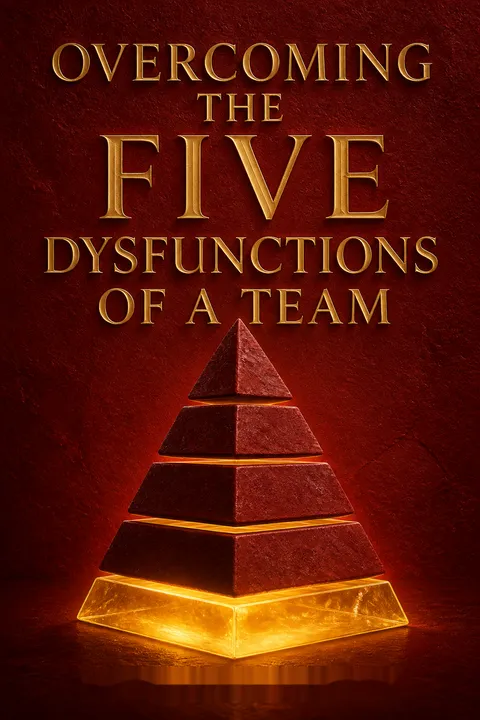
The chain matters. The guide presents teamwork as a set of linked behaviors, not a team-building mood. People first need enough trust to admit mistakes and uncertainty. That openness makes honest debate possible. Debate lets a group consider competing views before deciding. Clear decisions give colleagues something concrete to uphold, and peer accountability helps them follow through. The chain ultimately points toward collective results, rather than individual status or departmental wins.
Practical, not magical. Lencioni argues that cohesive teams reduce the politics and confusion that slow organizations down. They can make better decisions and avoid repeatedly reopening settled issues. Yet none of this is automatic: it takes courage, persistence, and the leader’s visible participation. The model is a guide to what teams must practice, not a guarantee that harmony alone will improve performance.
What's useful about this model is its attention to dependencies. A team cannot reliably demand accountability if members fear that honest feedback will be punished, just as a decision cannot earn genuine support if important objections never surface. This resembles systems thinking: a weak link can constrain the whole process. The model also counters the common habit of treating teamwork as a soft add-on to strategy. Still, the sequence should not be mistaken for a universal law. Teams facing urgent, tightly specified tasks may need different amounts of debate and disclosure than groups making ambiguous, high-stakes decisions.
Call a group a team only when its members share outcomes and responsibility
Membership has a test. The guide describes a team as a relatively small group, generally three to twelve people, with common goals and shared responsibility for achieving them. Members must be willing to put the group's needs ahead of personal or departmental preferences. Sharing a manager or appearing on the same organization chart is not enough if people work independently and do not depend on one another.
Do not fake interdependence. A group that is really a collection of individual contributors may function perfectly well without intensive team-building. Pretending otherwise creates expectations of collaboration and shared ownership that the work itself does not support. Before planning an off-site, leaders should decide whether the group has shared work, shared outcomes, and mutual accountability. If only a smaller subset meets those conditions, that may be the actual team.
This distinction is a useful antidote to organizational overuse of the word team. It directs attention away from labels and toward the structure of the work: who depends on whom, and who bears the consequences of a decision? Research on coordination likewise suggests that collaboration is most valuable when tasks are interdependent, not simply because people occupy the same unit. The limit is that modern organizations often rely on networks and temporary project groups that do not fit a stable, small-team picture. Leaders can still apply the test by clarifying which decisions and outcomes are genuinely shared.
Let the leader risk vulnerability before asking colleagues to lower their guard
Trust means openness. In this guide, vulnerability-based trust means being able to admit mistakes, limitations, uncertainty, and the need for help without expecting retaliation. It is different from merely knowing how a colleague usually behaves. The leader sets the standard because employees watch what happens when someone tells an uncomfortable truth.
Silence is learned. In one company, a CEO reviewed feedback showing that he listened poorly and gave too little praise. When he asked his executives what they thought, they reassured him until a facilitator pointed out that the same executives had supplied the critical ratings. One person finally spoke honestly, and colleagues promptly contradicted him. The episode taught the room that candor was risky. A modest personal-history exercise can start repairing this pattern by helping colleagues understand one another before judging behavior.
The episode shows how quickly a leader's response can establish the real rules of a room. This connects with psychological safety, the shared belief that people can take interpersonal risks without humiliation. The guide's gradual approach is stronger than demanding instant intimacy: modest disclosure can invite empathy without requiring a dramatic confession. That distinction matters, particularly where hierarchy or personal history makes disclosure feel unsafe. Behavioral profiles may provide a common language, but they should be treated as conversation prompts, not definitive explanations of character or reliable predictors of performance.
Use trust to surface disagreement before it hardens into private politics
Debate the work. Productive ideological conflict means direct, energetic disagreement about issues and ideas, rather than attacks on people. Without trust, arguments tend to become contests for influence, while the most consequential objections migrate to private conversations after meetings. Teams should agree on basic conflict norms, such as how to handle interruptions and strong emotion, so members know what candor looks like in their setting.
Leaders must draw it out. A leader may need to mine for conflict by asking what concerns remain unspoken, or to reassure participants during an unusually direct exchange that the disagreement is acceptable. Meetings also need an opening reason to care: the stakes of a decision should be clear before discussion begins. The aim is not constant argument. It is enough honest debate to examine consequential choices before the group moves on.
The guide's central distinction is between disagreement that tests ideas and hostility that targets identity. That distinction matters because groups often confuse politeness with fairness, even when quiet members are withholding useful information. Clear norms and active facilitation can reduce that risk. Yet more visible conflict is not automatically better: status differences, cultural expectations, and conversational dominance can make a forceful debate look open while excluding some voices. A skilled leader therefore measures conflict by whether relevant perspectives have been heard, not by how loud or dramatic the meeting becomes.
Seek informed buy-in, then make every decision unmistakably clear
Agreement need not mean consensus. The guide defines buy-in as genuine support for a decision, even when some members initially preferred another option. People are more likely to support the outcome when their views were heard, considered, and answered. After the debate, the leader may need to make the final call rather than wait indefinitely for everyone to agree.
Write down the decision. At the end of a meeting, the team should state exactly what it decided and resolve mismatched assumptions. Then members should communicate the decision to their teams, preferably live and within a day or two, so employees can ask questions. One company announced a hiring freeze, only to discover that several executives assumed it exempted their departments. Another team appeared to support a travel-cost rule, but some members never passed it on. A nod in the room is not proof of commitment.
This approach combines voice with decisiveness. In organizational psychology, procedural fairness often matters because people are more willing to accept an unfavorable outcome when they believe the process treated their views seriously. The guide turns that principle into a practical habit: surface objections, state the decision, and check what others understood. The phrase disagree and commit, however, should not be used to silence continuing concerns or conceal a decision that lacks real support. Teams need a way to revisit a choice when new evidence appears, while still avoiding endless debate over settled matters.
Make peers responsible for standards, and have leaders model the discomfort
Accountability should travel sideways. The guide defines team accountability as colleagues reminding one another when behavior or performance falls below agreed standards. It should not depend entirely on a manager delivering corrections from above. But peer accountability rarely takes hold if the leader avoids difficult conversations. In one example, a CEO tolerated an executive using a laptop during meetings because he felt awkward telling the person to stop. The team saw the behavior, and the silence around it.
Practice focused feedback. The Team Effectiveness Exercise asks members to identify one behavior that strengthens each colleague's contribution and one that can hinder the group. The leader receives feedback first, then the rest of the team. The guide recommends doing this after trust has begun to form, and returning to the improvement points after a few months. Specific, timely feedback gives colleagues a chance to adjust before a small behavior becomes a larger performance problem.
Peer feedback can correct problems faster than waiting for formal reviews, and it distributes responsibility for the team's working norms. The exercise's emphasis on one strength and one improvement point also makes feedback more manageable than a long inventory of faults. But candor needs safeguards: feedback should refer to observable behavior and agreed standards, not personality judgments or office politics. In a high-power or retaliatory culture, asking peers to confront one another can increase risk rather than trust. Leaders need to make the norms credible by responding fairly when uncomfortable feedback is offered.
Put one shared priority on a visible scoreboard
Choose a rallying point. A thematic goal is the team's most important shared priority for a defined period, supported by a few objectives that make progress concrete. A transportation company formed through several acquisitions chose to operate as one unified organization. Its supporting objectives included consistent practices, aligned computer systems, and a single approach to customer service. The functional teams kept doing their jobs, but the shared priority shaped how they worked together.
Make progress visible. A scoreboard displays a small number of critical measures, so members can tell whether the team is succeeding without relying on impressions or political signals. The guide warns against measuring everything, since a crowded dashboard can obscure priorities. It also warns that individual ego, career concerns, and loyalty to one's own department can displace collective results. Team members must be willing to contribute beyond the boundaries of their specialties.
A shared priority helps coordinate attention, especially when departments have legitimate but competing demands. The idea resembles a focusing device: it tells people which trade-offs matter most during a particular period. Measures make that priority discussable rather than aspirational. Yet measurement has a familiar hazard: when a metric becomes the sole target, people can optimize the number while neglecting the underlying purpose. A compact scoreboard should therefore pair operational indicators with informed judgment, and teams should change measures when they stop representing the result they actually value.
Treat team-building as six months of routines, not a one-off retreat
Build a cadence. The field guide offers a six-month roadmap: prepare with assessments, hold a one- or two-day kickoff, review commitments the following week, revisit progress around the third month, and assess the team's development again around month six. The dates are a flexible structure, not a prescription. What matters is returning to the team's agreements during ordinary meetings and real work.
Make reflection part of the job. The guide says it is not unusual for team members to spend as much as 20 percent of their time working through issues together. It also describes adrenaline addiction, the impulse to keep reacting to urgent demands instead of pausing to examine confusion and poor coordination. Leaders must protect time for review, keep commitments visible, and show that the effort is not a temporary management fashion. A retreat without follow-through is an event, not a team-building process.
The roadmap recognizes that behavior changes through repeated practice, not a single burst of enthusiasm. Regular review can help teams remember commitments when daily pressures return, while scheduled reassessment creates a moment to notice drift. The guide's framing of constant urgency as a kind of addiction is vivid, though it should not turn every fast-paced workplace into a diagnosis. The practical question is whether meetings and follow-up reduce rework, confusion, and unresolved conflict. For distributed teams, some face-to-face work may be valuable, but the essential discipline is sustained, purposeful contact.
Analysis
The guide's strongest contribution is its account of how ordinary workplace habits reinforce one another. A leader who cannot acknowledge a weakness teaches others to conceal theirs. Concealed concerns leave decisions untested, weak decisions invite quiet noncompliance, and the absence of peer correction allows individual or departmental interests to displace shared work. The model is therefore less a checklist than a causal story about how teams lose the capacity to coordinate.
Its practical orientation is also a strength. Rather than treating trust as an abstract virtue, it offers exercises, meeting practices, and follow-up routines that make behaviors observable. The personal-history discussion illustrates how context can soften snap judgments; the decision-clarification practice addresses a mundane but costly source of confusion. These are useful because they convert an intangible culture problem into specific moments a leader can change.
The framework has limits. Its five-part chain can sound more linear than real organizational life. Teams may need to make a provisional decision before trust is deep, or create basic behavioral standards before members are ready for extensive candor. Disclosure exercises also require care: vulnerability should be invited, not coerced, and leaders must consider differences in status, culture, and psychological safety. The book's recommendation of personality profiling is best interpreted as a prompt for discussion, not as a scientific verdict on an individual's abilities.
Likewise, visible goals and scoreboards help direct attention, but no small set of metrics fully captures organizational value. Goodhart's law, the tendency for a measure to lose usefulness when it becomes a target, is a relevant caution. Teams need measures that illuminate progress without replacing judgment. Taken together, the guide is most persuasive when treated as a practical diagnostic: identify where cooperation breaks down, create a small behavior that addresses it, and revisit whether the change improves shared results.
Review Summary
Overcoming the Five Dysfunctions of a Team receives mostly positive reviews for its practical approach to team building. Readers appreciate the clear, actionable advice and exercises for addressing common team issues. Some find it repetitive of the original book, while others value it as a standalone guide. The book's focus on trust, conflict, commitment, accountability, and results resonates with many readers. Critics note the outdated use of MBTI and some authoritarian language. Overall, it's considered a useful resource for managers and team leaders seeking to improve team dynamics.
People Also Read





Glossary
Vulnerability-based trust
Safety to be candidA team condition in which members can admit mistakes, weaknesses, uncertainty, and the need for help without fearing retaliation or loss of standing. It differs from simply predicting how colleagues will behave. This kind of trust allows people to share information and concerns that would otherwise remain hidden.
Productive ideological conflict
Debate about important issuesDirect, energetic discussion of ideas, decisions, and other matters important to the team. The disagreement is aimed at finding a better answer, not defeating or humiliating a colleague. The guide distinguishes it from conflict driven by personal attacks, status contests, or political maneuvering.
Thematic goal
A period's shared priorityThe team's overarching priority for a defined period. It gives members a common focus while they continue their normal functional responsibilities. Supporting objectives describe what must be accomplished to achieve it, and can be used to organize discussion and track progress.
Commitment clarification
Explicitly record team decisionsA short practice at the end of a meeting in which members state what they believe the team decided. The leader records the agreements and resolves differences in interpretation before the group leaves. Its purpose is to prevent assumptions from becoming conflicting actions.
Cascading communication
Carry decisions to teamsThe process of communicating a team's decisions to the people and departments affected by them, usually within a day or two. The guide recommends a live conversation, in person or by phone, so employees can ask questions and hear how firmly their manager supports the decision.
Team Effectiveness Exercise
Structured peer feedbackA facilitated exercise in which each team member identifies one behavior that strengthens every colleague's contribution and one behavior that can hinder the team. The leader receives feedback first. Members then choose improvement points and revisit their progress, making peer accountability more concrete.
Team #1 Dilemma
Choosing which team comes firstThe conflict of allegiance faced by a manager who leads one team while serving on another. The guide argues that members should prioritize the team they belong to when making collective decisions, rather than lobbying mainly for the department or group they manage.
Scoreboard
Visible measure of progressA simple visual display of a team's most important goals and measures of progress. It should contain a small number of relevant indicators, not every available metric. The scoreboard helps members assess performance, keep attention on shared priorities, and organize discussion around what needs action.
Enter the danger
Address the difficult issueA leader's willingness to step directly into an uncomfortable matter rather than avoiding it. This can mean naming a behavior that harms the group or confronting a stalled disagreement. The leader's example makes it more legitimate for colleagues to address problems with one another.
Depth-Frequency Conflict Model
Map conflict intensity and frequencyA tool created by The Table Group for describing how often and how intensely a team engages in conflict. Members can compare their perceptions of the team's pattern and identify where discussion is too rare, too shallow, or otherwise unhelpful. It is intended to prompt diagnosis and discussion.
Adrenaline addiction
Compulsive busyness over reflectionThe tendency of busy leaders to keep reacting to urgent demands rather than slowing down to review, think, and discuss how work is proceeding. The guide uses the term for a pattern in which constant motion persists despite confusion or declining productivity, making team development feel like an unaffordable interruption.
Fundamental attribution error
Misread others' behavior as characterThe tendency to explain another person's negative behavior as a fixed character trait while explaining one's own similar behavior through circumstances. In a team, this bias can produce unfair judgments and distrust. Learning more about colleagues' experiences can help members consider explanations beyond presumed bad intent.
FAQ
What's "Overcoming the Five Dysfunctions of a Team" about?
- Purpose of the Book: "Overcoming the Five Dysfunctions of a Team" by Patrick Lencioni is a practical guide designed to help leaders, managers, and facilitators implement the concepts from his previous book, "The Five Dysfunctions of a Team."
- Focus on Teamwork: The book emphasizes the importance of building a cohesive team and provides tools and exercises to overcome common team dysfunctions.
- Field Guide Format: It serves as a field guide, offering step-by-step instructions and exercises to help teams build trust, engage in conflict, commit to decisions, hold each other accountable, and focus on results.
Why should I read "Overcoming the Five Dysfunctions of a Team"?
- Practical Tools: The book provides actionable tools and exercises that can be directly applied to improve team dynamics and performance.
- Proven Model: It builds on the well-regarded model from "The Five Dysfunctions of a Team," offering deeper insights and practical applications.
- Broad Applicability: The concepts are applicable across various types of organizations, including businesses, non-profits, and sports teams, making it a versatile resource for anyone involved in team leadership.
What are the key takeaways of "Overcoming the Five Dysfunctions of a Team"?
- Five Dysfunctions: The book addresses five key dysfunctions: absence of trust, fear of conflict, lack of commitment, avoidance of accountability, and inattention to results.
- Building Trust: Trust is foundational and involves vulnerability among team members, which is crucial for effective teamwork.
- Commitment and Accountability: Achieving commitment and embracing accountability are essential for team success, requiring clear communication and peer-to-peer accountability.
How does Patrick Lencioni suggest building trust within a team?
- Vulnerability-Based Trust: Lencioni emphasizes the importance of vulnerability-based trust, where team members are open about their weaknesses and mistakes.
- Personal Histories Exercise: He suggests exercises like sharing personal histories to help team members become comfortable with vulnerability.
- Behavioral Profiling: Using tools like the Myers-Briggs Type Indicator to understand each other's strengths and weaknesses can foster trust.
What is the significance of conflict in Lencioni's model?
- Productive Conflict: Lencioni advocates for productive, ideological conflict, which involves passionate debate around important issues without personal attacks.
- Conflict Norms: Establishing clear norms for conflict helps teams engage in healthy debate and avoid destructive behavior.
- Conflict Profiling: Understanding individual and collective conflict styles can help teams manage disagreements effectively.
How does "Overcoming the Five Dysfunctions of a Team" address commitment?
- Buy-In and Clarity: Commitment requires both buy-in from team members and clarity about decisions and goals.
- Disagree and Commit: Teams should be able to disagree during discussions but commit to decisions once made, ensuring alignment and progress.
- Cascading Communication: Lencioni emphasizes the importance of communicating decisions clearly and promptly to ensure organizational alignment.
What role does accountability play in Lencioni's model?
- Peer-to-Peer Accountability: Lencioni stresses the importance of team members holding each other accountable for behaviors and performance.
- Leader's Role: The leader must model accountability by addressing issues directly and encouraging team members to do the same.
- Team Effectiveness Exercise: This exercise helps teams provide direct feedback to each other, fostering a culture of accountability.
How does Lencioni suggest teams focus on results?
- Collective Results: Teams should prioritize collective results over individual or departmental goals to ensure overall success.
- Scoreboard: Using a visible scoreboard helps teams track progress and stay focused on key objectives.
- Avoiding Distractions: Teams must avoid distractions like ego, career advancement, and departmental priorities that can detract from collective goals.
What are some practical exercises included in the book?
- Personal Histories Exercise: This exercise helps build trust by encouraging team members to share personal stories and challenges.
- Behavioral Profiling: Tools like the Myers-Briggs Type Indicator are used to understand team dynamics and individual strengths and weaknesses.
- Team Effectiveness Exercise: This exercise involves giving and receiving feedback on individual contributions to the team's success.
How does Lencioni address common objections to team-building efforts?
- Time Commitment: Lencioni argues that the time spent on team-building is outweighed by the benefits of improved productivity and decision-making.
- Touchy-Feely Concerns: He emphasizes that the book's approach is practical and grounded in business realities, not touchy-feely exercises.
- Adrenaline Addiction: Lencioni highlights the need to overcome the addiction to constant busyness and focus on strategic team development.
What are the best quotes from "Overcoming the Five Dysfunctions of a Team" and what do they mean?
- "Trust is the foundation of teamwork." This quote underscores the importance of trust as the basis for all other team dynamics.
- "Conflict is not a bad thing." Lencioni emphasizes that healthy conflict is necessary for effective decision-making and innovation.
- "Commitment requires clarity and buy-in." This highlights the need for clear communication and genuine support for team decisions.
How can leaders effectively implement the concepts from "Overcoming the Five Dysfunctions of a Team"?
- Lead by Example: Leaders should model the behaviors they want to see, such as vulnerability, accountability, and commitment.
- Facilitate Open Dialogue: Encourage open and honest communication to build trust and address conflicts constructively.
- Regular Check-Ins: Use regular meetings and follow-ups to reinforce team commitments and track progress toward goals.
About the Author
Other books by Patrick Lencioni







Download PDF
Download EPUB
.epub digital book format is ideal for reading ebooks on phones, tablets, and e-readers.








