

Key Takeaways
Treat teamwork as the advantage competitors cannot copy quickly
Talent was not enough. DecisionTech began with experienced executives, ample funding, strong technology, and influential investors. Yet rivals passed it. Inside the company, meetings produced few decisions, deadlines slipped, and executives protected their own turf. The problem was not a shortage of individual ability. It was that capable people were not working as a genuine team.
Kathryn, a new CEO with little software-industry experience, concluded that the company had to repair how its leaders behaved together before its other advantages could matter. The book’s central argument is that teamwork can distinguish an organization, but it depends on practicing ordinary human behaviors with unusual consistency. The model treats team problems as connected: weakness in one area can undermine the group’s ability to deliver results.
What's striking is the contrast between DecisionTech's impressive resources and its poor coordination. It presents teamwork not as a pleasant extra, but as the mechanism that turns specialized expertise into shared output. That distinction matters in any organization where work crosses functional boundaries. Still, teamwork is not a substitute for sound strategy, adequate resources, or technical competence. Kathryn's point is narrower and more convincing: without a working leadership group, those advantages are difficult to mobilize.
Let leaders admit limits before asking colleagues to trust each other
Trust requires exposure. The book uses “vulnerability-based trust” to mean confidence that teammates can acknowledge mistakes, weaknesses, and requests for help without those admissions being used against them. It is different from simply believing someone will complete a task reliably. When people hide their shortcomings, they spend energy managing appearances and hesitate to ask for help.
Kathryn starts with a low-risk personal-history exercise. Executives share details such as their hometown, childhood interests, and first jobs. In about forty-five minutes, they learn unexpected facts about one another and begin to see colleagues as people rather than job titles. A more direct exercise asks each person to name a strength and a weakness at work. Kathryn models the behavior first by admitting she is poor at public speaking.
The useful distinction here is between competence-based confidence and interpersonal safety. A team can trust someone to deliver while still feeling unable to tell that person bad news. Small disclosures can make colleagues easier to understand, but disclosure alone does not create trust. The leader’s response to an admitted mistake is the real test. If openness is followed by punishment, the exercise teaches concealment more efficiently than any policy could.
Make meetings the place where real disagreements get resolved
Tension is not debate. The book calls productive disagreement about ideas “ideological conflict.” It contrasts this with personal attacks, sarcasm, and carefully guarded comments. DecisionTech’s executives often disagreed privately but avoided direct debate in meetings. That produced a false calm: decisions stayed unresolved, frustration accumulated, and issues resurfaced repeatedly.
Kathryn asks the team to bring disagreements into the room and stay with them until a decision is possible. She compares meetings to films: both need conflict to hold attention, but workplace discussions matter because their outcomes shape what people do. At first, the executives mistake conflict for wasted time. Then they surface a stuck debate about outsourcing IT and recognize that avoiding the argument had prolonged the problem rather than saved time.
This section makes a practical case for locating disagreement where decisions are made, instead of allowing it to leak into side conversations. The distinction between challenging an idea and attacking a person is essential: intensity does not automatically make conflict useful. A leader also has to notice who is not speaking and whose view is being dismissed. Otherwise, a lively meeting can simply give the most forceful people a better stage.
Hear every argument, then commit without waiting for unanimity
Buy-in is not unanimity. The book treats commitment as clarity about what the team has decided and willingness to support the decision, even when some members preferred another option. Seeking consensus can trap a group in endless negotiation. Waiting for certainty can do the same, especially when the available information cannot eliminate risk.
At DecisionTech, the executives debate whether their priority should be revenue, market share, or new customers. They hear competing arguments, then Kathryn sets a concrete target: eighteen new customers by year’s end, with at least ten willing to serve as references. The number is a decision, not a discovery of perfect certainty. Because the team has been heard, members can move forward without pretending they all began in agreement.
What's valuable is the separation of voice from veto. People are more likely to support a decision when they know their reasoning was considered, but participation does not require every participant to get their preferred outcome. This is especially useful when delay carries a cost. The caution is that a leader’s final call should follow genuine debate, not merely imitate it. Otherwise, “commitment” becomes a polite name for compliance.
Make promises public so peers can enforce them
Clarity makes accountability possible. In this model, accountability means teammates challenge one another when agreed responsibilities or standards are being missed. It is not limited to a manager’s formal review. Without a clear plan and shared commitment, peers can avoid a difficult conversation by claiming they never agreed to the expectation.
During a review of DecisionTech’s work toward its customer goal, Carlos admits that competitor analysis has not started. He explains that other work and unavailable colleagues got in the way. Kathryn points out that he should have raised the obstacle earlier, while Nick recognizes that he must make his staff available. The exchange shows that responsibility can be shared without becoming blame. Public goals, named owners, and regular progress reviews make it easier to raise problems while there is still time to act.
Peer accountability can distribute leadership instead of leaving one manager to police every commitment. It also makes standards feel mutual: colleagues ask for follow-through because they are carrying the same objective. The method works best when expectations are concrete and people can explain real constraints without being treated as disloyal. A missed deliverable may reflect poor effort, unclear ownership, or a blocked dependency. Accountability should uncover which one, not assume the answer.
Put the executive team ahead of departmental comfort
Departments can become competing loyalties. DecisionTech’s executives cared about their own staffs, sometimes more than the group responsible for steering the company. Kathryn asks which group is each executive’s “first team ”: the executive leadership group or the department they manage. Her answer is that the leadership group must come first when company-wide choices are made. That does not require neglecting direct reports; it means local interests cannot automatically outrank the organization’s shared needs.
The tension becomes visible when executives debate engineering resources. Martin initially hears questions about staffing as a personal attack on his work. Once he explains what his engineers are doing, colleagues can weigh product development against sales and marketing needs. The team ultimately decides to stop one product line and delay another, then redirect engineers to help with customer demonstrations.
The “first team” idea addresses a subtle structural problem: executives can appear cooperative while acting mainly as advocates for their own departments. A shared leadership identity makes trade-offs discussable across boundaries. Yet loyalty to the whole cannot mean that specialist knowledge is ignored. The resource debate works because Martin explains the engineering work and the others contribute market, financial, and customer perspectives. Collective responsibility is not the same as everyone knowing every function equally well.
Give the whole team one visible scoreboard
Results need a near-term measure. The book warns that executives can focus on personal recognition, career interests, or departmental status instead of the team’s outcomes. A distant measure such as profit may not tell a young company what to change this week. DecisionTech therefore identifies more immediate categories to review monthly: revenue, expenses, new customers, customer satisfaction, employee retention, market awareness, and product quality.
The point is not to track numbers for their own sake. The executives agree that every function contributes to the company’s customer goal, rather than treating sales as JR’s responsibility, marketing as Mikey’s, or product quality as Martin’s alone. Later, the group rejects an offer to sell the company, choosing to continue building it together. The team’s subsequent improvement includes meeting its revenue goals in three of four quarters and moving close to the industry’s leading position.
A shared scoreboard turns abstract unity into something teams can inspect and act on. It also makes the question “Who owns this?” less likely to become an excuse for everyone else to disengage. Measures must still be chosen carefully. If a team rewards one visible target too strongly, members may neglect harder-to-measure work such as learning, service quality, or sustainable workloads. A useful scoreboard informs judgment; it should not replace it.
Keep practicing the behaviors after the retreat ends
A workshop is only a beginning. Kathryn’s off-sites create moments of progress, but the team initially returns to old habits. Over time, she reinforces the work in ordinary meetings, confronts unproductive behavior, and keeps attention on shared goals. The effort is demanding: JR leaves rather than continue the process, and Kathryn asks Mikey to leave after repeated disrespect and refusal to change. Her story about once promoting a high-performing but destructive employee explains the cost of tolerating conduct that harms the group.
Kathryn’s operating rhythm includes weekly staff meetings, quarterly two-day meetings, and annual planning sessions. The book estimates that her team spends about eight scheduled days together each quarter. The fable’s outcome is improvement, not instant perfection: DecisionTech grows, morale rises, and a new executive is taught the team’s practices as part of joining.
The narrative’s strongest lesson is that team culture is maintained through repeated decisions, not a single inspiring retreat. It also refuses to equate kindness with tolerating behavior that damages the group. Still, removing a difficult colleague is a serious intervention, and the story gives that choice a favorable outcome. In practice, leaders need clear expectations, a genuine chance to improve, and fair process. Otherwise, “team fit” can become a convenient label for punishing dissent or difference.
Analysis
The fable is effective because it converts an abstract model into observable behavior: a laptop opened during a meeting, an argument left unresolved, a colleague not challenged, a goal stated without an owner. This makes the framework easier to diagnose than a generic appeal to “better culture.” Its causal sequence is also useful: guardedness reduces honest debate, weak debate leaves decisions ambiguous, ambiguity makes peer accountability awkward, and weak accountability permits personal or departmental priorities to dominate.
The model’s strength is its insistence that these are not independent problems. A team cannot reliably demand accountability for a decision that was never clear, nor expect candid conflict when admitting a mistake feels dangerous. Kathryn’s actions illustrate an important leadership obligation: demonstrate openness, protect disagreement about work, and refuse to let status shield anyone from shared standards. The concrete customer target and regular reviews show how relational work becomes operational rather than remaining a retreat exercise.
There are limits to the fable’s clean architecture. Real teams do not always move through dysfunctions in a single direction. A group may have strong trust and still lack skill, authority, or resources. Conflict can expose useful differences, but power imbalances may make open disagreement costly for junior members. A team can also become highly cohesive around the wrong objective. The model therefore needs safeguards: leaders should invite dissent, distinguish evidence from rank, and revisit whether the goals themselves remain sound.
Metrics deserve similar caution. A visible target can coordinate effort, but any measure may distort behavior if treated as the whole definition of success. DecisionTech’s customer objective works in the story because the team connects it to references, product feedback, and future sales. The broader lesson is not that every team needs more meetings or more candor at any price. It is that trust, debate, decisions, accountability, and results must be designed as a working system, then checked against the organization’s actual purpose.
Review Summary
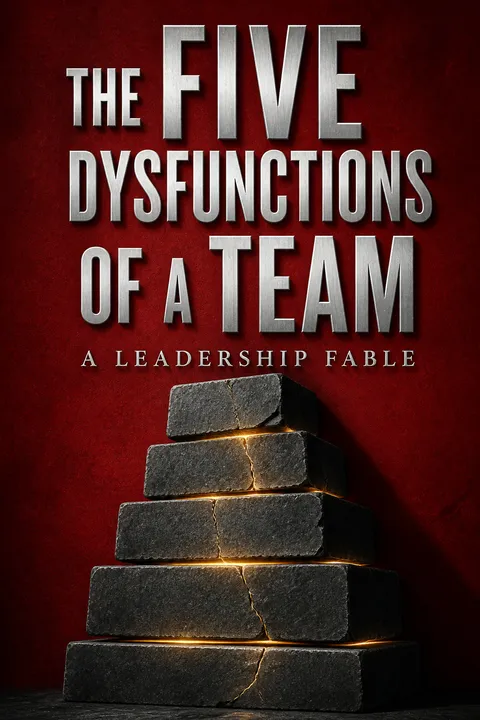
The Five Dysfunctions of a Team, Enhanced Edition receives mostly positive reviews for its accessible fable format and practical insights into team dynamics. Readers appreciate the clear model of five dysfunctions: absence of trust, fear of conflict, lack of commitment, avoidance of accountability, and inattention to results. Many find it applicable to various work environments and helpful for improving team performance. However, some criticize its simplistic approach and question its real-world effectiveness. The book's storytelling format is praised for making complex concepts more engaging, though a few readers find it contrived.
People Also Read






Glossary
Five Dysfunctions Model
Team failure diagnosticA framework for understanding how team behaviors undermine collective results. It links a lack of openness among members to weak debate, unclear decisions, reluctance to challenge peers, and attention shifting from shared outcomes to individual or departmental interests. The model is intended as an interconnected system, not five isolated problems.
vulnerability-based trust
Safety to admit weaknessThe confidence that teammates will not exploit an admission of error, limitation, uncertainty, or need for help. It differs from confidence that someone will perform a task reliably. In the book, this interpersonal openness allows colleagues to spend less effort protecting their reputations and more effort addressing shared work.
ideological conflict
Debate focused on ideasDirect, sometimes passionate disagreement about proposals, priorities, or approaches, without turning the dispute into a personal attack. Its purpose is to expose perspectives and reach a stronger decision. The book contrasts it with sarcasm, private complaints, and artificial calm that leaves important issues unresolved.
first team
Primary leadership allegianceThe group an executive treats as the main team to which they owe loyalty and shared responsibility. In the book, the executive leadership group should take priority over the department an executive manages when company-wide trade-offs arise. This does not mean neglecting a department, but it prevents local interests from automatically prevailing.
Mining
Surface hidden disagreementA meeting practice in which someone deliberately draws out a disagreement that participants are avoiding. The person keeps the issue visible and encourages the group to resolve it rather than retreat into vague agreement or side conversations. It is especially useful when a team has learned to suppress debate to preserve appearances.
Real-Time Permission
Encourage difficult debateA practice of interrupting a tense but constructive discussion to remind participants that disagreement is acceptable and useful. The brief reassurance can help people continue examining an issue instead of withdrawing as discomfort rises. It is meant to support debate about ideas, not excuse hostility or disrespect.
Cascading Messaging
Align messages after meetingsA short closing process in which team members review the decisions they made, confirm what remains confidential, and agree on what to communicate to employees or other groups. It helps reveal misunderstandings before leaders send inconsistent instructions and makes commitments clearer beyond the executive room.
FAQ
What's "The Five Dysfunctions of a Team" about?
- Leadership Fable: The book is a leadership fable that explores the challenges of building a cohesive team. It uses a fictional story to illustrate real-world team dynamics.
- Five Dysfunctions Model: It introduces a model that identifies five dysfunctions that prevent teams from working effectively: absence of trust, fear of conflict, lack of commitment, avoidance of accountability, and inattention to results.
- Practical Solutions: The book provides practical solutions and strategies to overcome these dysfunctions, aiming to help teams achieve better results.
- Broader Application: While focused on executive teams, the principles can be applied to any group working together, from small departments to large organizations.
Why should I read "The Five Dysfunctions of a Team"?
- Improve Team Dynamics: The book offers insights into common team challenges and provides actionable strategies to improve team dynamics and performance.
- Leadership Development: It is particularly useful for leaders who want to foster a more cohesive and effective team environment.
- Engaging Storytelling: The fable format makes complex concepts accessible and engaging, allowing readers to relate to the characters and scenarios.
- Universal Principles: The principles discussed are applicable across various industries and team settings, making it a valuable resource for anyone involved in teamwork.
What are the key takeaways of "The Five Dysfunctions of a Team"?
- Trust is Foundational: Building trust among team members is crucial for overcoming other dysfunctions and fostering open communication.
- Embrace Conflict: Healthy conflict is necessary for effective decision-making and should be encouraged rather than avoided.
- Commitment and Accountability: Teams must commit to decisions and hold each other accountable to achieve collective goals.
- Focus on Results: The ultimate measure of a team's success is its ability to achieve results, which requires prioritizing team goals over individual interests.
What are the five dysfunctions according to Patrick Lencioni?
- Absence of Trust: This dysfunction arises from team members' unwillingness to be vulnerable and open with one another.
- Fear of Conflict: Without trust, teams are unable to engage in healthy, productive conflict, leading to artificial harmony.
- Lack of Commitment: A lack of conflict prevents team members from fully committing to decisions, resulting in ambiguity.
- Avoidance of Accountability: Without commitment, team members are less likely to hold each other accountable for their actions.
- Inattention to Results: When accountability is lacking, team members may prioritize personal goals over team objectives.
How does Patrick Lencioni suggest building trust within a team?
- Vulnerability-Based Trust: Team members must be willing to be vulnerable, admitting weaknesses and mistakes without fear of reprisal.
- Personal Histories Exercise: Sharing personal stories and backgrounds can help team members relate to each other on a human level.
- Behavioral Profiles: Tools like the Myers-Briggs Type Indicator can help team members understand and empathize with each other's differences.
- Leader's Role: Leaders must model vulnerability and create an environment where it is safe for team members to do the same.
What strategies does "The Five Dysfunctions of a Team" offer for encouraging healthy conflict?
- Mining for Conflict: Designate a team member to bring up and address buried disagreements to ensure they are resolved.
- Real-Time Permission: Encourage team members to remind each other that conflict is necessary and productive during discussions.
- Conflict Mode Instruments: Use tools like the Thomas-Kilmann Conflict Mode Instrument to understand and manage different conflict styles.
- Leader's Restraint: Leaders should allow conflict to occur naturally and not intervene prematurely, fostering a culture of open debate.
How can teams ensure commitment according to "The Five Dysfunctions of a Team"?
- Clarity and Buy-In: Ensure that all team members understand and agree on decisions, even if they initially disagreed.
- Cascading Messaging: Review key decisions at the end of meetings to ensure alignment and consistent communication to the rest of the organization.
- Deadlines and Contingency Plans: Set clear deadlines for decisions and discuss worst-case scenarios to reduce fear and encourage decisiveness.
- Leader's Role: Leaders must push for closure and be comfortable with making decisions that may later prove to be wrong.
What role does accountability play in overcoming team dysfunctions?
- Peer Accountability: Team members should hold each other accountable for performance and behavior, reducing reliance on the leader for discipline.
- Public Goals and Standards: Clearly define and communicate team goals and standards to eliminate ambiguity and encourage accountability.
- Regular Progress Reviews: Conduct frequent check-ins to discuss progress and address any issues before they escalate.
- Leader's Role: Leaders should encourage peer accountability and step in only when necessary to maintain high standards.
How does "The Five Dysfunctions of a Team" define a focus on results?
- Collective Goals: Teams must prioritize collective goals over individual or departmental interests to achieve success.
- Public Declaration of Results: Making public commitments to specific results can motivate teams to work passionately toward achieving them.
- Results-Based Rewards: Tie rewards to the achievement of team goals to reinforce the importance of focusing on results.
- Leader's Role: Leaders must set the tone by valuing results above all else and ensuring that team members do the same.
What are the best quotes from "The Five Dysfunctions of a Team" and what do they mean?
- "Teamwork is the ultimate competitive advantage." This quote emphasizes the power of teamwork in achieving success and outpacing competitors.
- "Trust is the foundation of real teamwork." It highlights the importance of trust as the basis for all other team dynamics.
- "Conflict is not a bad thing." This quote challenges the common perception of conflict as negative, advocating for its role in healthy decision-making.
- "A decision is better than no decision." It underscores the importance of decisiveness and the willingness to commit to a course of action.
How does the fable format enhance the understanding of team dysfunctions?
- Relatable Characters: The fictional story allows readers to see themselves and their teams in the characters, making the concepts more relatable.
- Real-World Application: By illustrating the dysfunctions in a realistic setting, the fable demonstrates how they manifest in everyday team interactions.
- Engaging Narrative: The story format keeps readers engaged, making it easier to absorb and remember the lessons.
- Practical Examples: The fable provides concrete examples of how to address dysfunctions, offering a blueprint for real-world application.
What is the role of the leader in addressing the five dysfunctions?
- Modeling Behavior: Leaders must model the behaviors they want to see, such as vulnerability, conflict engagement, and accountability.
- Creating a Safe Environment: Leaders should foster an environment where team members feel safe to express themselves and take risks.
- Encouraging Accountability: Leaders must encourage team members to hold each other accountable and step in when necessary.
- Focusing on Results: Leaders should prioritize team results over individual achievements and ensure that the team remains aligned with its goals.
About the Author
Other books by Patrick Lencioni








Download PDF
Download EPUB
.epub digital book format is ideal for reading ebooks on phones, tablets, and e-readers.








