

Plot Summary
Prologue
In old age, Iris keeps one photograph of herself with a dark-haired man from a picnic. She hid it inside a gardening book, wrapped among newspaper clippings.
His raised hand partly blocks the camera, while a third person has been cut from the frame. Iris studies the bright grass, the unripe fruit, and the man’s guarded smile, trying to recover a happiness that the picture preserves but cannot explain.
The photograph makes memory both evidence and concealment. Its missing third figure turns a private moment into a puzzle, while Iris’s close inspection suggests that recollection is an act of reconstruction rather than retrieval. The gardening book is an apt hiding place: a record of how to tend what grows, sheltering proof of a past that cannot be tended back to life. The image offers intimacy without context, preparing the reader to question whose story is being seen and whose hand has been cropped away.
The Bridge and Notebooks
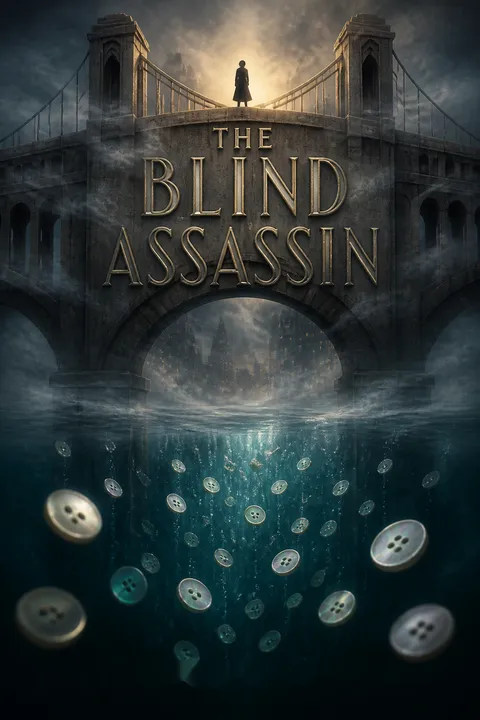
In 1945, Iris Griffen receives news that her younger sister Laura has driven Iris’s car through barriers at a bridge under repair and died in the ravine. Witnesses believe Laura turned deliberately; Iris tells the police it was an accident, then finds a bundle of school notebooks in her stocking drawer.
An old newspaper prints the official verdict, while another announces the posthumous publication of Laura’s novel, The Blind Assassin. Decades later, Iris writes from her Port Ticonderoga home, revisiting the family history behind both the crash and the book. The notebooks become the first tangible sign that the public account of Laura’s life, and perhaps Iris’s own account, cannot be trusted.
The novel begins by splitting fact from testimony. The police have witnesses, a coroner has a verdict, and Iris has an explanation, yet none settles what Laura intended. The notebooks complicate matters before their contents are known: they are both evidence and a burden handed to the survivor. Iris’s calm public statement contrasts with her bodily shock, establishing how respectability requires her to manage grief as performance. The opening also gives the reader a reason to listen closely: the story is being told by someone who has concealed things, but who may finally be willing to expose them.
Two Sisters at Avilion
Iris and Laura grow up at Avilion, the grand but declining Chase family home in Port Ticonderoga. Their mother, Liliana, dies after a stillbirth, leaving Iris to care for Laura while their father, Norval, returns from the First World War wounded, grieving his brothers, and increasingly dependent on alcohol.
Iris learns to be quiet and useful; Laura responds to loss with fierce belief, literal-minded questions, and little regard for rules. Norval keeps the factories running for his workers, but the Depression erodes the family’s wealth and his authority. As the sisters explore the house’s attics, cellars, and gardens, they become each other’s closest companions, even as Iris feels burdened by the duty to protect Laura.
Avilion is not simply a family home. It is an inherited script, designed by a dead grandmother and maintained by people who expect the girls to behave according to class and gender. Iris adapts by becoming competent and unobtrusive, traits that later make her seem reliable even when she is withholding the truth. Laura refuses those accommodations, but her directness leaves her exposed to adults who can define her as difficult or irrational. The sisters’ bond is therefore both intimate and unequal: Iris is assigned responsibility, while Laura becomes the person everyone believes needs managing.
The Picnic and Stranger
By 1934, Norval’s factories are struggling, and Iris, now eighteen, is expected to learn the business and watch over fourteen-year-old Laura. At the annual workers’ picnic, Laura slips away from Iris and meets Alex Thomas, a dark-haired outsider with a past in an orphanage and a failed religious vocation.
Laura is fascinated by his knowledge and his skepticism about God; Iris distrusts him but cannot ignore the attention he draws. The picnic also brings Richard Griffen, a wealthy Toronto manufacturer and Norval’s sharpest business rival, who has been invited to dinner at Avilion. Iris sees the social and financial power gathered around Richard, while Laura has found someone who speaks to her as if her questions matter.
The picnic places the novel’s central relationships inside a public ritual of paternal benevolence. Norval’s company feeds and entertains its workers, but the economic strain beneath the celebration is visible in the sparse food and anxious crowd. Alex arrives from outside both the family and the town’s class order, giving Laura a rare conversational equal. Iris, however, reads people through risk and consequence. Her impulse to supervise Laura and her attraction to the possibility of escape begin side by side, though she cannot yet distinguish one from the other.
A Fugitive in the Attic
After a strike, street violence, and a fire at the Chase button factory, police seek Alex as a suspected radical and arsonist. Laura has hidden him in the cold cellar; Iris discovers him there, moves him to the attic, and helps the sisters feed and conceal him while soldiers and Mounties search the town.
Alex denies setting the fire but will not explain who benefits from blaming him. In the cramped attic, Iris catches him smoking and he kisses her; she flees, shaken by her own response. When the search eases, Alex leaves for Toronto with food and a coat. He leaves a notebook of coded-looking words, while Laura gives Iris a photograph from the picnic with her own image cut away.
The rescue makes the sisters collaborators, but it does not make their motives identical. Laura acts from a moral rule that forbids abandoning a hunted person; Iris acts practically, then discovers that her own desire has entered the secret. Alex’s unexplained accusation of political convenience leaves suspicion hanging over the factory fire, while his code and Laura’s altered photograph give later events a material trace. The attic becomes a temporary space outside adult authority, yet it is not safe or innocent. The same hiding place protects Alex and exposes Iris to a relationship she cannot yet name.
A Marriage Buys the Future
With the Chase business near collapse, Iris marries Richard, whose money can preserve a future for her and Laura. Richard’s sister Winifred manages the wedding and teaches Iris how to behave among the wealthy. During their honeymoon, Richard receives telegrams announcing that Norval has died after the factories are permanently closed, but he keeps the news from Iris.
She learns the truth only after returning home. Soon after, Laura disappears, takes work at a Sunnyside amusement park, and is brought back by Richard. Laura says she wanted a life beyond his household; Richard insists that she obey him. Iris sees that her marriage has not rescued her family so much as transferred its dependence to Richard.
Iris’s marriage is framed as a responsible choice, but its bargain is unequal: financial security comes at the cost of autonomy, and Richard controls the information that would let Iris judge the bargain clearly. His concealment of Norval’s death shows how care can be used as a justification for control. Laura’s escape exposes the limits of the family’s protective language. She wants employment and independence, while Richard treats her as a problem to contain. Iris understands Laura’s anger but still participates in bringing her back, because survival and compliance have begun to look like the same thing.
The Lover Beneath the Story
After Laura’s return, Iris spots Alex across a Toronto street and crosses through traffic to reach him. He is still being watched and moves between borrowed rooms; Iris visits in secret, bringing money, cigarettes, and small comforts.
Their encounters become an affair conducted in rented rooms and hidden apartments, while Richard’s household continues around her. Alex earns money writing lurid science fiction for cheap magazines, and he tells Iris stories during their meetings.
She listens closely, even when he mocks romance or turns tenderness into a joke. His stories give their relationship a language, but they also let him avoid promising a future. Iris returns to him anyway, drawn by a desire that makes her feel both chosen and powerless.
The affair is not a clean escape from marriage. Iris’s access to Alex depends on the money, mobility, and social invisibility she possesses as Richard’s wife, while Alex’s precarious life makes him difficult to hold. Their difference in power does not erase their mutual desire; it shapes its terms. Alex’s irony protects him from dependence, and Iris’s attention becomes a form of longing for a world beyond her assigned role. The pulp stories function as both intimacy and evasion: they let the lovers approach danger indirectly, while making it harder to tell where fantasy ends and confession begins.
The Assassin Spares the Maiden
In Alex’s continuing tale, Sakiel-Norn’s wealth rests on enslaved children who weave carpets until their eyes fail, while noble families sacrifice girls to appease their gods. A blind assassin, himself brutalized as a child, is hired by courtiers to kill a tongueless maiden during a palace coup.
He enters her chamber intending to complete the contract, but instead treats her gently and saves her from the false priest who has paid to exploit her. When the Temple’s fraud is exposed, the assassin and girl escape through hidden passages and a canal. Outside the walls, invading armies close in. Iris presses Alex about whether the pair can love one another, while he insists that danger and exploitation will shape whatever future they get.
The fable makes the novel’s violence legible without reducing it to a single allegory. The blinded weavers, silenced sacrificial girls, and hired assassin are all products of institutions that convert vulnerable bodies into luxury, ritual, or profit. The assassin’s choice to spare the maiden is a break in his professional code, not proof that he has become innocent. Iris’s interest in the lovers’ fate reveals her hunger for a form of tenderness that does not require domination. Alex’s refusal to make the story safe keeps that desire under pressure.
A Voyage of Appearances
In 1936, Richard takes Iris, Laura, and Winifred on the Queen Mary’s celebrated maiden voyage, treating the trip as an education and a display of status. Iris watches Richard pursue business contacts while she and Laura remain largely alone.
Laura rejects the ship’s entertainments and later leaves school, finding its lessons and expectations useless. Richard keeps her under supervision, while Iris notices how little either sister can say plainly inside the household.
Meanwhile, Alex’s serialized fiction grows more extravagant: an alien invasion interrupts the blind assassin’s tale, and its promised rescue is repeatedly postponed. The pulp stories mirror the family’s own interruptions, as Iris and Laura both wait for an escape that neither can confidently arrange.
The ocean liner turns privilege into theater. Richard can move his family through a world of luxury, but the voyage does not create closeness; it enlarges the distance between people who already occupy different emotional realities. Laura’s refusal of school and shipboard amusements is not merely adolescent rebellion. She recognizes that the available futures are being designed for her by others. The serial’s abrupt shift from one plot to another reflects how desire is continually interrupted by circumstance. In both strands, promises of arrival sustain hope while also postponing the moment when anyone must choose.
A Baby and a Clinic
Iris discovers she is pregnant and later gives birth to Aimee, a dark-haired girl whose biological father is not yet named in the public family story. Around the same period, Laura tells Richard that she is pregnant.
He and Winifred call her unstable, then commit her to BellaVista, a private institution, where Laura is subjected to treatments and an abortion without Iris’s knowledge. Richard tells Iris that Laura’s pregnancy is a delusion and forbids contact.
The lie works because Iris is exhausted, financially dependent, and accustomed to letting Richard interpret events for her. Laura’s letters never reach her. In the years that follow, Iris remains unsure what happened, while Richard continues building his political reputation and Aimee grows up inside his household.
The two pregnancies expose how differently the women’s bodies are treated. Iris’s pregnancy is managed as a valuable family event, complete with medical care and a future heir; Laura’s is recast as madness, then removed from public view. Richard and Winifred exploit medical authority to make confinement look protective. Iris’s ignorance is not simple foolishness: it is produced by dependence, exhaustion, and the deliberate interception of information. Yet her later regret also depends on recognizing that she accepted a version of events because it was easier to live with than the possibility that she had failed her sister.
The Missing Man Returns
Alex leaves for Spain and later fights in the Second World War. A telegram eventually tells Iris that he has died in Holland; he has listed her as his next of kin. In 1945, Laura returns to Toronto after years away, expecting Alex may come back now that the war in Europe is over. Iris meets her at a tea room and tells her the news.
She also tells Laura that she and Alex were lovers, a truth that turns cruel in the moment because Laura has built her life around believing she saved him. Laura takes Iris’s purse and car keys, drives away, and crashes through the bridge barriers. Iris does not stop her in time. Her sister’s death leaves the notebooks and the false public story in Iris’s hands.
Iris’s disclosure is both fact and weapon. She is not inventing her relationship with Alex, but she chooses to present it in a way that destroys the hope sustaining Laura. The cruelty grows from years of competition, secrecy, and unspoken need, not from a single calculated plan. Laura’s final act echoes the danger that has followed her throughout life, yet the text keeps motive entangled with consequence. Iris can explain why she spoke, but explanation cannot restore the person who heard her. The crash turns private knowledge into irreversible public loss.
The Numbers Name Richard
After Laura’s death, Iris opens the notebooks and finds coded dates, repeated X marks, and a final O. The entries make her understand that Richard had been sexually abusing Laura, and that the pregnancy Iris had thought impossible was real. A Latin exercise describes a woman released from a painful life; another notebook preserves Alex’s strange list of words and the altered picnic photograph.
Iris now sees that Laura’s silence was not emptiness but a record she had hidden in plain sight. The clues also force Iris to reconsider her own past with Alex, including the possibility that her daughter Aimee is his child. Her certainty about the family begins to collapse.
The notebooks convert seemingly childish schoolwork into testimony. Their form matters: coded dates and a literary translation allow Laura to record what she could not safely say directly. Iris’s reading is an act of belated recognition, but also of interpretation; she must infer what the marks mean rather than receive a complete confession. The reveal makes her earlier assumptions about Alex and Laura untenable, while exposing how abuse flourishes when a powerful man controls the household’s account of reality. Laura’s papers do not undo her silence. They show that silence was one of the few forms of authorship she could keep.
Laura's Book Burns the Mask
Iris sends The Blind Assassin to a publisher under Laura’s name, presenting it as the dead sister’s novel. Its scandalous sexual content revives rumors about Laura and draws attention to Richard’s private conduct just as he seeks political power. The book’s inner story of a blind assassin and a silenced girl gives Iris a way to memorialize Alex while exposing a pattern of exploitation she could not state openly.
Richard’s political prospects collapse under the renewed scrutiny. In 1947, he is found dead aboard the Water Nixie at Avilion, officially from a cerebral hemorrhage. Iris never clarifies whether the publication was meant as justice, revenge, or both, but she knows it has changed the story the public tells about him.
The novel within the novel is an instrument with two edges. By attributing it to Laura, Iris gives her sister a voice and also takes control of that voice herself. Fiction can expose what public records conceal, but it can also distort the identities of the people it claims to honor. The publication damages Richard because it makes private power legible as public scandal. Iris’s motives remain morally mixed: memorial, retaliation, and self-protection overlap. The book’s authorship question therefore reproduces the larger problem of the novel: who has the right to tell another person’s story, especially after that person can no longer answer?
Aimee and the Lost Child
Aimee grows into an unsettled adult, struggles with addiction, and has a daughter, Sabrina. Iris tries to reach them, but Winifred uses money and guardianship to keep Sabrina close and Iris at a distance. Aimee dies after a fall in her Toronto apartment, leaving four-year-old Sabrina in Winifred’s care.
Iris later remembers confronting Aimee, who believed that Laura was her real mother and Alex her father. Iris denies the story, though she knows that her own relationship with Alex makes the child’s parentage more complicated than the family admitted. She regrets leaving that conversation without comforting Aimee. Sabrina eventually travels abroad, and Iris is left with no reliable way to reach her.
The damage of secrecy travels into the next generation. Aimee invents a family history that may be emotionally persuasive even when its details are wrong, because the official version has denied her access to the people and events that shaped her. Iris recognizes her daughter’s need for truth only after anger has made conversation impossible. Winifred’s control of money and custody turns care into possession, repeating the family’s older pattern of deciding who may belong to whom. Sabrina’s absence leaves Iris with a final audience she cannot compel to listen.
The Truth Left for Sabrina
In old age, Iris writes the account for Sabrina, who may never return from her travels. She finally admits that Laura did not write The Blind Assassin: Iris composed it from memory and imagination, then gave it to her sister as a posthumous work. She also tells Sabrina that Alex was her biological grandfather, not Richard, and that her family name conceals the truth.
Iris leaves the notebooks, photograph, and manuscript locked in a steamer trunk with a lawyer’s key. Winifred has died, and Iris’s own heart is failing. In 1999 she dies in her garden before she can know whether Sabrina will read the papers or cross the threshold she keeps imagining.
Iris’s confession does not offer a clean absolution. She admits to writing under Laura’s name, to withholding the truth from Aimee, and to using the book against Richard, while still framing the account as an inheritance for Sabrina. The act of telling is a final attempt to turn private guilt into usable knowledge. Yet the intended listener remains absent, so the story cannot guarantee reconciliation. Iris can leave evidence, but she cannot dictate how it will be read. The novel’s resolution is therefore ethical rather than restorative: she relinquishes control of the story, though she cannot repair the lives it has shaped.
Epilogue
In the closing image, Iris’s photograph of herself with Alex bears the trace of Laura: one cropped hand remains at its edge. Iris sees that the absent sister was present in the image all along, as she was in the story Iris made from their shared life.
The photograph can preserve the picnic, but it cannot restore its happiness or explain every choice that followed. What remains for Sabrina is the picture, the manuscript, and the possibility of seeing the family differently.
The final photograph refuses a simple division between author and subject, witness and participant. Laura is absent from the visible scene but persists through the cut hand, an image of connection that also resembles an act of editing. Iris’s realization does not solve the past; it changes how she understands her own role within it. The novel ends by distinguishing happiness from narrative. A sealed, perfect moment would contain no movement, while stories arise from loss, error, and the need to make meaning after consequences have already arrived.
Analysis
The Blind Assassin treats memory as a contested archive. Iris’s account is intimate, but intimacy does not guarantee accuracy: she mistakes silence for consent, accepts Richard’s explanations, and later turns what she knows into a novel attributed to Laura. The inserted newspapers and school notebooks show how public record and private testimony fail in different ways. Newspapers smooth violence into respectable language; private documents preserve fragments but still require interpretation.
The novel’s nested pulp story makes exploitation visible through bodies: blind children weave luxury carpets, girls are prepared for sacrifice, and an assassin is shaped by the same system that hires him. These inventions do not simply symbolize Iris’s life. They allow her and Alex to argue about whether tenderness can exist without power, while their own relationship remains compromised by dependence and secrecy. The story’s unfinished, repeatedly interrupted course resists the promise that love alone can rescue anyone.
At the center is the family’s economy of protection. Richard and Winifred call control care; Iris accepts that language when she feels unable to act; Laura refuses it and is punished as irrational. The later revelations do not make Iris innocent. They show how a person can be both injured by power and complicit in its silences. Her final confession offers Sabrina a truer inheritance, but not a repaired family. The book leaves truth as a gift that cannot force forgiveness, and storytelling as an imperfect form of justice that may preserve the dead while still appropriating their voices.
Review Summary
The Blind Assassin is a complex, multi-layered novel that blends family saga, science fiction, and historical fiction. Many readers praise Atwood's masterful writing and intricate storytelling, though some find the pacing slow and the narrative overly long. The book follows the lives of two sisters, Iris and Laura, in early 20th century Canada, exploring themes of love, loss, and secrets. While some readers found the multiple storylines confusing, others appreciated the gradual reveal and the novel's emotional depth. Overall, it's considered a challenging but rewarding read.
People Also Read



Characters
Iris Chase Griffen
The watchful elder sisterIris is the older Chase daughter, shaped by a family that expects her to be useful, composed, and responsible for Laura. She watches people closely but often mistakes silence for safety and compliance for choice. Her intelligence is practical, trained by money worries and social scrutiny; her deeper difficulty is that she experiences desire and resentment without knowing how to speak them plainly. Iris is not naturally cruel, yet fear can make her evasive and self-protective. She understands the cost of dependence but repeatedly accepts arrangements that limit her, partly because she believes she must keep the family intact. Her retrospective voice is observant, funny, and guarded, inviting sympathy without asking to be treated as innocent.
Laura Chase
The ungovernable younger sisterLaura is Iris’s younger sister, unusually direct, religiously intense, and unwilling to treat conventional explanations as final. As a child, she takes words literally and feels suffering with an immediacy that unsettles adults. Her compassion draws her toward people whom respectable society would rather ignore, while her refusal to perform gratitude or deference makes her vulnerable to being labeled strange. Laura can be stubborn, impractical, and startlingly self-contained. She and Iris share a close childhood but interpret family duty differently: Iris tries to manage danger, while Laura follows convictions even when they make her difficult to protect. Her presence challenges the family’s claim that obedience is the same as goodness.
Alex Thomas
The fugitive storytellerAlex is an outsider who comes to Port Ticonderoga with no stable family background and a history shaped by war and institutional care. He once trained for the ministry, but religious certainty gave way to skepticism. Intelligent, politically alert, and wary of dependence, he survives by moving between borrowed rooms and writing inexpensive science fiction. His humor can be playful or cutting, especially when someone expects him to offer reassurance. Alex is drawn to stories because they let him examine violence and power without pretending either can be neatly escaped. To Laura and Iris, he represents different possibilities: moral argument for one, dangerous intimacy for the other.
Richard Griffen
The polished industrialistRichard is a wealthy Toronto manufacturer, Winifred’s brother, and Iris’s husband. He values influence, order, and the ability to make arrangements before anyone else can interfere. His public manner is measured and respectable, but he regards people through the lenses of utility, loyalty, and control. He can fund generous gestures, yet generosity does not make him emotionally generous. Richard’s political ambitions depend on a carefully managed image, and he expects the people around him to protect it. His composure makes his authority seem natural, even when it rests on unequal power.
Winifred Griffen Prior
The society gatekeeperWinifred is Richard’s socially adept sister, a philanthropist who knows how to organize people, events, and reputations. She regards social life as a system that can be mastered through taste, money, and well-timed pressure. To Iris, she is first an imposing guide to elite behavior, then a rival whose kindness always carries conditions. Winifred is energetic and observant, but her concern for others rarely outranks her investment in family status. She believes security comes from controlling appearances, and treats people who threaten those appearances as problems to be managed.
Reenie
The household truth-tellerReenie works at Avilion and helps raise Iris and Laura after their mother dies. Practical, sharp-tongued, and protective, she interprets the town for the girls and gives them the plainspoken care their family often cannot provide. Her affection comes through food, warnings, and labor rather than sentimental declarations. Reenie distrusts pretension and knows how quickly a woman can lose security, which makes her advice both valuable and restrictive. She is a surrogate mother to the sisters, though her own needs and loyalties eventually pull her toward a life beyond the Chase household.
Norval Chase
The wounded factory heirNorval is Iris and Laura’s father, a First World War veteran who inherits the Chase industries after the deaths of his brothers. He feels responsible for his workers and refuses to treat them as disposable when the Depression makes business difficult. His injuries, grief, and drinking strain his ability to care for his daughters, even though he wants to preserve their home and the family enterprise. Norval’s decency is real but incomplete: good intentions cannot undo the silence and instability his children must live with.
Liliana Chase
The self-sacrificing motherLiliana, Iris and Laura’s mother, is remembered as earnest, religious, and devoted to public service. She teaches in a poor rural school, organizes aid for the war effort, and tries to make usefulness a moral practice. Her daughters experience her differently: Iris longs for her affection, while Laura’s questions expose the limits of the stories adults tell about birth and death. Liliana’s example gives both girls an inheritance of care, but also leaves them with a powerful idea of what a good woman is expected to endure.
Aimee Griffen
The daughter seeking originsAimee is Iris’s daughter and Sabrina’s mother. Raised amid wealth, family conflict, and carefully maintained silences, she struggles to understand where she belongs. As an adult, she resists Iris’s attempts to repair their relationship and builds a life marked by instability. Aimee’s suspicion that the family has concealed her origins reflects a real emotional deprivation, even when her conclusions are not reliable. She wants an explanation for why love in her family has so often felt conditional, and she distrusts the people who claim to know what is best for her.
Sabrina Griffen
The absent granddaughterSabrina is Aimee’s daughter and Iris’s granddaughter. As a small child, she experiences neglect and instability before being placed under Winifred’s guardianship. She grows into a young woman who travels far from the family and remains difficult for Iris to reach. Iris imagines Sabrina as both a lost child and an independent adult, projecting hopes onto someone whose actual thoughts she does not know. Sabrina matters because she may inherit the family’s evidence, but she is not obligated to accept the story Iris leaves for her.
Callista Fitzsimmons
The artist in the householdCallista is a sculptor and muralist who becomes part of Norval’s social circle and a vivid presence in the girls’ childhood. She is independent in dress and manner, comfortable among men who would rather keep women decorative. Her political sympathies and artistic commitments put her at odds with Richard’s conservative world. Iris admires her confidence, while Reenie distrusts her closeness to Norval. Callista’s role shows how a woman may claim public space without escaping the judgments attached to her private life.
Myra Sturgess
Iris’s practical neighborMyra is Reenie’s daughter and, in Iris’s old age, a persistent neighbor who brings food, arranges help, and worries over Iris’s health. She is earnest and conventional, with a strong belief in practical care and religious reassurance. Iris often teases her, especially when Myra tries to manage her life, but also depends on the attention she provides. Myra’s ordinary kindness contrasts with the family’s elaborate secrets: she is less interested in explanations than in making sure Iris has eaten and is safe.
Walter Sturgess
The steady-handed repairmanWalter is Myra’s husband and a local handyman who drives Iris when she can no longer manage alone. He is practical, unshowy, and comfortable repairing the small failures that others overlook. His dependable presence gives Iris a form of care that asks no confession in return.
Mr. Erskine
The cruel tutorMr. Erskine is hired to improve the Chase girls’ education and imposes discipline through humiliation and violence. His authority is protected by the assumption that adults know best, leaving the girls with few safe ways to resist. Reenie’s intervention ends his position in the household.
Elwood Murray
The town photographerElwood runs the Port Ticonderoga newspaper and photographs local events. His camera captures the picnic image that Laura later alters, making him an unwitting custodian of evidence. He is curious, proud of his craft, and sensitive to the town’s social hierarchy.
Plot Devices
The story inside the story
A fable mirrors desireAlex’s pulp narrative follows an enslaved, blind assassin and a tongueless maiden in the city of Sakiel-Norn. Its episodes move from child labor and sacrifice to a planned coup, an unexpected act of mercy, and escape amid invasion. Alex and Iris revise, debate, and interrupt the tale during their secret meetings. Its violence reflects real structures of exploitation, while its uncertain romantic promise gives Iris a way to imagine intimacy without directly naming her own. Later pulp episodes, including the Lizard Men of Xenor, fracture and postpone the original plot, echoing the lovers’ interrupted future.
Newspaper and society clippings
Public records hide private livesNews reports, obituaries, school bulletins, and society columns appear between sections of Iris’s account. They document deaths, political speeches, social events, and official explanations in a tone that makes contradiction easy to miss. Their omissions matter as much as their statements: public sources reduce family crises to accidents, respectable marriages, and civic duty. Reading them beside Iris’s recollections shows how reputation is manufactured and how a town’s version of events can survive even when the people involved know it is false.
The altered photograph
A cropped hand preserves a bondThe picnic photograph first appears as Iris’s treasured image of herself with Alex, while Laura’s hand is cut off at the edge. Laura later makes and alters copies, removing herself from the composition and coloring the remaining figures in ways that express her private judgments. The image connects the sisters, Alex, and the competing accounts of who loved whom. Its cropping is not merely visual decoration: it records absence, concealment, and the wish to control who remains visible in a memory.
Laura’s school notebooks
Coded pages expose buried harmThe notebooks appear at the opening as a bundle hidden in Iris’s drawer. Their contents include exercises, a coded sequence of dates and marks, and fragments of writing that Iris interprets only after Laura’s death. They turn childhood schoolwork into a private record of events that could not be named safely inside the family. Their importance is not that they provide a complete, neutral transcript. They force Iris to confront evidence she had failed to recognize and to revise her assumptions about Laura, Richard, Alex, and herself.
The false author credit
A memorial becomes an accusationThe Blind Assassin is presented publicly as Laura’s posthumous novel, but Iris ultimately reveals that she wrote it from memory and invention. Giving Laura credit protects Iris’s identity, gives her sister a lasting public presence, and allows the book to wound Richard’s reputation without openly naming every private fact. The attribution complicates the difference between honoring someone and speaking in their place. It also makes the reader reconsider the novel’s nested stories as acts of authorship, testimony, and revenge.
FAQ
Synopsis & Basic Details
What is The Blind Assassin about?
- Complex family saga: The novel explores the lives of two sisters, Iris Chase and Laura Chase, through multiple timelines and narratives, revealing a complex family history marked by secrets, betrayals, and societal pressures.
- Layered storytelling: It interweaves Iris's present-day reflections with her memories of the past, and also includes a novel-within-a-novel, "The Blind Assassin," attributed to her sister Laura, creating a multi-layered narrative that blurs the lines between fiction and reality.
- Exploration of themes: The story delves into themes of love, loss, memory, power, and the role of women in society, using the Chase family's history as a microcosm for broader social and political issues.
Why should I read The Blind Assassin?
- Intricate narrative structure: Atwood masterfully weaves together multiple timelines and narratives, creating a complex and engaging reading experience that challenges the reader to piece together the truth.
- Rich character development: The novel features well-developed and flawed characters, whose motivations and relationships are explored in depth, offering a nuanced portrayal of human nature.
- Thought-provoking themes: It delves into profound themes of love, loss, memory, power, and the role of women in society, prompting readers to reflect on their own lives and the world around them.
What is the background of The Blind Assassin?
- Post-war Canada: The novel is set against the backdrop of post-World War II Canada, exploring the social and political changes of the time, including the rise of industrialism, the impact of war, and the changing roles of women.
- Historical references: It incorporates historical references to the Great Depression, the Spanish Civil War, and the rise of fascism, providing a broader context for the characters' lives and the events that shape them.
- Cultural context: The story reflects the cultural norms and expectations of the time, particularly regarding gender roles, class distinctions, and the societal pressures placed on women.
What are the most memorable quotes in The Blind Assassin?
- "She had her reasons. Not that they were ever the same as anybody else's reasons. She was completely ruthless in that way.": This quote, spoken by Iris about Laura, encapsulates Laura's enigmatic nature and her tendency to defy societal expectations, highlighting her complex character.
- "The word is a flame burning in a dark glass.": This quote, used as an epigraph, speaks to the power and danger of language and storytelling, a central theme in the novel, and the way words can illuminate or obscure the truth.
- "What will it be, then? he says. Dinner jackets and romance, or shipwrecks on a barren coast?": This quote, from the novel-within-a-novel, highlights the power of storytelling and the way narratives can shape our understanding of reality, reflecting the complex relationship between Laura and her lover.
What writing style, narrative choices, and literary techniques does Margaret Atwood use?
- Multiple narrative layers: Atwood employs a complex narrative structure, interweaving Iris's first-person narration with excerpts from Laura's novel, "The Blind Assassin," and other documents, creating a multi-layered and fragmented story.
- Shifting perspectives: The novel shifts between different points of view, allowing readers to see events from multiple perspectives and challenging the notion of a single, objective truth.
- Foreshadowing and symbolism: Atwood uses subtle foreshadowing and recurring symbols to create a sense of unease and to hint at the hidden truths that are gradually revealed throughout the story.
Hidden Details & Subtle Connections
What are some minor details that add significant meaning?
- The white gloves: Laura's white gloves, mentioned at the beginning of the novel, become a symbol of her detachment and her deliberate choice to separate herself from her family and her past, a "Pontius Pilate gesture."
- The lipstick heart: The lipstick heart with initials and the word "FUCK" found under the bridge where Laura and her lover meet, reveals the raw, passionate, and rebellious nature of their relationship, contrasting with the more refined world of Iris.
- The silver box: The small silver box containing Laura's ashes, which Iris keeps, becomes a tangible reminder of her sister's presence and a symbol of the complex emotions surrounding her death.
What are some subtle foreshadowing and callbacks?
- The apple tree: The recurring image of the apple tree, present in the picnic photo and in the descriptions of the park, foreshadows the themes of temptation, loss, and the fall from innocence, connecting to the biblical story of the Garden of Eden.
- The Water Nixie: The name of Richard's sailboat, "The Water Nixie," foreshadows his death by drowning, and also connects to the mythological water spirits, hinting at the dangerous and unpredictable nature of his life.
- The colour red: The recurring use of the colour red, in clothing, flowers, and descriptions of violence, foreshadows the themes of passion, danger, and death, creating a sense of foreboding throughout the novel.
What are some unexpected character connections?
- Reenie and Myra: The connection between Reenie, the family's former housekeeper, and Myra, the town busybody, reveals a continuity of local knowledge and gossip, highlighting the way stories and secrets are passed down through generations.
- Callie Fitzsimmons and Alex Thomas: The connection between Callie Fitzsimmons, the artist, and Alex Thomas, Laura's lover, reveals a shared world of artistic and political rebellion, suggesting a hidden network of like-minded individuals.
- Iris and the younger generation: Iris's unexpected connection with the young student who wins the Laura Chase Memorial Prize, and her recognition of her granddaughter in the student, highlights the cyclical nature of time and the enduring legacy of the past.
Who are the most significant supporting characters?
- Reenie: As the family's former housekeeper, Reenie serves as a source of local knowledge and a link to the past, providing a grounded perspective on the Chase family's history and the town's social dynamics.
- Winifred Griffen Prior: As Richard's sister, Winifred embodies the societal pressures and expectations placed on women, and her actions reveal the complex power dynamics within the Griffen family.
- Callie Fitzsimmons: As an artist and a friend of Laura's lover, Callie represents a world of artistic and political rebellion, offering a counterpoint to the more conventional characters in the novel.
Psychological, Emotional, & Relational Analysis
What are some unspoken motivations of the characters?
- Richard's need for control: Richard Griffen's actions are driven by a deep-seated need for control, both in his personal life and in his business dealings, stemming from his insecurities and his desire to maintain his social standing.
- Laura's desire for authenticity: Laura Chase's rebellious behavior and her creation of "The Blind Assassin" are driven by a desire for authenticity and a rejection of the societal constraints placed upon her, as well as a need to express her inner world.
- Iris's yearning for connection: Iris Chase's reflections and her search for truth are driven by a deep yearning for connection with her sister and a desire to understand the forces that shaped their lives, as well as a need to make sense of her own life.
What psychological complexities do the characters exhibit?
- Iris's guilt and grief: Iris Chase is haunted by guilt over her sister's death and her own role in the family's dysfunction, leading to a complex emotional landscape marked by grief, regret, and a desire for redemption.
- Laura's idealism and rebellion: Laura Chase exhibits a complex mix of idealism and rebellion, driven by a desire for authenticity and a rejection of societal norms, but also by a deep-seated sense of alienation and despair.
- Richard's insecurity and ambition: Richard Griffen's actions are driven by a deep-seated insecurity and a relentless ambition, leading to a manipulative and controlling behavior that ultimately destroys his relationships and his own life.
What are the major emotional turning points?
- Laura's death: Laura Chase's death is a major emotional turning point for Iris, forcing her to confront the mysteries of her sister's life and the hidden truths of their family.
- The discovery of Richard's betrayal: Iris Chase's discovery of Richard Griffen's deceit and manipulation shatters her trust and forces her to reevaluate her marriage and her own identity.
- The revelation of the novel's authorship: Iris Chase's confession that she was the true author of "The Blind Assassin" is a moment of liberation and empowerment, allowing her to reclaim her voice and agency.
How do relationship dynamics evolve?
- Iris and Laura's complex bond: The relationship between Iris and Laura is marked by both love and rivalry, with each sister seeking her own path while remaining deeply connected to the other. Their bond is tested by secrets and betrayals, but ultimately endures as a testament to the power of sisterhood.
- Iris and Richard's power imbalance: The relationship between Iris and Richard Griffen is characterized by a power imbalance, with Richard seeking to control and manipulate Iris, while she gradually awakens to his true nature and seeks her own autonomy.
- Iris and Reenie's surrogate mother-daughter dynamic: The relationship between Iris and Reenie evolves from a childhood bond to a complex dynamic of loyalty and resentment, as Iris grapples with her own identity and Reenie's role in her life.
Interpretation & Debate
Which parts of the story remain ambiguous or open-ended?
- The true nature of Laura's death: The circumstances surrounding Laura Chase's death remain ambiguous, with the possibility of suicide or an accident left open to interpretation, reflecting the elusiveness of truth and the limitations of memory.
- The identity of Laura's lover: The true identity of Laura Chase's lover in "The Blind Assassin" is never fully revealed, leaving readers to speculate about his motivations and his impact on her life.
- The meaning of the ending: The ending of the novel, with Iris Chase preparing to die and leaving her story for her granddaughter, is open-ended, leaving readers to ponder the legacy of the Chase family and the enduring power of storytelling.
What are some debatable, controversial scenes or moments in The Blind Assassin?
- The graphic violence in "The Blind Assassin": The graphic violence and sexual content in Laura Chase's novel, "The Blind Assassin," can be seen as both a reflection of the characters' inner turmoil and a critique of societal norms, sparking debate about the role of violence in literature.
- Richard's manipulation of Iris: Richard Griffen's manipulative and controlling behavior towards Iris Chase raises questions about the nature of power and the ways in which women are often exploited and silenced.
- Laura's actions and motivations: Laura Chase's actions and motivations, particularly her relationship with her lover and her decision to end her life, are open to interpretation, sparking debate about her agency and her role in the family's tragedy.
The Blind Assassin Ending Explained: How It Ends & What It Means
- Iris's final act of storytelling: The novel concludes with Iris Chase preparing to die, having completed her story and leaving it for her granddaughter, Sabrina. This act of storytelling is a final attempt to reclaim her voice and agency, and to pass on her version of the truth.
- The enduring power of narrative: The ending emphasizes the enduring power of narrative to shape our understanding of the past and to challenge the dominant narratives of history, highlighting the importance of individual perspectives and the elusiveness of objective truth.
- A legacy of ambiguity: The novel's open-ended conclusion leaves readers with a sense of ambiguity, reflecting the complexities of human relationships and the enduring mysteries of life and death, and the impossibility of ever fully knowing another person.
About the Author




Download PDF
Download EPUB
.epub digital book format is ideal for reading ebooks on phones, tablets, and e-readers.








