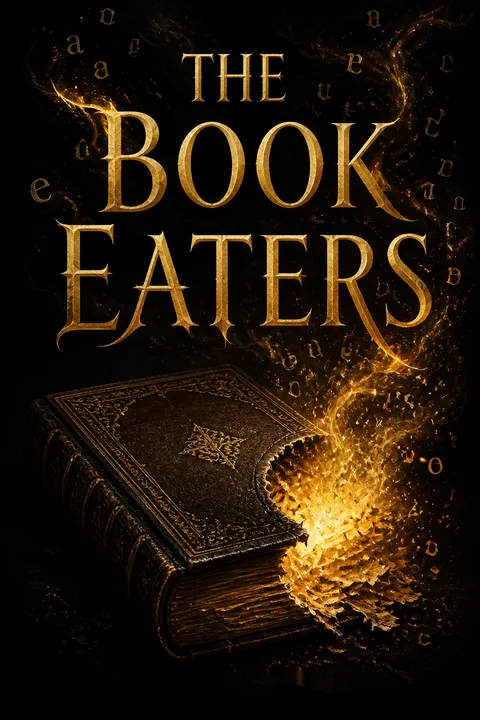


Plot Summary
A Vicar for Cai
On Christmas Eve in Newcastle, Devon Fairweather, a book eater who survives by consuming printed pages, brings a local vicar into her flat and locks him with Cai, her five-year-old son. Cai is a mind eater: unless he consumes human minds, starvation drives him toward madness and death. Devon waits for the struggle to stop, then leaves the injured vicar at a shelter, where his condition may pass unnoticed.
Cai wakes speaking with the man's adult cadence, a fresh reminder that each meal blurs the child she is trying to protect. Devon has spent months searching for the vanished Ravenscar family, the only makers of Redemption, a drug that lets mind eaters live on books. A dealer has finally offered her a meeting.
The opening makes care inseparable from harm. Devon does not mistake feeding Cai for a good deed; she understands that a stranger pays for his survival, and proceeds because every alternative means watching her child deteriorate. Her question about whether victims are kind turns morality into a desperate sorting ritual, not a clean defense of violence. Cai's borrowed voice gives the cost a domestic intimacy: each meal enters their home and alters the person Devon is trying to save. The search for Redemption begins as a practical need, but its urgency is already entangled with shame, exhaustion, and love.
The Guest in Snow
At Fairweather Manor, Devon grows up among the Six Families, an isolated society of book eaters who absorb books by eating them and are taught to obey inherited customs. She is a rare daughter, indulged by the patriarch Uncle Aike and delighted by the manor's libraries, but kept ignorant of the world beyond them.
One winter, she finds journalist Amarinder Patel lost in the snow and leads him inside, expecting a welcome for their unusual guest. Instead, Aike treats Mani as a threat because he might expose the Family.
Devon is sent to fetch a fairy tale, steals Jane Eyre from a forbidden shelf, and reads it rather than eating it. When she returns, Mani has been confined for transfer to Ravenscar Manor, and Devon begins to sense that the adults' stories hide something ugly.
Devon's childhood is warm without being free. The manor offers play, books, and affection, yet even her curiosity is managed through approved stories and carefully withheld knowledge. Her decision to read Jane Eyre is small but consequential: she discovers that information can be encountered rather than swallowed, and that disobedience can begin as a private change in how she uses a book. Mani's capture complicates her childish belief that guests are welcomed by courtesy. The scene plants the central mismatch between what the Families call protection and what their rules actually protect: their authority.
Ramsey Leaves Home
Four years later, twelve-year-old Devon climbs into a restricted library with her older brother Ramsey to look at the dragons kept under knightly control. The hungry mind eaters turn on the children, and Knight Commander Kingsey Davenport arrests them.
Because the Family does not punish girls, Ramsey bears the consequence: the knights take him for training, while Kingsey warns Devon that people she loves will suffer when she breaks rules. She carries that warning as guilt for years.
At eighteen, she leaves Fairweather Manor to marry Luton Winterfield, a wealthy patriarch, and has little freedom to question the bargain. She wonders why Ramsey cannot attend her wedding, but accepts that he is busy with knightly duties, still believing obedience might keep her family intact.
The library incident converts Devon's curiosity into a lifelong burden. Kingsey's lesson is not simply that rules have consequences; it assigns responsibility for institutional punishment to the girl who provoked it, despite the system's own choice to discipline Ramsey. Devon internalizes the accusation, which makes obedience feel like a form of care. Her first marriage follows the same logic on a larger scale: she is told that her privileged position makes the contract fortunate. The emotional trap is already visible. Devon learns to interpret other people's coercion as the price of her own mistakes.
The Daughter's Birthday
At Winterfield Manor, Devon's wedding to Luton brings wealth, formal hospitality, and a lavish feast of books, but no real choice about her husband. On Christmas morning she gives birth to Salem and discovers a fierce attachment that Family custom has no room to accommodate.
Luton permits Devon to nurse and raise the girl for three years, while his sister Gailey tries to weaken their bond by arranging forced separations. Luton eventually ends that intervention because the crying disrupts his household, not because he recognizes Devon's right.
On Salem's third birthday, he drugs Devon, sends her back to Fairweather Manor, and denies the private arrangement he had promised. Devon wakes far from her daughter and runs for Birmingham, but her family stops her before she can reach Salem.
Motherhood breaks the comforting fiction that Devon can be a good bride by complying. Her bond with Salem is not an abstract rebellion; it is built through nursing, touch, and daily care, while the household treats separation as an administrative necessity. Luton sometimes protects that bond, but only when its disruption inconveniences him, revealing how conditional his kindness is. The birthday betrayal is especially cruel because it turns a child's celebration into the instrument of Devon's removal. Her failed run begins the book's recurring question: when a system controls the available choices, what does obedience actually buy?
The Games Room
After her capture, Devon is sent to marry Matley Easterbrook, a brutal patriarch whose estate is wealthy through exploitation of undocumented workers. On her wedding day, Matley's younger brother Jarrow takes her to a games room, where Tomb Raider gives her a story about an adventurous woman who leaves the safety of a manor.
Jarrow becomes her friend as they play, and he shows her maps of the world and a route through Ireland that might evade the Families. Devon refuses to flee without Salem.
Later, she learns she is pregnant again and that Jarrow is asexual; she admits her attraction to women and recognizes how little of her life she has chosen. When she gives birth to Cai, whose tongue marks him as a mind eater, Matley attacks her. Jarrow intervenes, teaches her Morse code, then is exiled from the estate.
Jarrow's friendship matters because it supplies Devon with a relationship not organized around ownership, marriage, or rank. Video games and maps offer more than distraction: they let her rehearse a life in which a woman moves through the world by choice. Yet she cannot accept escape while Salem remains behind, showing that imagination alone cannot dissolve attachment or practical responsibility. Her recognition of her sexuality and Jarrow's asexuality also exposes the narrowness of Family expectations. The tenderness of their bond is real, but the institution makes even friendship precarious, punishing Jarrow for helping Devon survive.
Christmas Without Redemption
For years, Devon raises Cai under Matley's electronic surveillance, receiving Redemption from the Ravenscars so her son can avoid feeding on people. Then the Ravenscars disappear and the supply ends.
On Christmas morning, Matley arrives with armed guards and tells Devon that the knights no longer need Cai; he intends to kill the child rather than keep him. As the guards pin Devon down, Cai bites Matley and consumes his mind. Devon tears out one guard's throat with her bookteeth, then kills the other as he flees.
The violence saves Cai but leaves him overwhelmed by Matley's memories, unable to function. Within minutes Ramsey arrives with knights, turns the scene into a staged murder and robbery, and tells Devon that her son's survival now depends on cooperating.
The crisis destroys the distinction between the monster others fear and the mother Devon believes herself to be. She kills to prevent Cai's murder, while Cai's own survival requires the act that makes him seem monstrous to the Family. Matley's contempt is not merely personal cruelty; it is the society's treatment of mind eaters made explicit in one household. Ramsey's arrival then converts Devon's emergency into political leverage. Even the rescue is conditional, showing how institutions absorb acts of resistance and repurpose them for their own survival.
The Bomb Beneath Cai
Ramsey explains that Cai's consumption of Matley has overloaded his young mind and may leave him comatose. To clear the damage, Devon is forced to place a captured human infant within reach; Cai feeds, and the child survives physically but is left profoundly harmed.
Ramsey then disguises Devon as a dragon and takes her to Camelot, the knights' base, where surgeons implant an explosive device in Cai that Ramsey can trigger remotely. He orders Devon to find the missing Ravenscars and their Redemption, while using the device to ensure her cooperation.
After eight months of preparation, Ramsey releases Devon and Cai into human society with cash, a phone, and strict reporting rules. Cai has been fed a stranger and speaks Polish, carrying another person's memories.
Ramsey's control is effective because it exploits Devon's care rather than overcoming it. He makes the threat to Cai both bodily and remote, turning ordinary acts such as missed calls into possible death sentences. The infant's feeding marks a further moral injury: Devon accepts a choice that saves her son while damaging another child's life, and the book refuses to make that bargain emotionally clean. Cai's changed language makes memory transfer visible, not theoretical. By sending them outside the compound, Ramsey grants movement without freedom, using distance as another form of confinement.
A Map Outward
Alone with Cai, Devon struggles to navigate human cities, teaches herself enough Polish to understand him, and begins feeding him strangers when his hunger becomes dangerous. Her first victim is a drunken old man who admits he once wanted to be good; after Cai consumes him, Devon carries the body to the bathroom and weeps.
She searches the Ravenscars' former suppliers, killing four men who try to traffic her, and learns to disguise herself among humans. A parcel containing a video game and a Morse-coded phone number finally reaches Jarrow.
In Brighton, she meets him and his sister Victoria, who has endured her own forced separation from her children. Jarrow can build a device to block Ramsey's signal, but Devon refuses to leave Cai behind, so the siblings agree to help her find the Ravenscars first.
This stretch turns survival into a skill acquired through repeated, costly improvisation. Devon's first feeding is not presented as a triumph over weakness; the old man's reflection about goodness enters Cai's mind and haunts Devon's understanding of what she has done. Her cultural education also unsettles the Family's claims that their customs are natural or universal. Jarrow and Victoria offer practical solidarity, but their support depends on accepting Devon's central condition: Cai must come too. Love is therefore not a symbol that floats above logistics. It determines where she can go and what risks she will accept.
The Stranger Named Hester
Two years after leaving Camelot, Devon reaches Newcastle with Cai still dependent on scarce food and the knights closing in. When her chemical contact fails to appear at a pub, she meets Hester, a short, sharp-eyed woman whose Christmas date has also stood her up.
Devon nearly brings Hester home as Cai's next victim, but the woman recognizes her and reveals that she represents Killock Ravenscar. Hester gives Cai Redemption, letting him eat printed pages again, and offers more medicine if Devon joins the Ravenscar household.
Devon resists accepting another patriarch's rule, but Cai insists that they have no viable alternative. Before they can settle terms, Ramsey and the knights spot them near Newcastle station. Hester shoots four pursuers, and Devon carries her and Cai onto the Edinburgh train.
Hester first appears as both a possible victim and a possible companion, forcing Devon to confront how quickly desperation can erase the difference. The reversal is not only that Hester knows her identity, but that she brings the resource Devon has pursued for years. Cai's first return to paper eating offers relief without resolving his wider dependence or the question of obedience. His insistence that they must accept help gives the child a strategic voice, even as Devon remains the parent responsible for the consequences. The station attack makes intimacy and danger arrive together.
A Coup at Midnight
Ramsey boards the moving train in disguise and confronts Devon, warning her not to trust Hester blindly. He arranges a false emergency: he cuts the lights, frightens passengers with a knife, and drives the group off the train before Berwick.
As Devon, Cai, and Hester cross the fields toward shelter, Ramsey heads to Alnwick. At a church, he confronts Kingsey, the commander who once forced him into knight training, and shoots him dead, then persuades the remaining knights to follow his leadership.
He has found Hester's Ravenscar pistol and uses it as evidence that Killock is alive. By morning, Hester has secured a car and revealed their destination, Traquair House in Scotland. Devon and Cai arrive tired, exposed, and still unsure what sort of refuge awaits them.
Ramsey's conduct blends genuine tactical insight with a hunger for power. He helps Devon escape immediate capture, but does so by manufacturing terror and manipulating her route, preserving his own access to the Ravenscars. Killing Kingsey is both personal reversal and political coup: the pupil who learned to master fear now uses that lesson to justify becoming the source of fear for others. His competence makes him more dangerous, not more ethical. The episode also complicates the apparent alliance between siblings, since Ramsey's protection remains a tool he expects to control.
A House of Saints
At Traquair House, Devon discovers that Killock's household is made up not of ordinary book eaters but of mind eaters, including Hester. Killock calls them saints and explains that the family once hid its mind-eater children from the knights, preserving them instead of sending them to be controlled.
He claims he killed his father, Weston, to obtain Redemption and free his siblings. Yet the household's Christmas service exposes the cost of his new order: Killock consumes a captive man as religious communion while the others watch.
Hester later shows Devon the scar where her feeding tongue was cut away, part of her abandoned plan to make the household safe through Redemption and enforced abstinence. Killock has rejected that promise and built a familiar hierarchy around himself.
The revelation at Traquair does not offer a simple refuge from the Families. Killock's rebellion has preserved people whom the wider system would confine, but his language of sainthood recasts predation as sacred entitlement. Hester's scar embodies a different political possibility, one based on accepting limits to protect others, though it has not won her brother's loyalty. Devon recognizes that the old hierarchy can reproduce itself even among the oppressed. The question becomes not whether a group has suffered, but what it does with power once it has escaped its former captors.
The Way Out Opens
Devon admits to Hester that Ramsey sent her to locate the Ravenscars, but insists the knights will attack regardless and asks Hester to flee with her and Cai. Hester is furious and uncertain.
Devon also learns from Mani, the aging journalist once taken from Fairweather Manor, that he spent years helping Weston produce Redemption and now keeps the household's records. Mani agrees to steal a large supply of the drug and Killock's production notes in exchange for escape to Ireland.
Devon finally tells Cai about Ramsey's mission and the explosive implanted in his abdomen; Cai demands an end to secrets but chooses to stay with her. At the River Tweed, Jarrow and Victoria give them two tested signal blockers and a plan to cross to Ireland. Hester later accepts Devon's invitation and prepares to leave.
The escape plan becomes possible only when Devon changes her method from solitary control to negotiated trust. Mani's knowledge links the novel's opening encounter to its endgame, while his decision to leave reflects the human cost hidden beneath the Families' private history. Devon's confession to Cai risks their bond but also recognizes his capacity to participate in his own future. Jarrow's signal blockers answer Ramsey's technological threat, whereas Hester's decision remains emotional and political. Each ally contributes a different form of freedom: information, protection, companionship, or medicine.
The Labyrinth's Last Choice
At seven on Christmas Eve, Devon and Cai meet Mani at the brewery, where he has packed Redemption and stolen the Ravenscar production ledger. Hester and Killock argue outside; before Devon can understand why, Ramsey arrives hours early with knights and dragons.
He presses the detonator, but Jarrow's blockers protect Cai. Devon and Hester flee toward the observation tower as the knights assault Traquair. Hester is shot in the shoulder, then saves herself from another bolt with the new leather handbag Devon bought her.
Killock charges Ramsey and the knights, giving Devon time to enter the hedge maze with Hester. At the tower, Hester shoots Ealand, while Ramsey wounds her and fights Devon. Cai leaps onto his uncle and feeds. Devon survives, but Cai absorbs Ramsey's memories and becomes dangerously disoriented.
The climax gathers the book's competing forms of control into one night: the bomb, the assault, the maze, and the intimate violence between siblings. Devon's gift to Hester becomes unexpectedly practical protection, turning affection into a material resource without reducing it to sentiment. Killock's charge gives Devon time, but does not undo his earlier choices or the harm he caused. Cai's decision to feed on Ramsey saves his mother and may also damage his own sense of self. The escape succeeds at the cost of bringing the conflict inside the family directly into Cai's mind.
No More Fairy Tales
Devon wakes injured beside Cai, who has survived but speaks with Ramsey's memories mixed into his own. Mani and Hester are alive; the knights have killed Killock and set Traquair ablaze, while some Ravenscars may have escaped. Devon and Cai reunite with Hester and carry the stolen Redemption through the woods toward the River Tweed.
Cai asks whether the deaths were worth their escape and reminds Devon that Salem remains in Birmingham. Devon cannot promise a happy ending for the daughter she has not seen in years, but says she intends to return for her. Jarrow and Victoria wait in a car by the bridge. Cai runs to them, and Devon follows, leaving the Families behind with medicine, a signal shield, and a future none of them can yet picture.
The resolution refuses to confuse escape with repair. Cai is alive and supplied with Redemption, but his uncle's identity has entered the same crowded mental space as his other victims. Devon has also not recovered Salem, and the final promise to return remains an intention rather than a solved problem. What has changed is the scale of her imagined future: it now includes allies, travel, and choices beyond the manors. The closing movement is therefore neither triumph nor defeat. It is a provisional departure, made meaningful by the fact that Devon and Cai move toward it together.
Analysis
The novel treats reading, memory, and appetite as forms of possession. Book eaters acquire knowledge by consuming it, while mind eaters acquire another person's interior life through a literal feeding. Neither process leaves the eater untouched. Cai's changing voices make memory transfer an intimate, unstable inheritance, and Devon's own accumulated knowledge cannot compensate for the education her family withheld. She knows thousands of stories but initially lacks the conceptual room to imagine a life outside marriage, motherhood, and obedience.
The Families' social order survives by describing coercion as care. Brides are told they are privileged; children are assigned to households; mind eaters are confined in the name of safety. The book complicates any easy opposition between oppressive tradition and liberating rebellion. Killock escapes the old order but reconstructs its patriarchal logic, while the knights defend their institutional survival through threats and violence. Suffering does not automatically produce justice, and shared victimhood does not guarantee ethical use of power.
Devon's motherhood is the story's moral engine, but not a claim that love makes her actions pure. She repeatedly harms strangers to keep Cai alive, and she cannot protect Salem at the same time. Her care is powerful precisely because the story refuses to make it costless. Cai, meanwhile, is not merely the object of protection: he asks for truth, weighs danger, and chooses to stay with Devon. Their bond becomes more durable when she stops treating secrecy as the only form of care.
The ending offers departure rather than resolution. Redemption and allies give Devon and Cai a chance to live differently, but Salem remains distant, Cai carries Ramsey's memories, and the damage of the assault cannot be undone. Freedom begins not when every wound is healed, but when the characters can make choices beyond the systems that named those choices for them.
Review Summary
The Book Eaters receives mixed reviews, with many praising its unique premise and atmospheric writing. Readers appreciate the exploration of motherhood, identity, and oppressive systems. Some find the story gripping and thought-provoking, while others feel it falls short of its potential. Criticisms include underdeveloped worldbuilding, flat characters, and a plot that doesn't fully capitalize on the book-eating concept. Despite these issues, many reviewers still recommend it for its originality and dark fantasy elements.
People Also Read






Characters
Devon Fairweather
Runaway book-eater motherDevon is a tall, tough book eater raised to believe that obedience and privilege make her life fortunate. She loves old stories, especially fairy tales, yet gradually recognizes how narrowly her family has shaped what she can imagine. Her defining drive is to keep her children safe, even when the means available to her are violent or morally compromising. She is perceptive about other people's pain but often protects herself through secrecy, alcohol, and practical detachment. Her strength is not purity; it is her capacity to keep making decisions after guilt has become part of daily life. As she encounters people beyond the Families, she begins to distinguish genuine care from the rules that claim to protect her.
Cai Devonson
Hungry mind-eater childCai is Devon's son, a mind eater whose unusual tongue marks the danger his kind pose to humans and the danger the Families believe he poses to themselves. His hunger is physical, but every feeding also brings another person's memories, habits, and voice into his young mind. He is bright, observant, and often more adult than his appearance suggests, yet still wants games, comfort, and the freedom to make choices. Cai fears being reduced to a monster, while also recognizing that his survival can harm others. His relationship with Devon is loving but strained by her protective secrecy and the burdens she makes decisions about on his behalf.
Hester Ravenscar
Ravenscar's wary emissaryHester is a compact, bookish woman from the Ravenscar family, with hazel eyes, a dry wit, and a habit of concealing vulnerability behind brisk competence. She is experienced with weapons and careful about whom she trusts, in part because her household's politics are dangerous even to its own members. Hester's loyalty to her siblings coexists with deep unease about the choices made in the name of their freedom. She is capable of tenderness, but reluctant to imagine a life beyond promises and obligations she has already made. Her meeting with Devon places two women shaped by coercive family systems in uneasy, consequential proximity.
Ramsey Fairweather
Devon's knight brotherRamsey is Devon's older brother, sharp-minded, physically formidable, and shaped by the knight order's brutal training. He understands fear as something to master and tends to interpret control as strength. His loyalty to the knights is bound up with his identity and his belief that their power protects the Families. Ramsey can be strategic and unexpectedly useful, but he treats people as pieces in plans and justifies coercion as necessity. His old closeness with Devon gives their conflict particular force: he knows which responsibilities she will never abandon and builds his leverage around them.
Jarrow Easterbrook
Devon's games-room allyJarrow is Matley's younger brother, an asexual man whose quiet independence sets him apart from the marriage expectations of his family. He uses games, comics, and technology as both pleasure and refuge, then shares those worlds with Devon when she is isolated at Easterbrook Manor. His care is practical: he gives her maps, teaches her Morse code, and helps develop a way to protect Cai from remote control. Jarrow wants freedom for himself and his sister Victoria, but his friendship with Devon tests whether he can support a choice that carries danger for everyone.
Killock Ravenscar
Exiled household leaderKillock leads the Ravenscar household after a violent break with the older order. He presents himself as a liberator of mind eaters and frames feeding through religious language, calling his community a house of saints. His intelligence and charisma help him gather people around a shared history of oppression, but his authority remains intensely personal and difficult to question. Killock's central contradiction is that he seeks freedom from one system while rebuilding many of its habits inside his own household. Hester's devotion to him is complicated by her fear that he has changed beyond recognition.
Amarinder Patel
Journalist held by the FamiliesAmarinder, usually called Mani, is a human journalist who investigates the secretive book-eater Families and unexpectedly meets Devon as a child. His curiosity brings him into their world, where his literacy, education, and knowledge of human institutions make him useful to powerful people. Years later, he remains observant and dryly pragmatic despite age, disability, and a long history of confinement. Mani's account of his life exposes how the Families turn human expertise into a resource while denying the person behind it any real freedom.
Salem Winterfield
Devon's distant daughterSalem is Devon's daughter with Luton Winterfield. Her early life is shaped by the Families' marriage customs, which treat children as links between households rather than as people who belong to their mothers. Devon's memories of Salem's curiosity, birthday, and love of shells keep the absent girl emotionally present throughout the story. Salem represents both the tenderness Devon has known and the unresolved cost of the choices she makes to protect Cai.
Luton Winterfield
Devon's first husbandLuton is a wealthy patriarch who marries Devon and fathers Salem. He can be indulgent toward his daughter and occasionally restrain other adults, but his kindness never overrides the Family's claims on Devon. He values order, reputation, and practical convenience, and tends to treat emotional distress as a problem to be managed. His paternal affection and his willingness to participate in a system that separates mothers from children exist side by side.
Matley Easterbrook
Devon's violent husbandMatley is an Easterbrook patriarch whose wealth rests on human exploitation and whose authority is protected by family custom. He is contemptuous of weakness and views mind-eater children as liabilities unless they serve his interests. Matley can be charming in public, but his domestic behavior reveals a man accustomed to having his preferences treated as law. His treatment of Devon and Cai shows how easily the Families' talk of survival excuses cruelty.
Victoria Easterbrook
Jarrow's exiled sisterVictoria, usually called Vic, is Jarrow's older sister and another person displaced by the Families' marriage system. She is quiet and sometimes struggles to communicate, but she listens closely and can recognize when another person's danger resembles her own. Her choice to support Devon grows from hard-earned knowledge of what happens when isolated women are told to wait patiently for freedom.
Kingsey Davenport
Knight commander and mentorKingsey commands the knights and enforces the Families' rules, including the control and confinement of mind eaters. He is formidable, disciplined, and capable of using fear as a deliberate teaching tool. His authority shapes both Ramsey's training and Devon's early belief that disobedience makes loved ones suffer.
Plot Devices
Book-eater biology
Knowledge with teethBook eaters absorb the contents of books by consuming their paper, covers, and bindings, while mind eaters survive by taking human minds through a long, muscular tongue. Both kinds resemble humans but possess unusual strength, night vision, and a biological inability to write. Mind eating also transfers memories and personality traits, so Cai's meals repeatedly alter the child Devon is trying to preserve. This biology drives the plot's central moral bind: feeding can keep someone alive while changing the eater and harming another person. It also gives the Families a rationale for controlling mind eaters, even as that control protects the social order.
Redemption
Hunger made negotiableRedemption is a Ravenscar-made drug that lets mind eaters sustain themselves on books instead of human minds. It does not erase their craving, but it prevents the physical starvation and madness that follow when they cannot feed. Because the Ravenscars alone know how to produce it, the drug gives their family extraordinary political leverage over other Families and the knights. When the Ravenscars vanish, Cai's supply ends and Devon is forced to hunt for human victims. The medicine therefore functions as both a literal treatment and a bargaining chip, tying personal survival to the power struggles surrounding its manufacture.
The Salem compass
A child's face carriedLuton gives Devon a compass containing a small picture of Salem after Devon is returned to Fairweather Manor. The object is meant as a consolation, but Devon keeps it as a tangible link to the daughter she cannot visit. She carries it through years of escape, feeding, and pursuit, touching it during moments when she is close to despair. The compass cannot guide her back to Salem or resolve the separation, yet its physical presence prevents her from turning absence into forgetfulness. It makes the cost of protecting Cai visible in Devon's daily life.
The implanted explosive
A remote leashThe knights surgically place an explosive device inside Cai and give Ramsey a transmitter capable of triggering it from a distance. The threat forces Devon to report regularly and pursue the Ravenscars, even when she knows the knights may discard her after she has served their purpose. Jarrow and Victoria later build signal blockers that prevent the detonation signal from reaching Cai, turning a coercive device into a technical problem that can be resisted. The device's power is psychological as well as physical: Devon hides its existence from Cai for years because she believes the truth would only deepen his suffering.
Morse code and signal blockers
Communication without writingBecause book eaters cannot write or type, Devon uses Morse code as a workaround, first through tapped signals and later through sounds sent over a phone. Jarrow's lessons give her a private way to communicate when ordinary written messages are impossible. Much later, he builds signal blockers to shield Cai's implanted explosive from Ramsey's transmitter. These devices answer two separate forms of confinement: the species-wide barrier that limits written communication and the knights' specific threat of remote control. Together, they make clandestine alliance and escape materially possible.

Download PDF
Download EPUB
.epub digital book format is ideal for reading ebooks on phones, tablets, and e-readers.








