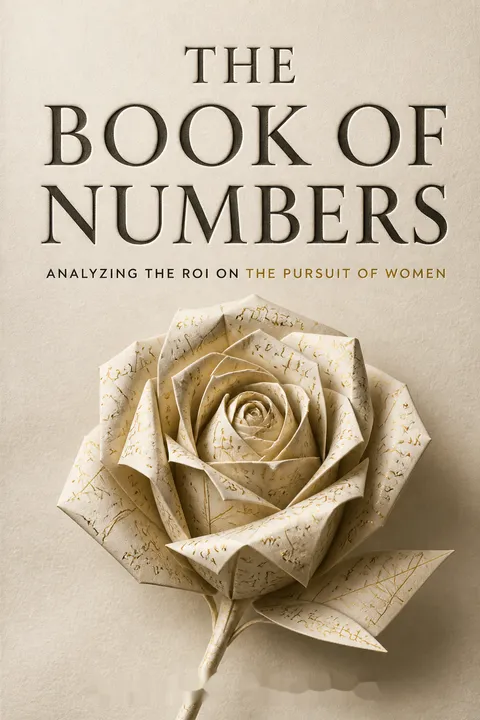


Key Takeaways
Treat romantic pursuit as a high-risk investment, not a life mandate
The starting question. Clarey traces the book to his economics blog, which began as a way to bring charts to political arguments at parties. Posts connecting money and dating drew more attention than technical economic analysis, so he turned the subject into a cost-benefit question: what does pursuing a relationship cost, and what might it return? The framing challenges the assumption that every man must organize his life around finding a partner.
A personal counterexample. The foreword’s narrator describes leaving work, traveling alone for 16 months, and starting a new life after deciding the pursuit no longer suited him. His story gives the book’s calculation a practical purpose: examine the trade before letting custom or social pressure make the decision for you.
The investment metaphor is useful because it makes hidden costs discussable. Time, attention, and emotional energy are scarce resources, even when no invoice records them. It also restores choice to a topic often treated as destiny. But romance is not a conventional asset: its value can include companionship, care, and shared meaning that are difficult to price. The framework works best as a prompt for personal reflection, not as proof that relationships have a single measurable return.
Use bleak dating odds to question assumptions, not accept prophecy
A stacked estimate. The book estimates that 2.72% of women meet its definition of marriageable, that 0.197% would marry an average man, and that 14.25% of marriages would remain happy. Multiplying these inputs produces its headline figure of 0.00076283% for a randomly approached woman leading to a happy marriage. Clarey stresses that this is a per-encounter estimate, not a man's lifetime odds.
A rough model, not a verdict. The author calls the calculations ballpark estimates and says the data are incomplete. He also describes a more practical pool: 1.2 million women who meet his marriageability estimate, with about 35,160 potentially willing to date an average man. Those numbers remain the author's estimates, not established probabilities for any individual's future.
The calculation makes assumptions visible, which is a genuine strength: a reader can ask what happens when an input changes. Its decimal precision, however, risks making uncertain judgments look actuarially exact. A probability built from rough population estimates does not automatically describe one person's prospects, especially when attraction, location, and individual choices shape who meets whom. The most defensible use of the figure is as a challenge to unexamined optimism, not as evidence that a particular reader is doomed.
Define success narrowly before trusting any relationship statistic
The outcome sets the result. Clarey defines success as a committed relationship that stays happy, rather than a date, sex, or simply avoiding divorce. To estimate the share of women considered marriageable, he combines three methods: counting selected dealbreakers, reviewing 900 Match.com profiles across three states, and comparing men's reported dates with marriages. These methods produce estimates of 1.25%, 5.4%, and 1.5%, which he averages to 2.72%.
Preferences enter the model. The dealbreakers include obesity, certain degrees, financial delinquency, political commitments, single parenthood, herpes, mental illness, and multiple tattoos. The author acknowledges that overlap among traits changes the calculation, and attempts to adjust for it. But the criteria themselves are judgments about what makes a good spouse, not neutral measurements of marital compatibility.
This section illustrates a central lesson from measurement theory: a statistic inherits the values embedded in its definitions. If success means lifelong happiness, a count of marriages cannot measure it cleanly. If a tattoo or degree is classified as disqualifying, the resulting estimate partly records the classifier's preference. That does not make the exercise useless. It does mean readers should separate a transparent personal standard from a general claim about relationship quality, and ask whether each measure actually tracks the outcome it is meant to represent.
Improve controllable factors while remembering effort cannot guarantee a partner
Actions change the search. The model does not treat men as powerless. Clarey argues that asking more women out creates more opportunities, while fitness, presentation, education, income, and conversational skill may improve a man's appeal. In his scenarios, a typical man asks out about three women a year from ages 16 to 36; a serial dater asks out about 100. Both scenarios assume 20% say yes, because men usually select whom they approach rather than asking randomly.
More attempts, different odds. The book presents the serial dater's intense effort as a way to make a rare outcome more plausible. Yet it also describes dating as work, which consumes time that could go elsewhere. Its point is not that effort guarantees success, but that a single encounter rate and a lifetime search are different questions.
This is a useful distinction between agency and control. People can change preparation, where they meet potential partners, and how often they initiate contact. They cannot compel mutual attraction or determine another person's choices. The book's effort model resembles a sales funnel, where more attempts may produce more opportunities, but the analogy has limits: people are not interchangeable prospects, and the quality of interaction matters. A healthy application emphasizes deliberate action without turning rejection into a demand to scale up indefinitely.
Count lost time and emotional strain alongside the visible dating bill
The bill is broader than dates. Clarey divides costs into pursuit, maintenance, and disposal. His estimate of lifetime explicit spending is about $260,785, including dates, education, cars, weddings, ongoing household expenses, and a possible divorce. He estimates a lower total for men who do not divorce. These figures depend on assumptions about typical spending and relationship paths, so they are not a universal price tag.
The counterfactual compounds. The author also estimates that investing the same $260,000 from age 18 to 79 in the S&P 500, with an assumed inflation-adjusted annual return of 8.64%, would grow to about $9.7 million. He adds opportunity costs, such as foregone work or leisure, and intangible costs like rejection, conflict, and heartbreak, which resist precise pricing.
Opportunity cost is powerful because it asks what a choice displaces, not merely what it costs upfront. This makes the book's financial examples memorable, but the investment comparison is a hypothetical counterfactual: it assumes the money would actually have been saved and invested consistently, and that the chosen return applies across decades. Emotional costs also vary widely. Readers can retain the useful accounting habit while treating the impressive totals as scenarios rather than settled measurements.
Online abundance can make real connection feel disposable
A larger pool, thinner contact. Clarey argues that dating platforms create an apparent abundance of possible partners while reducing the cost of ignoring or rejecting one another. He cites three men's informal online dating experiments, which together normalized to 32,600 swipes for 11 dates. These self-selected experiments are not representative studies, but the author uses them to illustrate how easily online activity can fail to become an in-person relationship.
Digital substitutes matter. The book argues that online attention, pornography, paid companionship, and virtual interaction can satisfy some desires without the effort of meeting someone face to face. It describes this as a change in incentives: when attention seems plentiful and a swipe requires little commitment, people may invest less in each interaction. Clarey's account applies this argument to both men and women, though its broad claims extend beyond the evidence he presents.
The book identifies a real conceptual tension: a larger menu of options can increase choice while making any one option feel less consequential. In behavioral economics, the number of alternatives and the cost of switching can shape commitment, but neither effect is automatic. Digital tools also help people find partners outside their immediate circles, including people with unusual shared interests. The useful question is not whether online dating is inherently harmful, but whether a person's online habits lead toward the kind of connection they say they want.
Replace an absent family plan with seven concrete arenas of excellence
A life beyond pursuit. The book's alternative to making romance the central project is a life organized around physical health, meaningful work, adventure, friendship, a personal passion, intellectual growth, and moral conduct. Clarey argues that these pursuits make life worthwhile in their own right, rather than merely keeping a disappointed bachelor busy.
A story of reinvention. The foreword's narrator describes leaving a cubicle job, traveling around the world with a backpack, and returning with plans to convert a bus for further travel. That account echoes the book's argument that time and identity can be redirected when a person stops treating partnership as the only route to a satisfying life. Excellence, in this framing, means investing effort in abilities and commitments that remain valuable whatever happens romantically.
This is the book's strongest constructive move: it replaces a single fragile source of validation with several domains of agency. The idea connects to self-determination, the view that well-being is supported by competence, autonomy, and meaningful connection. Friendship and craft can provide those things without requiring a romantic outcome. A caution matters, though: self-development need not be a consolation prize for being single, and partnership need not be the enemy of independence. The framework is most humane when both possibilities remain legitimate.
Treat dating as a bounded search instead of an endless chase
Search with criteria. Clarey recommends screening for compatibility early, stating relationship intentions clearly, and considering a wider geographic range rather than repeatedly dating locally without shared goals. He illustrates the approach through a friend nicknamed Black Calamity Jane, who set explicit criteria on a dating app, traveled in an RV to meet six potential partners, and found someone she married. They later divorced, a reminder that careful search cannot control what follows.
Invest in yourself too. The book's closing paradox is that improving fitness, earning capacity, character, and social confidence may make someone more appealing, even when those qualities are pursued for their own sake. Clarey gives illustrative targets, including earning $65,000 and asking many women out, and claims large gains in probability. Those multipliers depend on his speculative model, so the practical lesson is bounded effort, not guaranteed returns.
The search strategy is clearest when viewed as a way to reduce wasted effort: specify what matters, communicate honestly, and screen before making large commitments. The anecdote also supplies an important counterweight to the book's numerical certainty. A promising match and a deliberate process did not ensure a lasting marriage. That is not a reason to abandon search, but a reason to distinguish good process from guaranteed outcome. Personal development is most durable when its benefits do not depend on whether a partner appears.
Analysis
The book turns dating into an economic question, then uses the language of actuarial calculation to challenge the social expectation that men should pursue marriage at any cost. Its most useful contribution is not the headline probability. It is the insistence that time, money, attention, and emotional strain belong in the same decision, and that an unmarried life can be deliberately built rather than merely endured.
The numerical case is much less secure than its precision suggests. Several inputs come from informal profile reviews, self-reported dating histories, online experiments, and estimates that the author himself labels ballpark figures. The definition of a marriageable partner embeds contestable preferences, while the final calculation multiplies uncertain population estimates as though they compose a dependable individual probability. A statistic that combines those choices can illustrate the author's worldview, but its many decimal places do not make it predictive. The model's scale and scope also shift: a random approach, a selected date, and a lifetime of searching are different events.
The book's broad claims about sex differences, modern women, and marriage should therefore be read as the author's interpretation, not as findings established by the calculations. The rhetoric often treats heterogeneous people as a single type, and it turns disputed norms into apparent empirical criteria. That weakens its claim to impartial analysis. Yet a reader need not accept those claims to use the underlying decision framework: define the relationship sought, examine the costs of pursuing it, and decide what level of effort fits personal priorities.
The strongest synthesis is neither blind optimism nor statistical fatalism. Treat the model as a prompt to make assumptions explicit, not as a forecast of romantic destiny. Search with discernment, protect time for other sources of meaning, and recognize that no spreadsheet can settle what companionship is worth to a particular person.
Review Summary
The Book of Numbers by Aaron Clarey receives mixed reviews. Many praise its statistical approach to dating and relationships, finding it insightful and thought-provoking. Readers appreciate Clarey's analysis of the costs associated with pursuing women and his advice to focus on self-improvement. However, critics argue the book is biased, contradictory, and oversimplifies complex issues. Some find the content offensive or misogynistic. Despite controversy, many readers recommend it as a valuable perspective on modern dating, particularly for young men seeking to understand relationship dynamics.
People Also Read










Glossary
ROI
Return relative to costShort for return on investment. Clarey adapts the financial term to relationships by comparing the possibility of a happy committed partnership with the money, time, effort, and emotional strain spent pursuing one. Because the return is not financial and some costs are intangible, the book's model produces several kinds of comparison rather than one conventional percentage.
Average Joe 5
An average hypothetical manThe book's stand-in for an American man considered average in height, income, status, education, and looks. Clarey uses this hypothetical person to make estimates apply to a broad group rather than to a specific reader. The label also highlights a limitation: actual outcomes vary with individual traits, preferences, location, and the people someone chooses to meet.
Deal Breaker Method
Estimate marriageability by exclusionsOne of three approaches Clarey uses to estimate what share of women are marriageable. It counts selected traits he considers serious obstacles to a happy marriage, then attempts to adjust for overlap among them. The method's result depends heavily on which traits qualify as dealbreakers and on the quality of the data used to estimate their prevalence.
Spinster at 35 Ratio
Estimate women outside marriage plansClarey's label for the share of women who have not married by age 35, which he removes from his estimate of women likely to marry. He uses a minimum estimate of 30%, drawing on data about never-married women. The measure treats age 35 as a meaningful cutoff for men's interest, an assumption that readers may not share.
Male Black Widow Paradox
Biology versus perceived relationship riskClarey's metaphor for the conflict between men's biological drive to pursue relationships and his argument that modern relationship costs and risks may outweigh their expected benefits. The phrase frames dating as a gamble in which a rare desirable outcome may come with potentially severe financial and emotional losses.
unicorn
A rare potential compatible partnerThe book's informal shorthand for a woman who meets its marriageability criteria and is also willing to date an average man. Clarey uses the term to emphasize how small his estimated pool becomes after applying successive filters. It is a label within his model, not a recognized category or a measured type of person.
FAQ
1. What is "The Book of Numbers: Analyzing the ROI on the Pursuit of Women" by Aaron Clarey about?
- Economic Analysis of Dating: The book applies financial concepts, specifically ROI (Return on Investment), to the pursuit of women, dating, and marriage from a male perspective.
- Statistical Approach: Clarey uses statistics, actuarial models, and real-world data to estimate the chances of men achieving a happy marriage and the costs involved.
- Focus on Modern Realities: The book examines how societal changes, feminism, technology, and government policies have altered the traditional dynamics between men and women.
- Practical Guidance: It aims to help men make informed decisions about investing their time, money, and energy in relationships, emphasizing the importance of aligning expectations with reality.
2. Why should someone read "The Book of Numbers" by Aaron Clarey?
- Eye-Opening Statistics: The book provides data-driven insights into the modern dating landscape, challenging common assumptions about relationships and marriage.
- Cost-Benefit Perspective: It offers a unique economic framework for evaluating the pursuit of women, which is rarely discussed in mainstream relationship advice.
- Actionable Advice: Readers receive practical strategies for improving their odds or choosing alternative paths, such as focusing on personal excellence.
- Reality Check: Clarey’s blunt, no-nonsense tone helps men avoid delusion and disappointment by understanding the true risks and rewards of modern relationships.
3. What are the key takeaways from "The Book of Numbers" by Aaron Clarey?
- Extremely Low ROI: The statistical chance of an average man achieving a happy marriage is minuscule, especially when factoring in modern societal trends.
- High Costs Involved: The pursuit of women can cost men hundreds of thousands of dollars, years of time, and significant emotional energy.
- Action Matters: While the odds are low, men can improve their chances through self-improvement, effort, and strategic dating, but the investment is substantial.
- Pursue Excellence: Focusing on personal development and excellence not only enriches a man’s life but ironically increases his attractiveness and chances with women.
4. How does Aaron Clarey define and calculate ROI (Return on Investment) in the context of pursuing women?
- ROI Formula Applied: Clarey adapts the financial ROI formula—benefits divided by costs—to the pursuit of women, where "benefits" are the chances of a happy marriage and "costs" include time, money, and emotional investment.
- Success Defined: "Success" is defined as being happily married, not just dating or having sex.
- Comprehensive Costs: Costs are broken down into explicit (financial), opportunity (what else could have been done with those resources), and intangible (emotional/psychological) categories.
- Statistical Modeling: The model multiplies the percent of marriageable women, the percent willing to marry an average man, and the percent chance of a happy marriage to estimate the overall ROI.
5. What are the main assumptions and limitations in Aaron Clarey’s analysis in "The Book of Numbers"?
- Ballpark Estimates: The study is a first attempt and uses best-effort, ballpark figures rather than precise actuarial data.
- Male Perspective: The analysis is explicitly from the perspective of the average man ("Average Joe 5") and does not account for individual chemistry or personality.
- Data Limitations: Many statistics are extrapolated or inferred due to lack of perfect data, and some variables (like happiness) are difficult to quantify.
- Focused Demographic: The book primarily analyzes women aged 18-35 and men under 45, focusing on traditional marriage as the goal.
6. What methods does "The Book of Numbers" use to estimate the percentage of marriageable women?
- Deal Breaker Method: Evaluates the percentage of women without major deal breakers (e.g., obesity, single motherhood, mental illness, financial irresponsibility, etc.), resulting in about 1.25%.
- Online Dating Profile Survey: Reviews 900 online dating profiles across three states to estimate the percentage of women without obvious deal breakers, yielding 5.4%.
- Dates Per Marriage Method: Calculates how many women men date before marrying, suggesting only 1.5% are marriageable.
- Final Estimate: The average of these methods gives approximately 2.72% of women as marriageable.
7. How does Aaron Clarey determine the likelihood that a marriageable woman will marry an "Average Joe 5"?
- Spinster Ratio: Removes women who have no interest in marrying by age 35 (about 30%).
- Standards for Men: Considers women’s requirements for looks, income, and status, finding only 2.93% of women are willing to date an average man.
- Dates Per Marriage for Women: Women marry about 9.6% of the men they date, further reducing the odds.
- Final Probability: The combined effect results in only 0.197% of women likely to marry an average man.
8. What does "The Book of Numbers" reveal about the chances of achieving a happy marriage for the average man?
- Multiplicative Odds: The chance of being happily married is the product of the percent of marriageable women, the percent willing to marry an average man, and the percent chance of a happy marriage.
- Final Statistic: The resulting chance is approximately 0.00076% per event (asking out a random woman).
- Real-World Translation: For the average man, this translates to about 4.5 in 1,000 men achieving a happy marriage, or 1 in 6 for highly proactive "serial daters."
- Action Increases Odds: Taking more action (asking out more women, self-improvement) can improve these odds, but the baseline is extremely low.
9. What are the explicit, opportunity, and intangible costs of pursuing women according to "The Book of Numbers"?
- Explicit Costs: Includes direct expenses like dating, weddings, divorce, and lifestyle inflation, totaling around $260,000 over a lifetime.
- Opportunity Costs: If the same resources were invested in the S&P 500, a man could have nearly $9.7 million by retirement age.
- Intangible Costs: Emotional pain, stress, heartbreak, and psychological trauma are common and often underestimated.
- Total Cost: Clarey argues the true cost is "total"—essentially a man’s entire life, given the time, money, and energy invested.
10. What are the main societal and technological trends that "The Book of Numbers" claims are lowering the ROI of pursuing women?
- Feminism and Careerism: Modern feminism encourages women to prioritize careers, politics, and self-fulfillment over relationships, making traditional marriage less likely.
- Social Media and Online Dating: The internet creates an illusion of abundance, raises standards, and reduces real-world effort and investment in relationships.
- Government and Welfare: Economic independence and welfare reduce women’s dependency on men, further shifting relationship dynamics.
- Substitute Goods: Both men and women increasingly fulfill their needs through digital means (porn, social media, online attention), reducing the incentive for real relationships.
11. What strategies and advice does Aaron Clarey offer men in "The Book of Numbers" for navigating the modern dating landscape?
- Accept Harsh Realities: Recognize that the odds are stacked against finding a quality, happy marriage, and you are not insane for noticing this.
- Align Expectations: Don’t waste time on delusions; understand the statistical reality and adjust your goals accordingly.
- Leave a Line in the Water: Use technology to cast a wide net, but be strategic and efficient in screening for quality women.
- Pursue Excellence: Focus on self-improvement in physique, profession, adventure, comradery, passion, intellect, and morality—this not only enriches your life but paradoxically increases your attractiveness to women.
12. What are the best quotes from "The Book of Numbers" by Aaron Clarey and what do they mean?
- "You effectively stand NO CHANCE at being happy in your pursuit of women. AND That pursuit will cost you EVERYTHING in life." — Emphasizes the book’s central thesis about the low ROI and high cost of modern relationships.
- "Chase excellence, not women." — Suggests that focusing on personal development is both more rewarding and more likely to attract women.
- "Numbers Don’t Lie." — Underlines the book’s reliance on data and statistics to cut through societal narratives and wishful thinking.
- "The true economic nature of the pursuit of women is more of a gamble than it is an investment." — Frames dating and marriage as a lottery, not a rational investment, given the odds and costs.
- "Make sure you live your life to the best extent possible. And if some nice, sweet girl happens along the way, all the more power to you." — Encourages men to prioritize their own lives and happiness, with relationships as a possible bonus, not the main goal.
About the Author
Other books by Aaron Clarey



Download PDF
Download EPUB
.epub digital book format is ideal for reading ebooks on phones, tablets, and e-readers.








