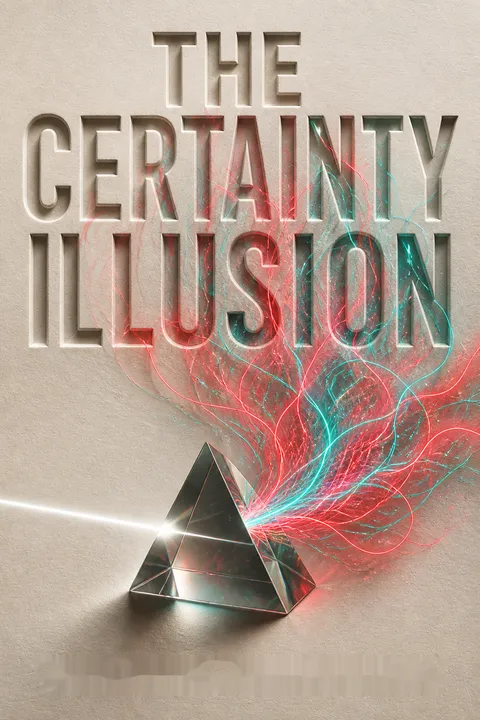


Key Takeaways
Recognize the certainty illusion: more information can make trustworthy guidance harder to find.
A paradox of abundance. Caulfield opens with a furious audience member who insists science cannot be trusted. His weary agreement is not an argument against science. It is a recognition that research and its institutions are fallible, while the information environment increasingly distorts them. The certainty illusion is the feeling that limitless access to information should make decisions clearer, even as the systems supplying that information reward attention, outrage, and persuasion over accuracy.
The guideposts are targets. Science, moral language, and other people’s opinions can help people navigate uncertainty. Their value also makes them attractive tools for selling products, advancing politics, or manufacturing confusion. The central problem is therefore larger than misinformation: the production and distribution of trustworthy knowledge are themselves under pressure.
What's striking is the distinction between having information and having dependable ways to judge it. More data can increase confusion when sources disagree, incentives are hidden, and the loudest claims appear most certain. That makes uncertainty literacy more useful than either blind trust or reflexive distrust. The book's framing also suggests a practical test: ask who benefits if a claim feels settled before the evidence is clear. The risk is that emphasizing corruption can deepen cynicism. The remedy is not to treat every source as equally suspect, but to assess how a claim was produced and whether independent evidence supports it.
When science words sell certainty, ask for the mechanism and evidence.
Jargon can impersonate proof. Scienceploitation is the use of scientific language or discoveries to lend credibility to products and claims that the evidence does not support. The word quantum, for example, appears in wellness products despite quantum physics having no demonstrated connection to the promised healing effects. In an earlier version of the same trick, radioactive products were sold as health aids. Eben Byers reportedly drank more than 1,400 bottles of radium water and died from the consequences.
The pattern repeats. Excitement about stem cells, genetics, or the microbiome can be repackaged as ready-made treatments. In one review of nearly 250 alternative medicine clinic websites, only 19 percent acknowledged limitations in the evidence for their advertised stem cell therapies. Science can be complex, but a seller who cannot explain how a product works may be using complexity to impress rather than inform.
Scientific language can act like a borrowed credential: the audience recognizes the prestige of a field without being given enough information to evaluate the claim. Asking for a mechanism, relevant human evidence, and a plain-language account of uncertainty shifts attention from the vocabulary to the argument. This is not a demand that every explanation be simple. Some science is genuinely difficult. The useful distinction is whether complexity is being clarified or used as cover. Historical examples also show that the trick is not limited to modern wellness marketing. New discoveries repeatedly create commercial opportunity before their practical value is established.
Expect research to advance slowly, and distrust promises of imminent revolutions.
Hype has institutional roots. The hype pipeline describes how exaggerated expectations can enter at funding, research, publication, and publicity stages. Researchers compete for grants and attention, so bold claims about fast clinical benefits can appear attractive. An analysis of successful U.S. National Institutes of Health grant applications found a large increase in promotional language between 1985 and 2020. Separately, studies have found substantial exaggeration in biomedical abstracts and university press releases.
Progress is not a product launch. Many promising biomedical ideas fail to become widely useful treatments, and clinical translation is uncertain. Yet investment can still pay off in unexpected ways. Research tools developed during genomics work helped scientists understand the virus behind COVID-19 and supported vaccine development. The lesson is to fund research without promising that each exciting field will quickly deliver cures, jobs, or a revolution.
The book usefully separates the case for research investment from the case for inflated promises. That distinction matters because basic knowledge often produces benefits that cannot be forecast in advance, while hype can set expectations that science cannot meet on schedule. The account also locates exaggeration inside institutions, not only among influencers or commercial fraudsters. A further implication is that communication standards and funding rules shape public trust. Still, headline-grabbing examples should not become proof that all scientific claims are overblown. The more defensible approach is to ask what a study actually demonstrates, what remains speculative, and how far the result is from clinical use.
A single dramatic paper cannot outweigh a tested body of evidence.
One study is a starting point. The single study syndrome is the habit of treating one paper as decisive proof, especially when it confirms a preferred belief. Caulfield illustrates the danger with Andrew Wakefield's 1998 report suggesting a link between vaccination and autism. It described only twelve children, could not establish causation, and was later retracted after investigations exposed serious problems with its data and conflicts of interest. Yet the paper continued to influence public debate after its retraction.
Bad research can outlive correction. Predatory journals may publish work with little meaningful review, while fake or hijacked journals imitate reputable publications. Retracted studies also continue to circulate and be cited. Before relying on a surprising claim, check its methods, publication venue, retraction status, and relationship to other research. Extraordinary claims deserve especially careful scrutiny, not automatic dismissal or automatic belief.
This takeaway is a defense of cumulative reasoning, not a demand to follow consensus unthinkingly. A single study can reveal an overlooked question or challenge assumptions, but confidence should depend on whether independent work supports it. The Wakefield example shows why corrections must be visible and timely: withdrawing a paper does not erase the memory or political uses created by its initial release. There is also a useful division of labor here. Readers need not personally audit every statistical method, but they can look for trustworthy evidence syntheses and whether relevant experts have engaged with the finding.
Replace virtuous labels with specific questions about safety, health, and impact.
A halo is not evidence. A health halo is a word or label that makes a product seem healthier, safer, or more virtuous than the evidence warrants. Natural, clean, organic, and non-GMO can all trigger that impression. The word natural has no consistent definition, while organic does describe certain production practices, not necessarily superior nutrition or safety. For currently approved genetically modified foods, major scientific reviews cited in the book found no evidence of unique harm to human health, despite widespread consumer concern.
Good intentions can mislead. A green package, an immune-boosting claim, or a grain-free pet food label may sound reassuring without showing a real benefit. Research on food labels finds that perceived healthiness can lead people to eat more, and organic labels can change taste judgments even when the food is identical. The useful question is not whether the label sounds good, but what measurable difference it establishes.
Labels compress complicated decisions, which explains their appeal in a crowded marketplace. They can also communicate real information: organic standards, for example, concern production methods, even if they do not guarantee that a food is healthier. Separating what a label certifies from what consumers infer keeps criticism precise. The same discipline applies to clean beauty and pet food: a legitimate wish for safety does not establish that a branded alternative is safer. This approach avoids both marketing credulity and blanket dismissal. It asks for the specific outcome that matters, then checks whether the label or product has evidence for it.
Notice when moral urgency, identity, or a gripping story steers your judgment.
Good aims can bias evidence. White hat bias is the distortion of research information in service of goals considered righteous. Researchers and audiences may give weak evidence more weight when it supports a desirable outcome, such as preventing disease. Caulfield links this tendency to wishful thinking, which also shaped his childhood belief that ancient structures and ambiguous images showed alien intervention. Such stories can seem harmless, but ancient alien theories have often denied the achievements of non-European civilizations and reinforced racist assumptions.
Identity can dress up as health advice. The book also examines masculinity marketing, where claims about testosterone and wellness are mixed with political identity. Tucker Carlson's promotion of testicle tanning, for instance, was not supported by scientific evidence. Compelling narratives and self-righteous feelings deserve a pause: they may make an uncertain claim feel obvious before its evidence has been examined.
The important insight is that bias does not require bad intent. A worthy goal can make researchers, journalists, or consumers less demanding of evidence because the desired conclusion feels morally urgent. Narrative adds emotional force, helping people remember a particular case while obscuring whether it represents a broader pattern. Yet storytelling is not inherently deceptive; it can make complex findings understandable and humane. The practical distinction is whether the story is used alongside representative evidence or as a substitute for it. Identity-based health claims warrant special care because they can sell belonging and status as if they were biological facts.
Treat star ratings as engineered signals, not a crowd's verdict.
A crowd can be staged. In a well-known prank, writer Oobah Butler invented a restaurant called The Shed at Dulwich, posted fake reviews, and made the nonexistent venue London's top-rated restaurant on TripAdvisor. The story exposes how readily a rating can become a signal of quality without any real experience behind it. Estimates vary, but the book places unreliable online reviews around 25 to 30 percent of the total, with some product categories worse.
The incentives are enormous. Positive ratings can boost sales and search placement, encouraging businesses to buy reviews or recruit customers to post them. Caulfield calls the mutually profitable pattern the fake review cycle: businesses gain sales, platforms gain activity and advertising, and reviewers may be compensated, while customers lose reliable guidance. AI-generated text makes fake reviews harder to spot. Even genuine ratings can be skewed by mood, price expectations, and the opinions already posted.
The Shed prank is powerful because it demonstrates a system weakness rather than merely describing one. Ratings become persuasive through perceived authenticity, similarity, and consensus, all of which can be manufactured or distorted. The phrase crowd wisdom is only useful when judgments are sufficiently independent; visible ratings can instead anchor later reviewers and encourage herding. Readers should be cautious about assuming that a large number of reviews cures these problems. Volume cannot repair systematic manipulation. The book's concern is not that every review is false, but that platforms profit from a trust signal they may not reliably protect.
For high-stakes choices, seek comparative expertise over popularity.
Different reviews answer different questions. In one comparison involving more than 1,200 products, the highest-rated consumer product received a higher score from Consumer Reports only 57 percent of the time. Consumer reviews can reveal how a product felt to a buyer, but expert comparisons may better assess performance across competing products. Reviews of physicians are even more limited: studies discussed in the book found no clear relationship between online ratings and patient clinical outcomes.
Ask who is represented. Reviewers are a self-selected group, often people with unusually positive or negative experiences. Ratings can also reflect the reviewer’s culture, mood, or identity. The book notes that film criticism and movie ratings have been heavily dominated by men, shaping which tastes appear universal. For polls, check who commissioned them, how respondents were selected, and how questions were phrased. Opinions are information, but they are not automatically representative or expert.
The key is to match the source to the decision. A review can be useful for learning about wait times or customer service, yet poorly suited to judging whether a clinician made the right medical decision. Comparative testing, professional expertise, and lived experience each reveal different dimensions of quality. None is flawless, so triangulation is stronger than treating one rating as a verdict. Representation also matters: an average may conceal whose experience is missing. The book's critique should not erase patient feedback, which can expose dismissive treatment or inaccessible systems. It warns against confusing satisfaction scores with technical competence.
Pause before sharing, and check whether a claim survives context.
Start with a beat. Caulfield's practical advice begins with pausing to ask whether a post is accurate before sharing it. This matters because attention-grabbing content often triggers fear, anger, or self-righteousness, precisely the states that can speed judgment. A simple accuracy prompt, the book reports, can improve the quality of information people share.
Then widen the view. When a claim uses scientific buzzwords, ask what research directly supports it. When it promises a breakthrough, check how far the work is from a real-world application. When a label promises goodness, identify what it actually measures. When a study makes a surprising claim, look for replication, retraction notices, and the broader evidence. For purchases, seek independent comparative assessments and talk to people whose judgment is known, rather than assuming an anonymous rating is authentic.
This advice is modest by design. It does not ask readers to become full-time fact-checkers, an impossible burden in an information environment built to overwhelm attention. A pause creates room for the question that engagement metrics tend to suppress: is this worth passing on? Context checks then direct effort toward the most consequential claims. The approach is strongest when paired with trusted sources that synthesize evidence, since individual consumers cannot inspect every paper. Skepticism is most productive when it has a destination: better evidence, clearer uncertainty, and a decision proportionate to the stakes.
Repair research incentives, because personal skepticism cannot clean a polluted system.
The fix must reach institutions. The book argues that individual media literacy cannot compensate for research systems that reward publication volume, hype, and commercial appeal. Suggested reforms include prioritizing quality over quantity, supporting replication and negative results, improving access to research data, discouraging predatory publishing, and clearly flagging retracted work in search results and databases. Faster retractions matter because discredited papers can continue shaping public debate long after correction.
Protect the value of science. The book cites analysis suggesting that disruptive research has declined even as the number of published papers has grown. That finding does not mean scientific investment is pointless. The pandemic vaccines illustrate how long-term research can enable a major advance that no single project could guarantee. The goal is to make reliable knowledge easier to produce, find, and understand, while resisting the promise that every investment will deliver an immediate revolution.
The book's strongest structural claim is that bad information is not simply a consumer error. Academic incentives, platform business models, and weak correction systems can make unreliable content abundant and credible-looking. Reform therefore needs to change rewards and infrastructure, not only teach better individual habits. There is a tension in proposed fixes: defining quality or labeling dubious journals can itself concentrate authority and risk suppressing legitimate dissent. The safeguards are transparency, independent review, and room for challenge. The larger principle is compelling: trust is earned through accountable procedures, visible correction, and incentives that reward dependable work rather than impressive-looking output.
Analysis
The book is organized around three compromised guides: science, moralized ideas of goodness, and public opinion. Its most valuable move is to connect them through one incentive problem. People need help deciding what is true, healthy, or worthwhile, so the signals that promise certainty become economically and politically valuable. Once valuable, they invite imitation and manipulation. A pseudo-scientific product borrows the prestige of research; a health label borrows the moral force of care; a star rating borrows the credibility of consensus.
This structure makes the book more than a catalogue of scams. It shows how apparently separate failures reinforce one another. Hype creates public expectations that marketers can exploit. Predatory journals supply material that can be cited as proof. Emotionally compelling stories make weak claims memorable. Online metrics then make popularity resemble evidence. The resulting problem is epistemic as well as informational: people lose confidence not only in particular claims, but in the institutions and processes that could help distinguish claims. The argument is strongest when it distinguishes science as a revisable method from science as a brand. Its critique of research incentives does not require the conclusion that all research is corrupt, and its warning about health halos does not require denying that some labels communicate real production standards. That distinction is essential. Without it, skepticism can collapse into indiscriminate distrust, the very condition in which evidence-free claims thrive.
A useful way to apply the book is to separate three questions that marketing often fuses: What is the claim? What evidence supports it? What values determine whether the result is desirable? Evidence can assess safety or effectiveness, but it cannot alone settle every moral or political choice. Keeping those questions distinct preserves both scientific rigor and legitimate disagreement. The practical response is layered: slow down as an individual, compare evidence across independent sources, and demand institutional rules that reward transparency and correction. The point is not to become certain about everything. It is to make confidence proportional to evidence, and to protect the systems that make that proportion possible.
Review Summary
The Certainty Illusion receives mixed reviews averaging 3.97/5 stars. Readers praise Caulfield's examination of pseudoscience, fake scientific journals, manipulated reviews, and misuse of terms like "natural" and "quantum." The book explores three main illusions: science, goodness, and opinion. Many appreciate its accessible writing and Canadian perspective, finding it essential reading for navigating misinformation. However, some criticize perceived political bias, smugness, and excessive examples. Several note the book may primarily appeal to those already skeptical of wellness culture and pseudoscience, with limited practical solutions offered for combating misinformation.
People Also Read

Glossary
certainty illusion
False feeling of clarityThe mistaken confidence that abundant information and easy access to it make decisions more certain. In the book, the illusion grows as the systems people rely on, including science communication and online opinions, become distorted by commercial, political, and attention-based incentives.
scienceploitation
Science used as sales glossThe use of scientific terms, discoveries, or imagery to market products and ideas that are not supported by the relevant evidence. It often borrows the credibility of exciting fields, such as quantum physics or stem cell research, while offering little clear explanation of how the advertised claim follows from the science.
hype pipeline
Incentives that inflate research claimsThe chain through which exaggerated promises can enter research, from grant applications and funding decisions through publication, institutional publicity, and media coverage. The concept highlights that hype is not confined to advertisers. Academic and funding systems can reward researchers for overstating novelty, impact, or near-term benefits.
health halo
Label that implies healthfulnessA word, label, or visual cue that leads people to perceive a product as healthier, safer, or more virtuous than the evidence establishes. Terms such as natural, clean, or immune-boosting can serve as shortcuts for judgment, influencing purchases and behavior even when the promised benefit is unclear.
goodness illusion
Virtue used to imply certaintyA messaging strategy that exploits the desire to make choices considered good for oneself, family, community, or the environment. It presents a product, lifestyle, or political position as an obvious route to a worthy goal, even when the evidence is incomplete, misleading, or unrelated to that goal.
white hat bias
Evidence distorted for good endsThe distortion or overly positive presentation of research in service of outcomes perceived as righteous or socially beneficial. A worthy goal can make weak findings seem conclusive, encourage selective attention to favorable results, and reduce scrutiny of methods. The bias can arise without researchers intending to deceive.
opinion economy
Markets built on public judgmentsThe commercial system that gathers, aggregates, promotes, and monetizes opinions, ratings, and reviews. It offers consumers convenient guidance, but the economic value of apparent authenticity creates incentives to manipulate ratings, purchase reviews, and shape what products, services, or cultural works people notice.
zombie science
Discredited research still circulatingResearch that has been retracted, exposed as faulty, or otherwise discredited but continues to circulate as if it were valid. Such work can remain influential through citations, media coverage, and advocacy, particularly when its claims support a political or commercial agenda.
Galileo gambit
Contrarianism framed as persecutionA faulty argument that treats rejection or criticism as evidence that a claim is correct, by comparing its advocate to Galileo. The comparison ignores the difference between challenging an established orthodoxy with evidence and rejecting a well-supported scientific consensus without comparable evidence.
motte-and-bailey fallacy
Retreat from a controversial claimA rhetorical move that advances a bold or difficult-to-defend position, then retreats to a modest claim almost everyone accepts when challenged. The retreat can make critics appear opposed to the reasonable principle, while distracting attention from the original claim that remains unproven.
single study syndrome
One paper treated as decisiveThe tendency to rely on a single research paper as decisive evidence for a broad claim. A study can be interesting or worth following up, but its methods, context, and relationship to the accumulated research matter. The syndrome is especially risky when the paper supports a preferred or contrarian conclusion.
fake review cycle
Fraud rewarded across platformsA reinforcing pattern in which businesses buy or arrange positive reviews, gain visibility and sales, and then spend more on marketing through the platforms that host those reviews. The business, platform, and reviewer may benefit financially, while consumers lose access to dependable opinions.
The Certainty Six
Six habits for judging claimsCaulfield's practical set of strategies for navigating unreliable information: pause and consider accuracy, watch for scienceploitation, resist research hype, scrutinize goodness-based marketing, consult the broader body of evidence, and preserve independent taste and judgment rather than surrendering decisions to ratings.
About the Author
Other books by Timothy Caulfield
Download PDF
Download EPUB
.epub digital book format is ideal for reading ebooks on phones, tablets, and e-readers.








