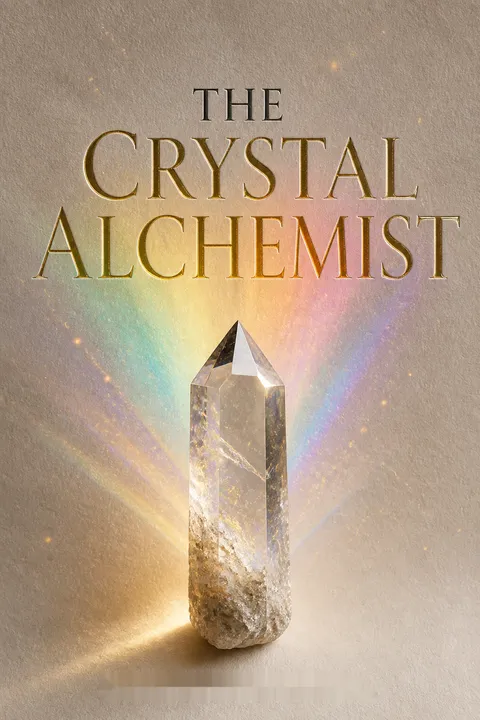


Key Takeaways
Let a crystal focus change, but make your own actions the engine
A practice, not proof. Frazier treats crystals as partners in intentional change. In her metaphysical model, each has a distinctive vibration that can influence a person or place through entrainment, a term for two vibrating systems falling into sync. She connects this idea to pendulum clocks, but that physical analogy does not establish that crystals heal people or alter their circumstances.
An experience became a path. The author began exploring crystals after a Reiki practitioner placed stones on her throat during a session. She recalls an emotional release and the end of persistent throat symptoms, an experience that changed her outlook. The book’s practical invitation is to use a stone as a focus for reflection, ritual, and chosen action, rather than treating it as a replacement for medical care or personal effort.
The strongest version of this idea is psychological rather than supernatural: a meaningful object can anchor attention, signal a desired state, and make a deliberate practice easier to enter. Rituals can also shape expectations, which affect how experiences are perceived. Those effects can matter without proving that a mineral emits healing energy. The distinction protects both the reader’s curiosity and their judgment. A personal story can explain why a practice feels transformative, but it cannot isolate the cause of symptom change or show that the same result will occur for others.
Choose a stone by color, lattice, opacity, then shape
Start with the strongest cues. Frazier’s selection guide treats color as the main clue: red and black relate to grounding, blue to communication, green and pink to love, and yellow to self-worth. She links these colors to the chakra system, a map of seven energy centers. A crystal lattice system is its internal geometric structure, which the book assigns a metaphysical function: monoclinic for growth and protection, triclinic for balance, orthorhombic for clearing, tetragonal for attraction, hexagonal for vitality and manifestation, and cubic for grounding and stability.
Refine the choice. In this model, clear or transparent stones amplify energy, while opaque stones absorb excess. Shape is a final consideration: points direct, clusters spread energy, and spheres diffuse it. These are the author’s spiritual correspondences, not established geological properties.
The guide is memorable because it turns a crowded shop into a decision tree: identify the desired quality, then narrow the options. That can help a beginner make a choice without memorizing hundreds of stone descriptions. It also invites a useful question: does the system describe a crystal’s inherent power, or give the user a symbolic vocabulary for clarifying a need? The latter is easier to defend and still useful. Quartz’s piezoelectricity has practical technological applications, but that physical property does not demonstrate that a crystal can change a person’s health or emotions.
Work on one or two pressing shifts instead of buying blindly
Choose the work first. The book groups common aims into six areas: health and wellness, prosperity, purpose, self-esteem, forgiveness, and relationships. Its Life Energy Questionnaire asks readers to rate dissatisfaction in those areas, then start with the most pressing one or two. The point is to give attention a direction rather than treating a large collection as a substitute for deciding what needs attention.
Select with a method or intuition. Once the aim is clear, use color, lattice, and transparency to narrow the choices. Frazier also recommends entering a shop with an intention, holding a candidate stone, and noticing the response. She recounts being drawn to quartz with chlorite inclusions while focused on clearing old energy. In her view, repeated attraction can be meaningful; practically, it can also prompt a person to notice what they have been seeking.
Limiting the number of priorities is a sound design choice. Attention is finite, and a focused ritual is easier to evaluate than a dozen simultaneous interventions. The questionnaire adds a small act of self-assessment before shopping, which can reduce impulse buying. Intuition can serve as a source of hypotheses about what feels important, but it is not an infallible diagnostic instrument. Pairing an intuitive choice with a concrete question, such as what behavior or feeling should change, makes the practice more accountable and easier to adapt.
Put crystals where your intentions need a daily cue
Match objects to activities. Frazier recommends placing stones where their intended role will be visible: calming stones in a bedroom, creativity stones near a workspace, or relationship stones in shared rooms. She also suggests wearing a pendant near the chakra associated with an intention. In her account, a crystal can shape a space’s energy; it can also function as a reminder to pause, breathe, or act with that intention in mind.
Map a room consistently. The book uses the fêng shui bagua, a map that assigns parts of a space to life areas such as career, prosperity, and relationships. Traditional fêng shui aligns these sectors with compass directions; Western, or black hat, fêng shui aligns them from the front door. Frazier advises choosing one method rather than mixing them.
Placement turns an abstract wish into an environmental prompt. Behavioral design uses the same principle: visible objects can cue a routine, while the location of a tool can make an action easier to remember. That practical value does not depend on accepting the bagua’s energetic claims. The author’s advice to choose one mapping system also has a broader lesson: a consistent symbolic framework is easier to use than a patchwork of contradictory rules. For a reader, the test is whether a placement supports a useful action or simply adds another decorative obligation.
Use a crystal to make meditation concrete, flexible, and repeatable
Meditation has many doors. Frazier uses the term meditative activities for practices that turn attention inward and toward the present. They include quiet sitting, repeating a mantra, focusing on an object, movement, prayer, visualization, guided exercises, and mindful everyday tasks. A crystal can provide a sensory anchor, such as its weight in the hand, or serve as a reminder of the quality being cultivated.
Fit the practice to the person. The author describes meditation as something other than forcing the mind to go blank. A reader might hold amethyst while focusing on a breath, carry clear quartz during a routine chore, or use a grounding stone during a walk. She also suggests starting with a few minutes and choosing a practice that feels sustainable. The aim is attention and reflection, not performing a perfect ritual.
This flexible definition makes meditation more accessible to people who find silent sitting frustrating. Attention training can occur through movement or sensory focus, and a tactile object may help some people return to the present when their minds wander. The crystal is not essential to those benefits; it can be a personally meaningful anchor. That distinction matters because it keeps the practice portable and affordable. If a stone becomes a distraction, the same method can use breath, sound, or an ordinary object instead.
Combine stones only when each has a clear job
Build combinations with purpose. Frazier calls crystals that contain more than one mineral bonus crystals, and argues that their properties can complement one another. She also recommends combining separate stones for layered aims, such as pairing a stone associated with self-esteem with one associated with self-love.
Use a grid as a plan. A crystal grid is a deliberate arrangement of stones in a geometric pattern around an intention. The center stone represents the main aim; surrounding stones add qualities, while stones at the perimeter can contain or direct the arrangement’s energy. For example, a relationship grid might put rose quartz at its center, communication stones around it, and carnelian as a reminder to invite joy. Frazier also combines crystals with meditation, sound, movement, and aromatherapy, treating each as part of a chosen ritual.
The grid’s practical strength is its architecture: the center names a priority, the surrounding pieces distinguish subgoals, and the boundary makes the arrangement feel complete. This resembles visual planning tools used in design and project work, where spatial relationships help people see how separate components contribute to a whole. More elements do not necessarily mean more effectiveness, however. A simple arrangement may be easier to remember and interpret. The most useful combination is one whose parts correspond to distinct intentions, rather than a pile of stones whose symbolism is impossible to track.
Keep minerals out of drinking water unless safety is verified
Treat mineral safety seriously. Some stones contain substances the book identifies as potentially harmful, including arsenic, lead, mercury, copper, and asbestos. Frazier advises keeping risky specimens away from children, pets, food, and drink, washing hands after handling crystals, and cleaning surfaces where they have rested. Some stones can also be damaged by water or salt, so those are poor default cleaning methods.
Use an indirect method. For a crystal elixir, the author places potable water in a sealed glass jar, then surrounds the jar with crystals for 24 hours. This avoids putting minerals directly into the water. She proposes using the resulting water in drinks, baths, or sprays, but the book’s claim that water acquires a crystal’s energy is not scientifically established. Crystal practices should not replace professional medical advice or treatment.
This is the book’s clearest point of contact with conventional risk management: stones are physical materials, and their composition matters regardless of metaphysical belief. The sealed-jar method reduces direct exposure to mineral particles, but it does not establish that the water gains therapeutic properties. Readers can preserve the symbolic ritual without drinking it by using the jar as a visual focus or making a non-ingested spray. When a health concern is involved, safety and evidence deserve priority over the appeal of an elegant ritual.
Define the person you intend to become, not only the goal
Separate outcome from orientation. Frazier distinguishes a goal, such as earning a degree, from an intention, such as cultivating knowledge in service of a purpose. In her framework, goals describe what someone wants to achieve; intentions describe the qualities they want to embody. Crystals, meditation, and affirmations are presented as ways to keep that chosen orientation in view.
Let discomfort invite review. The author tells of staying for years in a well-paid job that felt ethically and personally wrong. After she was dismissed because she could not meet a new daily office requirement, she felt relief, despite later financial difficulties. The experience helped direct her toward work she found more meaningful. Her advice is to make affirmations positive and tied to a chosen identity, while remaining willing to revise an intention when circumstances or values change.
The distinction between outcome and orientation resembles values-based approaches to behavior: a person may not control whether a promotion arrives, but can choose to act with fairness, curiosity, or care. That shift can preserve agency during uncertainty. The job story also shows why discomfort is information, not an automatic command. Relief after leaving a bad fit can clarify a value, but external shocks can create hardship as well as opportunity. Reflection is most useful when paired with practical planning, especially around finances, health, or relationships.
Turn a valued crystal practice into one repeatable daily habit
Start with one action. Frazier describes habit formation as a value-to-intention-to-action sequence: an activity matters, that value creates a reason to do it, and a concrete action follows. She recommends choosing one practice at a time, attaching it to a reminder, and returning to it promptly after a missed day. A crystal placed in view can act as a cue to meditate, repeat an affirmation, or pause and check an intention.
Use supports, not perfection. The author recounts keeping houseplants alive after using a watering app and following a regular schedule. She also recommends building a small practice before adding more. Her book repeats the popular claim that 21 days of consistent repetition creates a habit. That should be treated as a rough motivational rule, not a universal timetable; the important point is a routine that can survive ordinary interruptions.
The practical advice aligns with habit research in broad outline: cues, repetition, and manageable actions support consistency. The exact time required for a habit to feel automatic varies with the person and behavior, so a fixed 21-day deadline can turn a missed day into unnecessary failure. The plant-watering story illustrates a more durable principle: external reminders can bridge the gap between wanting to act and remembering to act. A crystal can serve that role, but an app, note, or established routine can do it just as well.
Analysis
The book is part practical guide, part memoir, and part spiritual argument. Its organizing system is deliberately usable: choose a focus, associate it with a color and chakra, refine the choice through lattice and opacity, then place or use the stone in a ritual. That sequence gives readers a way to turn an enormous marketplace of minerals into a manageable set of symbolic choices. The personal stories supply emotional force, especially the account of the author’s first Reiki session and the job that ended after years of dissatisfaction.
The central interpretive question is what kind of value a crystal practice offers. Frazier presents energetic mechanisms as explanations, drawing on terms such as vibration, piezoelectricity, and entrainment. But these scientific concepts do not demonstrate that a stone can heal an illness, alter another person’s feelings, or attract money. The book’s anecdotes are meaningful accounts of experience, not controlled tests. Keeping that distinction clear is not a dismissal of the practice. A stone can function as a tactile reminder, a focus for meditation, or a prompt to reconsider priorities, even if its proposed energetic effects remain unverified.
That distinction also clarifies where the book is strongest. Its advice to focus on one or two areas, select a practice, use an object as a cue, and build consistency can be useful independently of metaphysical belief. The safety chapter is especially important because crystals are not interchangeable decorations: their chemical composition, fragility, and suitability for water vary. The book’s indirect elixir method reduces direct contact, but its claims about infused water should not be mistaken for established treatment.
Ultimately, the most grounded reading is that crystal alchemy is a collaboration between an object and the person using it. The stone supplies beauty, texture, and symbolic focus; the person supplies interpretation, intention, and action. That model preserves the book’s invitation to experiment while keeping responsibility for health decisions and life change where it belongs: with evidence, judgment, and the practitioner.
Review Summary
The Crystal Alchemist receives mostly positive reviews, with readers praising its comprehensive and informative approach to crystal use. Many find it helpful for beginners and experienced users alike, appreciating the practical advice and personal anecdotes. The book covers crystal selection, energy work, and everyday applications. Some reviewers note the lack of images as a drawback. Overall, readers value the book's organization, depth of knowledge, and accessible writing style, often recommending it as a valuable reference guide for those interested in crystal healing and metaphysical practices.
People Also Read





Glossary
Entrainment
Synchronizing of vibrationsIn the book, entrainment describes two systems with different rhythms or vibrations moving into sync when they are near each other. Frazier uses pendulum clocks as an analogy and applies the idea to crystals influencing a person or environment. The clock example describes physical synchronization; it does not by itself establish crystal-based healing.
Crystal lattice system
A crystal’s internal structureA crystal lattice system is the ordered internal geometric arrangement of a mineral. Geology classifies crystals by their structures. Frazier assigns metaphysical qualities to six lattice systems, including balance, clearing, attraction, vitality, and grounding, and adds amorphous as a category for healing stones that do not have a crystalline lattice.
Meditative activities
Practices for inward attentionFrazier uses this term broadly for practices that focus attention inward and in the present moment. It includes conventional quiet meditation, but also movement, prayer, guided exercises, visualization, mantras, and mindful everyday tasks. The term is meant to reduce the assumption that meditation requires sitting still and emptying the mind.
Fêng shui bagua
A map of life areasThe bagua is a fêng shui map used to associate parts of a home, room, or workspace with life areas such as prosperity, relationships, career, and health. The book describes compass-based traditional placement and Western placement oriented from the front door. Frazier advises choosing one approach and applying it consistently.
Crystal elixir
Water prepared near crystalsA crystal elixir is water that practitioners believe has taken on a crystal’s energetic properties. Frazier’s preferred preparation keeps the water in a sealed glass jar and places crystals around the outside for 24 hours, rather than immersing stones in drinking water. The claimed transfer of healing energy is not scientifically established.
Crystal grid
A patterned crystal arrangementA crystal grid is a group of stones arranged in a geometric pattern around a stated intention. In Frazier’s method, a center stone represents the main aim, inner stones add or clarify qualities, and perimeter stones contain or direct the arrangement’s intended energy. The grid can be placed where its purpose seems relevant.
Record keeper crystals
Crystals used as intention remindersFrazier uses this name for crystals marked by naturally occurring triangle-shaped etchings, often found on quartz. She believes they can hold a person’s deeper purpose and current intention, and recommends holding or carrying one while reflecting. In everyday terms, the distinctive marking can also serve as a visual cue to revisit an intention.
Value-intention-action pipeline
Values leading to repeated actionThis is Frazier’s account of how a habit begins: a person first values an activity, that value gives rise to an intention, and the intention leads to an action. She recommends choosing crystal practices that matter personally, using reminders to prompt them, and establishing one routine before adding another.
About the Author
Download PDF
Download EPUB
.epub digital book format is ideal for reading ebooks on phones, tablets, and e-readers.








