

Key Takeaways
Treat cultural difference as a public good, not a defect to erase.
Difference belongs in the design. Sacks challenges the idea that peace requires one universal culture or faith. In his Jewish framework, the covenant with Noah establishes shared duties for humanity, while the covenant with Abraham gives one people a distinct religious path. The Noahide laws are a traditional set of seven basic rules, including prohibitions on murder and theft, and a duty to establish justice. Shared moral limits do not require shared identity or worship.
Beware imposed sameness. Sacks calls the pull toward a single universal truth Plato's ghost: the belief that one worldview should replace particular traditions. He reads the biblical story of Babel as a warning about a unified project that suppresses human variety. Difference can produce conflict, but it can also let communities contribute distinct forms of wisdom.
What's powerful here is the distinction between equal human worth and identical ways of life. Pluralism becomes more than a polite arrangement when people see another group's traditions as meaningful, rather than as errors to be tolerated. The argument also needs a boundary: respect for cultural difference cannot excuse violence or coercion. Sacks supplies that boundary through shared duties to protect life and establish justice. The difficult work is deciding how those duties apply when a community's practices and an individual's freedom come into conflict.
Global interdependence demands moral responsibility, not just faster markets.
Connection creates exposure. Sacks opens with a gathering of religious leaders at Ground Zero after the September 11 attacks. Leaders from different faiths prayed together at the site, a vivid contrast with violence committed in religion's name. For Sacks, globalization links distant lives through commerce, communication, and shared risks, while rapid change can outpace people's ability to understand or influence it.
Fear needs an answer. When people feel powerless, anxiety can harden into anger and violence. Sacks argues that conversation is a practical defense: people must speak about their fears and listen to those of others. He also warns that media channels can narrow audiences into groups that hear only familiar views, while dramatic confrontation gets more attention than quiet compromise. Economic and political choices therefore need public moral debate.
The chapter's sharpest insight is that connection alone does not create solidarity. A supply chain, a news feed, or a shared security threat can make people interdependent without giving them a language for mutual obligation. Deliberation helps turn exposure into understanding, especially when it includes people who bear consequences but lack power. Yet conversation is not a substitute for material remedies or accountable institutions. Listening can reveal injustice; it cannot by itself redistribute resources or prevent violence.
Let trade reward difference, but never mistake wealth creation for justice.
Exchange can benefit both sides. Sacks defends markets because people and societies have different skills, resources, and needs. Trade lets each contribute what others value and gain what they lack. He draws on comparative advantage, the economic principle that exchange can benefit both parties even when one is more productive overall, provided each specializes in what it does relatively better. In this way, difference can become a reason to cooperate rather than fight.
Markets have limits. They can generate wealth, but they do not guarantee a fair distribution or protect everything people value. The book cites figures from the turn of the century: the richest fifth of the world's population received 86 percent of global income, while the poorest fifth received 1 percent. Sacks argues for keeping markets while judging economic systems by their effects on human dignity.
The case for exchange is strongest when it counters the assumption that another group's gain must be one's own loss. But comparative advantage describes potential gains, not who captures them. Bargaining power, labor protections, and ownership shape the distribution, and some costs, such as environmental damage, may not appear in prices. The useful conclusion is neither to romanticize markets nor dismiss them: treat them as powerful tools whose rules and outcomes require public scrutiny.
Make poverty relief an obligation that restores independence and dignity.
Justice includes material conditions. Tzedakah is a Jewish concept that joins charity with justice. Because property is understood as held in trust from God, giving to people in need is not merely optional generosity. Sacks contrasts it with mishpat, meaning justice administered through law and fair procedures. A decent society needs both: lawful protection and a distribution of resources that allows people to live with dignity.
Help people regain agency. Biblical provisions included leaving part of a harvest for the poor, cancelling debts periodically, and returning land during the Jubilee year. These measures aimed to prevent hardship from becoming permanent dependence. Maimonides describes help that enables someone to earn a living as the highest form of giving. Even people receiving aid should have enough to give to others, because participation and generosity protect dignity as well as meeting need.
Tzedakah offers a useful correction to debates that treat poverty relief as either a private favor or a matter of procedure alone. It asks whether people have the real means to participate in society. That emphasis aligns with the capabilities approach, which evaluates freedom by what people are actually able to do, not simply by formal rights. The framework does not specify a modern tax or welfare system, however. Its force lies in setting a moral test for policy: assistance should reduce dependence and preserve agency.
Put education first: access to knowledge is access to power.
Information changes societies. Sacks traces three earlier shifts in communication: writing made knowledge easier to preserve, the alphabet made literacy more attainable, and printing helped spread religious debate and new ideas. Each changed not only how information travelled, but who could access it. He treats the Internet and instant global communication as a fourth major shift, with consequences that cannot yet be fully known.
Make access universal. Education gives people the tools to use information, broaden their work prospects, and respond to economic change. Sacks points to Brazil's Bolsa-Escola program, which gave poor families financial support when children attended school. He reports that school participation there rose to 97 percent. His proposal is to make primary education a priority in international aid, alongside the systems and resources needed to help children learn.
Education is a particularly strong choice for investment because knowledge can be shared without being used up. A literate, educated population can also contribute to civic life, not only to the labor market. Still, digital access is not the same as education: devices and online material cannot replace trained teachers, safe schools, or instruction suited to local languages and needs. The larger principle is that technology expands opportunity only when institutions help people turn information into understanding and capability.
Markets need trust built in families, communities, and shared institutions.
Cooperation takes practice. In the Prisoner's Dilemma, two suspects can each protect themselves by informing on the other, but if both do so, both receive a worse outcome than if they had remained silent. Repeated interactions can encourage cooperation because people learn whether others reciprocate. Sacks describes Tit-for-Tat, a strategy that begins cooperatively and then mirrors an opponent's last move, and a later program called Generous, which occasionally overlooks a hostile move to prevent endless retaliation.
Trust has a home. Sacks uses social capital to mean the trust and habits of cooperation that make collective life possible. He calls relationships grounded in loyalty and mutual responsibility covenantal, in contrast with contractual relationships based on defined exchanges. Families, friendships, congregations, and voluntary groups help create trust that markets and governments need but cannot produce on their own.
The game-theory examples make a valuable point: cooperation is not simply a pleasant moral preference. Under repeated contact, it can be a sound strategy for survival. The analogy has limits, since real communities involve unequal power, norms, and institutions that a simple game cannot capture. Trust also depends on fair enforcement, not only goodwill. Still, the distinction between contractual exchange and durable belonging clarifies why a society can become wealthier while its social foundations grow weaker.
Treat the planet as a trust, not an asset to liquidate.
Short-term gain can erase a future. Sacks uses Easter Island as a warning: its inhabitants cut down forests for transport, farming, and canoes. As the trees disappeared, the island's food supply and social stability suffered. The story illustrates how a community can damage the ecological foundations on which it depends.
Stewardship sets limits. In the biblical account, humans are told both to work the garden and to guard it. Sacks interprets this as responsibility rather than absolute ownership: people use the natural world, but hold it in trust for God and future generations. The Sabbath limits human work each week; the sabbatical year lets farmland rest. A story about a man planting a slow-growing carob tree makes the same point: some benefits are meant for people not yet born.
Stewardship makes distant consequences morally visible by giving them a human relationship: the people who inherit the world are not abstractions but future members of a shared community. This can counter the tendency to discount costs that arrive beyond a decision-maker's lifetime. The metaphor does not settle every policy dispute, such as which uses of land are acceptable or who should pay for conservation. It does insist that uncertainty is not permission to treat irreversible damage as someone else's problem.
Make forgiveness possible through truth, restitution, and a refusal to retaliate.
Forgiveness interrupts repetition. In the biblical story of Joseph, his brothers sell him into slavery, then years later depend on him for survival without recognizing him. Joseph reveals himself only after seeing that they have changed: one brother offers to take the place of the youngest, just as he once helped condemn Joseph. Their remorse makes reconciliation possible. For Sacks, forgiveness is not pretending the wrong never happened; it is refusing to let the past dictate every future action.
Justice still matters. Sacks recounts how Laura Blumenfeld, whose father was shot by a Palestinian attacker, later met the attacker's family and spoke at his trial. Her mother publicly expressed forgiveness. The encounter put a human face on both families' pain, but it did not solve the wider conflict. Sacks distinguishes justice, which addresses wrongdoing, from forgiveness, which can help repair relationships after harm.
The account shows why reconciliation can begin with recognition rather than agreement: an enemy becomes a person with a family, a history, and a capacity to change. Forgiveness can loosen the grip of inherited grievance, but it should not be demanded from victims or used to avoid accountability. The section is strongest when it holds both ideas together. Justice addresses the harm and its consequences; forgiveness can create room for a relationship no longer governed by retaliation.
Use six moral compass points to steer globalization toward human dignity.
A compass, not a formula. Sacks offers six Cs as moral bearings for decisions in a world too complex for one simple rule. They are not a step-by-step policy method; they help identify whether choices are moving toward or away from human dignity.
1. Control: accept responsibility instead of treating change as inevitable.
2. Contribution: judge economic activity by what it adds to human lives.
3. Compassion: attend to people facing poverty and powerlessness.
4. Creativity: invest in education and human potential.
5. Co-operation: protect relationships and institutions that make trust possible.
6. Conservation: safeguard nature and future generations.
Keep the compass public. Sacks argues that these principles should guide conversations among citizens, religious communities, governments, and business leaders. They are meant to orient decisions, not replace detailed debate about competing needs.
The framework's strength is its range: it connects personal responsibility, economic life, social bonds, education, and ecology without pretending that any one department can solve the whole problem. It also counters the habit of treating efficiency as the only test of a decision. Its weakness is deliberate: compass points do not tell policymakers how to resolve conflicts between, for example, employment and conservation. That makes them a starting language for judgment, not a substitute for evidence, democratic negotiation, or transparent trade-offs.
Build a global covenant that binds rights to duties across generations.
Shared life needs a promise. Sacks proposes a global covenant, not a world government or a contract spelling out every policy. A covenant is an enduring commitment that creates obligations between people who recognize one another's integrity. For a global society, it would pair universal human dignity with respect for cultural difference, and rights with duties toward people who lack power or resources.
Hope requires participation. Sacks distinguishes hope from optimism: optimism expects improvement, while hope trusts that people can help make improvement possible. The covenant must also include people not yet born, since present choices shape the world they inherit. Its practical test is whether societies protect the basic conditions that let people live with dignity, while resisting uniformity imposed in the name of progress or faith.
The covenant idea offers a moral foundation where global institutions remain fragmented: it asks people to regard distant strangers and future generations as participants in a shared project. Its emphasis on duties matters because rights can remain paper promises when no one accepts responsibility for making them real. Yet a moral commitment needs institutional expression. Without measurable obligations, representation, and ways to challenge violations, a covenant risks becoming an inspiring statement that leaves unequal power untouched.
Analysis
Sacks's central move is to refuse a false choice between universalism and tribalism. Universal rules matter, because dignity and protection from violence cannot depend on membership in a favored group. But those rules do not exhaust what makes a human life intelligible. People inherit languages, memories, rituals, and loyalties through which universal ideas acquire practical meaning. His account of Jewish covenant gives this claim a distinctive structure: a shared moral obligation to humanity can coexist with a particular religious vocation.
The political payoff is a richer account of peace. Peace is not the disappearance of difference, nor merely a pause enforced by superior power. It is a discipline of coexistence, supported by conversation, fair institutions, exchange, and relationships that survive narrow calculations of advantage. This also explains why the book treats economics and religion as mutually relevant. Markets can connect people who might otherwise compete violently, but cannot decide how gains should be distributed. Religious traditions can motivate solidarity, but may also sanctify exclusion. Neither domain is safe without moral criticism from beyond itself.
The argument is persuasive as a compass, less complete as a policy program. The idea that difference enriches society does not specify how to respond when traditions conflict with individual rights, or when economic participation is formally open but bargaining power is radically unequal. Likewise, forgiveness can loosen cycles of inherited grievance, but it cannot replace justice or be imposed on those harmed. These tensions do not undo Sacks's thesis. They show why his call for dialogue must be joined to accountability and material reform.
The book's enduring contribution is to make pluralism a positive moral commitment rather than a reluctant truce. It asks whether people can remain rooted in their own traditions while recognizing the integrity of others. That is demanding precisely because it rejects both cultural domination and the easy claim that all differences are superficial. A global covenant, in this sense, is less a finished constitution than a continuing practice of shared responsibility.
Review Summary
The Dignity of Difference is praised for its insightful exploration of religious diversity, globalization, and societal challenges. Readers appreciate Sacks' eloquent writing, depth of knowledge, and ability to address complex issues. The book offers a compelling argument for embracing differences while maintaining one's own beliefs. Many find it thought-provoking and relevant to current global issues. Some reviewers note that certain chapters are more challenging than others, but overall, the book is highly recommended for its unique perspective on interfaith dialogue and social harmony.
People Also Read










Glossary
Dignity of difference
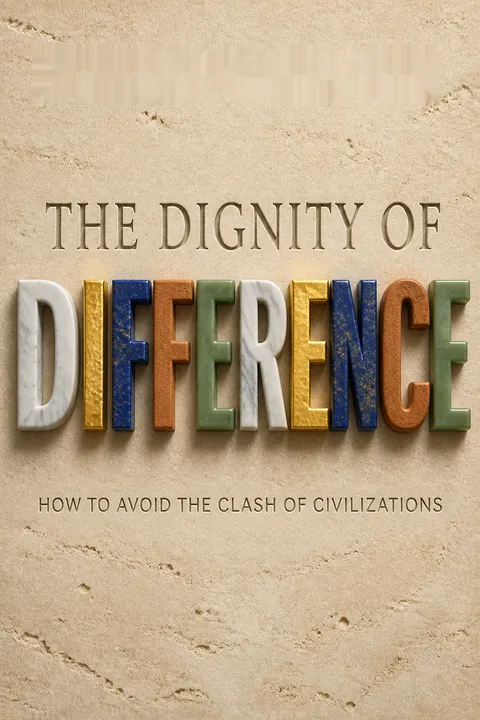
Respectful cultural pluralitySacks's principle that shared human dignity does not require people to share one culture, religion, or account of truth. Difference can enrich common life because distinct communities contribute different forms of meaning and wisdom. The principle rejects both tribal exclusion and the imposition of a single universal culture, while retaining shared duties to protect life and justice.
Plato's ghost
The pull toward samenessSacks's label for the influential belief that truth is universal and that particular cultures or traditions are lesser versions of a single ideal. He argues that when one group claims exclusive possession of truth, it may seek to convert, assimilate, or dominate others. The idea can appear in religious projects and secular systems alike.
Noahide laws
Shared human moral dutiesA traditional Jewish account of seven basic commandments associated with God's covenant with humanity after the Flood. They include prohibitions on idolatry, blasphemy, murder, theft, sexual transgression, and cruelty to animals, together with the duty to establish justice. In Sacks's argument, they express common moral obligations without requiring people to become Jewish.
tzedakah
Justice expressed through givingA Jewish concept combining charity and justice. Since property is understood as held in trust from God, sharing with people in need is more than optional generosity. Tzedakah includes meeting basic needs and protecting dignity, but its highest form helps a person become economically independent and less reliant on continued assistance.
mishpat
Justice through lawA Hebrew term Sacks uses for justice administered through legal procedures, including the rule of law and the fair treatment of people involved in disputes. He distinguishes mishpat from tzedakah, which concerns the substantive distribution of resources. A just society needs both reliable legal protections and conditions that allow people to live with dignity.
covenantal relationships
Bonds grounded in trustRelationships sustained by loyalty, mutual responsibility, and commitment to a shared life, rather than by a single exchange of advantage. Sacks contrasts these bonds with contracts, which specify terms between parties pursuing mutual benefit. Families, friendships, communities, and congregations can foster the trust and habits of cooperation on which markets and political institutions depend.
Six Cs
Moral bearings for globalizationSacks's framework of six principles for judging the direction of global change: Control, Contribution, Compassion, Creativity, Co-operation, and Conservation. They call for responsible agency, economic contribution to human dignity, concern for those in need, investment in education, protection of trust, and stewardship of nature. The principles orient judgment rather than prescribe a detailed policy solution.
social capital
Trust supporting cooperationThe trust and shared habits that allow people to cooperate beyond immediate self-interest. Sacks connects social capital to repeated interactions and to institutions such as families, voluntary associations, and religious communities. It supports economic and political life, although it is not itself produced by markets or governments.
Prisoner's Dilemma
A conflict between self-interest and cooperationA game-theory scenario in which two people make choices without being able to coordinate. Each can protect themselves by betraying the other, but if both do so, both receive a worse outcome than if they had cooperated. In Sacks's account, repeated encounters can change incentives and make reciprocal cooperation more likely.
Tit-for-Tat
Cooperate, then mirror behaviorA strategy for repeated versions of the Prisoner's Dilemma. It begins by cooperating, then responds to an opponent by repeating that opponent's previous move. Sacks uses it to illustrate how reciprocity can support cooperation, while noting that unbroken retaliation can trap participants in a cycle of hostility.
Generous
Reciprocity with occasional forgivenessA computer strategy discussed by Sacks that resembles Tit-for-Tat but occasionally overlooks an opponent's hostile move. This small element of forgiveness can prevent repeated retaliation while making exploitation less reliable. The model illustrates how cooperation may be more durable when not every injury triggers an equal response.
About the Author
Other books by Jonathan Sacks




Download PDF
Download EPUB
.epub digital book format is ideal for reading ebooks on phones, tablets, and e-readers.








