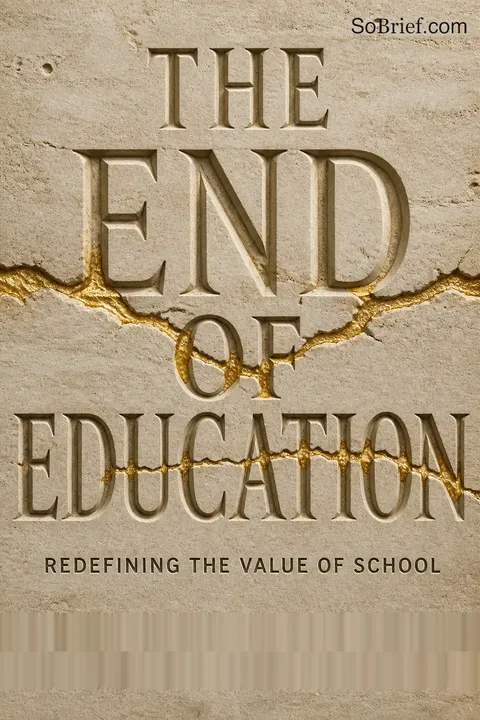


Key Takeaways
Give school a purpose larger than jobs, tests, or information delivery
Purpose comes before method. Neil Postman argues that school debates focus obsessively on means, such as testing, computers, and teaching techniques, while neglecting the prior question: What is school for? He distinguishes temporary motivation from a lasting reason to learn. That reason, he says, comes from a narrative: a shared story about where people come from, what matters, how they should live, and what future they can help build. He calls such meaning-making stories “gods,” not necessarily religious beings, but sources of purpose and direction.
Learning needs a why. Postman does not dismiss practical teaching methods. He argues that methods alone cannot explain why students should attend, persist, or care. A school without a compelling purpose risks becoming little more than a holding place. His challenge is to put educational ends before the machinery designed to achieve them.
What's powerful here is the distinction between getting attention and earning commitment. A lively lesson may engage students for an hour; a credible purpose can make difficult work feel worth doing. Research on motivation likewise distinguishes external rewards from a sense of autonomy, competence, and belonging. Yet shared purpose is not automatically benign. A school can unite students around a story that excludes some of them. The useful test is not whether a narrative inspires, but whether it gives students both a reason to participate and room to question the story itself.
Treat career preparation and consumption as outcomes, not education's north star
Work matters, but it is not everything. Postman criticizes the idea that schooling's main job is to produce productive workers. He calls this the god of Economic Utility: the promise that good grades and good behavior will reliably lead to a good job. He argues that the promise is shaky and that employability is too narrow a measure of a person's worth. Broad language skills and general understanding may help people find work, but their value is not limited to that use.
Buying cannot supply purpose. Consumer culture adds a second promise: that acquiring more goods makes life better. Postman points to television advertising as a powerful early teacher of this belief, noting that American children of his era encountered hundreds of thousands of commercials before adulthood. He does not oppose work or buying things. He objects when either becomes the main answer to why people learn or live.
Postman's argument is strongest when it challenges the reduction of students to future economic units. Treating education as human-capital investment can obscure civic judgment, curiosity, and the ability to understand one's own society. Still, secure work is not a shallow concern for families facing material hardship. The sharper distinction is between preparing people to earn a living and claiming that earning is the purpose of life. Schools can take economic inequality seriously without allowing market demand to define the whole curriculum.
Teach students to question what technology changes, not merely what it enables
A tool carries assumptions. Postman warns that technologies deliver benefits while also changing habits, institutions, and ideas about what counts as knowledge. He calls the uncritical worship of technical progress the god of Technology. In his account, computers may make information easier to retrieve, but schools were never only distribution centers for information. They also teach young people to cooperate, take responsibility, and live with others. A private screen cannot automatically perform those social tasks.
Study the effects, too. Postman's “technology education” means examining how a technology shapes its users and society, not simply learning its controls. A useful class would ask what cars do to cities and family life, or how television affects politics and attention. He argues that every major technology offers advantages and disadvantages, often distributed unevenly. The right response is neither rejection nor worship, but informed judgment.
This remains a useful corrective to the idea that access to information equals education. Media studies, human-computer interaction, and design ethics all ask how tools reshape attention, authority, and behavior, rather than treating them as neutral channels. Postman also notices a social dimension that efficiency metrics tend to miss: learning happens among people, not just inside individual minds. His caution needs a counterweight, however. Digital tools can support collaboration and access when deliberately designed. The key question is not whether technology belongs in school, but which educational purposes it serves and what it displaces.
Let young people repair the places they depend on
Responsibility starts nearby. To make planetary stewardship concrete, Postman tells a fable about a collapsing New York City. A fictional mayor puts hundreds of thousands of students to work cleaning neighborhoods, planting greenery, tutoring younger children, and creating local arts and news. The imagined program, called Operation Survival, does not magically solve every problem. Its point is that students might learn by helping make their city livable, rather than treating civic life as someone else's responsibility.
Participation can teach. Postman proposes more modest versions of the fable: students could care for school grounds, publish neighborhood news, stage performances, or teach younger pupils. He argues that local care can grow into concern for the planet, because distant environmental responsibility is hard to sustain without a sense of responsibility for one's immediate surroundings. The principle is not to replace study with unpaid labor, but to give learning a meaningful public use.
The fable anticipates service learning, where academic study is paired with work that addresses a real community need. Such projects can connect abstract ideas to consequences and give young people a visible role in public life. The design matters: students should help choose the work, connect it to learning, and reflect on its impact. Otherwise, “participation” can become a euphemism for extracting free labor or assigning children responsibilities adults have abandoned. Postman's strongest insight is not that students should run a city, but that schools should stop treating their energy as a classroom-management problem.
Teach knowledge as correction, not a warehouse of settled answers
Being wrong is part of knowing. Postman's “Fallen Angel” story presents human beings as fallible, yet capable of correcting mistakes. He uses science as a model: its strength is not that it possesses final truth, but that claims can be tested, challenged, and revised. In the book's example, William Harvey's account of blood circulation met resistance from some physicians even after it was established. Knowledge advances through argument and correction, not by pretending error belongs only to other people.
Make claims examinable. Postman objects to textbooks that present conclusions without showing who reached them, how, or with what uncertainty. He suggests treating teachers and texts as sources to investigate, and asking students to identify errors, support corrections, and question their own assumptions. This is not an invitation to believe nothing. It is practice in distinguishing evidence-based doubt from reflexive disbelief.
The idea aligns with modern accounts of science as organized error correction: criticism, replication, and revision make knowledge more reliable than individual certainty. It also has a psychological advantage. When mistakes are treated as information, students have more reason to expose confusion rather than hide it. But fallibility should not collapse into the claim that all positions are equally plausible. Some claims have much stronger evidence than others. Teaching intellectual humility therefore requires two skills at once: willingness to revise, and disciplined standards for deciding what deserves revision.
Teach America as a continuing experiment, not proof of national perfection
A nation can remain unfinished. Postman proposes teaching the United States as an ongoing experiment in self-government, not as a completed triumph. The Constitution, in this view, is a framework whose meaning is tested through debate. Students should encounter arguments over freedom of speech, religious liberty, immigration, public education, and the effects of technology, rather than memorize only a flattering national story.
Include failure in the story. The country proclaimed ideals of liberty while excluding enslaved people, women, and others from full participation. Postman's point is that such contradictions belong in the account: they show how the meaning of national ideals has been disputed and expanded. He imagines students reading foundational documents, then arguing about what they mean now. Patriotism, on this model, is not certainty that a country is best. It is informed participation in the work of improving it.
This is a compelling model of civic education because it links attachment to responsibility. Students can care about a political community without being asked to regard it as flawless. Deliberative democracy depends on citizens who can argue from evidence, hear opposing claims, and accept procedures even when they lose. Still, a national story of gradual improvement can make injustice sound safely past or inevitable in its resolution. The experiment metaphor works best when it preserves unfinished conflicts and asks who gets to define success, rather than treating expanded inclusion as a guaranteed outcome.
Use diversity to enlarge shared culture, not harden identity into camps
Difference can strengthen the common story. Postman distinguishes cultural pluralism, which adds many groups' histories and contributions to an inclusive public narrative, from a separatist version of multiculturalism that treats group identity as the curriculum's sole organizing principle. He argues that public schools should neither erase cultural differences nor turn them into competing claims of inherent virtue. The English language offers his practical illustration: it has absorbed words from many peoples and histories, becoming more expressive through contact.
Teach across boundaries. Postman recommends studying language, religion, customs, art, and artifacts to show how cultures influence one another and share human concerns. He argues that learning about other traditions should expand judgment, not merely raise pride in one's own group. His argument against separatism is forceful, but his language of assimilation can understate why groups seek recognition after exclusion. A common culture is credible only if its shared story makes space for those it once left out.
Postman identifies a real tension: public institutions need enough common ground to support cooperation, while difference must not be flattened into a single approved identity. Contemporary pluralist theory treats shared civic life less as sameness than as negotiated membership, where groups can contest the terms of belonging. That perspective strengthens his case for a common story while challenging his suggestion that schools should make cultural identities less distinct. Recognition is not necessarily separatism. The practical question is whether difference is taught as a resource for mutual understanding or converted into a fixed ranking of groups.
Show students how language frames the world they think they see
Words are more than labels. Postman argues that language guides attention, shapes categories, and influences how people interpret events. Definitions, questions, and metaphors are especially powerful because they set the terms of thought. Calling a behavior something a person “has” rather than something a person “does,” for example, can shift judgments about responsibility. A metaphor can do similar work: describing the mind as a container suggests a different kind of teaching from describing it as a garden.
Study how subjects speak. Postman wants students to examine the language of every discipline: what counts as a fact, what makes an answer valid, and which metaphors guide inquiry. He draws on “general semantics,” the study of how words and symbols map a world that they can never fully capture. Learning how definitions are chosen and questions are built helps students see that descriptions are useful tools, not reality itself.
This connects closely to cognitive linguistics, which studies how metaphor and categorization structure reasoning, and to legal theory, where definitions can determine rights and responsibilities. The lesson is practical: before debating an answer, examine how the question has framed the problem. Yet Postman's emphasis on language should not imply that reality is only a verbal construction. Material conditions resist description, and evidence can expose the limits of a metaphor. Strong language education helps students move between words and the world, checking each against the other.
Make public school a rehearsal for shared civic life
A public is made, not found. Postman argues that public schools do more than serve an already unified population: they help create people able to share institutions despite differing backgrounds and beliefs. The classroom offers a setting where individuals practice listening, following fair procedures, cooperating, and accepting obligations to a group. These lessons are not delivered by information alone. They emerge from living and learning alongside other people.
Choose the destination first. This is why Postman treats questions about school purpose as more fundamental than debates over class size, choice, tests, or ownership. Such decisions matter, but their value depends on what kind of public the school is meant to support. A school that serves only isolated consumers or job applicants may distribute useful skills while neglecting civic judgment. Public education needs both a shared purpose and the habits that let people disagree without abandoning one another.
The classroom as a small civic institution makes the book's argument tangible. Democratic competence is partly procedural: people learn to take turns, justify claims, and work with those they did not choose. That experience cannot be replicated simply by giving every student personalized content. At the same time, public schools are not automatically democratic; unequal authority and exclusion can reproduce social divisions inside them. The institution earns its civic role when students have meaningful ways to participate and when its rules are open to scrutiny, rather than asking them to practice compliance alone.
Analysis
Postman's book is best understood as an argument about legitimacy, not a handbook of classroom techniques. Its central claim is that educational methods cannot supply their own reason for existing. A school needs a story that connects study to a picture of human life, civic obligation, and the future. The proposed stories form a coherent architecture: planetary interdependence gives the widest horizon, human fallibility supplies an intellectual ethic, American constitutional debate offers a civic setting, diversity supplies a model of cultural vitality, and language explains how people construct and contest meaning.
The architecture is more useful than any single prescription. It redirects reform from the question “Which intervention works?” to “What counts as worthwhile learning, and for whom?” That is a crucial prior question, since the same technology, assessment, or curriculum can serve very different ends. Postman's attention to narrative also clarifies why purely instrumental promises are fragile: job preparation and information access may persuade adults, but they rarely explain why education deserves public commitment.
The book's main vulnerability is its confidence that common purpose requires a sufficiently unified story. Shared institutions do need common commitments, but pluralistic societies often sustain cooperation through overlapping principles and fair procedures rather than one comprehensive narrative. Postman's own language of making Americans risks treating assimilation as civic unity, and his critique of separatist multiculturalism sometimes gives too little weight to unequal power and the need for historical repair. A more durable reading treats his narratives as proposals for public argument, not doctrines to be imposed.
The enduring value of the book is its insistence that schools are moral and political institutions even when they claim to be merely technical. A serious school must teach knowledge, but also how knowledge is made; teach civic ideals, but also their failures; and use technology, while helping students judge its consequences. Its strongest invitation is to make the purpose of education a public question again.
Review Summary
The End of Education is a thought-provoking book that challenges the current education system's focus on economic utility and technology. Postman argues for a more meaningful narrative in education, emphasizing cultural literacy, moral instruction, and critical thinking. While some readers found his ideas inspiring and relevant, others criticized his stance on multiculturalism and religious undertones. The book's age (published in 1995) is noted, but many readers still find its core arguments applicable to modern education debates.
People Also Read





Glossary
god to serve
purpose-giving cultural storyPostman's metaphor for a narrative powerful enough to organize individual and communal life. Such a story describes origins, offers ideals and behavioral guidance, explains the present, and imagines a future. It need not be religious or scientifically provable. In schooling, it supplies a durable reason to learn that cannot be replaced by temporary motivation or technical method.
The Spaceship Earth
planetary interdependence narrativeA proposed educational narrative in which humanity shares one vulnerable planet and therefore has responsibilities that cross national and cultural boundaries. Postman uses the spaceship image to connect local stewardship with global survival: pollution, ecological damage, violence, and deprivation cannot be treated as problems belonging only to distant others.
The Fallen Angel
fallibility and correction narrativePostman's story of human beings as capable of serious error but also able to recognize and reduce it. The “fall” represents limited understanding, while the possibility of correction offers hope. The narrative makes humility a principle of learning and interprets science as a disciplined practice of revising claims rather than a store of final truths.
The American Experiment
unfinished civic self-governmentPostman's narrative of the United States as a continuing test of whether people can govern themselves through debate, constitutional procedures, and changing interpretations of freedom and equality. It treats founding documents as invitations to ongoing argument, not proof that national ideals have already been fulfilled.
The Law of Diversity
difference sustains vitalityPostman's term for the principle that languages, arts, cultures, and human communities gain vitality through exchange and difference. He connects the idea to entropy, the tendency toward sameness and disorder, and argues that diversity can expand shared standards of excellence rather than eliminate standards or require cultural isolation.
The Word Weavers/The World Makers
language shapes perceived realityPostman's narrative about human beings as creators and users of symbols. Language does not merely name an independent world; its categories, metaphors, and definitions influence what people notice and how they interpret it. Because people are also shaped by the language they use, studying language becomes a way to understand knowledge, morality, and social power.
general semantics
study of words and realityA field associated in the book with Alfred Korzybski that studies how symbolic descriptions relate to the world they represent. It examines processes of selecting, organizing, and generalizing experience, and warns against confusing a verbal map with reality itself. Postman presents it as a way to investigate how language can encourage clearer thought or reinforce error.
time-binding
carrying knowledge across generationsKorzybski's term for the distinctively human capacity to preserve experience symbolically and pass it from one generation to another. Language and other systems of symbols allow people to inherit knowledge, revise it, and communicate it to the future. Postman uses the concept to show why human learning depends on both individual thought and accumulated cultural history.
technology education
study of technology's effectsPostman's proposed study of how technologies shape habits, institutions, relationships, and ideas, rather than only how to operate devices. Students would examine both benefits and costs, including who gains, who loses, and which ways of thinking a technology encourages or sidelines. It is presented as a humanities subject, not simply technical training.
The Great Conversation
historical exchange of ideasA description of knowledge as an ongoing exchange among thinkers across generations. Ideas are inherited, argued over, revised, and sometimes corrected. Teaching a subject historically gives students access to this process, showing not only what a field currently claims but how its questions, evidence, and conclusions developed.
FAQ
What's "The End of Education" about?
- Purpose of the book: "The End of Education" by Neil Postman explores the crisis in the American educational system, focusing on its failure to provide students with a unifying narrative or purpose.
- Central thesis: Postman argues that schools have lost their way by promoting false "gods" such as consumerism, technology, and ethnic separatism instead of meaningful narratives.
- Educational critique: The book critiques the current educational practices and suggests that without a transcendent purpose, schooling becomes meaningless.
- Proposed solutions: Postman offers alternative narratives that could redefine the value of education and provide students with a sense of purpose and direction.
Why should I read "The End of Education"?
- Insightful analysis: The book provides a thought-provoking analysis of the current state of education and its impact on society.
- Alternative perspectives: Postman offers alternative narratives that challenge conventional educational practices and encourage critical thinking.
- Cultural critique: It examines the influence of technology and consumerism on education, making it relevant for understanding modern cultural dynamics.
- Educational reform: The book is valuable for educators, policymakers, and anyone interested in educational reform and the future of schooling.
What are the key takeaways of "The End of Education"?
- Narrative importance: Schools need a unifying narrative to give students a sense of purpose and direction.
- Critique of current practices: The book criticizes the focus on economic utility, consumerism, and technology in education.
- Alternative narratives: Postman suggests narratives like "The Spaceship Earth" and "The American Experiment" as potential guiding stories for education.
- Role of education: Education should focus on making a life, not just making a living, and should foster critical thinking and creativity.
What are the best quotes from "The End of Education" and what do they mean?
- "Without a transcendent and honorable purpose, schooling must reach its finish." This quote emphasizes the need for education to have a meaningful purpose beyond mere technical skills.
- "We are the god-making species." Postman highlights humanity's need to create narratives that give meaning to life and learning.
- "The measure of a narrative’s 'truth' or 'falsity' is in its consequences." This suggests that the value of a narrative lies in its ability to provide identity, community, and moral guidance.
- "The purpose of a narrative is to give meaning to the world, not to describe it scientifically." Postman argues that narratives are essential for understanding and interpreting the world.
How does Neil Postman define the "gods" in education?
- "Gods" as narratives: Postman uses "gods" as a metaphor for the narratives or guiding stories that give purpose to education.
- Current failing gods: He identifies consumerism, technology, and ethnic separatism as the current "gods" that fail to provide meaningful direction.
- Need for new gods: Postman argues for new narratives that can inspire and guide students, such as "The Spaceship Earth" and "The American Experiment."
- Role of narratives: These "gods" or narratives should help students understand their place in the world and their responsibilities to it.
What is the "Spaceship Earth" narrative proposed by Neil Postman?
- Global responsibility: "Spaceship Earth" is a narrative that emphasizes the interconnectedness of all people and the need for global stewardship.
- Environmental focus: It highlights the importance of caring for the planet and understanding the impact of human actions on the environment.
- Interdependence: The narrative teaches students about the interdependence of all life and the importance of cooperation and solidarity.
- Educational application: Schools can use this narrative to teach students about environmental science, global citizenship, and sustainable living.
What is the "Fallen Angel" narrative in "The End of Education"?
- Human fallibility: The "Fallen Angel" narrative focuses on the idea that humans are inherently fallible and prone to making mistakes.
- Learning through error: It emphasizes the importance of learning from mistakes and the continuous pursuit of knowledge and improvement.
- Critical thinking: This narrative encourages critical thinking and skepticism, teaching students to question assumptions and seek truth.
- Educational approach: Schools should foster an environment where making mistakes is part of the learning process and not something to be punished.
How does "The American Experiment" narrative redefine education?
- Continuous argument: "The American Experiment" narrative views America as a continuous experiment in democracy and freedom.
- Historical context: It encourages students to engage with the history of American ideals and the ongoing debates about freedom and equality.
- Active participation: The narrative promotes active participation in civic life and understanding the responsibilities of citizenship.
- Educational focus: Schools should teach students about the importance of argumentation, critical thinking, and the role of citizens in shaping democracy.
What role does diversity play in Neil Postman's educational narratives?
- Celebration of diversity: Postman emphasizes the importance of diversity in enriching education and fostering creativity and innovation.
- Cultural understanding: Schools should teach students about different cultures, languages, and perspectives to promote tolerance and empathy.
- Unity through diversity: The narrative of diversity highlights the idea that differences can lead to a stronger, more cohesive society.
- Educational application: Schools can incorporate diverse perspectives into the curriculum to help students appreciate the richness of human experience.
How does Neil Postman view the role of technology in education?
- Critique of technology: Postman criticizes the overemphasis on technology in education, arguing that it often distracts from meaningful learning.
- Technology as a tool: He suggests that technology should be used as a tool to enhance learning, not as an end in itself.
- Impact on thinking: Postman warns that technology can change the way students think and process information, often leading to superficial understanding.
- Balanced approach: Schools should teach students to critically evaluate technology and its impact on society and learning.
What does Neil Postman mean by "The Word Weavers/The World Makers"?
- Language as creation: This narrative emphasizes the power of language in shaping our understanding of the world and ourselves.
- Role of language: Language is seen as a tool for creating meaning, constructing reality, and communicating ideas.
- Educational focus: Schools should teach students about the power of language, including the use of metaphor, definition, and narrative.
- Critical language skills: Students should learn to use language critically and creatively to express themselves and understand others.
How can educators implement Neil Postman's ideas in the classroom?
- Adopt new narratives: Educators can incorporate Postman's proposed narratives, such as "Spaceship Earth" and "The American Experiment," into the curriculum.
- Focus on meaning: Shift the focus from rote learning and technical skills to teaching students how to find meaning and purpose in their education.
- Encourage critical thinking: Create an environment where students are encouraged to question assumptions, make mistakes, and learn from them.
- Integrate diverse perspectives: Include diverse cultural, historical, and linguistic perspectives in the curriculum to enrich students' understanding of the world.
About the Author

Download PDF
Download EPUB
.epub digital book format is ideal for reading ebooks on phones, tablets, and e-readers.








