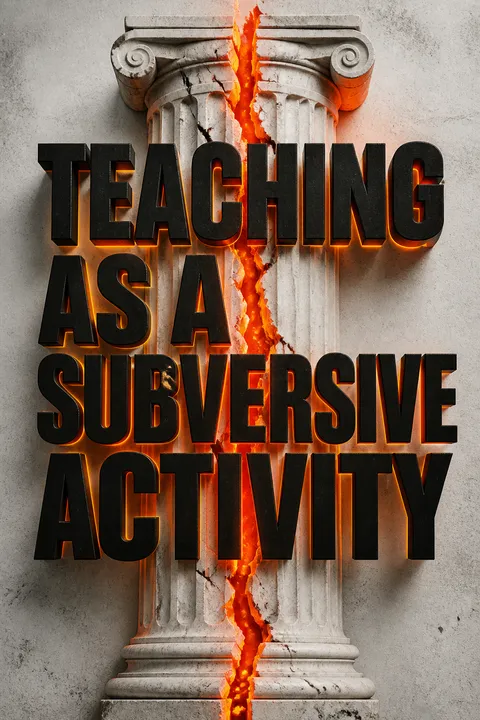


Key Takeaways
Teach students to detect when their culture's confident stories stop matching reality.
Education is a survival tool. Postman and Weingartner begin with a mismatch: society faces rapid change, but schools keep transmitting ideas and routines inherited from a slower world. They argue that schools should help people notice when familiar explanations no longer fit, question who benefits from them, and invent better responses. They call this capacity “crap detecting,” a disciplined skepticism toward misleading claims, clichés, and assumptions, including those a person’s own community treats as obvious.
Criticism keeps society adaptable. The authors imagine schools as a counterweight to institutions that resist change, including bureaucracies and mass media. Their goal is not reflexive opposition to authority. It is citizens able to test authority’s claims, recognize problems early, and take part in revising society. A democracy, in this view, survives by making room for informed dissent.
Classroom routines teach obedience even when the lesson praises independent thought.
The classroom has a hidden curriculum. The authors argue that students learn not only from the lesson’s stated content but from the roles and behaviors the classroom repeatedly rewards. A room where students sit quietly, repeat approved answers, and wait for the teacher’s judgment teaches passivity, even if the syllabus celebrates creativity.
Routine becomes instruction. Most classroom questions in the book’s examples have one answer the teacher already knows. Students learn to guess that answer instead of testing the question or admitting uncertainty. The same pattern appears in the authors’ account of school trivia: a former student takes visible pride in recalling an obscure fact, as if rapid recall were the measure of intelligence. The lesson is not that facts are useless. It is that a classroom’s daily practices often teach more powerfully than its stated ideals.
Make students generate questions, not merely memorize other people's answers.
Questions create knowledge. The inquiry method is a learning environment in which students practice the work of finding things out: posing questions, clarifying terms, observing, forming explanations, and checking them. The authors contrast this with memorizing answers to questions chosen by someone else. Their point is practical: a learner who can ask a useful question can direct further learning without waiting for an authority to supply the next fact.
One discussion opens many doors. In a classroom exchange about whether “he doesn’t” is more correct than “he don’t,” students begin debating who defines educated speech, whether dialects can be correct, and how dictionaries record language. The teacher guides with questions instead of delivering a ruling. The example shows inquiry expanding from a small language puzzle into questions about authority, social judgment, and how rules arise.
Choose problems learners recognize as real before asking them to investigate.
Relevance gives inquiry traction. The authors argue that a sound method cannot rescue a subject students see as pointless. They parody surgeons who perform operations because they enjoy them, rather than because patients need them, to expose teaching that serves a teacher’s interests instead of a learner’s needs. A school assignment about ancient Egypt, for example, may invite research and group projects yet still feel detached from students’ lives.
Real concerns invite effort. In a program on St. Croix, students brought questions about relationships, adulthood, work, and political events. They exchanged personal letters with an instructor, and their writing improved through meaningful communication rather than isolated grammar drills. The authors do not claim students must choose every topic. Teachers can suggest problems, but inquiry gains depth when learners can see why the answer matters to them.
Treat learners as meaning-makers, not empty containers waiting for facts.
Perception is active. “Meaning making” is the book’s term for the ongoing process by which people interpret experience through their prior assumptions, purposes, and language. The authors use Adelbert Ames’s visual demonstrations to argue that perception is not a simple copy of the outside world. In one demonstration, a turning trapezoidal window appears to swing back and forth rather than rotate continuously, showing how expectations help organize what observers see.
Expectations shape the encounter. The book also cites Robert Rosenthal’s school study: teachers told that certain pupils were likely to make notable gains reportedly treated them in ways associated with improved performance. Postman and Weingartner use this to challenge fixed labels of intelligence. The implication is that teaching must attend to what learners actually understand, not just what instructors intend to transmit. The claim should not be stretched into saying expectations alone determine achievement; conditions beyond a teacher’s beliefs matter too.
Teach language and media as forces that shape what counts as real.
Words organize perception. “Languaging” names the book’s view of language as an activity that helps structure thought, not merely a container for ideas already formed. Categories can hide the speaker’s role in a judgment: calling someone stupid presents an evaluation as if it were an objective feature of that person. The authors draw on General Semantics, a program for noticing how words abstract, classify, and sometimes mislead.
Media change the environment. The book applies the same scrutiny to communication technologies. Print, television, and other media do more than carry different content; their forms influence attention, participation, and who can speak to a wide audience. The authors urge students to examine how a medium works, not just what it shows. This literacy can reveal hidden influence, though language is not a prison: people can compare vocabularies, seek evidence, and revise their interpretations.
Trade teacher control for listening, choice, and genuine student responsibility.
The teacher designs conditions. In the inquiry environment, the teacher does not act mainly as a dispenser of correct answers or the final judge of every idea. The work is to pose problems, listen closely, invite students to challenge claims, and help them develop standards for evaluating evidence. Student questions and mistakes become material for the lesson rather than interruptions to a preset script.
Small experiments can shift roles. The authors suggest that a teacher try a class devoted to students solving a problem, or ask students to produce questions before seeking answers. They also recommend reviewing one’s own grading judgments, since a grade reflects the evaluator’s assumptions as well as the student’s performance. These practices do not eliminate the need for expertise or guidance. They make authority answerable to learning, instead of allowing procedure to stand in for it.
Make schools solve neighborhood problems, not merely rehearse school subjects.
The community can become curriculum. For city schools, the authors propose learning through projects that address local needs. Students might produce community information, repair appliances, run gardens or workshops, create cultural programs, or contribute to city services. The point is not simply job training. Students would investigate problems, plan responses, do practical work, and see whether their efforts help. Adolescents would have real responsibility, with teachers acting as advisers.
Games can model complexity. The book also describes educational simulations in which students make decisions for fictional nations or businesses and face the consequences. Such exercises can make abstract systems vivid and give students practice deliberating together. But the cited discussion warns that a game simplifies reality and can reward winning over understanding. Community projects and games work best when reflection accompanies action, and when students are encouraged to question the rules of the system they are learning to navigate.
Teach students to abandon obsolete assumptions before change makes them dangerous.
Survival sometimes requires unlearning. The authors argue that when environments change slowly, education can preserve inherited knowledge. When change accelerates, the same habit can become a liability. Students must learn to distinguish concepts that still help from those that no longer fit, then revise their explanations and actions. The book calls this selective forgetting, not a rejection of history or accumulated knowledge.
Build flexibility, not certainty. The authors favor intellectual habits such as tolerating uncertainty, considering multiple causes, and adapting explanations when evidence changes. Their examples include scientific challenges to established accounts of the universe and human origins, which met resistance from institutions invested in older beliefs. The final aim is not to make students permanently skeptical of everything. It is to help them keep learning when familiar answers fail, and to make that capacity part of education’s central purpose.
Analysis
Teaching as a Subversive Activity is a polemic with a practical core. Its central argument is ecological: a school is not a neutral channel for content but an environment that trains habits through the roles it assigns, the questions it permits, and the behaviors it rewards. That claim joins several strands into one program. Inquiry develops the ability to learn; relevance gives inquiry a reason to matter; language and media study expose how perceptions are formed; and institutional redesign gives students space to exercise judgment. The book’s most durable insight is this alignment: a school cannot credibly teach independence through routines built on dependence.
The authors are strongest when they show how ordinary practices contradict stated educational goals. Their examples of closed questions, irrelevant assignments, and student alienation make the hidden curriculum legible. Their proposal to connect learning with real community problems also moves beyond the familiar choice between abstract academics and narrow vocational training. Yet the argument sometimes treats learner interest as a more reliable guide than it can be. Students may not initially recognize what knowledge will become useful, and open inquiry can reproduce misinformation or existing inequalities without careful scaffolding. Teachers still need subject expertise, shared standards, and ways to distinguish strong evidence from persuasive but weak claims. The 1969 context also matters. The book’s media examples and some social assumptions belong to their period, while its account of communication power remains applicable to any setting where a few channels dominate public attention. Its challenge is not to discard every syllabus or test on principle. It is to make those tools serve learning rather than define it. Read this way, subversion means institutional self-correction: schools should equip students to question inherited arrangements, including the school itself, and to act responsibly when the available answers are inadequate.
Review Summary
Teaching as a Subversive Activity challenges traditional education methods, advocating for inquiry-based learning and student-centered classrooms. While some readers find the ideas revolutionary and still relevant decades later, others criticize the book as impractical or outdated. Many educators appreciate Postman's emphasis on critical thinking and questioning authority, though some find his proposals extreme. The book's provocative stance on reforming education systems sparks debate among readers, with some praising its potential for positive change and others questioning its feasibility in modern school settings.
People Also Read









Glossary
Crap detecting
Critical evaluation of claimsA habit of testing claims, assumptions, and familiar beliefs instead of accepting them because they are widely repeated or endorsed by authority. In the book, it includes noticing misleading language, checking whether explanations fit observable reality, and being willing to challenge one’s own community’s assumptions.
Inquiry method
Learning through investigationAn approach to teaching that makes learners practice the activities through which knowledge is developed. Students pose questions, clarify meanings, observe, classify, form generalizations, and test them. The teacher organizes an environment for investigation rather than primarily transmitting predetermined answers.
Meaning making
Interpreting experience activelyThe process by which a person gives meaning to experience using prior knowledge, assumptions, purposes, and available symbols. The book uses the term to challenge the idea that students simply receive identical knowledge from a lesson. Learners interpret what they encounter, so teaching must engage with and help develop those interpretations.
Languaging
Using symbols to perceiveThe active use of words and other symbol systems in thinking, communication, and interpretation. The book argues that language does not merely report a ready-made reality. Its categories and structures influence what people notice, how they classify experience, and what conclusions seem reasonable.
Sapir-Whorf Hypothesis
Language shapes perceptionThe view, associated with Edward Sapir and Benjamin Lee Whorf, that the structures and vocabulary of a language influence how its speakers organize and interpret experience. The book uses this idea to argue for studying language as part of every subject. It presents language as influential, not as the only determinant of thought.
General Semantics
Language awareness for clearer judgmentAlfred Korzybski’s approach to examining how language relates to experience and how verbal habits can distort judgment. It encourages awareness that words are not the things they refer to, that descriptions are abstractions, and that broad labels can hide differences or present interpretations as facts.
Open systems and closed systems
Flexible or fixed answer settingsA closed system treats answers as fixed within defined rules, often as right or wrong. An open system allows for degrees of adequacy, changing evidence, and multiple possible solutions. The book argues that consequential human problems are often open, so forcing them into binary answers can distort the issue.
Future shock
Disorientation caused by rapid changeA condition in which a person’s learned picture of the world no longer corresponds to the world encountered. The book uses the term for the confusion and helplessness that can follow when people are educated for conditions that have changed. Education should help learners revise their beliefs and strategies as circumstances shift.
Self-fulfilling prophecy
Expectation that helps cause its outcomeA prediction that influences people’s behavior in ways that help bring about the predicted result. The book applies the idea to education, where a teacher’s expectations can shape treatment of students and students’ perceptions of their own abilities. It uses the concept to question fixed labels of intelligence and potential.
FAQ
What is Teaching as a Subversive Activity by Neil Postman about?
- Critique of traditional education: The book argues that conventional schooling is outdated, focusing on rote memorization and passive learning rather than preparing students for a rapidly changing world.
- Call for educational reform: Postman and Weingartner advocate for a new approach that emphasizes inquiry, critical thinking, and adaptability to social, technological, and political changes.
- Role of language and perception: The authors explore how language shapes reality and stress the importance of teaching students to think critically about language and meaning.
- Schools as agents of change: The book proposes that schools should act as "anti-entropy" forces, fostering social criticism and the questioning of prevailing assumptions.
Why should I read Teaching as a Subversive Activity by Neil Postman?
- Insight into educational reform: The book offers a radical critique of existing educational practices and provides practical proposals for transforming teaching and learning.
- Preparation for societal change: It equips readers with concepts and strategies to foster flexible, creative learners capable of navigating a rapidly changing world.
- Understanding language’s power: The book reveals how language not only communicates but also limits and shapes thought, making semantic awareness crucial for critical thinking.
- Relevance for educators and parents: Its ideas are valuable for anyone interested in improving education, from teachers and administrators to parents and policymakers.
What are the key takeaways from Teaching as a Subversive Activity by Neil Postman?
- Inquiry over content: The curriculum should be built around open-ended, meaningful questions rather than fixed content, encouraging critical thinking and active learning.
- Language shapes knowledge: Understanding and teaching the power of language is central, as it structures perception and meaning.
- Relevance and engagement: Learning must be relevant to students’ lives to foster genuine engagement and prevent alienation.
- Schools as anti-bureaucracy: Education should counteract bureaucratic rigidity and media homogenization by nurturing independent, critical thinkers.
What is the "crap detecting" concept in Teaching as a Subversive Activity by Neil Postman?
- Definition and importance: "Crap detecting" refers to the ability to critically evaluate information, identify falsehoods, and resist indoctrination—a vital survival skill in a democratic society.
- Role of schools: The book argues that schools must develop students’ crap detecting abilities to foster social, political, and cultural criticism.
- Anthropological perspective: It involves viewing one’s own culture from an outsider’s perspective, recognizing biases and prejudices embedded in language and ideology.
- Courage and freedom: Effective crap detecting requires intellectual courage and the freedom to challenge accepted norms and authority.
How does Teaching as a Subversive Activity by Neil Postman define and advocate the inquiry method?
- Inquiry as a new medium: The inquiry method is a process-oriented approach where students actively engage in questioning, observing, and problem-solving rather than passively receiving information.
- Teacher’s role: Teachers act as facilitators, asking divergent questions, encouraging student interaction, and focusing on thinking processes rather than fixed answers.
- Characteristics of good learners: The method cultivates confidence, flexibility, persistence, and the ability to suspend judgment, with learners recognizing that answers often depend on context.
- Contrast with traditional teaching: It stands in opposition to content-driven, answer-focused education, promoting open-ended exploration and critical engagement.
What does "The medium is the message" mean in the context of education in Teaching as a Subversive Activity by Neil Postman?
- Medium shapes learning: The structure and process of the educational environment (the medium) determine what students learn, beyond the explicit content.
- Content-method dichotomy challenged: The book critiques the separation of content and method, arguing that method itself carries powerful messages that shape attitudes and behaviors.
- Classroom behaviors as messages: Students learn to seek "The Right Answer," trust authority, and avoid questioning due to the implicit rules of traditional classrooms.
- Implications for reform: Recognizing the medium’s influence is essential for designing learning environments that foster inquiry and critical thinking.
How does Teaching as a Subversive Activity by Neil Postman address the issue of relevance in education?
- Relevance is crucial: Students must perceive what they learn as relevant to their lives and survival, or risk disengagement and alienation.
- Critique of traditional curricula: Many subjects are disconnected from students’ realities, focusing on arbitrary or outdated content without meaningful context.
- Learner-centered questions: The authors propose a curriculum based on questions that students find meaningful, fostering engagement and authentic learning.
- Consequences of irrelevance: Irrelevant curricula lead to cheating, boredom, and a lack of genuine learning.
What are the key concepts of language and meaning in Teaching as a Subversive Activity by Neil Postman?
- Semantic awareness: The book highlights the importance of understanding abstraction, levels of abstraction, and the direction of meaning (intensional vs. extensional).
- Language "fixes" reality: Language tends to turn changing realities into static concepts, which can mislead and cause prejudice or oversimplification.
- Language and sanity: Sanity is linked to how closely language corresponds to externally verifiable reality; psychotherapy aims to shift language from subjective to objective meanings.
- Language as a learning focus: The book argues that every teacher is a language teacher, as disciplines are inseparable from their language systems.
How does Teaching as a Subversive Activity by Neil Postman describe the role of questions in education?
- Questions as perception tools: Questions shape what and how we perceive, with their form and assumptions determining the nature of answers.
- Curriculum centered on inquiry: The book promotes a curriculum built around open-ended, divergent questions rather than fixed answers.
- Types of questions: Emphasizes the importance of open-system questions that allow for multiple answers and solutions, fostering critical thinking.
- Encouraging student inquiry: Teachers should encourage students to ask and explore their own questions, making learning more meaningful and relevant.
What criticisms does Teaching as a Subversive Activity by Neil Postman make about traditional schooling and teachers?
- Authoritarian and rigid structures: Traditional schools enforce rigid syllabi, grading systems, and teacher-student hierarchies that stifle creativity and learning.
- Teacher-student disconnect: Many teachers lack communication and empathy with students, especially in urban or disadvantaged settings.
- Resistance to change: The book highlights that many teachers are committed to outdated metaphors and methods, making educational reform difficult.
- Suppression of dissent: Schools often resist change and suppress dissenting ideas, hindering the development of critical, independent thinkers.
What radical proposals for teacher training and school reform does Teaching as a Subversive Activity by Neil Postman suggest?
- Moratorium on textbooks and tests: The book proposes suspending textbooks and conventional testing to encourage student-centered learning.
- Role reversal and self-examination: Suggests teachers teach outside their specialties, write books on their subjects, and undergo psychotherapy to understand their motivations.
- Democratizing education: Advocates eliminating courses, requirements, and full-time administrators, making classes elective, and involving students in school governance.
- Focus on teacher attitudes: Emphasizes the need for new teacher attitudes and behaviors centered on listening, questioning, and facilitating inquiry.
How does Teaching as a Subversive Activity by Neil Postman view the impact of new media and languages on education?
- Media as new languages: The book argues that electronic media (radio, TV, computers) are new symbolic systems that shape perception and must be studied critically.
- Extending literacy: Education must expand beyond print literacy to include understanding and using new media effectively.
- Media’s influence on thought: Media influence social and cognitive processes, making it vital for students to understand their effects for meaningful participation in modern society.
- Preparation for change: Understanding new media is essential for survival and adaptability in a rapidly evolving world.
About the Author

Download PDF
Download EPUB
.epub digital book format is ideal for reading ebooks on phones, tablets, and e-readers.








