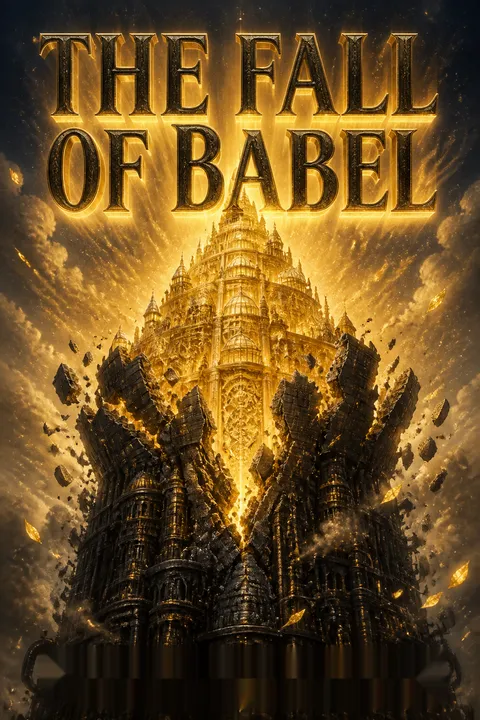


Plot Summary
A Thief at Heaven’s Gate
After the fighting around the Tower’s crown, Adamos Boreas climbs through fog and wreckage with Captain Brahe’s diary in his pocket. Lumenguard soldiers led by Sergeant Elrin Allod capture him, while Elrin’s sharp-eyed sister, Runa, questions the clues he carries about Voleta, his sister. Their march ends at Nebos, a gilded city sealed beneath a crystal dome.
Adam mistakes the soldiers’ familiarity with his life for a confidence trick, until he sees a poster advertising a performance about himself and Voleta. The city’s beauty gives way to a more immediate danger: the windstile strips away the air, and Adam nearly suffocates before Runa pulls off her helmet and helps him breathe again.
Adam arrives believing that survival depends on reading a con before it closes around him. Nebos defeats that habit by making the impossible literal: its citizens know him because they have watched his life. His near-suffocation at the gate also makes the city’s hidden costs physical. Paradise is not simply protected from outsiders; it is engineered to decide who can breathe inside it. Runa’s brief act of care complicates Adam’s suspicion, setting up a relationship in which trust must be earned against the evidence of Nebos’s surveillance.
The Man in the Poster
Captain Dyre orders a public accord to decide whether Adam may remain in Nebos or be executed. Sergeant Elrin takes him to his mother, Docent Ida Allod, whose black office reflects her severe taste and command of the city’s artistic life. Ida initially calls Adam an impostor, then recognizes him by details only he could know.
She argues for his life, but the narrow vote admits him only provisionally, binds him to Runa, and makes her responsible for his conduct. Adam also sees Ossian, the gentle furnace keeper, and discovers that the city’s supposed furnace is the Nautilus, a glowing spiral that consumes objects and turns slow water into the clouds concealing Nebos.
Nebos governs through spectacle as much as law. The accord gives its people a voice, yet Adam’s fate is reduced to a vote by strangers who already believe they know his character. Ida’s defense saves him while also turning him into her property and artistic subject. The Nautilus extends this contradiction: a marvel sustains the city, but its residents barely understand it. Their dependence on inherited machinery has outlasted their curiosity, a pattern that will matter when the Tower’s old systems begin to fail.
A Life Stolen by Art
At dinner, Adam steals silverware from the docents and learns that Ida’s scintillations are films assembled from preserved memories called espials. That evening, she projects The Daredevil’s Brother, a polished but distorted account of his childhood and Voleta’s daring.
When Adam confronts her, Ida reveals that his missing eye supplies the images. Runa admits she watched the film and despises its exploitative treatment of him, though its false version of his life has shaped her feelings.
Adam refuses the easy escape Runa offers and decides to correct the record by learning how the art works. She teaches him that Nebos’s reliquaries were meant to preserve useful knowledge, but that the Parlor’s practice of blinding living people corrupted the original purpose.
The film turns memory into a political object: whoever edits the past can assign motives to the living and make exploitation look like destiny. Ida’s version of Adam is not false because every image is fabricated, but because selective images are made to serve her interpretation. Adam’s desire to correct the record marks a change from mere survival to self-definition. Runa’s discomfort matters because she has already been shaped by the same distortion. Their intimacy begins not with certainty about one another, but with shared recognition that mediated knowledge can injure.
A Baby from the Trail
Elrin drafts Adam into the lumenguard and takes him to the Fundament, where soldiers launch a windscow into the storm-filled cavity inside the Tower. The boat returns loaded with discarded household goods and an infant hidden among apples. Adam strips off his armor, takes the child, and rides the scow through flying debris to the black trail.
There he meets Faruq, an elderly caretaker, and a camp of children with only a few surviving adults to protect them. Faruq explains that starvation, disease, and violence have left thousands of orphans in the Vein. Adam returns the baby, ashamed of his assumptions, and promises Faruq he will find a way to bring the children somewhere safer.
Adam’s encounter with the infant forces him to move beyond the protective cynicism that has helped him endure poverty. He first judges Faruq through the logic of abandonment, then learns that the old man is keeping children alive in a place designed to grind communities apart. The windscow’s cargo makes the imbalance between Nebos and the Vein visible: the city receives gifts while the people who carry them remain outside. Adam’s promise is impulsive, but it commits him to a form of responsibility larger than protecting Voleta alone.
Five Thousand Hidden
Adam tells Runa the truth about the children, and she joins his plan despite the danger to her family and position. They enlist Ossian, who is himself an orphan raised in Nebos, and Faruq, who distrusts any offer that might be another trap.
Using the windscow in repeated trips, they move the children into the Warren’s abandoned habitation halls, while Ossian supplies food and clothing from his vast collection. To disguise their visits, Adam and Runa let Nebos believe they are lovers, appearing together at public events while managing the rescue by day.
Their feigned courtship begins to acquire real tenderness. By the time the final children arrive, nearly five thousand have crossed into the city, hidden beneath a society that has never had to look directly at its own abundance.
The rescue depends on converting Nebos’s habits into cover. Its citizens are so absorbed by celebrity and etiquette that Adam and Runa can smuggle children beneath a public romance. Yet the plan is more than clever concealment: Ossian’s hoarded objects become practical resources, and the Warren’s forgotten rooms become shelter. Each character’s history changes the meaning of the work. Ossian recognizes the children’s vulnerability because he once shared it; Runa risks complicity with a culture she has long resented; Adam learns that protection can mean building a place for others, not merely shielding one person.
The Brick Layer’s Murder
Adam and Runa visit the Delectus, where its automaton librarian grants Adam special access to an espial of the Brick Layer’s death. They watch six Nebosans bind the founder beneath the pyramid’s capstone because they fear his plan to welcome the hods. The stone falls, but the Brick Layer vanishes in a flash of blue light, leaving his clothes and necklace behind.
Ida arrives with Elrin and soldiers to seize the valuable lens known as the Brick Layer’s Eye. In the ensuing struggle, an accidental discharge of Sphinx medium triggers a violent blast in the Nautilus. Ida and Elrin are pulled into its slow water and die; Adam retrieves the Eye as the Tower shudders around them.
The revelation breaks Nebos’s founding myth at its source. Its residents did not merely forget the Brick Layer’s wishes; their ancestors killed him to protect their privilege, then built a culture that treated exclusion as safety. Ida’s creative control of Adam’s life and her attempt to claim the Eye mirror that original theft of authority. The blast is accidental, not a clean act of justice, and it leaves Adam and Runa with grief as well as evidence. Their cause now rests on exposing a crime that the city’s institutions were designed to conceal.
Senlin Boards the Hod King
Elsewhere, Thomas Senlin is trapped among the zealots operating the Hod King, a vast burrowing siege engine built to attack the Tower. He secretly means to destroy it before it can reach the Sphinx. Senlin earns a place as a stepper, then is promoted to the bridge after Marat learns he has been inside the Sphinx’s home.
To keep contact with Finn Goll and John Tarrou, Senlin hides a coded message in a book he sends to the furnace; Finn answers by arranging book titles to spell their agreement. Senlin learns that Marat’s Wakemen are wounded outsiders drawn in by promises of belonging, while the zealot uses hoddish and book-burning to isolate his followers and cultivate obedience.
Senlin’s position inside the Hod King tests the difference between strategic compromise and moral surrender. He must perform loyalty to a leader whose rhetoric of liberation conceals a plan for absolute rule. His coded book makes literacy a tool of resistance within a system that destroys books to prevent dissent. Yet Senlin’s growing proximity to Marat also complicates his judgment: the Wakemen are not simply monsters, but damaged people who have mistaken a new master for a community. Understanding their vulnerability does not lessen the danger they pose.
The Siege Reaches Oyodin
Captain Edith Winters leads the State of Art across the Tower to recover the paintings that encode the way into the Sphinx’s sealed machinery. Several ringdoms have lost or replaced their copies, and Marat has already stolen others.
In Oyodin, a city of glass buildings and sprawling gambling platforms, the crew discovers a thief climbing the enormous betting board with a painting. Voleta races across strangers’ shoulders after him, while Iren follows through the crowd.
The Hod King erupts from the Tower and destroys the port with its drill and artillery. Edith orders the State of Art into battle, but the engine’s armor withstands their cannons. The Hod King burrows away, leaving the crew with a clearer sense of its power and a lost opportunity to stop it.
The campaign to collect the paintings is a race against both Marat and the Tower’s political fragmentation. Oyodin’s glass architecture advertises transparency, yet its crowded gambling economy cannot protect a single shared treasure. Voleta’s pursuit turns her habitual fearlessness into a tactical asset, but the Hod King’s attack demonstrates the limits of individual daring against organized violence. Edith’s failed salvo also sharpens her responsibility: command does not mean certainty, and a good decision can still leave people exposed. The defeat forces her to seek knowledge and allies rather than rely on firepower alone.
The Cistern Floods
At the Cistern, Edith’s party finds a hidden community living among dark water, oysters, and glowing krill, the creatures that purify the Tower’s drinking supply. While Edith speaks with the residents, the Hod King breaks through the ringdom and floods its passages with sewage and clogworms.
Marat’s Wakemen attack the party: Edith fights Thornton and Cael, while Voleta and Iren face the spider-bodied Delyth in the underwater observatory. Voleta loses a hand, but Iren disables Delyth’s carriage and they recover the painting.
Edith is thrown into the water, then hauled out alive. The State of Art carries wounded residents to other ringdoms for treatment, but the Cistern is left devastated and its people fear the Tower will consume its resources again.
The Cistern makes the Tower’s dependence on overlooked labor and fragile ecology tangible. Its krill and oysters keep water clean, yet the ringdom’s people have been left to defend the system without protection. The battle turns that structural neglect into immediate bodily cost: Voleta’s injury, Edith’s near drowning, and the wounded residents all register the price of confronting Marat. Iren’s rescue of Voleta deepens their bond, while the recovered painting shows that the crew’s mission can succeed without preventing every harm. Preservation here requires care for people and systems together.
The Duke Comes Aboard
While Edith’s landing party is away, Duke Wilhelm Pell boards the State of Art disguised as a newspaper boy. He shoots Byron with a crossbow bolt and confronts Marya, intending to reclaim her and their daughter. Marya refuses to submit, then pursues him through the ship after Ann draws the duke away from the bridge.
Ann’s foot is pinned by one of his bolts, but she uses the ship’s familiar trip step to make him fall. Marya wounds him with a harpoon. Byron, who has survived because his body is powered by the Sphinx’s medium, rises and shoots the duke with the bolt he had pulled from his own chest. Marya hides the truth from the returning crew, unwilling to add another burden to their mission.
Marya’s confrontation with Wilhelm closes the domestic captivity that has shadowed her since Pelphia. She is no longer protected by a stage persona or rescued by someone else; she acts, and Ann’s return to help makes survival a shared effort. Byron’s apparent death exposes the cost and strangeness of his dependence on the medium, while his intervention overturns the duke’s belief that he controls every room he enters. Marya’s decision to conceal what happened is protective, but it also shows how often this crew manages danger by carrying private grief alone.
Cilicia Becomes a Sump
The State of Art reaches Cilicia to recover another painting, only to find the ringdom abandoned after its queen’s reckless attempt to repair a blackout ruptured sewage pipes. Clogworms fill the flooded streets, and Edith’s party crosses rooftops toward the likely emergence point of the Hod King.
On the palace roof, giant black swans attack them with acidic darts. Edith draws the flock away while Iren and the others escape. Meanwhile, Senlin’s coded signal reaches Finn, who plants black powder inside books and feeds them to the Hod King’s furnace as the engine tunnels.
Edith’s own attempt to plant a bomb fails, but Finn’s sabotage ignites the engine from within. The Hod King collapses, though a smaller hidden machine escapes with Marat and Senlin.
Cilicia shows how negligence at the top turns infrastructure into a weapon against ordinary people. The queen’s failed repair creates a toxic flood, while the abandoned city’s swans become another danger the crew must navigate. Against this backdrop, Senlin and Finn’s sabotage depends on the very books Marat destroys, transformed into explosives. Their different plans converge without coordination: Edith draws danger away, Finn attacks the engine’s interior. The Hod King’s fall is a genuine victory, but the escape of its smaller core prevents triumph from becoming closure.
Marat Claims the Bridge
The Hod King’s collapse leaves its surviving crew exposed, and Edith’s party helps the wounded while Marat escapes in the smaller Palatine with Senlin captive. The zealot’s Wakemen are revealed as a tight, injured circle bound to him by their need for belonging. Senlin is forced to guide Marat through the Sphinx’s maze, while the crew recovers paintings and works toward the same destination from outside.
Marat and his engineer, Gedge, assemble the combination to the vault called the Bridge of Babel. The door does not open. Marat turns to the Sphinx’s home itself, determined to break in and claim the machinery he believes will make him king, while Senlin searches for another chance to escape.
Marat’s failure at the vault punctures the certainty that has carried him through the Tower. He can gather paintings, seize a machine, and command followers, but he cannot make inherited systems obey merely by declaring himself their rightful owner. Senlin’s usefulness keeps him alive while also forcing him to participate in the route toward Marat’s goal. The Palatine is a smaller, more controllable version of the Hod King, an embodiment of Marat’s desire to replace collective labor with personal command. The conflict narrows from a public siege to a struggle inside the Sphinx’s house.
A Vote Beneath the Pyramid
In Nebos, Adam and Runa’s secret rescue is uncovered after Elrin discovers the children in the Warren. Ida and Elrin try to force Adam to surrender his remaining eye and keep quiet about the hods. During a fight near the Nautilus, a spark ignites the Sphinx’s medium; Ida and Elrin fall into the slow water, and Adam escapes with the Brick Layer’s Eye.
The city’s citizens learn from the recovered espial that their ancestors murdered the Brick Layer, then debate whether to expel the five thousand children. Adam and Runa are placed on purgatorial stools with nooses ready. Runa argues that Nebos must answer for the suffering beneath it, while Adam admits that his first motives were fear and guilt, not courage.
The crisis makes civic procedure both the instrument of injustice and the possible means of repair. Nebos holds an accord, but its residents have inherited a decision to exclude the people who built their comfort. Adam’s confession complicates the heroic story others have made of him: he has not always acted from noble conviction, and his willingness to face that fact becomes part of his moral growth. Runa’s argument is less about personal innocence than inherited responsibility. The nooses make the cost of their challenge literal, while the truth of the past forces the city to judge itself.
Edith Reopens the Vote
Edith arrives in Nebos with Iren, Voleta, and Reddleman as the accord is about to condemn Adam, Runa, and the children. She identifies herself as the Sphinx’s representative and challenges the citizens to defend their vote publicly. Her warning that Nebos’s privileges depend on honoring the Brick Layer’s commands silences the hands raised for expulsion.
The accord shifts, and the children are allowed homes. Faruq’s five thousand charges emerge from the Warren, ending the rescue’s concealment. Adam and Runa are released, and the newcomers begin to settle into the golden houses. Marya, meanwhile, chooses to leave the State of Art and becomes guardian to two of the children, Kapil and Nia, as well as caring for Olivet.
Edith uses authority to interrupt a false consensus, but her intervention is not simply a victory of force. She makes each citizen own the consequences of the vote, turning private prejudice into a public test of the community’s stated values. The children’s arrival then changes the question from whether Nebos will admit them to how it will live with them. Marya’s decision to take responsibility for Kapil and Nia grows from her own experience of being treated as property. Her new family is not a substitute for reconciliation with Senlin; it is a choice to act before certainty arrives.
The Capstone Finds Its Place
As Runa insists that the fallen black capstone matters to the Tower’s worsening tremors, Adam clears the overgrown crane that had been abandoned in Nebos’s park. He revives its controls and uses a spreader bar to lift the stone from the lawn. The crane lurches through the gardens, damaging benches and lampposts, but Adam guides the capstone above the golden pyramid.
Rather than needing precise mechanical alignment, the stone is drawn into place and locks onto the summit. Its sudden light reveals a doorway and stairs inside the pyramid. Adam and Runa descend into a chamber containing two pilot’s chairs, a control panel, and a star-filled window. The Brick Layer identifies Nebos as a vessel already traveling beyond the Tower.
Adam’s work turns the capstone from a symbol of unfinished architecture into a missing part of a larger machine. His improvised repair matters because he acts with practical skill rather than trying to solve the mystery through cleverness alone. The pyramid’s attraction to the stone suggests that the Tower’s systems were designed to fit together, even when their custodians forgot their purpose. The revelation that Nebos is a ship reframes the city’s isolation: its protective dome was not merely a wall around privilege, but part of a vessel carrying people and living things toward an unknown destination.
The Sphinx’s House Falls
At the Sphinx’s home, Edith’s group finds the Sphinx dead and her final recording nearly lost. It warns Edith not to open the Bridge until Nebos is safe and the Nautilus sealed. Marat’s remaining Wakemen attack: Senlin escapes Delyth with Voleta’s help, Iren and Voleta use the Sphinx’s spider machine against her, and Edith faces Marat on the lighthouse walkway.
Reddleman stops Marat from crushing Edith, but both men fall into the draining reservoir and vanish in its energy. Edith defeats the remaining attackers and reaches the Sphinx’s body, while Senlin and Voleta reunite with her. The group leaves the house with the warning that the reservoir is draining into the Nautilus, and that the Tower’s old balance is failing.
The fight brings the book’s competing forms of power into direct contact. Marat relies on armor, command, and fear; Edith’s survival depends on allies whose capacities are partial and whose bodies are vulnerable. Reddleman’s last act is not a grand victory but a physical interruption that gives Edith time to live. The Sphinx’s death removes the figure who once held the system together, leaving Edith to inherit not omniscience but responsibility. Her crew cannot simply restore the old order; they must decide what to preserve, what to change, and whom to trust without the Sphinx’s guidance.
The Tower Sets Sail
Adam and Voleta take their places as pilot and navigator of the Nebos, while the Brick Layer’s recorded instructions and the awakening bridge reveal the city’s course into space. The rising ringdom lifts the Tower’s crown away from its stone foundation. Edith seals the windstile and remains behind with Iren, Ann, and Byron as the State of Art escapes the collapsing edge.
Senlin searches Nebos for Marya and finds her with Olivet and the two children she has adopted. Their reunion is loving but cautious; Marya asks for time before attempting forgiveness, and Senlin accepts her boundary. As the city sails into a sky of galaxies, he stays with her and begins again as a father, teacher, and uncertain fellow traveler.
The ending refuses to equate reunion with repair. Senlin reaches Marya and their daughter, but he does not receive instant absolution; Marya’s need for time is treated as real, not as an obstacle his remorse can erase. At the same time, the departure of Nebos makes the Tower’s history irreversible. Edith remains to care for those left behind, while Adam and Voleta inherit a vessel whose destination is still unknown. The book closes by exchanging the old vertical quest for a shared outward journey, with responsibility and uncertainty carried forward together.
Analysis
The novel’s central conflict is not simply between a tyrant and the people resisting him. It is between different ways of organizing dependence. Marat understands that the hods need food, identity, language, and belonging, then uses those needs to make them obedient. The Sphinx and the Brick Layer imagine technology as a shared inheritance, but their systems are so obscure that ordinary people become dependent without understanding what sustains them. Edith’s challenge is therefore political and practical at once: she must keep the Tower alive while changing who benefits from its machinery.
The book repeatedly asks what counts as care. Adam begins by treating responsibility for Voleta as the whole of his moral life, then learns that protection without trust can become a cage. Senlin’s remorse is genuine, but Marya refuses to let it substitute for the time and choices she needs. Iren’s strength matters, yet she becomes more fully herself when she accepts attachment rather than treating it as a liability. Runa and Ossian turn private dissent into material refuge, giving five thousand children food, shelter, and a future before they can persuade the city to welcome them.
Memory and inheritance are equally unstable. Ida edits a life into a performance; the Delectus preserves testimony while also cataloguing stolen eyes; the Brick Layer’s murder shows that a society can inherit the fruits of a crime while forgetting the crime itself. Senlin’s teaching story about the magic chest gives this inheritance a plain consequence: every unexamined gift may pass its cost to children. The ending does not restore the old Tower or settle every relationship. Instead, Nebos departs as a vessel, Senlin and Marya begin a careful family life, and Edith remains to govern a damaged world. The future is not secured by a perfect leader, but by people willing to share responsibility, admit uncertainty, and keep learning what their systems are doing.
Review Summary
The Fall of Babel receives mixed reviews as the final installment in Josiah Bancroft's Books of Babel series. While many praise the imaginative world-building, unique characters, and beautiful prose, some feel the pacing is uneven and the ending unsatisfying. Critics note a shift in focus away from the main character, Senlin, and an overreliance on action scenes. Despite these criticisms, most reviewers recommend the series as a whole, citing its originality and engaging storytelling. The book's unexpected ending and philosophical themes are both praised and questioned by readers.
People Also Read


Characters
Thomas Senlin
The chastened headmasterSenlin is a former schoolmaster and airship captain whose instinct for order has repeatedly collided with the Tower’s violence. He is thoughtful, self-critical, and sometimes so absorbed in his own guilt that he mistakes self-punishment for moral clarity. His love for Marya and their daughter gives his choices a personal center, while his friendship with Adam, Finn, and John draws him into causes larger than himself. Senlin’s intelligence lies less in effortless mastery than in persistence: he studies people, machines, and systems, then tries to act despite knowing how often he has misunderstood them.
Adamos Boreas
The wary older siblingAdam is a practical thief who has spent much of his life protecting his sister, Voleta, through quick thinking and flexible morals. He is alert to scams, suspicious of authority, and more comfortable with action than with emotional honesty. Beneath his guarded manner, he carries guilt over the people he has betrayed and a deep need to be valued for more than his usefulness. His encounter with Nebos challenges his belief that safety means adapting quietly to the rules. He is drawn toward Runa because she sees both his failures and his capacity to choose differently.
Edith Winters
The Sphinx’s hard-pressed captainEdith is a farmer’s daughter, a formidable fighter, and the captain entrusted with the Sphinx’s ship. She thinks in practical terms, acts under pressure, and is willing to take responsibility for decisions others would rather leave unmade. Her iron arm is both a weapon and a visible reminder of what survival has cost her. Edith’s discipline can harden into ruthlessness, especially when she believes the Tower’s safety depends on it. Yet her concern for her crew and for people beyond the ringdoms repeatedly unsettles her certainty about who deserves protection.
Voleta Boreas
The daring time-struck sisterVoleta is an acrobat and explorer whose appetite for risk once made her seem nearly invulnerable. She is quick, curious, and impatient with boundaries, but her changing relationship with the Sphinx’s medium leaves her vulnerable to disorientation and memories beyond her own. Her bond with Adam is affectionate yet strained by years of protectiveness and flight. Voleta’s curiosity can lead her into danger, but it also lets her see connections others miss. She wants independence without being abandoned, a tension that makes her daring both a strength and a plea for connection.
Runa Allod
The painter who resists NebosRuna is an artist raised among Nebos’s abundance and her mother’s overbearing influence. She is perceptive, private, and wary of condescension, especially toward children and outsiders. Her paintings place beauty beside death, an approach that reflects her ability to look directly at what others would rather avoid. Runa’s relationship with Adam grows from discomfort with the way his life has been presented to her. She is drawn to a more honest, less insulated life, but must decide how much risk she is willing to take against the customs of her own city.
Marya Senlin
The musician and motherMarya is a gifted pianist whose public success has been entangled with coercion and a marriage that limits her freedom. She is resilient, observant, and capable of quiet defiance, though prolonged captivity has taught her to hide much of herself behind manners. Motherhood gives her a new source of purpose, but it does not erase her need for agency or time to understand her own life. Her feelings for Senlin remain deep and complicated. Marya values tenderness, yet she refuses to let love require the denial of harm.
Luc Marat
The would-be kingMarat is a charismatic revolutionary who understands the misery of the hods and knows how to speak to their hunger for belonging. His intelligence and strategic patience make him dangerous, while his resentment turns every relationship into a potential instrument of power. He presents himself as a servant of the oppressed but believes that order must ultimately flow through him. Marat’s followers are often people whom other communities rejected, and he offers them recognition while demanding obedience. His central weakness is an inability to imagine a world in which he is not the most important person in it.
Adelia, the Sphinx
The guarded inventorAdelia is the current bearer of the Sphinx’s title, an inventor and steward whose machines protect the Tower while also making its workings difficult for ordinary people to understand. She values preservation, shared resources, and the possibility that technology can serve more than its owner. Her secrecy is partly strategic, partly habitual, and sometimes harmful to those who depend on her. To Edith she is a mentor; to Marat she represents a rejected model of authority. Adelia’s choices carry the weight of a role larger than any single person.
Byron
The loyal stag-footmanByron is the Sphinx’s devoted footman, a stag-headed caretaker who expresses affection through meals, cleaning, and attention to the needs others overlook. He is anxious, formal, and often comic in his efforts to keep a volatile crew functioning. His careful rituals are not mere fussiness; they are how he creates a home amid violence and uncertainty. Byron’s loyalty is strong, but not blind. He can see when his friends need honesty more than reassurance, and his domestic competence becomes a quiet form of courage.
Iren
The chain-wielding first mateIren is the State of Art’s formidable first mate, a fighter whose strength and instinct for danger have protected the crew more than once. She often expresses care through action rather than words, and her suspicion of Reddleman reflects a hard-earned distrust of the Sphinx’s stranger inventions. Her friendship with Voleta is intense and protective, while her bond with Ann reveals a more vulnerable side. Iren is used to being the person who holds everyone else together. Accepting care herself is an unfamiliar challenge.
Reddleman
The revived, curious pilotReddleman is a physician brought back through the Sphinx’s medium, whose experience of death and time has left him detached, curious, and difficult to read. He approaches machines and people as puzzles, often with unsettling enthusiasm, but his knowledge and skill make him indispensable to the crew. His former life feels remote to him, yet he understands the dangers of dependence on the medium better than most. Reddleman’s cheerfulness can seem callous, though it often masks a genuine desire to understand how life works.
Ossian
The hoarder who makes roomOssian tends the Nautilus and fills his enormous storehouse with things others discard. He sees history and human attachment in objects that his neighbors call rubbish. An orphan raised in Nebos, he understands the difference between being admitted and truly welcomed. His kindness is practical: he finds food, clothing, and space where others see only clutter. Ossian’s instinct to preserve what can still be used offers a quiet counterpoint to a city built on easy abundance and disposal.
Faruq
The black trail’s guardianFaruq is an elderly caretaker who organizes a community of children in the black trail. He is proud, protective, and blunt about the cruelty that has shaped their lives. Faruq distrusts promises from the upper ringdoms because he has seen desperation mistaken for consent. His care is disciplined rather than sentimental: he keeps children together, gives them routines, and prepares them to survive. He asks for a chance to verify Adam and Runa’s offer before risking the lives entrusted to him.
Finn Goll
The fallen port masterFinn is a former port master whose elegance and criminal instincts have been stripped away by the Tower’s upheavals. He is shrewd, theatrical, and skilled at reading the motives of people who underestimate him. His history with Adam is complicated by manipulation and betrayal, yet he remains capable of loyalty when the stakes turn grave. Finn’s humor often conceals shame about the people he has harmed and the family he misses. He is most useful when he can turn a small opportunity into a decisive trick.
John Tarrou
The weary loyal friendJohn is a former miner and sailor whose drinking once made him careless with his own survival. His friendship with Senlin draws him into risks he might otherwise avoid. John is physically imposing but emotionally frank, and he has a gift for making difficult truths sound plain. He does not romanticize hardship, though he can find humor in the worst places. His loyalty is strongest when it becomes practical: carrying a message, holding a position, or helping a friend make a plan real.
Mr. Gedge
Marat’s proud engineerGedge is an ingenious engineer whose social awkwardness and pride make him difficult to approach. He is most confident among machines, where precision rewards his attention and does not ask for emotional trust. Marat’s recognition gives him a sense of purpose he lacked elsewhere, but Gedge’s technical brilliance does not prevent him from being manipulated by the man he admires. He believes his intelligence sets him apart, a conviction that can make him both inventive and dangerously blind to the human consequences of his work.
Elrin Allod
The eager lumenguard sergeantElrin is a tall, enthusiastic soldier who admires Adam and craves recognition from his mother, Ida. His confidence often masks insecurity, and his teasing with Runa is shaped by sibling rivalry as much as affection. He is proud of his skill as a marksman and of his place in the lumenguard, but he has difficulty separating duty from his need to be valued. Elrin’s loyalty to Nebos is sincere, even when his understanding of what that loyalty requires is incomplete.
Ida Allod
The controlling docentIda is a celebrated artist who regards her work as a means of revealing the truth of other people. Her certainty about her own insight leaves little room for the subjects she depicts to disagree. She values attention, control, and artistic distinction, and she often treats intimacy as a form of possession. Her strained relationship with Runa shows how admiration can become coercive when a parent mistakes influence for understanding. Ida’s confidence in her vision makes her compelling, but also prevents her from recognizing the harm she causes.
Ann Gaucher
The steady former governessAnn is an experienced governess whose calm competence has been honed by years of caring for difficult children and eccentric employers. She is practical, affectionate, and unafraid of unpleasant work, but she is not untouched by grief or fear. Ann’s tenderness with Olivet and her growing closeness with Iren give the crew a sense of domestic continuity. She often notices what others miss, from a child’s distress to the danger hidden in an ordinary step.
Captain Dyre
Nebos’s reluctant captainDyre commands the lumenguard and values procedure, discipline, and the protection of Nebos. He is irritable and exacting, but his attachment to civic duty is genuine rather than merely self-serving. He trusts rules because they make a small, isolated society manageable. As the city’s old assumptions are challenged, Dyre has to distinguish defending Nebos from preserving its inherited exclusions. His private interest in miniature painting offers a glimpse of the careful, less authoritarian person beneath the uniform.
Olivet Senlin
The infant at the story’s centerOlivet is the young daughter of Senlin and Marya. Though too small to understand the Tower’s conflicts, her presence changes the stakes of every choice her parents make. She is a source of hope, vulnerability, and responsibility, drawing adults toward a future they may not live to see. Her care also helps reveal the tenderness hidden beneath the crew’s hard-won competence.
Kapil and Nia
Marya’s new young chargesKapil and Nia are siblings newly arrived from the black trail. They are cautious, hungry, and still learning how to live in a place where food, water, and shelter are readily available. Their dependence on one another gives them a small anchor amid unfamiliar abundance. Marya’s decision to care for them reflects her instinct to make room for children whose lives have been shaped by adults’ choices.
Plot Devices
Espials and the Brick Layer’s Eye
Memory becomes contested evidenceReliquaries preserve what a dead or blinded person once saw, allowing Nebos to replay moments from the past. Ida turns this technology into entertainment by editing Adam’s memories into a flattering, misleading performance. The Brick Layer’s Eye, a lens capable of selecting and joining memories, helps reveal the truth behind the founder’s disappearance and the original purpose of the reliquaries. The device links the book’s private stories to its political history: whoever controls the record can shape what a community believes about itself.
The Sphinx’s Medium
Power at a bodily costThe red medium powers the Sphinx’s machines and sustains people whose bodies have been altered or revived. It can sharpen perception, preserve life, and distort a user’s sense of time, but dependence on it grows dangerous. Voleta’s changing doses affect her memory and awareness, while the Nautilus uses a related process to turn slow water into steam. The medium is not a simple fuel. It binds machinery, bodies, memory, and the Tower’s failing systems into a single unstable network.
The Granddaughter Paintings
A scattered key to the vaultThe Brick Layer’s Granddaughter paintings are distributed across the ringdoms and encode a combination through details in the painted scene. The Sphinx gathers them because they provide access to the Bridge of Babel, while Marat steals copies to reach the same goal. Their scattering makes collaboration necessary and their preservation a race. The images also connect the Tower’s political future to a lost child whom the Brick Layer chose to protect, linking an abstract mechanism to a specific act of care.
The Hod King and Palatine
Revolution engineered as conquestMarat’s enormous Hod King uses scores of human steppers to walk and drill through the Tower. Its scale makes it a weapon of terror, but its reliance on coordinated labor creates an opening for Senlin and Finn’s sabotage. A smaller hidden vessel, the Palatine, allows Marat to survive the larger engine’s collapse and continue toward the Sphinx’s home. The machines externalize Marat’s politics: collective bodies are treated as components, while the leader claims the right to command them.
Nebos, the Crowned Vessel
A city becomes a lifeboatNebos first appears to be a sealed paradise above the Tower, protected by a crystal dome, lightning mortars, and the fog generated by the Nautilus. The capstone and hidden bridge reveal that the ringdom is also a vessel, with its own controls, crew roles, and course beyond the Tower. This shift recasts Nebos’s gardens and machinery as provisions for a voyage, while making the inhabitants’ treatment of the hods part of the moral question of who belongs aboard.
The Books of Babel Series
Download PDF
Download EPUB
.epub digital book format is ideal for reading ebooks on phones, tablets, and e-readers.








