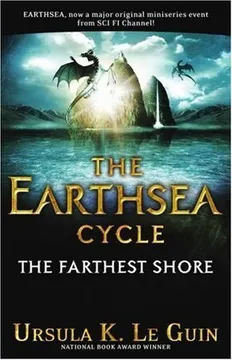


Plot Summary
Arren Leaves Enlad
Prince Arren2 reaches Roke carrying his father’s warning: spells have failed across Earthsea, and even a lambing charm in Enlad seemed empty of meaning. The Archmage Ged1 listens, then gathers the Masters of Roke, who disagree about whether the reports signal a deeper danger. Ged1 admits that his own magic cannot reveal what is wrong, and decides he must leave the protected isle to investigate.
Arren2 offers to accompany him. Though the Masters question the untrained prince’s2 usefulness, Ged1 accepts his choice rather than treating him as a servant. Arren2 sends word home and sails with Ged1 at dawn, leaving the safety and inherited duties of Enlad for a danger he cannot yet name.
The failing spell makes the crisis more than a shortage of useful tricks: the words that bind human knowledge to the living world have begun to lose their force. Roke’s debate shows how institutions can mistake their own stability for evidence that nothing is wrong. Ged refuses that comfort, but his choice of Arren also shifts authority away from rank and technical mastery. Arren’s lineage matters, yet Ged asks him to choose rather than obey. The adventure therefore begins as both an investigation into a damaged world and a test of whether inherited identity can become responsible action.
Hort Town’s Hollow Magic
Sailing as a trader and his nephew, Ged1 and Arren2 reach Hort Town, where crowded markets conceal lawlessness, slavery, and people numbed by hazia. A former sorceress now sells cloth and insists that her old performances were only tricks. She points them toward Hare,6 a once powerful wizard whose right hand was cut off after his magic had already failed.
Ged1 questions him in a derelict house. Hare6 explains that he believes a path through dreams can lead a powerful person beyond death, though his own account is broken by drug use and confusion. He promises to guide Ged1 there that night. The city’s disorder gives their search a human face: people are abandoning craft and judgment for numbness or impossible escape.
Hort Town does not simply lack magic; it has lost the social conditions that make skill meaningful. The former sorceress has converted artistry into commerce, while Hare’s damaged body and hazia dependence turn his search for transcendence into another form of self-erasure. His promise is dangerous precisely because it contains a distorted insight: the crisis is connected to a desire that reaches beyond ordinary life. Ged listens without accepting Hare’s explanation as truth. That restraint contrasts with the city’s appetite for quick relief, and gives the story a central question: what price does a person pay when the wish to escape suffering becomes a wish to escape being human?
The Slave Ship in Fog
That night, Arren2 is meant to guard Ged1 while the Archmage1 follows Hare6 into a drugged trance. Instead, Arren2 drifts toward the same vision. Thieves enter, strike both men, and carry Arren2 away to a slaver’s ship. When he wakes chained among captives, he learns that the slaver is Egre,16 the pirate Ged1 had been tracking.
Ged1 finds the galley in a supernatural fog, frees every prisoner, and magically silences Egre16 until he has something worth saying. Arren2 admits that he ran from the thieves to draw them away from Ged,1 despite being captured himself. Ged1 does not scold or praise him; he recognizes that Arren2 acted from trust, and tells him that he too may have been saved.
Arren’s failure at the door is not erased by his later courage; the episode makes both acts consequential. His lapse allows the thieves to take him, while his decision to draw them away from Ged prevents the robbery from becoming a killing. Ged’s rescue demonstrates immense power, yet his refusal to punish Egre beyond silencing him complicates the easy equation of justice with domination. The mentor’s trust also changes the emotional structure of the journey. Arren begins by idolizing Ged from a distance; now he learns that protection can move both ways, even when neither person fully controls what happens.
A Warning from the Dead
As Lookfar sails south, Ged1 explains that magic depends on place and balance, so its weakening in the unfamiliar South Reach may be easier to cause than elsewhere. He also recalls Cob,3 a gifted Havnorian mage who once summoned the dead for profit. When Ged1 was young, he forced Cob3 to cross into the land of the dead and return, hoping to make him understand the danger of treating death as a tool.
Cob3 survived the lesson and promised to abandon the forbidden lore. Ged1 now suspects that a mage seeking a way around death may be involved in the spreading ruin. Their destination becomes Lorbanery, where the loss of spellcraft has also drained the island’s famous silk industry.
This recollection gives the distant crisis a history without yet turning suspicion into certainty. Ged’s own past is implicated: he once used coercion to teach a moral lesson, and now recognizes that force cannot guarantee wisdom. Cob’s earlier encounter with death establishes a precedent for the present temptation, while the failing silk trade shows how metaphysical disorder translates into lost livelihoods. Arren, meanwhile, hears that even a powerful wizard can misuse knowledge through pride. The section quietly undermines the idea that expertise protects anyone from error. What matters is not merely what a person knows, but whether that knowledge remains answerable to consequence.
Lorbanery Forgets Its Craft
On Lorbanery, abandoned looms and untended silk orchards testify to years of decline, though the villagers deny that sorcerers ever mattered there. Ged1 visits Akaren,5 a former dyer whose mind has broken under the loss of her craft and its names. He removes the name she has exposed in her distress and gives her a new one, restoring enough order for her to leave the house quietly.
Her son Sopli,4 also a ruined dyer, later tells Ged1 that he has seen a shadowy ruler guarding a way back from death. He begs to join the westward voyage. Ged1 accepts him as a possible guide, while Arren2 resents being given no say. When Sopli4 reaches the boat, Arren2 boards too, bound by his promise despite his anger.
The island’s crisis becomes intimate in Akaren’s ruined orchard, where lost magic means lost identity, work, and dignity at once. Ged’s act with her name is not a cure for Lorbanery; it is a narrow, compassionate intervention that restores a boundary she can no longer maintain herself. Sopli offers information, but his vision is entangled with grief and obsession. Arren’s anger marks a change in their partnership: devotion alone no longer satisfies him when he feels excluded from judgment. The voyage asks him to move beyond obedience, yet he has not learned how to distinguish trust from surrender.
Obehol’s Bloodied Bay
Sopli4 identifies Obehol as the place he has sought, and Lookfar enters a quiet bay beneath its green mountains. Hidden attackers throw spears from the bluffs. Ged1 is struck in the shoulder, while Sopli,4 terrified of the water but desperate to reach land, leaps overboard and drowns. Arren2 rows away, then loses heart when the boat drifts back toward the hostile shore.
Seeing Ged1 bleed and unable to call on his magic, he lets the boat wander into open water, convinced that action cannot matter. The wind eventually carries Lookfar away from Obehol. Arren2 tends Ged1 only after the immediate danger has passed, and the two survivors continue without their guide,4 short of water and without any clear route home.
The attack strips away the protections Arren has assumed were guaranteed by Ged’s power. Sopli’s death is especially painful because the man’s fear of water and longing for a bodily route back to life converge in one irreversible choice. Arren’s paralysis is not a simple failure of courage; it is the behavior of someone who has made safety his only measure of what is worth doing. His belief that nothing matters becomes self-fulfilling as he leaves Ged unattended. The scene turns the abstract question of mortality into a practical one: when fear empties the future of meaning, can a person still choose the next necessary act?
The Rafts Beyond Maps
After drifting almost to death, Arren2 and Ged1 are found by the Children of the Open Sea, a people who live on linked rafts far beyond the mapped islands. The raft folk nurse them, share scarce water, and give Ged1 time to recover from his wound. Arren2 spends days swimming and working with their young people, but eventually tells Ged1 how he abandoned him at Obehol.
He admits that terror of death made him distrust Ged1 and seek a private escape from mortality. Ged1 answers that the pursuit of endless life rejects the very experiences that make a life one’s own. Arren2 accepts that he may fail again, yet chooses to continue. Ged1 names him Lebannen2 and tells him he will trust him.
The raft community offers a model of life that is neither protected by land nor defined by possession. Their generosity gives Arren room to recover, but it does not absolve him; his confession is the act that restores moral contact with Ged. The new name, Lebannen, recognizes a self capable of responsibility without pretending that fear has vanished. Ged’s teaching is not that death should be welcomed as pleasant, but that refusing it entirely would also refuse change, attachment, and loss. Arren’s renewed commitment is therefore more mature than his first vow: he proceeds with knowledge of his weakness rather than an imagined guarantee of heroism.
The Dance Loses Its Song
At the raft folk’s midsummer Long Dance, the chanters suddenly forget their songs before dawn, and the dancers fear that the night will never end. Ged1 asks Arren2 to sing. Arren2 begins the creation song of Segoy, and as he completes it, the sky brightens and morning returns. A great dragon, Orm Embar,7 then lands among the rafts.
Rather than attack, he tells Ged1 that another power in the West is destroying dragons and asks for his help. Ged1 accepts, and Lookfar races north after him. Before leaving, the pair thank the raft chief,14 whose people have replenished their supplies. The song’s recovery and Orm’s7 appeal turn the expedition from a search for evidence into a race toward the source of the damage.
Arren’s song matters because he restores a shared practice, not because he discovers hidden wizardly power. His voice answers a communal silence with a memory older than the crisis, and dawn returns through participation rather than force. Orm Embar’s arrival expands the threat beyond human communities: even dragons, beings whose magic is inseparable from their nature, are vulnerable. The scene also makes the raft folk’s generosity materially important, since their stores allow the pursuit to continue. Arren is no longer merely protected or instructed. He contributes a skill that changes what others can do, a first glimpse of leadership grounded in service rather than command.
The Dragons Lose Speech
On the way through the Dragons’ Run, Ged1 and Arren2 see dragons attack one another and a dying creature abandoned on the rocks. Ged1 understands that their speech has been taken, leaving them without the reason that distinguishes them from beasts. Orm Embar7 explains that the enemy has survived death and gained power over dragons through their fear.
Meanwhile, Roke suffers its own collapse: the Master Changer10 sees islands disappearing in the Stone of Shelieth, and the Master Summoner9 is left nearly lifeless after looking into it. The Changer10 vanishes, apparently seeking Ged.1 The boat passes burned settlements and reaches Selidor, where the cause of the ruin must finally be confronted.
The dragons’ lost language makes the crisis legible as a destruction of relationship: without speech, their ancient intelligence cannot hold against fear and appetite. The parallel events on Roke show that distance and protective walls no longer offer immunity. The Stone of Shelieth does not provide a manageable explanation; its vision overwhelms the people who seek certainty from it. These two strands converge on Selidor, where the danger is no longer a rumor or regional decline. It has reached both the deepest institutions of magic and the oldest beings in the world. Knowledge can reveal the scale of a threat, but it cannot substitute for the courage to meet it.
Selidor’s Summoned Dead
On Selidor, Ged1 rests while Arren2 guards him and Orm Embar7 waits nearby. A sending appears on a dune, showing the long sought mage,3 who now calls himself a king and master. The image vanishes, but Ged1 explains that it is only a projection, not the man himself.3 That night, Cob3 summons the dead to stand around the travelers.
Ged1 releases them from the command, then tells Arren2 that their apparent return to life is only a shadow of what Cob3 promises. Arren2 chooses to continue into the land of the dead, knowing he may not find a way back. The next day, he leads Ged1 across Selidor toward the western cape, where Orm Embar7 has found a shelter built from dragon bones.
Selidor strips away the comforts of interpretation one by one. Cob’s sending can speak and threaten, but it is not a body; the dead can appear, but their presence does not restore the relationships or activity of life. Arren sees the seduction of Cob’s promise in a form that cannot be mistaken for genuine return. His decision to continue is therefore not based on a belief that Ged can guarantee his survival. The choice is a form of consent to uncertainty. When Ged lets Arren choose the route across the island, their roles have shifted: the younger man now supplies direction as well as loyalty.
The Door in the Dry River
At the western cape, Ged1 summons Cob,3 who appears in the flesh beside a house made of dragon bones. Cob3 claims to have defeated death, but Orm Embar7 attacks him and is killed by the enchanted weapon Cob3 carries. Cob3 crawls through a dark opening into the land of the dead, and Ged1 and Arren2 follow.
In the Dry Land, Ged1 confronts him: Cob3 has preserved neither life nor selfhood, only an empty existence that drains meaning from the living world. Cob3 leads them to the source of the breach, then tries to stop Ged1 from closing it. Arren2 strikes Cob3 with his inherited sword, but Ged1 halts him and seals the opening with the Rune of Ending, restoring the boundary between life and death.
The climax distinguishes survival from life. Cob’s body persists, but his refusal of mortality has severed him from the names, relationships, and sensory world that make existence meaningful. Orm Embar’s death gives the struggle a cost that cannot be reversed, while Arren’s sword proves useful without making violence the final answer. He can interrupt Cob’s attack, but Ged must close the breach through an act of restoration rather than revenge. The Rune of Ending does not abolish death; it returns death to its proper place in the balance. The decisive victory is a limit accepted, not a power seized.
Kalessin Brings Them Home
With the breach closed, Ged1 has spent his magic. He and Arren2 climb the Mountains of Pain, where Arren2 carries Ged1 when he collapses. They cross back into the living world and wake on Selidor’s shore beside Orm Embar’s7 body. Kalessin,8 the eldest dragon, appears and carries them east.
At Roke, Ged1 kneels before Arren,2 recognizing him as the future king, then leaves on Kalessin8 toward Gont. The Masters have begun to recover: the Changer10 returns, and the Summoner9 rises from his near-death state. Arren’s2 journey ends not with magical mastery but with the strength to carry another person through a darkness he once could not face.
The return reverses the journey’s early power dynamic. Ged, once the guide whose magic seemed sufficient for two, can no longer climb without Arren’s physical strength. Arren’s endurance becomes the bridge back to life, while Kalessin’s aid carries them beyond what human effort can finish. The restoration of the Masters suggests that Roke can heal, but Ged does not resume the authority he has surrendered. His kneeling makes recognition flow toward Arren, and his departure prevents victory from becoming a return to the old order. The story closes its central relationship by making love an act of release: Ged prepares the heir to rule and then chooses his own road home.
Epilogue
The closing account tells that Arren2 is crowned King of All the Isles in Havnor. One tradition says Ged1 attends the ceremony and later sails away alone in Lookfar.
Another says Arren2 travels to Gont to find him, but learns that Ged1 has gone into the mountain forests. Arren2 refuses to send anyone after him, recognizing that Ged1 belongs to a different kind of kingdom. He returns to Havnor and is crowned.
The two accounts differ over whether Arren sees Ged again, but both preserve the separation that follows their shared ordeal. The coronation completes the public consequence of the journey: the empty throne is filled, and the political order that the Masters could not provide becomes possible again. Ged’s absence is not presented as abandonment. Arren understands that the Archmage’s work has ended and that his own begins in a different sphere. The competing traditions also suit a story concerned with the limits of possession: even the person who has shaped Arren’s life cannot be made to remain at his side.
Analysis
The Farthest Shore treats the wish to defeat death as a political and ecological crisis, not merely a private temptation. Cob’s3 project damages magic, craft, speech, and social order because it imagines that one self can be preserved by cutting it loose from every relation that makes it alive. The resulting world is not full of spectacular destruction at first. It is full of things that still look functional but have lost purpose: markets without trust, silk looms without pride, songs without meaning, and dragons without language.
Arren’s2 journey gives this argument a human scale. He begins by loving Ged1 as an ideal and hoping that his ancestry conceals a special gift. Obehol breaks both fantasies. He fails the man he admires1 because fear has narrowed his attention to escape. His confession on the rafts does not make him fearless; it makes him able to act while knowing that fear remains. The change is measured in concrete responsibilities: he sings when the chanters cannot, leads across Selidor, and carries Ged1 when the Archmage1 can no longer carry himself.
Ged’s1 arc complements Arren’s.2 A lifetime of mastery has taught him that wisdom is not unlimited intervention. He must still act against Cob,3 but the decisive spell restores a limit rather than granting control over death. Once he has spent his magic, he accepts that he has finished the work of the Archmage.1 Arren’s2 future rule and Ged’s1 departure are therefore paired consequences, not separate rewards. The novel imagines maturity as accepting loss without confusing acceptance with passivity. Life matters because it is finite, and love becomes trustworthy when it helps another person enter that finitude rather than promising protection from it.
Review Summary
Reviews of The Farthest Shore are largely positive, praising Le Guin's poetic prose, philosophical depth, and mature themes surrounding death, balance, and immortality. Many readers appreciate the mentor-student dynamic between Ged and Arren, and the book's Taoist-influenced worldview. Critics note its slower pacing compared to earlier installments, with some finding the characters less emotionally engaging. Several reviewers highlight its surprisingly progressive elements for 1972, including diverse characters and deconstructionist fantasy storytelling. Most consider it a worthy, emotionally resonant conclusion to the original trilogy.
People Also Read


Characters
Ged
The restless ArchmageArchmage of Roke, Ged is a formidable wizard whose experience has made him wary of power used for its own sake. He is practical on the sea, patient with Arren’s2 questions, and often severe when fear or pride clouds judgment. His past includes mistakes that make him alert to the danger of believing skill can conquer every limit. He chooses Arren2 as a companion not because the prince2 is trained in magic, but because he sees a capacity for growth and responsibility. Ged’s care is real, though he does not soften every lesson to make it easy. His central tension is between a lifetime of action and the need to recognize when action must end.
Arren
The young heirArren is the prince of Enlad, raised with the habits of command but not yet certain what his inherited place requires of him. He begins with a romantic devotion to Ged1 and imagines that proximity to greatness will reveal a hidden power in himself. The voyage instead exposes his fear, impatience, and susceptibility to promises of safety. Arren is observant and capable with a boat, a sword, and a song, but his deepest strength lies in choosing to act after he has seen his own failures clearly. He learns to accept help without surrendering judgment, and to love Ged1 without needing to become his equal in magic.
Cob
The forbidden scholarCob is a Havnorian mage remembered for his command of spells that summon the dead. His intelligence and magical strength are matched by a powerful resistance to limits, especially the limits imposed by mortality. In Ged’s1 account, Cob is not a crude villain but a serious practitioner whose ambition makes dangerous ideas seem reasonable. He gives shape to the question that shadows the voyage: whether knowledge can free a person from suffering, or whether the wish to control every boundary eventually destroys what made freedom valuable.
Sopli
The broken dyerSopli is a former Lorbanery dyer whose craft and family life have been damaged by the island’s decline. His visions of a ruler3 who has escaped death give Ged1 a possible lead, but Sopli is neither a reliable guide nor a simple madman. He longs to prove that life can continue without loss, while his fear of the sea reveals how deeply he dreads the path he has chosen. His presence forces Arren2 to face how desperation can make a false promise feel like hope.
Akaren
The dyer who lost namesAkaren is Sopli’s mother4 and a former master dyer, a woman whose skill once joined practical work with a deep knowledge of color and craft. The loss of her art has left her frightened, furious, and unable to hold on to the identity she once guarded. She is not merely a victim of the failing magic; her distress preserves a clear memory of what has been lost. Her encounter with Ged1 reveals the human cost of a crisis that might otherwise seem abstract.
Hare
The ruined wizardHare is a former weatherworker and pirate ally whose magic and physical freedom have both been taken from him. He turns to hazia and fragmented visions, yet retains a belief that a hidden route can defeat death. His damaged state makes him a troubling guide: he has encountered something real, but cannot explain it clearly or separate insight from delusion. Hare embodies the cost of pursuing power without a stable sense of purpose.
Orm Embar
The dragon who seeks helpOrm Embar is an ancient and powerful dragon of the western isles, accustomed to being feared rather than asking for aid. His appeal to Ged1 signals that the crisis has reached beings beyond human politics. Orm is proud, dangerous, and direct in a way that differs from human speech, yet his concern for the dragons’ lost language makes his mission more than self-preservation. His presence forces Arren2 to revise his childhood longing for dragons into an encounter with their vulnerability.
Kalessin
The eldest dragonKalessin is the oldest dragon encountered in the story, a being whose age and power make ordinary measures of status inadequate. Kalessin acts with an inscrutable calm, intervening without explaining more than necessary. The dragon’s relationship with Ged1 carries the weight of an old debt, but neither controls the other. Kalessin represents a form of wisdom not based on human institutions or mastery, and offers aid without turning it into a contract of obedience.
Thorion
Roke’s Master SummonerThorion is the Master Summoner, a respected practitioner whose knowledge concerns the boundary between life and death. He shares Ged’s1 caution about using the lore of the dead, but the crisis tests the very art he has spent his life studying. His fate at Roke shows that expertise does not make a person invulnerable to the forces he investigates. Through him, the novel makes the weakening of magic visible inside its most secure institution.
Master Changer
Roke’s questioning mageThe Master Changer is a thoughtful, cautious member of Roke’s council and a fellow Enlad native. He worries that the reports of failing magic may be too slight to justify a dangerous voyage, yet he is capable of revising his judgment when the evidence deepens. His use of the Stone of Shelieth reveals the cost of seeking certainty through a vision too large for one mind to bear. He represents responsible caution, and its limits.
Master Patterner
The keeper of patternsThe Master Patterner lives in Roke’s Immanent Grove, attending to patterns rooted in the world rather than to the politics of the School. He is among the first to sense that the danger reaches deeper than a few failed spells. His guardedness is not indifference; he recognizes that some truths cannot yet be stated plainly. He offers Ged1 a warning rather than a solution, making his role one of perception at the edge of knowledge.
Master Doorkeeper
The guardian of RokeThe Doorkeeper is the ageless, smiling guardian of the Great House, one of the few people who knows Ged’s true name. He helps convene the Masters and supports Ged’s1 departure while remaining at Roke to preserve its boundaries. His quiet steadiness contrasts with the council’s anxious debate. He represents continuity and watchfulness, guarding a place without pretending that its walls can keep every danger away.
Gamble
The hopeful Roke studentGamble is a young sorcerer in training who guides Arren2 around Roke. His humor gives way to sincere interest when he speaks about the possibility of a king returning to Havnor. He introduces Arren2 to the political hopes that surround the prophecy and the empty throne.
Chief of the raft folk
The sea people’s leaderThe chief leads the Children of the Open Sea, a community living on linked rafts beyond the mapped islands. He is reserved, observant, and careful about the difference between his people’s obligations and those of land dwellers. Despite that distance, he chooses to rescue Ged1 and Arren2 and gives them shelter. His hospitality is practical rather than sentimental, grounded in a belief that strangers in danger should be helped.
Erreth-Akbe
The fallen heroErreth-Akbe is one of Earthsea’s legendary mages and Arren’s2 chosen hero. His history connects the royal sword, the western dragons, and the old stories of courage. His appearance in the narrative tests the difference between honoring the dead and trying to command them.
Egre
The slaver captainEgre is a former pirate who now transports chained captives for sale. He represents the open violence and exploitation beneath Hort Town’s busy markets. His encounter with Ged1 shows that power can restrain an offender without granting the mage a right to dictate every consequence.
Plot Devices
The Equilibrium
The world’s living balanceEarthsea’s Equilibrium is the interdependence of opposing forces, including life and death, power and restraint, and change and continuity. It is not a rule that prevents people from doing harm; it is a condition that makes every act matter beyond its immediate target. The failing spells, empty crafts, and frightened dragons show what happens when people try to escape their place in that balance. Ged’s1 decisions are guided by the need to act only when necessary, while the final struggle requires him to restore a boundary rather than abolish death itself.
True Names and the Old Speech
Language binds being to worldIn Earthsea, knowing a thing’s true name gives a mage a relationship to its nature, while the Old Speech carries the power of the world’s making. The weakening of names therefore signals more than forgotten vocabulary: it means that spells, crafts, and identities are losing their grounding. Akaren’s5 distress, the silencing of dragons, and the Masters’ fading arts all echo this loss. The story also treats names as intimate trust. Ged1 speaks Arren’s2 true name when their bond has changed, and Cob’s3 loss of meaningful identity reveals the cost of trying to exist outside the world’s relationships.
The Stone of Shelieth
A vision beyond safe knowledgeThe Stone of Shelieth allows a mage to glimpse vast truths, but what it reveals depends on the person looking into it. The Master Changer10 sees lands disappearing from the world, while the Master Summoner9 sees the springs of being run dry. The object does not offer a clear plan or a weapon against the threat. Instead, it exposes how incomplete perception becomes dangerous when a person mistakes a vision for mastery. Its use at Roke makes the crisis immediate inside the School and underscores that knowledge has limits even for its most disciplined practitioners.
The King’s Sword
Inheritance made useful through choiceArren2 carries the ancient sword of Serriadh, a royal heirloom associated with service to life rather than violence for gain. Early in the voyage, its weight feels like an inheritance he has not earned and does not know how to use. The sword becomes meaningful only when Arren2 accepts responsibility for his own actions and makes a choice in the land of the dead. Its function is not to prove that he possesses secret magic. It gives physical form to a duty he must understand for himself.
Gobardon and the Rune
A skyborne sign of endingGobardon and the stars that gather beneath it form a pattern associated with the Rune of Ending. The constellation appears repeatedly as the travelers move toward the farthest west, linking their route to a boundary they do not yet understand. Its arrival becomes especially important when the Long Dance falters and Arren2 sings the creation song that carries the gathering through the night. The stars serve as a quiet navigational and symbolic device: they do not solve the mystery, but they help mark the journey’s movement toward an ending that must also restore the possibility of renewal.
Download PDF
Download EPUB
.epub digital book format is ideal for reading ebooks on phones, tablets, and e-readers.








