

Key Takeaways
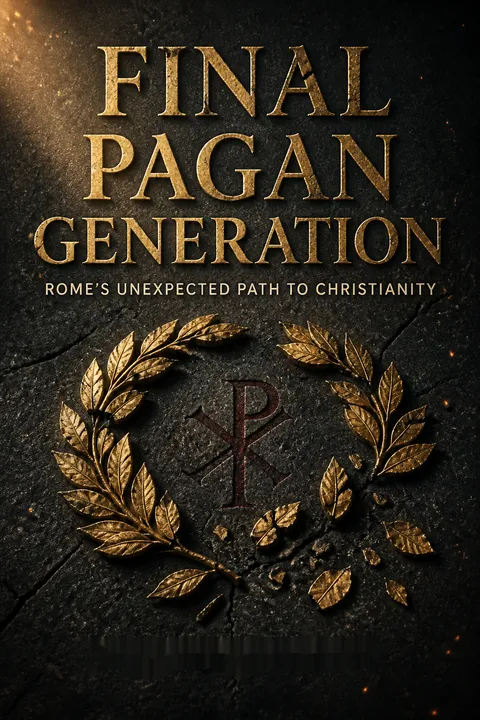
The final pagan generation describes a worldview, not paganism’s last believers.
A cohort, not a census. Watts uses “the final pagan generation” for elite Romans born in the 310s, both Christian and non-Christian, who grew up expecting traditional public religion to endure. They were not the last pagans. Pagan worship continued long after their deaths. What made their generation distinctive was that its members were children in a world without a Christian emperor, then adults who watched Christianity gain state support and public power.
A different vantage point. The book opens with the destruction of Alexandria’s Serapeum in 392, a dramatic event that younger Christians and pagans treated as a turning point. The older generation did not generally see the century as a battle between two religions. Four unusually well-documented men, Libanius, Themistius, Ausonius, and Praetextatus, reveal how age and experience shaped their priorities.
What's valuable here is the distinction between a demographic label and a remembered world. A generation can be “final” in the sense that it is the last cohort raised with one set of assumptions, even when people who share those assumptions remain alive afterward. This is a useful correction to histories that treat later outcomes as obvious from the beginning. The method has limits: four elite men cannot represent millions of people, and elite letters preserve polished self-images. Watts uses them most persuasively as evidence of a viewpoint, not a poll of Roman belief.
In 310, Rome’s gods were infrastructure, not just private beliefs.
The sacred was everywhere. Temples and shrines filled cities, country estates, and homes. A late Roman list counts roughly 2,478 temples in Alexandria, while Rome’s calendar marked 177 days as festivals or holidays. Statues appeared in public spaces and private houses. Processions brought noise, light, incense, flowers, and offerings into city streets. Traditional religion was not a separate activity people entered only when they chose to worship. It formed part of the surroundings in which they worked, traveled, celebrated, and raised children.
Habit blurred boundaries. Children learned rituals by watching relatives, nurses, and teachers. Christians, too, could participate in family customs or encounter religious festivals without treating every act as a statement of allegiance. Some Christian writers urged believers to avoid pagan practices, but doing so could mean disentangling themselves from ordinary civic and family life.
The infrastructure analogy helps explain why religious change could not be accomplished by changing belief alone. Institutions, buildings, calendars, and everyday habits reinforce one another. A public ritual may feel less like a declaration of doctrine than like a familiar part of the neighborhood, especially when attendance is optional and participation varies. The analogy also has a limit: people are not passive users of infrastructure. Romans could ignore, reinterpret, or resist religious customs, and Christian critics did precisely that. The point is not that belief was unimportant, but that belief operated inside a dense material and social environment.
Stable careers and gold tied elite Romans to the imperial status quo.
A system worth joining. Reforms under Diocletian and Constantine expanded the government, created more offices, and made administration more efficient. The gold solidus, a stable high-value coin, helped concentrate wealth among officials and landowners who could access it. For ambitious elites, imperial service offered salaries, honors, exemptions from some local financial duties, and a path to greater influence.
Success ran through relationships. There was no centralized examination system for recruiting promising young administrators. A candidate relied on relatives, teachers, and friends to introduce him to officials. Libanius’s letters show this machinery at work: he sought positions for the connected Miccalus and a chance for the poorer student Bassus to demonstrate his rhetoric. Their prospects depended not only on ability, but on patrons who expected favors to be repaid.
This is a strong account of how institutions secure cooperation without demanding sincere agreement. Salaries and honors create incentives, while personal debts make the system feel like a web of relationships rather than an impersonal state. That combination can produce loyalty even when people privately dislike particular policies. It also complicates any simple story of meritocracy: talent mattered, but connections shaped who got the chance to display it. The evidence concerns the literate elite, not the wider population, and the book makes clear that access to stable gold and high office was sharply unequal.
Track enforcement, not edicts, to judge Rome’s religious transformation.
Law and daily life diverged. Constantine supported Christianity and issued statements against traditional practices, but the surviving evidence does not show a broadly enforced campaign to close temples. Under Constantius, the government went further: a law in 356 prescribed death for sacrifice and another ordered temples closed. Yet sacrifices continued, temples remained open, and there is no record of prosecutions under these laws. Constantius himself visited Rome’s temples in 357.
Capacity shaped policy. Roman law depended on officials and local authorities to carry out imperial decisions. Governors could delay, ignore, or adapt instructions, and emperors had to consider the disruption a policy might cause. That did not make the laws meaningless. They expressed a direction and could enable particular attacks. But a law’s wording alone cannot tell whether ordinary religious practice changed across the empire.
The distinction between legislation and implementation is central to understanding state power. A decree can signal priorities, encourage some actors, and intimidate others even when enforcement is uneven. Conversely, a government may lack the personnel or cooperation needed to impose a policy consistently. This resembles a familiar problem in modern public administration: the center announces rules, but local institutions determine much of their practical meaning. The nuance matters because neither “the empire banned paganism” nor “the bans changed nothing” fits the evidence. Policy had effects, but those effects varied by place, official, and circumstance.
Julian’s pagan revival demanded more religious conformity than old pagan life did.
Restoration became a program. When Julian became emperor in 361, he reopened temples, restored sacrifices, and created regional priestly administrators. His aim was not simply to permit old customs. He wanted a more organized, active religious life, with priests responsible for festivals, temple property, and the conduct of local worship. Many Romans had previously been free to attend or ignore festivals as they chose.
Belief entered public rules. Julian also restricted Christian teachers who taught classical texts without affirming the religious ideas the emperor associated with them. Some lost their posts. The policy made religious identity a condition of professional opportunity. Libanius supported many of Julian’s religious aims, yet still asked officials to spare friends whose property was affected by temple restorations. His support for revival did not erase personal loyalties or practical limits.
Julian’s case shows that a policy described as restoration can be an innovation in practice. He was trying to rebuild traditional worship through administrative structures and rules about teachers, not merely remove restrictions. This is a useful reminder that religious freedom and religious revival are not always the same thing: a state can restore one tradition by imposing new demands on its adherents and disadvantaging others. The episode also makes political behavior look less like a clean contest of convictions. Libanius could sincerely welcome temples reopening while objecting when the policy injured people he knew.
Christian youth built escape routes from the careers their parents prized.
A new model of success. Many young elites still pursued the offices and honors their parents had sought. Others left law, teaching, or government for the church or an ascetic life. Athanasius’s Life of Antony helped make withdrawal from ordinary obligations seem both spiritually serious and socially imaginable. Antony, presented as a man from a prosperous family, relinquished property and moved away from settled life to pursue religious discipline.
Friends made exit possible. Young men such as John Chrysostom and Basil formed close partnerships that supported their commitment to asceticism. Their parents sometimes objected because sons were abandoning family duties, careers, and inheritances. Not every attempt lasted: the death of a parent could return an aspiring ascetic to the estate and responsibilities he had left. These were social choices, not simply private changes of belief.
The book’s account of friendship reveals how an alternative culture can become durable. A person may find it difficult to reject a prestigious career alone, but a circle of peers can supply recognition, practical support, and a different standard of achievement. The same social ties that once helped students succeed in the imperial system could now help them leave it. This does not mean ascetic life was a frictionless escape. Family care, property, and dependency created real obligations, and the surviving stories often present a sharper break than people could sustain in practice.
Bishops gained power by turning elite skills into authority outside government.
Church office changed. As Christian institutions accumulated property, charitable resources, and political responsibilities, they increasingly needed leaders who could manage estates, negotiate with officials, and represent communities. Ambrose illustrates the shift. He had served as an advocate and provincial governor before becoming bishop of Milan in 374. He brought administrative experience, family wealth, and elite connections into the church.
The old channels lost their monopoly. In 384, the senator Symmachus asked the young emperor Valentinian II to restore the Altar of Victory and public support for traditional Roman religion. Ambrose opposed the request. He used his standing as bishop, his influence with the emperor, and his recent diplomatic service to block it. The decision showed that a leader who had left imperial office could still shape imperial policy, sometimes more effectively than those who remained within the old establishment.
Ambrose’s rise is not best understood as religion replacing politics. His ecclesiastical authority drew strength from skills and resources developed within elite Roman life. The boundary between church and state became a contested zone where leaders carried methods, networks, and expectations from one institution into another. This resembles institutional entrepreneurship: an actor uses expertise gained in one setting to establish authority in a new one. Yet bishops were not fully independent. They still needed congregations, buildings, funds, and often imperial recognition, so their power was influential but not unlimited.
The Serapeum’s fall was a shock, not the inevitable finish line.
A landmark became vulnerable. In 392, a dispute in Alexandria escalated after Bishop Theophilus began converting an abandoned imperial building. Religious objects discovered there were paraded and mocked, sparking street violence. Pagan defenders retreated to the Serapeum, a major temple complex. After an imperial pardon cleared the defenders, Christians destroyed the statue of Serapis and removed images of the god around the city. The episode made a once imposing religious institution seem exposed.
A dramatic event is not a census. The destruction capped years of growing pressure on traditional worship, but it did not mean that pagan practice vanished. Temples, images, festivals, and household rites remained across the empire, and some survived for centuries. Younger people could see the event as evidence that a new religious order was possible. Older elites, formed by decades of continuity, often saw it as a dangerous episode rather than the end of their world.
The Serapeum demonstrates how a single event can change perceptions without immediately transforming an entire society. A highly visible institution falls, and people revise their sense of what is possible. That is different from proving that most people have changed their beliefs or habits. Historians are especially vulnerable to treating dramatic episodes as representative because they are vivid, well narrated, and easy to place at the end of a story. Watts’s distinction between symbolic impact and broad social change keeps the event important without making it stand for every Roman’s experience.
Read Libanius’s temple defense beside the career he still wanted to protect.
One man, several priorities. In his later years, Libanius complained about attacks on temples and pressed officials to stop them. He did so through appeals, letters, and relationships with administrators, the tools that had served him throughout his career. At the same time, he worried about his health, the loss of his partner and son, his school’s standing, and his ties to powerful officials. His religious concerns mattered, but they shared space with family grief and professional ambition.
The archive preserves a crafted self. Libanius’s late letters present him as a connected elder statesman, while later Christian histories often used him as a symbol of worldly success that younger Christians had rejected. Neither image captures everything. His career shows an older elite still active in a changing empire, but it also shows how the surviving record favors educated men whose influence and self-presentation left written traces.
This is a useful corrective to the habit of sorting historical actors into single identities: pagan, Christian, traditionalist, or reformer. People can care deeply about a threatened institution while choosing tactics that preserve family ties, reputation, and access to officials. The letters also raise a source-critical question: a collection is not a transparent diary. Its selection and arrangement can turn a writer’s life into an argument about his own importance. Reading for both the stated grievance and the social purpose of the letter makes Libanius more human and the evidence more reliable.
Analysis
Watts’s central contribution is to shift the explanation of fourth-century religious change from inevitability to lived perspective. The rise of Christianity did not arrive as a clear historical destination for people born in the 310s. They experienced it amid routine work, patronage, inheritance disputes, civic obligations, and a religious landscape so extensive that it often functioned as background. Their limited imagination of a Christian empire was not simply stubbornness. It reflected the institutions and habits that had made their lives intelligible.
The argument is strongest when it shows how institutions shaped religious outcomes without requiring a coordinated plan. Diocletian and Constantine expanded an administrative order that rewarded cooperation. That order gave ambitious elites reasons to accommodate emperors whose religious policies they disliked. It also created networks and resources that younger Christians could repurpose, whether by entering the church or withdrawing into ascetic communities. Change therefore came not only through imperial commands, but through shifts in who could claim authority and what counted as success.
The book’s generational lens also requires restraint. Libanius, Themistius, Ausonius, and Praetextatus were exceptionally visible elites, not a representative sample of the Roman population. Their correspondence and speeches were crafted performances, not unfiltered records of private belief. Watts recognizes these limits and uses the men to reconstruct a social position rather than a universal mood. Still, the surviving evidence makes the older elite easier to hear than peasants, women, or urban laborers. The account is most persuasive when it avoids turning a cohort into a unified bloc.
The Serapeum’s destruction works as a powerful narrative hinge because it changed the imaginable future, not because it instantly erased traditional religion. The larger lesson is methodological: historians should distinguish the event that becomes a symbol from the slow, uneven processes that surround it. A society can undergo profound transformation while many of its members remain focused on ordinary obligations, and those ordinary decisions can help produce the very order they never foresaw.
Review Summary
The Final Pagan Generation offers a unique perspective on the 4th century Roman Empire's transition from paganism to Christianity. Watts focuses on four elite figures to illustrate how gradual changes in religious policy and social dynamics went largely unnoticed by those living through them. Readers appreciate the book's nuanced approach, detailed research, and insights into Roman society. Some found it dry or narrow in focus, while others praised its fresh generational analysis. The book draws parallels to modern religious shifts and highlights the importance of understanding historical transitions.
People Also Read


Glossary
Final pagan generation
elite cohort raised pre-ChristianWatts’s term for elite Romans born in the 310s, including both Christians and devotees of traditional religion, who grew up expecting the established public religious order to continue. It does not mean the last generation of pagans. It identifies a shared formative worldview: these Romans were raised before Christian emperors and then lived through Christianity’s growing political and social dominance.
Solidus
stable Roman gold coinA high-value Roman gold coin introduced in the fourth century. Its gold content remained unusually stable, making it a dependable store of wealth and a common form of compensation for senior officials. Access to solidi helped concentrate resources among imperial servants and wealthy landholders, while poorer Romans relied more heavily on lower-value coinage.
Curial obligations
local council duties and costsFinancial and administrative responsibilities attached to membership in a Roman city council, or curia. Councillors helped collect taxes and fund local services. These duties could burden people who inherited property, while high imperial office sometimes brought exemptions. The obligations shaped career choices, inheritance disputes, and the difficulty of leaving conventional elite life.
Christian youth culture
Christian alternatives for young elitesWatts’s description of younger Christians who turned away from the administrative, legal, or teaching careers their families expected. Some pursued church office; others joined ascetic circles that supported withdrawal from wealth, status, and ordinary social ambitions. These paths offered alternative forms of success and authority, while often creating conflict with family obligations.
FAQ
1. What is The Final Pagan Generation by Edward J. Watts about?
- Focus on a pivotal generation: The book examines the lives of elite Romans born in the 310s, who grew up in a pagan world but witnessed the rise of Christianity as the dominant force in the Roman Empire.
- Historical transformation: It covers the transition from Constantine’s reign through the late fourth century, exploring how social, political, and religious changes affected Roman society.
- Key figures and sources: Watts centers the narrative on figures like Libanius, Themistius, Ausonius, and Praetextatus, using their writings and careers to illustrate broader generational experiences.
- Methodological approach: The author draws on letters, orations, legal texts, and archaeological evidence to reconstruct the complex interactions between pagan elites, Christian authorities, and imperial power.
2. Why should I read The Final Pagan Generation by Edward J. Watts?
- Unique generational perspective: The book restores the overlooked viewpoint of a generation caught between the old pagan world and the emerging Christian empire, revealing their nuanced responses to change.
- Rich use of primary sources: Watts provides vivid insights into late antique elite life, education, and politics through detailed analysis of letters, orations, and biographies.
- Challenges simplistic narratives: The book complicates the idea of an inevitable Christian triumph, showing how personal ambitions and social networks often overshadowed religious conflict.
- Relevance to modern debates: By exploring themes of identity, power, and cultural change, the book offers valuable perspectives on religious transformation and societal adaptation.
3. Who were the "final pagan generation" according to Edward J. Watts?
- Definition and context: The final pagan generation refers to Roman elites born in the 310s, raised in a predominantly pagan environment but living through the Christianization of the empire.
- Social and political roles: These men held high offices, engaged in imperial administration, and were influential in cultural and intellectual life.
- Key representatives: Figures like Libanius, Themistius, Ausonius, and Praetextatus exemplify this group’s efforts to maintain traditional religious practices amid growing Christian dominance.
- Challenges faced: They navigated shifting imperial religious policies, the rise of Christian bishops, and the gradual erosion of pagan public cults.
4. What was the religious environment into which the final pagan generation was born, as described in The Final Pagan Generation?
- Pervasive pagan infrastructure: The early fourth-century Roman Empire was saturated with temples, statues, festivals, and rituals honoring traditional gods, forming a sensory backdrop to daily life.
- Integration with daily life: Religious festivals dominated the calendar, and rituals like incense offerings were woven into social and family activities.
- Christian minority experience: Christians lived amid this environment, often participating in or tolerating pagan customs due to social and practical pressures.
- Gradual change: The religious landscape was not static, but the dominance of paganism was deeply rooted in public and private life.
5. How did education shape the worldview of the final pagan generation in Watts’s analysis?
- Classical curriculum dominance: Education focused on grammar and rhetoric, immersing students in classical literature and pagan mythology, reinforcing traditional norms.
- Insulated scholastic environment: Schools functioned as intellectual families, often dominated by pagan teachers, keeping students somewhat detached from broader religious and political changes.
- Limited awareness of change: Despite Constantine’s pro-Christian policies, students like Libanius were so absorbed in their studies that they paid little attention to the shifting religious landscape.
- Formation of elite identity: Education was central to shaping the values and worldviews of the Roman elite, influencing their later responses to religious transformation.
6. What roles did key figures like Libanius, Themistius, Ausonius, and Praetextatus play in The Final Pagan Generation?
- Libanius: A prominent rhetorician and teacher from Antioch, whose letters and orations provide personal insight into elite intellectual and social life.
- Themistius: A philosopher and political advisor in Constantinople, who rose to senatorial prominence by supporting imperial policies and adapting to changing regimes.
- Ausonius: A Christian teacher and imperial official from Gaul, illustrating the integration of provincial elites into imperial service.
- Praetextatus: A Roman senator and priest, whose public offices and religious roles exemplify traditional senatorial life amid religious change.
7. How did Emperor Julian’s reign affect paganism and Christianity, according to Edward J. Watts?
- Brief pagan revival: Julian’s reign (360–363) marked a short-lived attempt to restore traditional pagan religion and reverse Christian advances, including reopening temples and reinstating sacrifices.
- Institutional innovation: Julian created a pagan priesthood modeled on imperial administration, organizing festivals and temple property in new ways.
- Legal and educational reforms: He issued laws excluding Christian teachers from schools, legislating belief in unprecedented ways.
- Limited long-term impact: Julian’s death ended the brief resurgence, and the underlying Christianization of the empire continued.
8. How did the imperial system and bureaucracy shape the opportunities and challenges for the final pagan generation?
- Stabilized bureaucracy: The empire under Diocletian and Constantine had a large, efficient administrative system, offering wealth and status to capable elites.
- Social networks and patronage: Advancement depended heavily on family connections, letters of introduction, and reciprocal favors, creating a self-perpetuating elite class.
- Economic prosperity: The introduction of the gold solidus coin stabilized the economy for the wealthy, enabling an age of elite luxury and opportunity.
- Political instability: The 350s brought civil wars and shifting power, requiring elites to carefully balance loyalties and navigate changing circumstances.
9. What was the nature of Christian youth culture and the younger generation’s response to religious change in the 360s and 370s?
- Emergence of Christian elites: The children of the final pagan generation often embraced Christianity more fully, with some entering episcopal office and others adopting ascetic lifestyles.
- Asceticism’s appeal: Influential texts like Athanasius’s Life of Antony inspired young men to renounce worldly ambitions for asceticism, despite social and familial pressures.
- Social challenges: These young Christians faced resistance from parents and peers, and formed supportive ascetic communities that countered traditional expectations.
- New power dynamics: The rise of Christian ascetics and bishops altered the political landscape, reducing the influence of pagan elites.
10. How does Edward J. Watts explain the generational gap in responses to religious change in The Final Pagan Generation?
- Older generation’s stability: Men born in the 310s valued political order over religious confrontation, often tolerating changes without violent resistance.
- Younger generation’s activism: Those born after Constantine anticipated and actively engaged in religious conflict, supporting Christianizing policies or pagan resistance.
- Failure of imagination: The older generation could not fully envision a Christian empire, leading to a more measured, pragmatic approach to transformation.
- Impact on policy and society: This generational divide shaped the pace and nature of religious change in the late Roman Empire.
11. What does The Final Pagan Generation reveal about the destruction of pagan temples, such as the Serapeum in Alexandria?
- Historical context: Watts situates the destruction of the Serapeum within broader religious and political conflicts, highlighting the role of Christian authorities and imperial policies.
- Contested narratives: The book discusses differing accounts from sources like Rufinus, Eunapius, and Damascius, showing how the event was remembered and interpreted by both pagans and Christians.
- Symbolic significance: The destruction marked a turning point in the visibility of paganism and the assertion of Christian dominance in urban religious landscapes.
- Practical consequences: The event signaled the decline of public pagan cults and the transformation of urban power structures.
12. What are the key takeaways and legacy of The Final Pagan Generation by Edward J. Watts?
- Complex transition: The shift from paganism to Christianity was gradual, contested, and shaped by generational perspectives rather than inevitable forces.
- Personal ambitions over dogma: Elite Romans often prioritized careers, family, and social networks over religious ideology, influencing their responses to imperial policies.
- Cultural persistence: Despite political and religious decline, the final pagan generation left a lasting legacy through literature, philosophy, and art.
- Historical reinterpretation: Watts challenges traditional narratives of paganism’s demise, encouraging readers to appreciate the nuanced realities of religious change and the enduring influence of pagan traditions in the Christianized empire.
Download PDF
Download EPUB
.epub digital book format is ideal for reading ebooks on phones, tablets, and e-readers.








