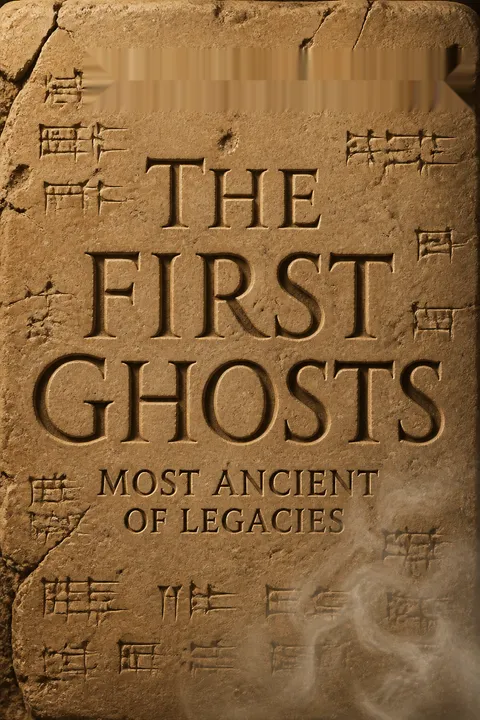


Key Takeaways
Treat ancient ghosts as documented social reality, not just folklore
A record, not an origin. The oldest known written word for a ghost appears on a Mesopotamian tablet from around the beginning of the third millennium BCE. The Sumerian word is gedim; the later Akkadian word is eṭemmu, the spirit that animates a living person and remains after death. This is the earliest evidence we can read directly, not proof that ghosts began there. The author argues that burial practices point to far older ideas: something of a person survives, travels elsewhere, and might return.
Taken for granted. Across nearly three millennia of cuneiform texts, ghosts appear in spells, omens, letters, myths, and royal inscriptions. King Ashurbanipal ordered enemy kings' tombs violated and their bones taken away, believing this would deprive their ghosts of rest and offerings. For these people, ghosts were not merely a private superstition; they were part of the world that politics and family life had to manage.
What's striking is the distinction between evidence for a belief and evidence for the thing believed in. Cuneiform records establish that ghosts shaped decisions, rituals, and fears, even if they cannot verify a supernatural presence. That distinction is useful well beyond ancient history: institutions can be studied through the realities people act upon. The book's claim that ghost belief is universal is more ambitious than its Mesopotamian evidence alone can prove, but the texts make a compelling case for taking ancient testimony seriously rather than dismissing it as quaint.
Read grave goods as evidence that families expected life to continue
Objects with a destination. Mesopotamian burials often included pottery, food, tools, jewelry, weapons, and personal possessions. The author reads these objects as evidence that the dead were expected to need something beyond the grave. The objects could also express wealth, status, or ritual, but their presence alongside the body suggests an afterlife imagined in familiar terms.
Royal lives, continued. At Ur, excavators uncovered sixteen elite tombs, some with lavish possessions and the bodies of numerous attendants. One grave held seventy-nine retainers. The tombs suggest that rulers were expected to preserve their rank and comforts below, while the attendants' deaths expose the human cost of that expectation. Archaeology cannot recover every person's beliefs, but these graves make the expectation of continued existence difficult to ignore.
Grave goods are powerful evidence precisely because they are actions, not abstract statements. Yet objects do not explain themselves: a vessel might serve the dead, the funeral, or both. The strongest interpretation comes from combining material remains with written descriptions of burial and offerings, rather than treating any single object as a transparent window into belief. The royal tombs also warn against romanticizing funerary custom. A burial can reveal what the powerful hoped to carry into the next life while showing how unevenly that hope was distributed.
Care for family dead through food, water, and remembrance
A continuing duty. In Mesopotamia, the living were expected to provide the dead with funerary offerings called kispu, pour water for them, and speak their names so they would not be forgotten. The eldest son usually carried this responsibility. Many people were buried beneath their houses, keeping the dead physically close to the family and making care for them part of domestic life.
Neglect could cause trouble. A ghost might return because descendants had stopped providing what it was owed. The dead could also be treated as allies: one ritual asks family ghosts to help a living relative before the sun god Shamash. This relationship was not only fear and appeasement. It was an ongoing exchange in which memory, offerings, and protection linked the living household to its ancestors.
This system turns remembrance into a practical obligation rather than a private feeling. Food and water make care visible, while naming keeps a person socially present. The arrangement also gives misfortune a human explanation: a ghost's distress can signal a broken relationship, not random supernatural malice. That framework can create solidarity across generations, but it can also burden surviving relatives with responsibility for events they may not control. Its importance lies in showing how ritual can make grief, duty, and family identity part of one repeated practice.
Look for neglected burial or violent death behind a restless ghost
Two sources of grievance. Mesopotamian texts describe troublesome ghosts whose needs were ignored and ghosts whose deaths left them with an unresolved fate. An unburied person, someone who died in battle, or a person lost in a river or wilderness might return because no proper burial or family care had settled the matter. The spells list many such cases, including people who died of hunger or thirst in prison.
A human past, still active. The ghost's behavior often reflected the life it had lived: some were needy, some resentful, and some dangerous. A family could identify likely causes by asking who had died without descendants, offerings, or a grave. These descriptions make the dead less like an abstract force and more like people carrying old injuries into the present.
The texts offer a social map of vulnerability. Burial, kinship, and access to food and water determine who can rest and who remains exposed. This makes the ghost story a way to register failures that might otherwise go unnoticed, including the abandonment of strangers and the aftermath of violence. The framework is humane in treating a restless ghost as wronged, though it can also reinforce the idea that a family's misfortune is evidence of neglect. Its explanatory power is strongest as a record of social values, not as a diagnosis of actual illness or death.
Use ritual to identify danger, not merely drive it away
A differential diagnosis. Mesopotamian exorcists did not assume every affliction came from a ghost. They considered eṭemmu, the spirit of a dead person, alongside utukku, a nonhuman demon, and other possible causes. Spell lists named different kinds of dead, from an unburied stranger to a forgotten relative, so a practitioner could investigate the likely source of trouble.
Ritual had procedures. Treatments might call on Shamash, the judge who managed relations between living and dead, or use an amulet, offerings, spoken formulas, and figurines. A namburbû was a ritual intended to avert a predicted danger. In one written charm, a small clay bead carries a direct instruction to a recurring ghost to stop entering the home. These texts combine diagnosis, protection, and treatment.
The striking feature is the methodical quality of the response. Practitioners sort possible causes, gather information, and choose a procedure, even though their explanations differ from modern medicine. Ritual also offers an organized response to distress when an illness or haunting feels uncontrollable. That does not make the diagnosis empirically sound by present standards. It does show that ancient care was not simply irrational panic: it had categories, trained specialists, and repeatable actions that made frightening experiences more manageable.
Separate literary visions of hell from everyday expectations of the dead
Two pictures of the afterlife. Stories such as the Descent of Inanna describe a dark Netherworld where the dead have little comfort. In the story, the goddess passes through seven gates and loses her clothing and authority before being judged. By contrast, grave goods suggest that ordinary people expected the dead to retain familiar possessions and some version of ordinary life.
Different sources, different purposes. The author cautions against treating literary accounts about gods as direct descriptions of daily belief. Royal funerary texts, household burials, and rituals for feeding the dead reveal other expectations. Mesopotamian sources do not describe a final moral court dividing people into destinations according to the goodness of their lives. The bleak literary landscape and the more familiar afterlife implied by burial customs need not be forced into one account.
This distinction is essential for reading any society whose literature, ritual, and daily practice do not line up neatly. A myth can preserve theological drama without functioning as a survey of popular belief. Conversely, a grave can reveal expectations without telling the full story people told about death. The book's comparison is persuasive, though the divide cannot always be drawn cleanly: stories and practices may influence each other even when they serve different purposes. The best reading keeps both forms of evidence in view without letting one erase the other.
A prince's staged descent shows how ghost belief could serve politics
A dangerous vision. In an Assyrian account, Prince Kummaya enters a temple and experiences a night vision of the Netherworld. He sees its frightening gods and demons, then faces Nergal, ruler of the dead, who warns him to change his conduct. Kummaya returns to public life in distress and announces his experience. The story presents a supernatural ordeal as a way to confront a powerful man's corruption.
An intriguing suspicion. The author proposes that Kummaya was Prince Shamash-metu-uballiṭ, and that the account's writer was Urad-Gula, a disgraced court exorcist seeking to regain the king's favor. In this reading, the vision may have been designed and politically useful. The tablet does not prove this reconstruction, but its shifts in narration and focus on a corrupt scribe make the identity puzzle central to the story.
The episode shows how religious authority can shape political behavior without requiring a modern separation between sincere belief and strategic use. A ritual may feel real to its subject and still serve someone else's interests. The proposed identities are especially vivid, but they remain an interpretation built from incomplete evidence, not a settled identification. That uncertainty is a strength when handled openly: it lets readers see how historical argument works, moving from textual clues toward a plausible reconstruction while keeping the gaps visible.
Consulting the dead was dangerous, but not beyond trained specialists
A controlled summons. Mesopotamian necromancers could seek out a dead person for answers, rather than simply banish a ghost. One Babylonian manual describes an oil made from unusual ingredients and applied to a human skull or a model of the deceased. The practitioner calls on Shamash, and the ghost may appear or speak. Another procedure uses a figure called a namtaru as a messenger for the dead.
No guaranteed answer. These operations required ritual precautions because seeing or hearing a ghost was considered dangerous. Some instructions say that silence makes the result doubtful and requires a further protective ritual. The surviving records include both a private letter mentioning consultations with ghosts and a royal report that appears to invoke a dead queen during a succession dispute. Necromancy served personal and political needs.
Necromancy complicates the familiar picture of ancient people trying only to escape the dead. The ghost could be a source of knowledge, counsel, or confirmation, although the texts do not establish that the answers were reliable. The repeated precautions also reveal a useful principle: seeking information from a powerful source can carry costs, especially when the source cannot be compelled with certainty. The manuals are valuable evidence of practice, but their existence alone cannot tell how often ordinary people attempted these procedures.
Read biblical ghost stories against the bans imposed on them
Prohibition signals presence. Deuteronomy condemns consulting ghosts and seeking answers from the dead, practices also known in Mesopotamia. In the story of Saul and the woman at Endor, the king secretly asks a professional to summon the dead prophet Samuel. The woman recognizes Saul only after the apparition appears, and Samuel delivers a message. The episode treats the consultation as possible even while the surrounding tradition disapproves of it.
Translation shapes interpretation. The Hebrew word often rendered as a ghost refers to the dead, while another disputed term may refer to demons rather than a human practitioner. The book argues that later religious interpreters sometimes softened the story because its plain account was uncomfortable. In the Gospels, disciples mistake Jesus walking on water for a ghost, suggesting that the idea remained familiar in everyday life.
A ban can reveal what a community fears, tolerates, or cannot fully suppress. The Endor story is especially revealing because its narrative depends on a practice that the wider biblical tradition condemns. Still, a prohibition does not prove how common a practice was, and disputed Hebrew vocabulary makes confident conclusions difficult. The passage is most valuable when read alongside its later interpretations: disagreement over what happened becomes evidence of changing boundaries between accepted religion and unwanted forms of contact with the dead.
Imagine the Netherworld as a pause in a cycle, not a moral courtroom
No final moral sorting. Mesopotamian sources do not describe the dead as being sent to reward or punishment according to their life's conduct. The dead entered the Netherworld, where kings retained status and families continued to owe offerings. The author suggests that this dark, crowded realm may have been an interval in a cycle rather than an eternal dead end.
A proposed recycling of life. A learned Babylonian interpretation links the limited supply of human life to the cycle of births and deaths: one person's death makes room for another person's life. On this reading, the eṭemmu is not reincarnated as the same individual, but its life-bearing element returns to circulation. This is the author's interpretation of scholarly texts, not an explicit, universally stated Mesopotamian doctrine.
The proposal gives a striking answer to a problem raised by the literature: why would anyone accept an endless, joyless afterlife? A temporary interval makes the Netherworld easier to reconcile with burial customs that equip the dead for continued existence. The idea also treats life as a finite resource, connecting individual death to collective continuity. Its elegance should not be mistaken for certainty, however. The argument relies on learned textual interpretation, and the surviving evidence does not show that every Mesopotamian shared this model.
Analysis
The book's unusual strength is its change of scale. It begins with prehistoric burials, where grave goods can suggest ideas about survival but cannot tell us exactly what people thought. It then moves into the cuneiform record, where ghosts become actors in domestic routines, medical explanations, royal vengeance, and literary narratives. This shift turns a familiar paranormal subject into a history of social obligations and intellectual categories.
Its most durable insight is that a ghost is not simply a frightening image. In Mesopotamia, the dead person could remain a family member with claims on descendants, a victim of improper burial, a political enemy whose remains could be attacked, or a source of information sought through necromancy. These roles share a practical logic: death does not automatically end a relationship. Ritual gives that continuing relationship rules and procedures.
The evidence is richest where the book stays close to tablets, objects, and actions. Its distinctions between family ghosts and outsiders, ghosts and demons, and literary Netherworlds and funerary practice help prevent overly simple readings. The author's speculative reconstructions, especially the identities behind Kummaya's vision and the theory of recycled life, are more fragile. They are compelling interpretive proposals, but the text itself cannot settle every connection.
There is also a useful tension between historical empathy and historical proof. Taking ancient testimony seriously means accurately describing what people believed and did, not treating their testimony as verification of supernatural events. That distinction allows the book to honor its sources without requiring readers to adopt their worldview. Its larger achievement is to show that the history of ghosts is also a history of family care, political power, uncertainty, and the human work of making death intelligible.
Review Summary
The First Ghosts by Irving Finkel explores ancient Mesopotamian beliefs about ghosts through cuneiform tablets. Readers praise Finkel's engaging writing style, humor, and vast knowledge, making complex topics accessible. The book offers fascinating insights into early ghost stories, burial practices, and afterlife concepts. Some found it overly detailed or academic at times, but most appreciated its unique perspective on ancient civilizations. Finkel's enthusiasm shines through, creating an enjoyable reading experience for those interested in history, archaeology, and the supernatural.
People Also Read

Glossary
eṭemmu
human spirit after deathThe Akkadian term for the human element that animates a person during life and survives death as a ghost. Mesopotamian texts describe the eṭemmu as capable of remaining in the Netherworld, receiving offerings, and sometimes returning to trouble or communicate with the living.
utukku
nonhuman spirit or demonAn Akkadian term for a class of supernatural beings, often hostile to humans. Unlike the eṭemmu, which is the ghost of a deceased person, an utukku is not human in origin. Exorcists could repel such beings but, in the book's account, could not kill them.
kispu
offerings for the deadThe Mesopotamian funerary offering made by the living to deceased relatives. It commonly involved food and was part of continuing care for family ghosts. Responsibility usually rested with the eldest son or another family caretaker, alongside pouring water and speaking the dead person's name.
namburbû
ritual to avert predicted evilA Mesopotamian ritual intended to release a person or household from a danger predicted by an omen. A specialist performed the prescribed actions and recitations to prevent the anticipated harm. The texts show that such rituals could accompany ghost-related fears, including the danger associated with hearing or seeing a ghost.
āšipu
ritual specialist and exorcistA trained Mesopotamian practitioner who used incantations, rituals, and specialist knowledge to address supernatural afflictions. The āšipu could investigate whether symptoms were attributed to a ghost, demon, or another cause, then select procedures intended to protect or heal the client.
Rephaim
shades of the deadA Hebrew plural term translated as shades in biblical passages about the dead in Sheol. It also appears in related ancient Near Eastern contexts, though its precise history and range of meanings remain debated. In this book, it provides a point of comparison between biblical and Mesopotamian ideas of the dead.
anamiru
plant used to reveal ghostsAn unidentified plant described in a Mesopotamian necromantic ritual. Crushed and mixed with oil, it was applied to the face to help the practitioner see a ghost or receive a prediction. The text connects the plant's name with seeing, but its botanical identity is unknown.
Download PDF
Download EPUB
.epub digital book format is ideal for reading ebooks on phones, tablets, and e-readers.








