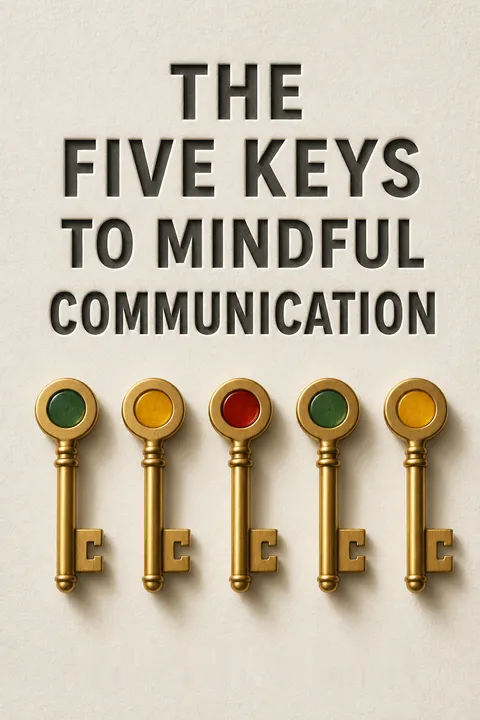


Key Takeaways
Treat conversation as shared ground, not a contest for territory
Connection beats defense. Chapman’s central claim is that communication works best when people recognize their mutual need to be seen, heard, and treated with respect. She calls this a “we-first” orientation: caring about the relationship without erasing individual needs. A story about a dog facing a hungry polar bear illustrates the possibility of interrupting threat with an unexpected signal of friendliness. In her own workplace, recalling that scene helped Chapman see a bullying colleague as a frightened, lonely person rather than a fixed enemy. It did not make his behavior acceptable, but it softened her fear and changed how she met him.
Warmth is not surrender. The aim is to stay curious and connected where possible, not to excuse harm or assume every hostile person will respond kindly.
What's striking is that the shift changes both the picture of the other person and the speaker’s own options. Seeing a colleague as more than a villain can loosen the reflex to retaliate, making a practical response easier to find. This resembles a systems view of conflict: each person’s behavior helps shape the interaction, even when responsibility is unequal. The limit matters. Compassion may reduce needless escalation, but it cannot guarantee safety or reform another person. Connection is a stance to choose when workable, not a duty to remain exposed to abuse.
Use the uncertain moment to pause before hurt becomes attack
Watch the transition. Chapman uses three traffic-light states to track communication. Green means open exchange, red means the channel has closed, and yellow is the unstable interval when surprise, embarrassment, or hurt may tip into defensiveness. The practical instruction is to stop at red and slow down at yellow. When Jason and Debra, a couple stuck in mutual irritation, tried small daily acts of kindness, they rebuilt enough appreciation to discuss disagreements without starting from accusation. The point was not to solve every issue with niceness, but to restore a little trust before attempting harder conversations.
Make a small gap. Notice the body’s tension, take a breath, and avoid sending the message that the first surge of feeling demands immediate action.
The yellow state is a useful bridge between emotional awareness and behavior. It treats the moment before a reaction as consequential, rather than assuming people can simply choose a better response once anger has taken over. The idea also fits everyday emotion-regulation practice: pausing creates a chance to notice what is happening before acting. Yet a pause is not always enough. Some conflicts need clear limits, outside support, or time apart. The traffic-light image is most useful as a prompt to assess the situation, not as a promise that every rupture can be repaired.
Train attention before expecting yourself to listen well
Return to direct experience. Chapman describes three capacities that support presence: the body notices sensations and surroundings, the heart registers another person’s feelings, and the mind stays curious rather than fixed on its first interpretation. Meditation is practice in returning attention to an anchor, often the breath, whenever thoughts carry it away. The aim is not to eliminate thoughts, but to notice distraction and come back. Chapman also suggests brief “positive interruptions”: a pause, a sound, a shift in someone’s expression, or an unexpected sensory detail that brings attention into the present.
Start with the body. A steady posture and a few unhurried breaths can make it easier to notice the speaker’s tone and expression instead of rehearsing a reply.
This account makes listening less mysterious. Attention is not just a good intention; it is a capacity that can be rehearsed in low-stakes moments and brought into conversation. The body also offers information that verbal content can miss, such as a tightening jaw or a change in another person’s posture. Still, bodily cues are clues, not reliable verdicts about what someone feels. Curiosity protects the practice from turning into mind-reading: observe the signal, then check its meaning rather than treating an interpretation as fact.
Reflect what you hear before trying to improve the other person
Show that the message landed. Mindful listening combines attention with encouragement. Chapman describes a teacher who notices students’ particular strengths, names them sincerely, and treats mistakes as opportunities to learn. The contrast is a listener whose attention is already crowded with judgments or a prepared counterargument. In one counseling example, a husband repeated his wife’s complaint about being late as a complaint about traffic. His version revealed that he had filtered her meaning through his own explanation. Reflecting a speaker’s point in plain language can expose such distortion and give the speaker a chance to correct it.
Encouragement is not flattery. Chapman warns that praise used to establish superiority can become another form of control. Useful recognition is specific, honest, and attentive to the other person’s actual experience.
Accurate reflection performs two jobs: it signals attention and tests whether the listener has understood. That makes it valuable in classrooms, families, and workplaces, where people often confuse listening with waiting for a turn to speak. Sincere recognition can also help people see strengths that shame or habitual criticism obscures. There is a necessary distinction between validating a person’s experience and endorsing every claim they make. A listener can convey, “That is how this felt to you,” while still asking for evidence or holding someone accountable.
Describe the event, not the courtroom story your anger builds
Separate pain from escalation. Chapman distinguishes the original hurt of an event from the extra suffering created by a defensive story. She traces one common path from complaint, to dividing people into sides, to blame, and finally retaliation. A man facing the end of his marriage moved through this sequence, interpreting loss as an attack and then trying to punish his partner. A different response begins by noticing what happened, what interpretation followed, and what feeling arose. Mark, a new father who felt displaced by his partner’s attention to their baby, initially tried to make her jealous. Reflecting on the episode helped him name sadness and longing instead of disguising them as anger.
Speak with care. Gentleness means reducing exaggeration and harm, not hiding a real grievance or pretending everything is fine.
The distinction between an event and the story built around it is useful because stories can turn uncertainty into certainty remarkably quickly. Naming observable details gives both people something concrete to examine, while naming an emotion can clarify what matters without assigning malicious intent. This does not make anger useless. Anger can register a violated boundary or an injustice; the question is whether its expression protects what matters or merely seeks an enemy. Forgiveness, in this approach, means making room for repair without denying the injury or requiring trust before it is earned.
Protect intimacy with honest boundaries, not possessive promises
Closeness needs space. Chapman describes relationships that swing between anxious pursuit and defensive withdrawal. Olivia, a woman in an abusive marriage, mistook dependency and fear of separation for love. Her recovery began with solitude, honest attention to what was happening, and recognition that friendliness toward herself mattered more than winning her partner’s approval. The book presents relationships as moving through recurring needs for time alone, discovery, commitment, and eventual change or loss. In practice, this means learning who someone is before making major commitments, keeping promises realistically, and allowing differences without trying to control the other person.
Safety comes first. Mindfulness is not a reason to endure violence. Olivia’s story includes a safe house, underscoring that boundaries and protection may require distance, help, or ending a relationship.
This is a valuable correction to the idea that intimacy means constant access or perfect agreement. Solitude can preserve a person’s judgment and make genuine choice possible, while reliable agreements create trust without ownership. The emphasis on accepting change also helps explain why disappointment is not proof that a relationship has failed; it may reveal a mismatch that needs discussion. But acceptance must not blur power differences. In a relationship marked by coercion or violence, the priority is safety and agency, not mutual warmth or better communication.
Treat emotions as signals, not commands to obey
Read the emotional weather. Chapman sorts emotions by how they function in communication. Open, responsive feelings such as compassion or sadness can help people notice what a situation calls for. Vulnerable feelings such as embarrassment or disappointment signal that expectations or fears have been touched. Defensive reactions such as contempt or revenge can narrow attention and increase harm. These categories are prompts for inquiry, not a demand to suppress unpleasant feelings. In a family conflict over a teenager’s curfew, a father’s rigid anger began to soften when he listened to his daughter and recognized how his own upbringing had shaped his fear of mistakes.
Ask what the feeling protects. Pause, locate the sensation in the body, and consider whether the emotion reflects the present situation, an old fear, or both.
The weather metaphor helps make emotion informative without making it infallible. A feeling can point toward a need, a danger, or a learned expectation, and its meaning becomes clearer when it is examined in context. The father’s change illustrates how listening to a family member’s account can reveal that an apparently present-day dispute carries older fears. At the same time, classifying feelings as open or defensive can oversimplify mixed experiences. Anger, for example, may contain both a justified alarm and a wish to retaliate. Careful reflection keeps the distinction from becoming another reason to judge oneself.
Match your response to the problem, not your preferred script
Let the situation inform action. Chapman calls skillful responsiveness a kind of shared improvisation: stay attentive to the people and details present, rather than forcing a plan onto them. A hospice volunteer noticed a lonely Japanese-speaking patient and introduced her to another patient’s family. In a workplace example, Zach faced a colleague who was spreading hostility about him. He avoided counter-gossip, stayed aware of the harm, and let coworkers and a supervisor see the pattern. When the colleague’s actions crossed a line, the organization intervened. The examples suggest a range of responses, from listening and offering help to setting a firm boundary.
Playfulness means flexibility. It does not mean treating serious harm lightly. It means remaining alert enough to choose a response that fits this person and this moment.
The strongest part of this idea is its refusal to reduce help to a universal script. The same attentive stance can lead to comfort, a practical offer, a question, or formal intervention, depending on what the situation requires. That resembles good professional judgment: gather cues, interpret cautiously, act proportionately, and revise as new information arrives. The book’s optimistic account of openness is most persuasive when paired with power-aware action. Calmness should not be confused with passivity, and compassion for a difficult person does not prevent documenting harassment or seeking protection.
Analysis
Chapman’s book is a practice manual built around a memorable diagnostic image: communication shifts among openness, shutdown, and the vulnerable interval between them. Its real subject is not conversational polish but the inner conditions that make dialogue possible. The five practices, presence, listening, speech, relationship, and response, are linked by a claim that attention changes what a person can perceive and therefore what action seems available. Stories make this abstract claim tangible, from a teacher who notices students’ strengths to a family whose rules conceal a father’s childhood fear.
The book’s most useful contribution is its insistence that a conversation can be studied as a process. Instead of asking only who was right, readers can track the moment a fact becomes an interpretation, an interpretation becomes a threat, and a threat becomes an attack or retreat. This is compatible with family-systems thinking, which treats behavior as shaped by recurring interaction patterns rather than isolated personalities. The traffic-light vocabulary gives ordinary people a shared shorthand for noticing those patterns before they harden.
The account also has limits. Its language of fundamental goodness and natural empathy is a moral and contemplative commitment, not an empirical guarantee about how people behave. Trauma, coercion, disability, culture, and unequal authority can shape what counts as safe communication. A person may be open and attentive yet still misread another, or encounter someone who uses dialogue strategically. Mindfulness can support discernment, but it does not replace boundaries, consequences, or specialized care.
The strongest reading, then, is neither that warmth solves conflict nor that defensiveness is always irrational. Rather, attention can distinguish a solvable misunderstanding from a dangerous pattern, and an honest feeling from the story attached to it. The book’s ambition is social as well as personal: repeated interactions create climates of trust or fear. Its practical promise is modest and consequential. A pause cannot guarantee reconciliation, but it can prevent one frightened reaction from deciding the whole conversation.
Review Summary
The Five Keys to Mindful Communication receives mostly positive reviews, with readers praising its insights on improving relationships and communication through mindfulness. Many found the concepts of "we-first" vs. "me-first" and the traffic light analogy helpful. Some readers appreciated the Buddhist influence and practical exercises, while others felt the book was too abstract or repetitive. Critics noted a lack of intersectional awareness and occasional self-aggrandizing statements. Overall, readers found value in the book's emphasis on deep listening, unconditional friendliness, and mindful presence.
People Also Read






Glossary
green light
Open communicationA symbol for communication in which attention remains available to present experience and to another person. Chapman connects this openness with three capacities: noticing through the body, empathizing through the heart, and remaining curious through the mind. A green light indicates that dialogue is flowing, not that everyone agrees or that boundaries are unnecessary.
yellow light
Vulnerable transitionA symbol for the uncertain interval between open communication and shutdown. It may arise when someone feels surprised, hurt, embarrassed, or disappointed. Chapman treats this interval as a chance to pause, notice fear and self-doubt, and choose whether to respond openly or move into defensiveness.
green zone
Emotionally safe spaceA setting that supports honest conversation and allows vulnerable feelings to emerge without being attacked or dismissed. It may be created through meditation, journaling, or dialogue with a trusted person. The defining feature is a commitment to pause harmful speech and listen with care, not a guarantee that every disagreement will be resolved.
we-first
Relational interdependenceA view of communication that recognizes people’s lives and interests as connected. It means considering the well-being of a relationship alongside personal needs, rather than treating every interaction as a contest for advantage. Chapman distinguishes it from self-erasure: remaining connected includes honesty, self-respect, and appropriate protection.
natural communication system
Body, heart, and mindChapman’s name for three innate ways of receiving information about the present: bodily attention to sensations and surroundings, emotional sensitivity to others, and an open mind able to question assumptions. Mindfulness practice is intended to restore coordination among these capacities when fear or habitual stories narrow attention.
positive interruptions
Attention returning to nowBrief breaks in habitual thought or activity that restore awareness of the present. A pause, a sensory detail, a flash of empathy, or a moment of doubt about one’s own opinion can interrupt a defensive story. The practice treats interruption as an opening for attention rather than as an obstacle.
toxic certainty
Self-righteous fixed opinionA rigid conviction that disguises insecurity by creating a sense of superiority over other people. Chapman argues that such certainty blocks curiosity, encourages contempt, and makes disagreement seem like proof that others are wrong or inferior. It can be reinforced by groups that repeat the same assumptions without examining them.
heartless-mind
Aggression justified by thoughtA defensive communication pattern that suppresses empathy and uses interpretations or arguments to justify harming, blaming, or controlling someone. It can appear as harsh speech, rigid rules, or retaliation. Chapman presents it as a learned reaction to fear, not as a person’s permanent identity.
mindless-heart
Need that overrides judgmentA defensive pattern in which emotional hunger or fear of abandonment overwhelms clear judgment and healthy boundaries. A person may cling to someone, excuse harmful behavior, or surrender personal agency in the hope of receiving security or affection. Chapman contrasts this with friendliness that includes both care and discernment.
relationship cocoon
Fear-based relationship cycleA seemingly stable but restrictive relationship pattern in which people avoid their own fears by assigning each other fixed roles. One person may pursue closeness while another withdraws or controls. The arrangement can preserve the relationship’s familiar rhythm while preventing honest intimacy, personal agency, and change.
surfing the wave of coincidence
Responsive improvisationChapman’s term for staying attentive to the present interaction and allowing its details to guide a flexible response. Rather than relying only on a preconceived plan, the person notices bodily, emotional, and situational cues, then acts in a way suited to the moment. It can mean listening, helping, or setting a limit.
FAQ
What's "The Five Keys to Mindful Communication" about?
- Core Focus: The book by Susan Gillis Chapman explores how mindfulness can enhance communication by fostering deep listening and mindful speech.
- Purpose: It aims to strengthen relationships, heal conflicts, and help individuals accomplish their goals through mindful communication.
- Approach: Chapman integrates Buddhist principles and her experience as a psychotherapist to teach readers how to be fully present in conversations.
- Structure: The book is organized around five key elements of mindful communication: silence, mirroring, encouraging, discerning, and responding.
Why should I read "The Five Keys to Mindful Communication"?
- Improve Relationships: The book provides tools to enhance personal and professional relationships by improving communication skills.
- Conflict Resolution: It offers strategies to address and heal conflicts through mindful practices.
- Personal Growth: Readers can develop greater clarity and confidence in their interactions, leading to personal and professional growth.
- Mindfulness Integration: It combines mindfulness with communication, offering a unique approach to everyday interactions.
What are the key takeaways of "The Five Keys to Mindful Communication"?
- Mindful Presence: Being fully present with an awake body, tender heart, and open mind is crucial for effective communication.
- Encouragement: Listening with unconditional positive regard can transform relationships and foster a supportive environment.
- Gentle Speech: Speaking with gentleness and refraining from harmful communication patterns can prevent conflicts.
- Unconditional Friendliness: Cultivating a friendly attitude towards oneself and others can lead to more meaningful connections.
What are the five keys to mindful communication according to Susan Gillis Chapman?
- Mindful Presence: Involves being fully present with an awake body, tender heart, and open mind.
- Mindful Listening: Encourages listening with empathy and unconditional positive regard.
- Mindful Speech: Focuses on speaking gently and refraining from harmful communication.
- Mindful Relationships: Emphasizes unconditional friendliness and acceptance in relationships.
- Mindful Responses: Involves responding with playfulness and creativity, staying open to the present moment.
How does Susan Gillis Chapman define "mindful presence"?
- Awake Body: Being aware of and attentive to your physical sensations and surroundings.
- Tender Heart: Engaging with empathy and compassion towards yourself and others.
- Open Mind: Maintaining curiosity and openness, free from preconceived notions and judgments.
- Integration: These elements together create a state of mindful presence that enhances communication.
What is the "relationship cocoon" concept in "The Five Keys to Mindful Communication"?
- Definition: A relationship cocoon is a pattern where partners avoid facing fears by turning each other into objects of craving or aggression.
- Cycle: It involves a cycle of mindless heart (pursuing intimacy) and heartless mind (creating distance).
- Impact: This pattern prevents genuine intimacy and leads to conditional friendships.
- Resolution: Breaking out of this cycle requires cultivating unconditional friendliness and self-awareness.
How does "The Five Keys to Mindful Communication" address conflict resolution?
- Mindful Listening: Encourages listening deeply to understand the other person's perspective without judgment.
- Gentle Speech: Advises speaking with kindness and refraining from aggressive or defensive language.
- Compassionate Insight: Involves understanding the root causes of conflict and addressing them with empathy.
- Practical Tools: Provides exercises and reflections to practice these skills in real-life situations.
What are the "four stages of heartlessness" in communication?
- Complaint/Criticism: The initial stage where one rejects pain and blames others.
- Divisiveness: Creating a divide by labeling others as enemies or threats.
- Blame: Projecting fault onto others to avoid personal responsibility.
- Retaliation: Acting out aggressively to punish others for perceived wrongs.
How does Susan Gillis Chapman suggest we handle "yellow-light emotions"?
- Definition: Yellow-light emotions are fear-based feelings like disappointment, embarrassment, and irritation.
- Awareness: Recognize these emotions as signals of underlying self-doubt or unrealistic expectations.
- Compassionate Insight: Approach these emotions with curiosity and kindness to uncover their root causes.
- Mindful Practice: Use mindfulness to stay present and prevent these emotions from escalating into red-light reactions.
What is the significance of "unconditional friendliness" in mindful communication?
- Core Principle: It involves accepting oneself and others without conditions, fostering genuine connections.
- Balance: Encourages a balance of aloneness and togetherness, respecting personal boundaries while being open to others.
- Healing: Helps break the cycle of mindless heart and heartless mind, leading to healthier relationships.
- Practice: Involves cultivating a friendly attitude towards all experiences, both pleasant and unpleasant.
What are some of the best quotes from "The Five Keys to Mindful Communication" and what do they mean?
- "Go with the green light": Encourages embracing openness and staying connected in communication.
- "Stop when the light is red": Advises refraining from harmful communication patterns and taking a pause.
- "Be careful when the light is yellow": Suggests being mindful of vulnerable emotions and addressing them with care.
- "Unconditional friendliness": Highlights the importance of accepting oneself and others without conditions for genuine relationships.
How can "The Five Keys to Mindful Communication" be applied in everyday life?
- Daily Practice: Incorporate mindfulness meditation to enhance presence and awareness in interactions.
- Active Listening: Practice listening with empathy and without judgment in conversations.
- Gentle Speech: Be mindful of your words, ensuring they are kind and constructive.
- Reflective Exercises: Use the book's exercises and reflections to deepen your understanding and application of mindful communication.
Download PDF
Download EPUB
.epub digital book format is ideal for reading ebooks on phones, tablets, and e-readers.








