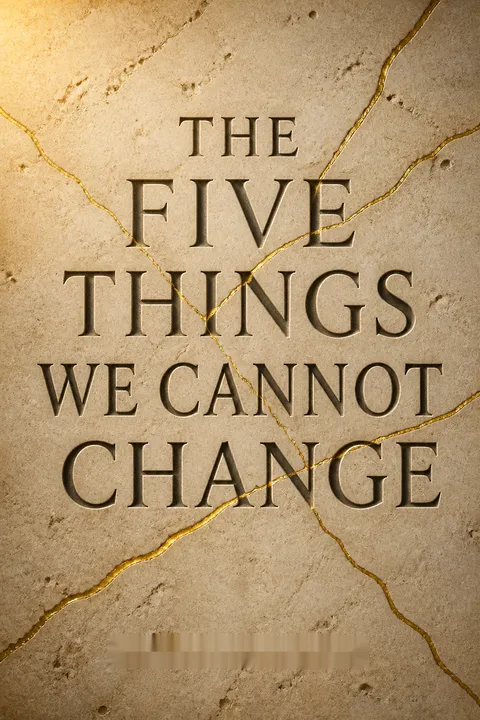


Key Takeaways
Stop demanding exemptions from the five facts every human life contains
Life has five constants. Psychotherapist David Richo calls them the givens: everything changes and ends; plans fail; life is not always fair; pain is unavoidable; and people are not consistently loving or loyal. Much of our distress, he argues, comes from expecting life to exempt us from these realities. An unconditional yes means meeting what is happening without first insisting it should be different. It is acceptance, not approval or passivity.
A prince meets reality. In the Buddha’s story, Siddhartha grows up sheltered from sickness, aging, and death. Seeing them beyond the palace walls begins his spiritual transformation. Richo’s central claim is similar: facing life’s conditions can deepen courage, compassion, and wisdom. The givens are not necessarily good, but resisting their existence adds another struggle to the one already underway.
The useful distinction is between accepting a fact and endorsing it. In Acceptance and Commitment Therapy, acceptance means making room for difficult experience while still acting according to chosen values. That makes Richo’s idea compatible with effort, treatment, and protest. The claim that every hardship is a gift is less secure: some events are simply devastating, and meaning may be something people create rather than discover. The stronger, more practical claim is that resistance cannot undo reality, while a response can still be chosen.
Let endings hurt fully, because grief is how attachment loosens
Loss needs mourning. Richo treats grief as a natural capacity for adapting to endings, not a failure to accept them. Relationships, bodies, enthusiasms, and possessions all change over time. Trying to freeze an early high point, such as the first rush of romance, turns change into evidence that something has gone wrong. A mature relationship may shift from excitement toward commitment; some relationships, of course, end.
Tears help us release. Mourning makes room for sadness, anger, and fear instead of burying loss under distraction or forced cheer. When someone dies, no replacement can restore that person. Yet grief can make room for new forms of connection, without pretending they are identical. Richo’s point is not that loss stops hurting, but that allowing grief can help people live with what cannot be recovered.
Grief research supports the importance of acknowledging loss, but it does not prescribe one orderly timetable or a single emotional sequence. People may move between sadness, practical tasks, relief, anger, and renewed connection in highly individual ways. Richo’s emphasis on mourning is valuable because it counters the pressure to perform resilience immediately. The caution is to avoid treating grief as a task that must reach completion. Continuing bonds with someone who died can coexist with adaptation, rather than signal a refusal to let go.
Plan carefully, then leave room for outcomes your plan cannot foresee
Plans are not guarantees. Richo does not argue against planning; he sees it as a healthy use of the ego. The problem begins when a plan becomes a demand that life cooperate. In his example, Doris Van Kappelhoff hoped to become a film dancer. A serious accident ended that path, and during recovery she began singing. She later became known as Doris Day. The disruption did not prove that every setback conceals a better destiny, but it opened a direction her original plan had not included.
Respond to what arrives. Richo calls meaningful coincidences that redirect a life synchronicity, and interprets them as possible signs of grace. More groundedly, his advice is to grieve disappointment, notice new options, and do what can be done next. Mistakes and failed plans can teach, but they need not be romanticized or treated as proof that events were arranged for a purpose.
This is a useful corrective to the belief that successful people simply execute better plans. Complex systems routinely produce outcomes no individual can fully predict, so adaptability matters alongside intention. Doris Day’s story illustrates possibility after disruption, not a rule that adversity improves a life. That distinction protects the lesson from becoming cruel to people whose losses yield no clear opportunity. The practical virtue is flexible commitment: pursue a direction seriously, while revising the route when new evidence or circumstances demand it.
Answer unfairness with repair, not revenge, while still demanding justice
Do not confuse acceptance with silence. Richo treats unfairness differently from the other givens: people can accept that unfairness occurs while still working to change it. In a personal conflict, a person can name the harm, ask for amends, and seek a change in the relationship. If those efforts fail, letting go of retaliation does not require pretending the harm was acceptable.
Choose restoration over payback. Retaliation aims to make an offender suffer; restoration aims to protect people, require accountability, and repair what can be repaired. Richo draws on the example of aikido, where the goal is to redirect aggression rather than simply injure an opponent. At the social level, he urges justice pursued without dehumanization. Compassion for someone who caused harm is not the same as trusting them, excusing them, or abandoning consequences.
Restorative justice offers a useful bridge between the book’s spiritual ideal and public policy: it emphasizes accountability, repairing harm, and, where possible, reintegration. It is not appropriate for every case, especially when safety is uncertain or power is unequal. Nonretaliation should not become a demand that victims reconcile with offenders. Richo’s strongest point is that justice and vengeance are different motives. A person can oppose abuse firmly, protect those at risk, and still refuse to let hatred dictate the response.
Face pain without adding shame, panic, or the fantasy of control
Pain is not a verdict. Richo draws on Buddhism’s first noble truth: human life includes suffering and dissatisfaction. Pain may come from illness, loss, betrayal, or a failed investment. Additional suffering can come from calling oneself stupid, obsessing over what cannot be changed, or trying to control every future risk. The distinction is not that pain is avoidable, but that some reactions compound it.
Hold acceptance and action together. Richo’s two-handed practice asks a person to acknowledge a predicament in one hand and a useful response in the other. Someone who has lost a job can recognize fear and grief while also beginning a search or asking for support. The book also rejects the claim that people are never victims: harm can be unavoidable. The aim is not to blame the harmed person, but to seek help, protect boundaries, and recover where possible.
Separating primary pain from secondary struggle resembles approaches in cognitive therapy, which examine how interpretations affect distress without implying that the original event was imagined. The distinction can restore agency, but it must be used gently: acute trauma, chronic illness, and severe depression are not solved by changing one’s attitude. Richo’s two-handed image helps because it gives equal weight to acknowledgement and action. Acceptance can mean recognizing present limits, not deciding that suffering is deserved, beneficial, or something a person must manage alone.
Love people without surrendering the boundaries that keep you whole
Love does not guarantee loyalty. Richo argues that partners, family, and friends will sometimes disappoint, reject, or betray one another. Childhood experiences can shape what adults expect from intimacy: someone whose needs were repeatedly unmet may become desperate for reassurance, while someone overwhelmed by closeness may withdraw. Recognizing those patterns can help a person respond to the present relationship rather than relive the past inside it.
Keep care and limits together. Richo’s five A’s of loving presence are attention, acceptance, appreciation, affection, and allowing. They describe ways of meeting another person, not a requirement to tolerate abuse. Love can remain generous while commitment depends on safety, reciprocity, and reasonable limits. His boundary checklist contrasts self-parenting, which protects judgment and personal needs, with codependency, in which someone gives up those needs to preserve a relationship.
The chapter’s best relational distinction is between the openness of love and the conditions required for continued access and commitment. Attachment research likewise shows that early relationships can influence expectations without fixing adult outcomes. That perspective supports curiosity about repeated patterns, while leaving room for therapy, changed circumstances, and healthier bonds. A potential danger is interpreting unconditional love as an obligation to stay. The book’s boundary principle corrects that risk: care for another person does not erase the right to leave, seek protection, or require accountability.
Name the feeling beneath the story before it hardens into resentment
Feelings are information. Richo uses SAFE for four basic feelings: sadness, anger, fear, and exuberance. They are bodily responses that can help people register loss, injustice, danger, and joy. He warns that words such as betrayed or rejected often mix a feeling with an interpretation of another person’s behavior. Asking what feeling sits beneath the story can clarify what needs attention. Jealousy, for example, may involve fear, sadness, and anger rather than one simple emotion.
Let feelings move. Richo describes a feeling as arising, being noticed and expressed, then cooling as life resumes. Suppressing it, turning it into drama, or feeding resentment can interrupt that process. This does not mean every feeling should be acted out. It means identifying the feeling, expressing it safely, and considering what belief or need gives it force. If the person listening is unsafe, choose a more trustworthy listener.
Emotion labeling is a practical skill because it can create distance between an experience and an impulsive reaction. The distinction between feeling and interpretation is also useful in conflict: ‘I feel afraid’ describes an inner state, while ‘I feel betrayed’ may already assign a motive. Still, emotions are not infallible reports about the world. Fear can misread a situation, and anger can identify a boundary without deciding what response is wise. The book’s sequence works best when feeling is treated as valuable evidence, then checked against context.
Choose refuges that help you face reality, not escape it
A refuge can either hide or help. Richo contrasts resources that support contact with life, such as friendship, nature, art, therapy, and meditation, with escapes that numb experience or become compulsive. He presents mindfulness as steady attention to the present, often practiced by noticing the breath and returning to it when thoughts pull attention away. The goal is not to stop thoughts or feel serene on command, but to notice what is happening without immediately fleeing or fixing it.
Use the three refuges. In Buddhism, Buddha represents awakened awareness, Dharma the teachings and practices, and Sangha the community of fellow practitioners. Richo presents them as supports for meeting difficulty, not magical shields against pain. In everyday terms, this means drawing on one’s capacity to become more aware, using practices that cultivate wisdom, and letting trustworthy people provide companionship.
The book’s distinction between escape and resource is more useful than a blanket suspicion of comfort. Rest, entertainment, and temporary distraction can be restorative; the relevant question is whether a refuge renews a person or narrows life through dependence. Mindfulness can help reveal that pattern by making urges observable before they become automatic. It is not a substitute for clinical care, especially in addiction or trauma. Richo’s inclusion of community is important: resilience is not merely an individual achievement, and support can be part of facing reality.
Practice compassion outward, without pretending another person's pain is yours to cure
Extend goodwill beyond preference. Richo describes metta, or loving-kindness, as a practice of wishing well for oneself and others, including strangers and difficult people. The four immeasurables are love, compassion, sympathetic joy, and equanimity. A practice can begin with a familiar person and widen to people one dislikes or does not know. The purpose is to loosen the ego’s narrow circle of concern, not to manufacture warm feelings on demand.
Breathe with suffering. Tonglen is a meditation of taking in and sending out. A practitioner imagines breathing in pain or constriction and breathing out openness, calm, or courage, first for personal distress and then for others. Richo presents this as a way to cultivate connection and compassionate response, not as a literal transfer of someone else’s suffering. Resistance is expected; the practice builds an intention rather than forcing an emotion.
These practices train attention toward people who are easy to overlook or resent, a useful counterweight to compassion limited to one’s in-group. Their value does not depend on supernatural claims: wishing others well can shape how a person attends and behaves. Tonglen’s imaginative exchange may be meaningful, but it should not blur the difference between empathy and responsibility. No one can absorb or cure another person’s pain through meditation alone. Compassion is strongest when inner practice supports concrete care, boundaries, and action.
Grow a stable self, then use it to serve a world beyond yourself
Personal growth needs two partners. Richo argues that psychological work and spiritual practice solve different problems. Therapy and reflection can help process childhood wounds, strengthen boundaries, and build a coherent sense of self. Spiritual practice can orient that self toward honesty, nonretaliation, compassion, and service. Neither substitutes for the other: meditation alone may leave old relational injuries untouched, while self-esteem alone does not necessarily motivate care for others.
Self and connection coexist. Richo uses no-self to describe the absence of a permanent, independent identity, not the disappearance of personality. A person remains distinct while also depending on other people and the natural world. His three dimensions, psychological health, spiritual maturity, and mystical awareness, are meant to inform one another. The practical test is whether growing inwardly makes someone more capable of living responsibly with others, rather than more certain of personal superiority.
This integration avoids two familiar reductions: treating every problem as an individual mindset, or treating personal development as selfish by definition. A stable sense of self can support generosity because it makes boundaries and responsibility more reliable. The no-self idea adds an ecological and relational perspective, though it is a spiritual interpretation rather than a clinical finding. The framework is most persuasive when judged by observable conduct: greater honesty, less retaliation, stronger limits, and more care. Inner growth cannot be measured only by claims of insight or unity.
Analysis
Richo organizes a wide-ranging therapeutic and spiritual book around a simple wager: much avoidable misery comes from demanding that reality obey the ego’s preferences. The five givens make that wager concrete. Aging, failed plans, injustice, pain, and imperfect love are not rare exceptions to a basically controllable life; they are recurring conditions. The book’s distinctive contribution is to make acceptance active. Grief, boundary-setting, justice work, emotional honesty, meditation, and seeking support are all ways to meet reality rather than surrender to it.
Its strongest practical safeguard is the repeated pairing of opposites. A person can accept a loss and look for work; love someone and leave an unsafe relationship; feel anger and refuse revenge. This both-and logic resists the false choice between helpless resignation and total control. The two-handed practice is a compact illustration: acknowledge what cannot be changed while holding the capacity to respond to what can.
The main interpretive risk lies in the book’s expansive spiritual account of purpose. It often presents painful events as conditions for growth or as elements of a meaningful evolutionary order. That can console some readers, but it cannot be established for every loss, and it may burden people whose suffering remains unresolved. The humane version of the argument does not require believing that every event was needed or arranged. It asks what response is possible now, and how pain might deepen care without being called good.
The result is a useful meeting point between psychotherapy and spiritual ethics. Psychological work explains how personal history shapes present reactions; spiritual practice widens attention beyond self-protection. The book is most convincing when these ideas lead to specific conduct, such as mourning honestly, setting limits, asking for repair, and listening without trying to control another person. Its central promise is not a pain-free life, but a less defensive way to inhabit a life that will remain uncertain and shared.
Review Summary
The Five Things We Cannot Change receives mostly positive reviews, with readers appreciating its insights on accepting life's givens. Many find it helpful for personal growth and understanding Buddhist principles. The book's core message resonates with readers, though some feel it becomes repetitive or too focused on Buddhism. Critics mention it can be slow-paced or difficult to follow at times. Overall, readers value the book's wisdom on embracing reality and finding happiness through acceptance of life's unchangeable aspects.
People Also Read










Glossary
givens
Unavoidable facts of lifeRicho’s term for conditions of existence that individuals cannot fully control. The five central givens are that everything changes and ends, plans do not always work, life is not always fair, pain is part of life, and people are not always loving or loyal. Accepting a given does not mean approving of harm or abandoning action.
unconditional yes
Open acceptance of realityA willingness to meet present reality without first demanding that it conform to personal hopes, fears, or expectations. For Richo, this attitude supports mindfulness and reduces the extra distress created by denial and futile control. It is not passive surrender: people can accept that a situation exists while still working to change what can be changed.
FACE
Four ego-driven reactionsRicho’s acronym for fear, attachment, control, and entitlement, which he identifies as motives behind defensive or self-centered behavior. He proposes that these reactions can be reshaped: fear can make room for love, attachment for letting go, control for allowing, and entitlement for working toward justice without retaliation.
five A's
Qualities of caring presenceAttention, acceptance, appreciation, affection, and allowing. Richo uses these five qualities to describe how people can offer support and intimacy without immediately judging, fixing, or controlling another person. They also serve as a model for self-nurturance and for the kind of emotional responsiveness that helps relationships feel safer.
SAFE
Four basic feeling categoriesRicho’s mnemonic for sadness, anger, fear, and exuberance. He presents these as fundamental emotional responses that help people register loss, unfairness, danger, and joy. Naming the feeling can distinguish direct emotional experience from interpretations or states of mind, and can support a more considered response.
metta
Unconditional loving-kindnessA Pali term used in Theravada Buddhism for loving-kindness. In Richo’s account, metta is an inclusive intention for the well-being of oneself and all beings, including strangers and difficult people. Its meditation practice gradually widens goodwill rather than limiting it to those who are familiar, liked, or helpful.
tonglen
Taking in, sending outA Tibetan Buddhist meditation practice whose name Richo explains as taking in and sending out. Practitioners imagine breathing in pain or constriction and breathing out qualities such as openness, peace, or courage. The practice is intended to develop compassion and a sense of connection, not to literally absorb or cure another person’s suffering.
three refuges
Supports for awakeningThe Buddhist refuge in Buddha, Dharma, and Sangha. Richo presents Buddha as awakened awareness, Dharma as teachings and practices, and Sangha as a community of practitioners. These are resources for meeting life’s difficulties, not guarantees that suffering will be removed or that painful events will be prevented.
four immeasurables
Boundless qualities of the heartThe Buddhist qualities of love, compassion, sympathetic joy, and equanimity. Richo describes them as capacities that can be cultivated without restricting them to a favored person or group. Equanimity means steadiness through changing conditions, not emotional numbness or indifference to suffering.
no-self
Interdependent, changing identityA Buddhist idea that there is no permanent, independent, fixed self. Richo distinguishes this from the disappearance of a person’s ordinary identity: people remain psychologically distinct while being dependent on relationships and the wider world. Recognizing this interdependence is meant to support compassion rather than erase personal needs or boundaries.
FAQ
What's "The Five Things We Cannot Change" about?
- Core Premise: The book by David Richo explores five immutable facts of life that contribute to human unhappiness when resisted. These are: everything changes and ends, things do not always go according to plan, life is not always fair, pain is part of life, and people are not loving and loyal all the time.
- Acceptance as Liberation: Richo argues that accepting these "givens" can lead to personal liberation and fulfillment. By embracing these realities, individuals can find happiness and peace.
- Blend of Disciplines: The book combines insights from Western psychology and Eastern spirituality, offering practical exercises to help readers accept life's challenges.
- Guidance for Growth: It serves as a guide to help readers open up to life's experiences, including those that are painful or disappointing, and discover their greatest gifts.
Why should I read "The Five Things We Cannot Change"?
- Understanding Unhappiness: The book provides insights into why many people remain unhappy despite their efforts, offering a new perspective on dealing with life's challenges.
- Practical Exercises: Richo includes practical exercises that help readers apply the concepts of acceptance and mindfulness to their daily lives.
- Integration of Wisdoms: It blends psychological and spiritual wisdom, making it a comprehensive resource for personal growth.
- Empowerment Through Acceptance: By learning to accept life's givens, readers can empower themselves to live more fulfilling and less stressful lives.
What are the key takeaways of "The Five Things We Cannot Change"?
- Acceptance of Change: Embrace the inevitability of change and endings as a natural part of life.
- Letting Go of Control: Understand that not everything will go according to plan, and learn to trust the process.
- Fairness and Justice: Accept that life is not always fair, and focus on acting justly without seeking revenge.
- Pain as a Teacher: Recognize pain as an integral part of life that can lead to growth and compassion.
- Unconditional Love: Accept that people are not always loving or loyal, and strive to love unconditionally.
What are the five things we cannot change according to David Richo?
- Everything Changes and Ends: Recognize that all things, including relationships and life itself, are impermanent.
- Plans Often Fail: Accept that life does not always follow our plans, and be open to new possibilities.
- Life's Inherent Unfairness: Understand that fairness is not guaranteed, and focus on maintaining personal integrity.
- Pain is Inevitable: Accept that suffering is a part of life, and use it as a catalyst for personal growth.
- People's Inconsistency: Acknowledge that people may not always be loving or loyal, and practice forgiveness and compassion.
How does David Richo suggest we embrace life's givens?
- Mindfulness Practice: Richo emphasizes the importance of mindfulness in accepting life's realities without resistance.
- Loving-Kindness: Cultivate loving-kindness towards oneself and others, even in the face of betrayal or disappointment.
- Spiritual Practices: Engage in spiritual practices that foster acceptance and equanimity, such as meditation and reflection.
- Psychological Work: Address and process emotions related to life's challenges, using them as opportunities for growth.
What is the role of mindfulness in "The Five Things We Cannot Change"?
- Present Moment Awareness: Mindfulness involves being fully present and accepting of the current moment without judgment.
- Reducing Suffering: By practicing mindfulness, individuals can reduce the suffering caused by resisting life's givens.
- Emotional Regulation: Mindfulness helps in managing emotions, allowing individuals to respond to life's challenges with equanimity.
- Path to Liberation: It serves as a path to personal liberation by fostering acceptance and reducing attachment to outcomes.
How does "The Five Things We Cannot Change" integrate Western psychology and Eastern spirituality?
- Psychological Insights: The book uses concepts from Western psychology to understand the roots of unhappiness and resistance.
- Spiritual Practices: It incorporates Eastern spiritual practices, such as mindfulness and loving-kindness, to promote acceptance.
- Holistic Approach: By blending these disciplines, Richo offers a holistic approach to personal growth and emotional well-being.
- Practical Application: The integration provides practical exercises that readers can use to apply these concepts in their daily lives.
What are some practical exercises suggested in "The Five Things We Cannot Change"?
- Mindfulness Meditation: Practice daily mindfulness meditation to cultivate present-moment awareness and acceptance.
- Loving-Kindness Meditation: Engage in loving-kindness meditation to foster compassion for oneself and others.
- Reflective Journaling: Keep a journal to reflect on personal experiences and emotions related to life's givens.
- Gratitude Practice: Regularly practice gratitude to shift focus from resistance to appreciation of life's gifts.
What is the significance of loving-kindness in "The Five Things We Cannot Change"?
- Universal Love: Loving-kindness is about extending unconditional love and goodwill to all beings, regardless of their actions.
- Healing Relationships: It helps heal relationships by promoting forgiveness and reducing the desire for retaliation.
- Personal Growth: Practicing loving-kindness leads to personal growth by opening the heart and fostering compassion.
- Spiritual Practice: It is a key spiritual practice that aligns with the book's message of embracing life's challenges with an open heart.
How does "The Five Things We Cannot Change" address the concept of control?
- Illusion of Control: The book highlights the illusion of control and how it contributes to stress and unhappiness.
- Letting Go: Richo encourages letting go of the need to control outcomes and trusting the natural flow of life.
- Acceptance of Uncertainty: Embrace uncertainty as a part of life, and focus on what can be controlled—personal responses and actions.
- Freedom from Control: By releasing the need for control, individuals can experience greater freedom and peace.
What are the best quotes from "The Five Things We Cannot Change" and what do they mean?
- "An unconditional yes to what is frees us from the self-imposed suffering." This quote emphasizes the power of acceptance in reducing suffering.
- "The givens of life are the most long-standing mysteries in human history." It highlights the universal nature of life's challenges and the importance of embracing them.
- "Love is the essence of our true and deepest self." This quote underscores the book's message that love is a fundamental aspect of human nature.
- "We are not alone in this; all creation joins us." It reflects the interconnectedness of all beings and the support available in facing life's challenges.
How can "The Five Things We Cannot Change" help in personal growth and emotional well-being?
- Acceptance as Growth: By accepting life's givens, individuals can grow emotionally and spiritually, leading to greater well-being.
- Tools for Resilience: The book provides tools and practices that build resilience in the face of life's challenges.
- Enhanced Relationships: It fosters healthier relationships through practices like loving-kindness and forgiveness.
- Path to Fulfillment: Embracing the book's teachings can lead to a more fulfilling and less stressful life by aligning with the natural flow of existence.
About the Author
Other books by David Richo






Download PDF
Download EPUB
.epub digital book format is ideal for reading ebooks on phones, tablets, and e-readers.








