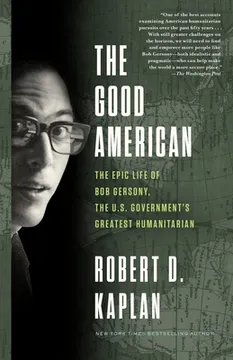


Key Takeaways
Put individual lives back into the evidence behind foreign policy
Policy reaches real people. In Mozambique, a displaced farmer described how she lost her seven-year-old daughter while fleeing soldiers across the Zambezi River. Gersony recorded her as the woman with the black kerchief, preserving a person, not just a casualty figure. That interview was one of 196 he conducted for his Mozambique investigation.
A life built around listening. Over 54 assignments, Gersony interviewed about 8,200 refugees, displaced people, and aid workers. He was neither a journalist nor a relief worker, but a U.S. government contractor whose reports helped policymakers see how decisions made in capitals landed on ordinary people. Kaplan’s central argument is that foreign policy becomes dangerously abstract when it loses contact with those consequences.
What's striking is how the individual story works at two levels. It restores dignity to someone whom statistics can erase, and it gives decision-makers evidence about what policy has actually done. This resembles a basic principle in medical ethics: a population-level intervention still has to answer for its effects on particular patients. Yet a moving account is not, by itself, proof of a general pattern. Gersony’s lasting value lies in joining humane attention to systematic checking, so that empathy informs judgment without substituting for evidence.
Treat listening as disciplined field research, not a warm gesture
Method made testimony usable. Gersony interviewed people privately, usually through a translator, and began with ordinary biographical questions before letting them tell what happened in their own order. He avoided leading questions, recorded distinguishing details rather than names, and used no tape recorder. He compared accounts across villages and camps, looking for recurring events and contradictions.
Repetition tested the pattern. For his Mozambique report, he interviewed 196 people across 42 locations in five countries. He described how he handled limits in testimony, including assigning a deliberately low maximum to vague counts of many victims. The method was painstaking, but it made a claim harder to dismiss as a single dramatic anecdote. In North Korea, where access and security constrained his sample, he distinguished corroborated findings from information based on only one or two sources.
The method joins ethnographic listening with the logic of measurement: a story becomes more informative when its source, context, and recurrence are made visible. Its transparency about weak as well as strong evidence is especially important, since rigor is not the same as pretending to certainty. Still, a large sample does not automatically represent a whole population. Access, fear, translation, and the selection of interviewees can shape what is heard. The practical lesson is to document those constraints as carefully as the testimony.
Let local markets shape relief before aid wrecks livelihoods
Generosity can distort prices. After Guatemala’s 1976 earthquake, foreign agencies sent free maize even though the country had just had a strong harvest. The donations pushed down the price of a crop local farmers depended on for income. Gersony took a different approach to rebuilding: he arranged for affordable corrugated roofing sheets, which survivors preferred to heavy clay tiles that had crushed houses during the quake.
Dignity was built into the transaction. People paid for the roofing with money earned through road-repair jobs. Selling supplies also meant recipients selected themselves, reducing the power of local officials to distribute aid through patronage. The program became self-sustaining. Gersony did not claim this was a perfect solution, and the poorest still needed help to afford materials. His point was to design assistance around how local economies actually worked.
This is a vivid example of a second-order effect: aid changes not only what recipients possess, but also prices, incentives, and local power. Development economics calls attention to these market interactions because a well-meant donation can damage producers who were not its intended target. The alternative is not a universal rule against free aid. In a famine or a destroyed market, direct distribution may be essential. The better question is whether relief fills a gap or accidentally competes with the people it is meant to help.
Pay people to rebuild before idleness feeds conflict
Work addressed more than income. In El Salvador’s civil war, displaced families crowded into camps with inadequate sanitation and few jobs. Gersony argued that people accustomed to working were vulnerable to recruitment by both guerrillas and death squads when they had nothing to do. He proposed paying displaced household heads to build latrines, drainage channels, and cobblestone streets at wages close to local rates.
The program created visible public goods. USAID funded the effort with about $100 million over five years, employing roughly 20,000 Salvadorans. People were paid through local credit unions and spent their earnings at nearby businesses. In Nicaragua, a related project hired thousands to repair roads and bridges by hand. These efforts treated employment as both an economic lifeline and a way to restore useful infrastructure.
The approach connects labor economics to conflict prevention: wages matter, but so do routine, status, and a credible role in community life. Public works can also make assistance legible, since residents see roads or drainage improve rather than a distant budget disappear. The caution is that jobs programs are not automatically fair or stabilizing. Poorly chosen wages can displace local employers, while patronage can capture hiring. Gersony’s insistence on market-rate checks and local delivery mechanisms is what makes the proposal more than a slogan.
Investigate allies with the same rigor as enemies
Political labels can conceal conduct. In Mozambique, Washington was debating whether to support RENAMO, an anti-communist insurgency backed by apartheid South Africa. Gersony was sent to assess refugee needs, not to build a case against the rebels. But across camps in five countries, he repeatedly heard that RENAMO had attacked villages, killed civilians, and forced people to carry supplies.
The evidence changed policy. His report drew on 196 interviews and conservatively estimated that RENAMO was responsible for at least 100,000 deaths. It helped persuade President Reagan not to provide the group with military support, and contributed to diplomatic space for peace talks. The report did not establish that FRELIMO forces were innocent. Its narrower finding was that the insurgency Washington was considering arming had committed extensive violence against civilians.
This is a classic principal-agent problem: a sponsor may assume that a proxy shares its goals, then overlook what the proxy does to local people. Independent evidence helps correct that blind spot. The report’s influence also shows why investigators must state what they can establish and what lies outside their inquiry. The account comes chiefly from refugees, and the conflict was complex, but the policy question was concrete: should the United States arm this group? On the evidence presented, withholding support was a defensible safeguard.
Keep moral judgment precise when yesterday's victims commit crimes
A simple story can hide fresh victims. After the 1994 genocide in Rwanda, Gersony’s team investigated whether the new Tutsi-led government’s forces were killing Hutus. Through more than 300 interviews across 91 locations, the team gathered accounts of systematic killings in parts of the country. Gersony estimated at least 30,000 Hutu civilians had been murdered. He distinguished these killings from the genocide, in which Hutu extremists had killed hundreds of thousands of Tutsis.
Truth was politically costly. Some U.N. and U.S. officials used the findings privately to press the Rwandan government, while the report itself remained confidential. The evidence was based on interviews and carried limits, including the difficulty of independently verifying every account. Still, treating the earlier genocide as a reason to ignore later victims would have erased a separate crime and weakened the credibility of human-rights claims.
What's valuable here is the refusal to make moral recognition a zero-sum contest. Naming one atrocity does not diminish another, and distinctions in scale, intent, and context are necessary rather than evasive. At the same time, allegations against a new government require careful scrutiny, particularly when testimony is gathered amid displacement and propaganda. Gersony’s reported method offers safeguards, but no interview process can remove every uncertainty. The strongest conclusion is disciplined: acknowledge the documented pattern, mark the limits of the evidence, and resist political pressure to simplify either side.
Find where the harmful mechanism works, not where policy looks visible
Patrols missed the source of piracy. Vietnamese refugees fled by boat through a vast stretch of the South China Sea, where Thai pirates robbed, assaulted, and sometimes killed them. The proposed response was more naval patrols. After interviewing survivors in camps, Gersony learned that the useful intelligence was on shore: dockside bars, fishing fleets, and crew members who knew which captains attacked refugee boats.
A targeted intervention changed behavior. DEA officer Tex Lierly worked with Thai Marine Police to pay informants, identify repeat offenders, and support prosecutions. The effort also credited Thai fishermen for rescues rather than portraying all of them as pirates. Boats reporting attacks fell to 24 percent of the 1985 level by 1986, then to 7 percent in 1987. The intervention focused on the network where the crime was organized, not the open sea where it was hardest to detect.
The strategy resembles network analysis: disrupt the relationships and incentives that sustain a crime instead of spreading resources thinly across a huge area. It also used local knowledge without relying solely on state officials. The decline in reported attacks is compelling, though reporting rates can be affected by access, trust, and changing definitions of an incident. Even with that caveat, the case shows how a small intervention can outperform a conspicuous but poorly matched tool when investigators first identify the operational bottleneck.
Sequence ambitious ideals around what people can safely do now
The Dayton promise met postwar fear. Bosnia’s 1995 peace agreement called for refugees and displaced people to return to their homes, including across ethnic lines. In interviews with about 250 Bosnians and many aid workers, Gersony found that people feared violence, discrimination, and losing scarce jobs. A pilot plan aimed to bring 600 minority families back to four towns; only 60 returned.
Housing offered a workable first step. Gersony recommended repairing homes for people returning to majority areas first, then attempting cross-ethnic return when conditions improved. USAID ultimately helped build or repair 2,548 homes in 48 villages, creating about 4,000 jobs. The approach helped stabilize daily life, but carried a real risk: rebuilding areas along ethnic lines could entrench separation. The book presents the tension, not a clean resolution.
This is a problem of sequencing, familiar in peacebuilding and institutional reform: a desirable end state can be undermined when people are asked to take risks before basic security exists. Housing, heat, and work are not substitutes for minority rights, but they can create conditions in which those rights become more than paper promises. The counterargument matters: aid focused on majority returns may consolidate the very divisions a peace agreement seeks to undo. The practical test is whether a temporary sequence includes credible protections and a path toward inclusion.
Check whether assistance reaches its named beneficiaries
Delivery systems can be staged. In 2002, Gersony interviewed 86 North Korean refugees and traders at 13 locations along the Chinese border to assess famine and food aid. He heard that U.N. inspections were announced in advance, relied on regime translators, and could be prepared for by officials who temporarily supplied food to schools and kindergartens. Interviewees also described aid being redirected to military and security institutions.
His estimate was consequential. Gersony estimated that as much as 80 percent of U.N. food aid went to the military and other security services. He carefully separated this conclusion from claims supported by only one or two sources. Washington reduced its contribution, although diplomacy later led to partial resumption. The episode shows why a shipment record cannot establish who ate the food, and why access and independent monitoring matter as much as volume.
This is an accountability question, not merely a question of generosity: the relevant outcome is whether aid reaches the people it is meant to help. In monitoring theory, verification must be independent enough that the party being evaluated cannot script the inspection. Yet suspending assistance can also harm vulnerable people when diversion is substantial but incomplete. The difficult policy choice is therefore not simply trust or cut off aid. It is to demand monitoring strong enough to distinguish humanitarian delivery from support for the regime.
Protect field expertise from bureaucracies that reward compliance
Field knowledge needs institutional backing. Gersony’s work depended on mentors inside State and USAID who gave him access to senior officials and room to challenge prevailing assumptions. In Iraq, he found that reconstruction faltered when agencies failed to coordinate and when military planners favored distant facilities over immediate problems such as raw sewage in Sadr City. In Micronesia, his recommendations on emergency supplies, water, and storm preparation were eventually implemented.
Expertise is not a lone-hero substitute. By the end of his career, many of his senior sponsors had left, assignments had become less consequential, and agencies increasingly relied on outside consultants. Gersony estimated that he had interviewed about 8,200 people across 54 assignments. His record suggests that governments need durable field capacity, local language knowledge, and channels that let inconvenient findings reach decision-makers.
The book’s institutional argument is sharper than a portrait of an exceptional individual. Gersony’s work mattered because a small circle of officials could convert observations into decisions. Without that route, even accurate reporting becomes archival residue. Outsourcing is not inherently inferior, and a single freelancer cannot provide continuity across every crisis. The design challenge is to preserve the useful parts of his practice inside institutions: local expertise, methodological independence, time in the field, and incentives to report failure rather than flatter patrons.
Analysis
The biography is organized around a question of knowledge: what can officials know about a distant crisis, and whose testimony counts? Kaplan’s answer is a life story rather than a formal theory. Gersony begins as a poor student who learns through concrete work, first in the commodity trade, then in Guatemala, where an earthquake teaches him that relief can damage the economy it intends to rescue. The same practical sensibility guides his later investigations. He listens, records, compares, and returns with evidence that disrupts the tidy categories of policymakers.
The strongest episodes show that method and temperament reinforce one another. Gersony’s anxiety makes him cautious about claims; his accounting habits push him toward detail; his outsider status frees him to challenge a bureau’s assumptions. His reports on Uganda and Mozambique demonstrate the value of testing a government’s allies as well as its enemies. Rwanda reveals the cost of doing so when human suffering collides with diplomatic necessity. The book does not present the fieldworker as omniscient. Its most credible moments show him distinguishing corroborated patterns from uncertain reports and admitting that a practical recommendation may carry moral costs.
There is also a limitation in the narrative. Kaplan relies heavily on retrospective interviews with Gersony and colleagues who admired him. The accounts of policy influence are sometimes difficult to separate from later claims about what one report changed. Interviewing refugees can reveal what official records omit, but sampling, translation, fear, and memory complicate inference. The biography is most persuasive when it treats method as a discipline for reducing error, not a guarantee of truth.
Its broader institutional lesson is urgent. Humanitarian action needs both moral purpose and strategic awareness, but neither can function without local information. The alternative to abstract planning is not romantic faith in ordinary people. It is a repeatable practice of listening, checking, and making policy answerable to consequences. Gersony’s achievement was not that he solved distant conflicts. It was that he made it harder for powerful people to pretend they understood them without going to the ground.
Review Summary
Reviews of The Good American are overwhelmingly positive, averaging 4.34 out of 5. Readers praise Kaplan's vivid portrayal of Bob Gersony, a largely unknown humanitarian who spent four decades working in global crisis zones. Many highlight the book's compelling blend of biography and geopolitical history, with Gersony's unique interview methodology and quiet integrity drawing particular admiration. Some readers note the dense detail and numerous acronyms can feel overwhelming, while others found this complexity intentional and rewarding. Several reviewers describe it as one of their favorite nonfiction reads.
Glossary
Gersony report
Field-based evidence briefingA detailed investigation based on Gersony’s interviews with refugees, displaced people, and local aid workers. Reports combined individual testimony with comparisons across locations, timelines, and other evidence, then presented findings to government or U.N. officials. The phrase became especially associated with his investigations of violence in Mozambique and Rwanda.
human intelligence
Information from peopleInformation gathered through direct contact with people, rather than from technical collection such as satellite images or intercepted communications. In Gersony’s work, it meant carefully interviewing refugees, residents, aid workers, and local officials to learn what had happened and how policies worked in practice. The book contrasts this ground-level knowledge with distant reporting.
self-selection
Recipients choose to participateA way of distributing assistance in which people select themselves by choosing whether to buy a needed item or take a paid job, instead of receiving goods through an official handout list. Gersony favored it in some recovery programs because it could reduce patronage and preserve recipients’ agency. It could not, by itself, ensure that the poorest could afford help.
conditionality
Aid tied to policy conditionsA policy of making reconstruction assistance contingent on governments taking specified steps. In Bosnia after the Dayton Accords, funding was linked to safe refugee return across ethnic lines. Gersony argued that immediate enforcement could intensify resistance and danger, and proposed beginning with practical reconstruction before attempting broader returns.
Disaster assistance response team
Emergency aid deployment teamA USAID team deployed to assess and coordinate disaster or humanitarian assistance. In the book, these teams operated in settings including Central America, Bosnia, and Iraq. Their effectiveness depended not only on technical response capacity but also on coordination with other agencies, local knowledge, and the ability to turn assessment into timely projects.
About the Author
Other books by Robert D. Kaplan






Download PDF
Download EPUB
.epub digital book format is ideal for reading ebooks on phones, tablets, and e-readers.








