

Key Takeaways
Read the South China Sea as Asia's strategic hinge, not a distant border dispute.
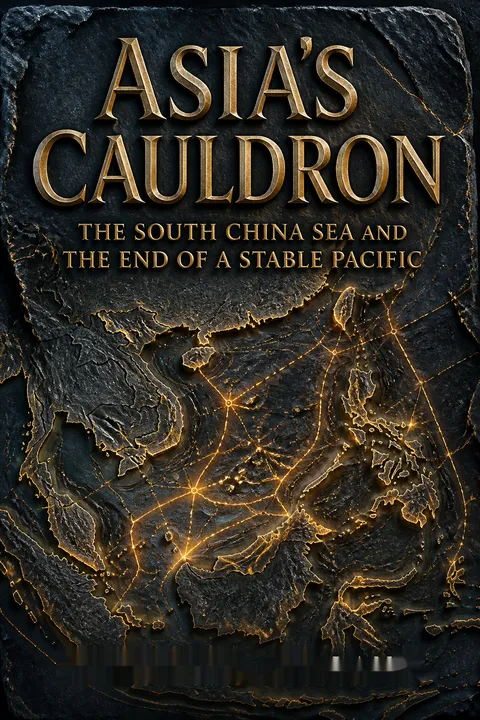
The map changes the story. Kaplan frames East Asia as a maritime world, where islands, coastlines, and narrow passages shape the movement of trade and military power. The South China Sea links the Indian and Pacific oceans through the Malacca, Sunda, Lombok, and Makassar straits. In the book's account, more than half of annual merchant fleet tonnage passes through these connected routes, while energy imports from China, Japan, South Korea, and Taiwan depend heavily on them. Small reefs matter because control of a feature can support claims to nearby waters and resources.
History keeps the map humble. Kaplan opens at the ruins of Champa, a maritime civilization with Indian and Khmer connections that once flourished along Vietnam's coast. Its disappearance reminds readers that today's dominant powers and borders are not permanent. The region is better understood as Indo-Pacific than as a self-contained East Asia.
What's striking is how geography makes distant events legible: a reef dispute can affect energy security thousands of miles away. This resembles network analysis, where the importance of a node comes less from its size than from the connections it enables. Yet maps can also make political outcomes look inevitable. Kaplan's Champa opening usefully resists that determinism, and his own account notes uncertainty about the sea's oil and gas potential. Strategic centrality raises the stakes, but it does not dictate who will prevail.
Water restrains invasion, but crowded navies still create dangerous miscalculation.
Distance is a brake. Kaplan draws on the idea he calls the stopping power of water: crossing a sea is one challenge, but landing an army and controlling a large hostile population is much harder. The Taiwan Strait is about one hundred miles wide, yet that distance complicates invasion and occupation. Unlike armies, ships and aircraft do not occupy territory in the same way, and naval forces move slowly enough to leave some room for decisions to be reconsidered.
Competition still escalates. The region's postcolonial land wars have largely given way to naval and air modernization. Submarines, missiles, and surveillance systems can deter an opponent without an invasion, but close encounters among ships create chances for error. Kaplan's point is not that maritime geography prevents conflict. It makes conquest harder, while shifting rivalry toward coercion, military signaling, and disputes that may be less visible to the public.
The distinction between defeating a force and governing a population is central to strategic thinking. It also helps explain why military deterrence can work without making war impossible. At sea, however, a state may misread routine patrols as preparation for attack, while the other side sees its own actions as defensive. This is a classic security dilemma: steps taken to feel safer can make neighbors feel less safe. Water can lower the likelihood of occupation, but it cannot remove fear, nationalism, or the risk of an accident.
China's maritime push follows geography and historical insecurity, not a cartoon villain's script.
Proximity creates strategic pressure. China's long southern coastline faces a sea through which much of its imported energy travels. Kaplan argues that a stronger Chinese presence there would help protect shipping and extend Chinese naval reach toward the Indian Ocean. He compares this ambition to the United States' past effort to dominate the Caribbean, a nearby sea that helped secure American influence across its hemisphere.
Memory matters, too. China's leaders inherit a history of foreign encroachment, lost territory, and divided authority. Kaplan presents that history as one reason Beijing resists outside influence near its coast. But the nine-dashed line, China's sweeping claim over much of the sea, conflicts with the claims of Vietnam, the Philippines, Malaysia, Brunei, and Taiwan. Understanding China's motives does not make those claims legally or politically uncontested. The central tension is between a great power's desire for strategic depth and its neighbors' fear of subordination.
The Caribbean comparison is powerful because it asks readers to apply the same standard to China that they apply to earlier American expansion. It exposes how strategic ambition can feel defensive from inside a rising power and threatening from outside it. The analogy has limits: the South China Sea is more central to global shipping, and its surrounding states are not simply weak dependencies. Historical grievance can explain a policy without validating it. That distinction makes it possible to take China's security concerns seriously without treating its neighbors' sovereignty as expendable.
Help Vietnam balance China without mistaking partnership for obedience.
Vietnam remembers the northern neighbor. Its identity developed through long periods of Chinese influence and resistance, alongside cultural ties to the Indianized Champa and Khmer worlds. Kaplan describes a country that defeated French and American forces, fought China in 1979, and still views Chinese pressure as an immediate concern. In 1995, Hanoi normalized relations with Washington and joined ASEAN, seeking wider diplomatic and economic ties.
Alignment stays cautious. Vietnam bought six Russian Kilo-class submarines and refurbished Cam Ranh Bay, a deep-water port it said could host foreign navies. These moves signaled a desire for stronger defense ties with the United States, but Hanoi did not want to depend on a distant power or rupture its substantial economic links with China. Vietnam's strategy is to preserve room to maneuver, using American presence as a counterweight while avoiding a formal alliance that could invite retaliation or leave it exposed if Washington's priorities change.
Vietnam illustrates a broader principle of small-state strategy: partnerships are most useful when they increase options rather than replace one dependency with another. Its history also complicates simple ideological categories. A communist government can cooperate with the United States when national interests align, while remaining wary of American pressure on domestic politics. The limitation is material: submarines and port access signal intent, but do not by themselves create reliable deterrence. Balancing depends on economic resilience, diplomatic skill, and the credibility of partners, not just procurement.
A weak state invites coercion even when its legal case is strong.
The Philippines faced a capacity gap. Kaplan describes an archipelago of more than seven thousand islands, with internal insurgencies and a military oriented mainly toward land security. After the United States closed its Subic Bay and Clark bases in 1992, Manila had little maritime capacity to defend its claims. In the 2012 Scarborough Shoal standoff, Chinese maritime enforcement vessels faced the pride of the Philippine navy, a former U.S. Coast Guard cutter built in the 1960s.
An alliance can buy time. The Philippines sought renewed American port visits, training, and military assistance. Kaplan calls the goal minimum-credible defense: enough capability to make coercion costly, not enough to match China ship for ship. But the country's weak institutions, corruption, and unresolved domestic conflicts limited what outside support could accomplish. Legal arguments and public appeals matter, yet they have less force when a state cannot monitor or protect the waters it claims.
This case separates legitimacy from capacity. International law can give a weaker country a compelling argument, but enforcement depends on political coalitions and practical capabilities. That gap appears in many areas of public life: rules are meaningful only when institutions can observe violations and respond. Still, capacity-building is not automatically stabilizing. If assistance encourages a government to take risks it cannot manage, it may deepen dependence or provoke a crisis. The strongest support pairs credible defense with restraint, governance reform, and channels for negotiation.
Treat Malaysia's shopping-mall harmony as a snapshot, not proof that identities have vanished.
A shared economy does not erase difference. In Kuala Lumpur, Malay Muslims, ethnic Chinese, and Indians shop in the same glittering malls. Kaplan initially sees a common consumer culture that seems to challenge the idea that civilizations are sealed off from one another. But urbanization also brings communities into closer contact, and can sharpen tensions when economic gains are uneven or religious identity becomes more politically important.
Malaysia remains a negotiated arrangement. Its population includes Muslim Malays and indigenous groups, Chinese Malaysians, and Indians, alongside migrants. The country's history as a collection of territories and communities has made national identity less cohesive than in Vietnam. Kaplan describes a relatively peaceful society that has reduced poverty and avoided major ethnic violence, but also retains communal divisions and unequal political arrangements. The mall reveals common desires; it cannot tell whether people feel equal, secure, or represented.
The mall is a vivid setting for separating everyday similarity from political solidarity. People can share tastes, products, and routines without sharing a sense of collective ownership or equal status. Social science often distinguishes contact from integration: proximity may reduce prejudice under some conditions, but competition and unequal treatment can intensify it. Kaplan's scene works best as a question, not a verdict. Consumer culture makes cultural boundaries more porous, yet institutions determine whether that contact becomes cooperation or resentment.
Singapore's small size makes capable institutions and credible defense existential necessities.
Security begins at home. Singapore sits beside the Strait of Malacca, a vital maritime passage, but has little territory and no substantial hinterland. Kaplan recounts how its leaders built a strong military, maintained conscription, and trained forces abroad because the island lacked space for large exercises. Singapore also built Changi Naval Base to accommodate American ships and cultivated close security ties with Washington.
Hard power supports economic freedom. Singapore's leaders argued that open shipping lanes and a balance among larger powers were essential to the city-state's survival. At the same time, the government developed infrastructure, attracted foreign businesses, and imposed strict standards on public administration. Its approach shows why small states may value military capability and outside partnerships even when they benefit most from trade. The strategy is not simply to become strong enough to deter every threat, but to make coercion costly and preserve freedom to trade.
Singapore's case connects state capacity with bargaining power. A small country cannot rely on size, so it invests in administrative competence, defense, and relationships that increase the cost of pressure. This resembles the logic of resilience in engineering: multiple supports keep a system functioning when one component fails. The model is not easily copied. Singapore's compact geography, resources, and unusually centralized governance differ from those of larger, more diverse states. Its success demonstrates what concentrated capacity can accomplish, not that every society should accept the same political trade-offs.
Judge autocrats by the institutions and exit paths they leave behind.
Development can precede democracy, but does not guarantee it. Kaplan contrasts Singapore's Lee Kuan Yew and Malaysia's Mahathir Mohamad with the Philippines' Ferdinand Marcos. Lee and Mahathir ruled in restrictive ways, yet also oversaw economic growth and state-building. Marcos, by contrast, left a legacy of corruption and weakened institutions. The comparison challenges the idea that all authoritarian governments produce the same results.
The test is succession and accountability. Kaplan draws on political thinkers who saw order as a precondition for broader participation, while warning that benevolent rulers can still suppress rights and make grave mistakes. A government that raises living standards may make society more complex and better prepared for representation. But the public cannot safely assume that a ruler will remain wise, or that prosperity will continue. The more durable achievement is a system capable of functioning when its powerful leader leaves office.
The strongest version of this argument treats development and political liberty as related but distinct goods. Economic security can expand people's ability to participate in public life, yet economic performance is not a substitute for voice, legal protections, or peaceful transfer of power. The Marcos contrast shows why personal competence is an unreliable foundation: once power is concentrated, failure can spread through the whole state. A useful measure of an autocrat's success is whether institutions become less dependent on the autocrat, not how impressive the leader appears.
Taiwan's strait and democratic identity make it more than a prize on China's map.
Geography raises the cost of invasion. Taiwan lies between the South China Sea and the Northeast Asian waters that carry regional trade. Its strait makes an amphibious assault difficult, and occupying the island would be harder still. Kaplan describes how the island's defenders focused on air defense, sea control, and making a landing infeasible, even as China's military advantage grew.
Political meaning raises the stakes. Taiwan is a functioning democracy whose identity developed through a distinct history, including Japanese rule, postwar authoritarian government, and eventual democratization. Its government also preserved important Chinese cultural collections after retreating from the mainland. Kaplan calls Taiwan a bellwether: if Beijing could force it into submission, other governments might question the reliability of American protection. Economic integration with China creates leverage in both directions, making the status quo valuable but vulnerable.
Taiwan shows how material geography and political symbolism reinforce each other. A water barrier raises the military cost of conquest; a democratic public and distinct political story raise the political cost. Neither guarantees security, especially when economic dependence can create influence without invasion. This distinction matters because coercion need not take the form of an assault. A state can retain formal institutions while losing room to make independent choices. Deterrence therefore concerns not only territory, but also the ability to decide freely.
Build regional rules and local capacity before maritime rivalry hardens into permanent facts.
The disputes are manageable, not simple. The South China Sea contains overlapping claims to reefs, fisheries, and possible energy resources. Kaplan argues that the Law of the Sea offers a framework based largely on coastlines and exclusive economic zones, but historical claims and nationalist politics complicate its use. ASEAN and a web of regional defense ties could help countries coordinate, though their members do not act as one unified power.
Borneo reveals another kind of fragility. The book ends with a water village in Sabah, home to impoverished migrants from the southern Philippines, and with anxieties about illegal migration, weak governance, and an uncertain federation. While governments focus on warships and maritime boundaries, coast guards confront smuggling, piracy, and human movement. The region's future is not only a contest among strong states. Internal disorder and poorly governed borderlands can reshape security just as surely as naval expansion.
This ending widens the lens from interstate rivalry to the everyday work of governing. Rules at sea require cooperation, but they also depend on functioning ports, coast guards, and public institutions on shore. The Borneo scene is a reminder that security is not only a military balance; it is also the capacity to manage migration, livelihoods, and political inclusion. ASEAN can help coordinate states, but regional declarations cannot repair local weakness by themselves. Durable order needs both diplomacy among capitals and credible administration at the margins.
Analysis
Kaplan's central achievement is to make the South China Sea intelligible as a connected system rather than a collection of obscure reefs. Shipping routes, energy dependence, national memories, military modernization, and state capacity all converge there. The book's travel narrative gives that argument texture: Champa's ruins unsettle assumptions about permanence, Singapore's precision embodies state capacity, and Sabah's water village exposes insecurity beyond the map of sovereign claims. The most useful conceptual move is the distinction between maritime competition and territorial conquest. Water makes occupation difficult, but it does not make coercion harmless. A rival can alter choices through patrols, economic leverage, military signaling, and pressure on alliances without launching an invasion. This helps explain why a naval balance can matter to small states even when war remains unlikely.
The account also resists moral simplification. China has understandable strategic interests and a history of humiliation, while its neighbors have legitimate reasons to fear domination. Likewise, authoritarian leaders can deliver public goods, but development does not erase the costs of censorship or the danger of succession. Kaplan's comparisons encourage judgment by consequences rather than labels.
The book's limits follow from its strengths. Its focus on geography and military power can make states seem more unitary and strategic than they are. Nationalist claims are also shaped by domestic politics, resource uncertainty, institutional capacity, and public opinion. The Caribbean analogy clarifies how a nearby great power may seek regional primacy, yet the South China Sea's more populous and capable neighbors complicate the parallel. The durable lesson is not that conflict is inevitable, but that stability must be actively negotiated, with enough regional capacity to prevent advantage from becoming coercion.
Review Summary
Asia's Cauldron offers an insightful analysis of the geopolitical tensions in the South China Sea. Kaplan examines the region's history, economics, and military dynamics, focusing on China's naval expansion and its impact on neighboring countries. While some readers praise Kaplan's blend of travelogue and political commentary, others criticize his perceived bias and factual inaccuracies. The book is generally considered a valuable primer on the complex issues surrounding the South China Sea, though opinions vary on Kaplan's conclusions and writing style.
People Also Read










Glossary
stopping power of water
A barrier to invasionThe idea that oceans and straits make it difficult to transport an army, land it on hostile shores, and then control the population inland. Water can reduce the feasibility of conquest and occupation, even when a state has a powerful navy. It does not prevent naval rivalry, coercion, or conflict.
Finlandization
Independence under outside pressureA condition in which a country retains formal sovereignty but limits its foreign policy to avoid provoking a stronger neighbor. In Kaplan's discussion, smaller Asian states could face pressure to accommodate Beijing's preferences even without being invaded or formally absorbed.
sea denial
Preventing an adversary's accessA military approach intended to make it dangerous or costly for an opponent to operate in a particular sea, rather than giving one's own navy uncontested control of that area. Submarines, mines, missiles, and aircraft can support sea denial by threatening enemy ships and restricting their movements.
sea control
Securing use of the seaThe ability to use a maritime area for one's own military and commercial purposes while limiting an opponent's ability to do the same. Kaplan contrasts this broader ambition with sea denial, which focuses on obstructing an adversary. A blue-water navy seeks the capacity to operate beyond coastal waters.
nine-dashed line
China's sweeping sea claimA U-shaped line shown on Chinese maps that encloses much of the South China Sea. It is associated with historical claims to islands and waters, but its precise legal meaning is disputed. The line overlaps claims by Vietnam, the Philippines, Malaysia, Brunei, and Taiwan, making it a central source of regional tension.
minimum-credible-defense
Enough force to deter coercionKaplan's description of the modest defense capability the Philippines needed to make violations of its claims less attractive. The goal was not to match China's armed forces, but to improve surveillance and defense enough to raise the costs of pressure and strengthen the credibility of the country's position.
FAQ
What's Asia's Cauldron about?
- Geopolitical Focus: Asia's Cauldron by Robert D. Kaplan examines the strategic importance of the South China Sea and its impact on global power dynamics, especially between the U.S. and China.
- Historical Context: The book explores historical interactions in the region, including the influence of India and China on Southeast Asia, with a focus on Vietnam and the legacy of Champa.
- Future Predictions: Kaplan discusses potential conflict and cooperation in the Indo-Pacific, emphasizing maritime routes and resources in shaping future geopolitical landscapes.
Why should I read Asia's Cauldron?
- Insightful Analysis: The book offers a deep analysis of shifting power dynamics in Asia, essential for understanding contemporary international relations.
- Cultural Perspectives: Kaplan provides rich historical and cultural insights, particularly regarding Vietnam's identity shaped by interactions with China and India.
- Strategic Importance: Readers gain an understanding of the South China Sea's critical role in global trade and military strategy, increasingly relevant today.
What are the key takeaways of Asia's Cauldron?
- Maritime Geopolitics: The South China Sea is crucial for global trade and energy supplies, described as "the throat of the Western Pacific and Indian oceans."
- Rising Tensions: The region is becoming an "armed camp," with escalating military presence and territorial disputes among regional powers.
- Multipolar Future: The future may be multipolar, with countries like Vietnam and Malaysia playing significant roles in balancing against China and the U.S.
What are the best quotes from Asia's Cauldron and what do they mean?
- "A just fear of an imminent danger... is a lawful cause of war.": Highlights the legitimacy of preemptive action in international relations, especially in the South China Sea context.
- "Champa represents a seafaring, piratical race.": Reflects the historical significance of Champa in maritime trade and its cultural legacy in Vietnam.
- "The shadow of China presently looms large.": Underscores China's dominant role in the region and the strategic calculations other nations must make.
What is the significance of the South China Sea in Asia's Cauldron?
- Strategic Waterway: It's crucial for global shipping, with over half of the world's merchant fleet tonnage passing through its waters.
- Resource Richness: The region contains significant oil and natural gas reserves, making it a focal point for territorial disputes.
- Military Rivalry: The South China Sea is a frontline for military competition between the U.S. and China, affecting regional security.
How does Kaplan describe Vietnam's historical relationship with China?
- Cultural Ties: Vietnam has a complex history with China, marked by cultural emulation and resistance, shaping its national identity.
- Historical Conflicts: Multiple invasions by China have led to deep-seated Vietnamese nationalism and a desire for independence.
- Modern Dynamics: Vietnam's geopolitical stance is influenced by its history, seeking a balancing relationship with the U.S. against China.
What role does India play in the context of Asia's Cauldron?
- Cultural Influence: India's historical maritime connections with Southeast Asia have left a lasting impact through trade and cultural exchange.
- Strategic Partner: India could play a crucial role in counterbalancing China's influence in the South China Sea and the broader Indo-Pacific.
- Shared Interests: India and Vietnam share interests in maintaining freedom of navigation and regional stability, potentially leading to closer cooperation.
How does Asia's Cauldron address the concept of multipolarity?
- Emerging Powers: The future of the Indo-Pacific may involve multiple powers, including Vietnam, Malaysia, and India, asserting their interests.
- Balance of Power: A balance of power is crucial to prevent any single nation, particularly China, from dominating the region.
- Diplomatic Maneuvering: Countries may engage in strategic partnerships and alliances to navigate the complexities of multipolarity.
What are the implications of the U.S.-China rivalry as discussed in Asia's Cauldron?
- Military Presence: The U.S. military presence is crucial for maintaining stability and deterring Chinese aggression in the South China Sea.
- Economic Competition: The rivalry extends to economic competition, with both nations vying for influence over trade routes and resources.
- Regional Alliances: Smaller nations may align with the U.S. to counterbalance China's growing power, leading to a complex geopolitical landscape.
What are the main territorial disputes discussed in Asia's Cauldron?
- Spratly Islands: Claimed by China, Vietnam, and the Philippines, leading to tensions and military confrontations over resources and positioning.
- Paracel Islands: Controlled by China but claimed by Vietnam, resulting in a long-standing conflict with historical implications.
- Scarborough Shoal: A flashpoint between the Philippines and China, significant for fishing rights and national sovereignty.
How does Kaplan view the future of the South China Sea?
- Potential for Conflict: The South China Sea is likely to remain a flashpoint due to competing territorial claims and military buildups.
- Opportunities for Cooperation: Despite tensions, there is potential for cooperation on resource sharing and environmental protection.
- Historical Lessons: Learning from past conflicts is crucial to navigating future challenges in the region.
How does Asia's Cauldron relate to broader themes of globalization and nationalism?
- Globalization's Impact: Globalization has interconnected economies and cultures, complicating territorial disputes and national identities.
- Resurgence of Nationalism: Nationalism resurges as a response to globalization, with countries asserting sovereignty over contested territories.
- Navigating Complexity: Understanding the interplay between globalization and nationalism is crucial for addressing challenges in the South China Sea.
About the Author
Other books by Robert D. Kaplan








Download PDF
Download EPUB
.epub digital book format is ideal for reading ebooks on phones, tablets, and e-readers.








