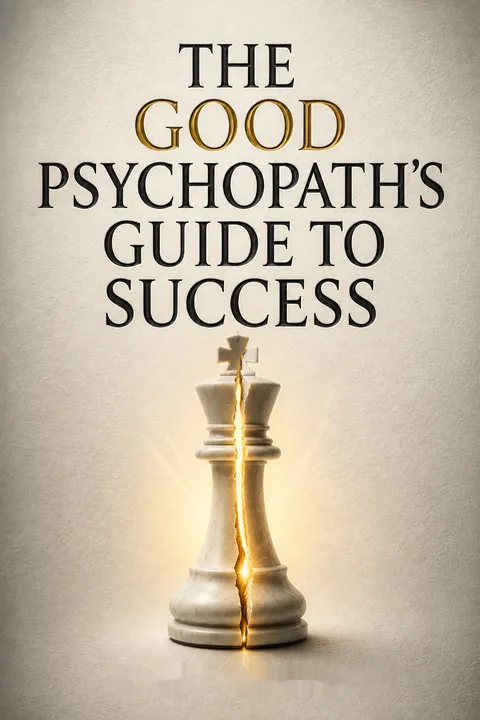


Key Takeaways
Borrow a psychopath's composure, never a psychopath's license to harm.
A surprising test. Psychologist Kevin Dutton invited former SAS soldier Andy McNab to view disturbing images while researchers monitored his brain activity, heart rate, and skin response. McNab’s readings did not rise as expected, prompting Dutton to describe him as psychopathic. The book uses this encounter to challenge the idea that psychopathy means violence: some associated traits, such as fearlessness, focus, and decisiveness, can also support demanding work.
A practical distinction. The authors use “good psychopath” for someone who can draw on such traits without causing unnecessary harm and who adjusts behavior to the situation. Psychopathic characteristics lie on a spectrum, they argue, rather than dividing everyone neatly into two categories. One laboratory response, however, cannot establish a clinical diagnosis or explain a whole person.
The opening reframes a sensational label as a question about capacities and choices. That makes the idea more useful than a simple celebration of emotional coolness: a surgeon’s ability to stay steady can serve patients, while callousness can injure them. It also invites caution. A response to disturbing images is not a complete measure of character, and the same behavior can look different across settings. The more reliable lesson is not to imitate a diagnosis, but to ask which traits a situation requires and what safeguards keep them from becoming harmful.
Turn personality traits up or down to fit the stakes.
Traits need settings. The authors picture personality as a mixing desk, with separate controls for qualities such as empathy, fearlessness, ruthlessness, and confidence. The useful setting changes with the task. A surgeon may need emotional distance to stay precise; a leader may need enough empathy to understand the people affected by a decision. No single trait is automatically a virtue or a flaw in every setting.
The shepherd's dilemma. During the Bravo Two Zero patrol in Iraq, McNab’s team encountered a shepherd boy whose release might reveal their position. They let him go and were later caught. The authors present this as a hard judgment under uncertainty, not a simple rule to choose mission over morality. McNab’s account stresses considering the whole situation and the consequences of each option, rather than reacting impulsively.
This model resembles context-sensitive judgment: the same capacity can help or harm depending on its intensity, purpose, and constraints. It is valuable because it replaces personality perfectionism with calibration. Yet a mixing-desk metaphor can make moral decisions sound more controllable than they are. People often lack reliable information, and “the mission” can be defined by institutions with their own blind spots. A sound application therefore needs more than flexibility: it needs accountability, clear limits on harm, and room to question who benefits from the chosen objective.
Start the hard task before your feelings grant permission.
Delay has a price. The book describes procrastination as postponing planned work in favor of less important activities. It identifies three common patterns: indecision that avoids responsibility, avoidance driven by fear of failure or judgment, and perfectionism that makes starting feel unsafe. The authors note that self-described chronic procrastination rose from about 5 percent in the late 1970s to roughly 25 percent in their account.
Make beginning smaller. The book links avoidance to a tug-of-war between emotional reactions and deliberate planning. Its practical advice is to picture the task, identify what feels threatening, protect a fixed block of time from distractions, and use short periods of available time rather than waiting for ideal conditions. It also recommends aiming for useful work, not flawless work: extra polishing can consume time after the gains have dwindled.
The useful shift is from waiting for motivation to treating action as a way of changing how a task feels. That aligns with behavioral approaches that break avoidance into manageable steps and reduce the moment’s emotional load. Time protection and imperfect drafts also counter the attention costs of constant switching. Still, not all delay is irrational: fatigue, unclear priorities, or an overloaded workload can be legitimate signals. The strongest version of the advice distinguishes fear-based avoidance from a genuine need to rest, renegotiate, or choose a more important task.
Pursue opportunity instead of organizing life around avoiding loss.
Loss changes the frame. In a study described by the authors, one group received £20 and could either keep it or gamble. Another group was shown £50, then had £30 taken away, leaving the same £20. The second group was more likely to gamble, apparently trying to recover what felt lost. The book connects this pattern to London taxi drivers who worked harder on slow days to avoid falling short, but stopped early on busy days when they could have earned more.
Reward redirects effort. The authors also describe a learning study in which participants with psychopathic traits learned more quickly when success brought a financial reward than when mistakes brought an electric shock. Their point is to notice when attention has become fixed on preventing a loss, and to ask what worthwhile gain is available instead.
This is a practical account of loss aversion, the tendency for a potential loss to weigh more heavily than an equivalent gain. The taxi example makes the bias visible in ordinary work: people can spend their best energy defending a minimum rather than exploiting a good opportunity. But reward focus is not always wise. Avoiding losses matters when the downside is catastrophic, and a calm decision still needs to account for risk, probability, and alternatives. The useful correction is not “always take the gamble,” but “do not let the loss frame make the decision for you.”
Name what you want before committing your time and talent.
Separate the goal from the impulse. McNab recalls buying a Porsche after a salesman treated him dismissively. He enjoyed the car briefly, then discovered its impracticalities and sold it. His real aim had been to answer the insult, not to own that particular car. A former SAS colleague made a similar mistake by buying a remote Scottish cottage, only to realize he wanted time with friends more than isolation in a dream home.
Match effort to reality. The book argues that achievement depends on both ability and the personality needed to use it well. The Parable of the Talents illustrates that people begin with different resources, so progress should be measured against what each person can realistically develop, not by comparing starting points. Once a goal is clear, commitment means aligning time and choices with it, while checking that the work produces results rather than just looking busy.
The distinction between a stated goal and its underlying motive connects to values clarification: people often pursue a symbol of success when what they want is belonging, autonomy, or respect. Asking what a desired outcome is meant to provide can prevent expensive detours. The book’s emphasis on realistic ability also pushes back against empty “anything is possible” advice. Its risk is treating existing limits as final. Capacity can change through learning and opportunity, so a useful assessment distinguishes current constraints from assumptions that have never been tested.
Challenge the crowd when agreement matters more than truth.
Conformity can overrule sight. In Solomon Asch’s line-judgment experiments, participants judged which line matched a sample. Most other people in the room were instructed to give the same wrong answer. The real participant followed the group at least once in 76 percent of cases, despite the answer being visually clear. When one member of the group gave the correct answer, the pressure to conform weakened sharply.
Practice a considered no. The authors connect that pressure to everyday life, including work overload and decisions made to keep others pleased. They recommend noticing when agreement is automatic, pausing before answering, and giving a reasoned refusal when a request conflicts with a priority. Their example of Carla, who could not say no at work, shows how constant accommodation can damage relationships, performance, and self-respect.
The Asch result captures how social belonging can distort even a simple judgment. In organizations, a lone dissenting view can therefore function as quality control, especially when a group faces pressure to decide quickly. But dissent is not automatically wisdom, and blunt refusal can carry unequal costs depending on a person’s status or safety. The practical challenge is to make disagreement specific and useful: identify the evidence, explain the risk, and invite scrutiny. That protects independent thought without turning contrarianism into another performance.
Persuade through the other person's interests, not your own pitch.
Make the message easy to receive. Dutton’s persuasion model groups five useful elements under the name SPICE. In plain terms, it calls for clear language, a benefit the listener recognizes, an unexpected or memorable angle, credible delivery, and sensitivity to the other person’s perspective. The book’s example is a university employee who could not get support for a cycling campaign until she connected it to a senior manager’s priority: raising revenue through higher parking fees.
Build rapport, not pressure. McNab’s undercover work depended on reading people and fitting the local setting; ordinary persuasion also benefits from attention, genuine compliments, and common ground. The aim is to understand what matters to the listener and frame a proposal in terms they can evaluate. The authors warn, through their examples, that influence can shade into manipulation when a person is steered without understanding what is happening.
The model brings together ideas from rhetoric and social psychology: comprehension lowers friction, relevance earns attention, and trust makes a request easier to consider. The revenue example shows why a technically good proposal can fail when it is framed around the advocate’s priorities alone. Ethical persuasion, however, is not merely a more polished route to compliance. A useful test is whether the listener could still make an informed choice if the framing were made explicit. Influence earns legitimacy when it clarifies mutual value rather than hiding the persuader’s agenda.
Treat a setback as a problem to solve, not a verdict.
Pause before taking offense. The book argues that people often react to a slight as if it were a judgment on their whole identity. It recommends checking what actually happened, whether the other person acted deliberately, and whether circumstances offer another explanation. In the authors’ terms, attributional style describes how someone explains events, including whether causes seem personal or situational, and temporary or pervasive.
Keep the objective visible. In the ultimatum game described in the book, one player offers a division of money and the other can accept or reject it. Rejecting an unfair offer leaves both with nothing. Participants with psychopathic traits reportedly accepted more unequal offers and kept more money, partly because they were less preoccupied with the insult. The practical lesson is not to tolerate every injustice, but to decide whether retaliation advances the goal or merely feeds wounded pride.
This is close to cognitive reappraisal: revisiting an interpretation before acting on it. The pause can prevent a small provocation from hijacking attention, relationships, or negotiations. Yet “do not take it personally” can be misused to minimize real mistreatment. Repeated discrimination, exploitation, or boundary violations call for evidence, support, and action, not simply a cooler attitude. The more complete principle is to separate the emotional sting from the factual question: what happened, what pattern does it belong to, and what response best protects the person’s interests?
Keep attention in the present; feelings need not dictate action.
Return to what is here. The authors contrast rumination about the past and worry about the future with attention to the immediate task. McNab describes treating each day of SAS selection as its own challenge, rather than replaying yesterday or forecasting tomorrow. A taxi driver’s story offers a quieter example: he gave an elderly passenger heading to hospice time to revisit meaningful places from her life, rather than rushing through the ride.
Feel, then choose. The book recommends noticing sensations and emotions without treating them as orders. Its prompts ask what a person would do if fear, embarrassment, or other people’s opinions were not controlling the decision. A simple mindfulness exercise, such as slowly attending to the taste and texture of a raisin, is offered as practice in staying present. The authors distinguish this skill from denying serious distress, which may require professional care.
Present-focused attention can interrupt the habit of treating imagined outcomes as if they were already happening. It also gives emotion a place without granting it the entire steering wheel. That resembles mindfulness and emotion-regulation approaches that build awareness before response. The distinction between savoring and merely devouring the moment adds useful nuance: intense focus can improve performance, while reflective attention can deepen experience. Neither mode is universally best. Grief, anxiety, and trauma do not disappear through concentration alone, so this practice is a tool, not a substitute for appropriate support.
Analysis
The book’s central move is to recast psychopathy from a monster label into a set of traits that can sometimes be useful: calm under pressure, decisiveness, confidence, and reduced susceptibility to social approval. Its strongest idea is not that readers should become psychopaths, but that behavior can be adjusted to context. A person can be empathic without being endlessly compliant, decisive without being reckless, and emotionally aware without treating each feeling as a command.
McNab’s military stories make the advice memorable because they dramatize judgment under pressure. The shepherd boy encounter, the interrogation accounts, and the daily discipline of SAS selection give abstract ideas physical stakes. Dutton’s psychological explanations then connect those scenes to procrastination, loss framing, conformity, persuasion, and attention. The result is lively and unusually concrete for a self-help book.
Its main weakness is evidential compression. Laboratory tasks, anecdotes, and complex traits are sometimes made to support broad claims about psychopaths and success. A striking response in a brain test does not settle diagnosis, and a controlled experiment does not automatically predict daily life. The book also risks making ruthlessness sound glamorous, despite its repeated distinction between constructive and destructive use. That distinction depends not only on individual restraint, but on institutions, incentives, and accountability.
The durable contribution is therefore a set of questions rather than a new identity: What is the actual goal? Which emotional response is useful here? Am I avoiding loss at the cost of opportunity? Am I conforming because the evidence persuades me, or because disagreement feels dangerous? Can the other person understand the benefit and still choose freely? Those questions preserve the book’s practical force while resisting its most tempting simplification: that cooler nerves alone make better decisions.
Review Summary
The Good Psychopath's Guide to Success receives mixed reviews, with an average rating of 3.81 out of 5. Many readers find the book interesting and helpful, praising its insights on applying psychopathic traits positively. The authors' writing style and humor are appreciated by some but criticized by others as distracting. Readers value the practical tips and self-assessment quizzes. Critics argue the book oversimplifies complex psychological concepts and lacks depth. Overall, it's seen as an entertaining, thought-provoking read that challenges conventional views on success and personal development.
People Also Read






Glossary
Good psychopath
Context-aware use of traitsThe book’s term for a person who can use traits associated with psychopathy, such as fearlessness, focus, confidence, and emotional detachment, without causing unnecessary harm. The defining feature is flexibility: traits are adjusted to the situation and directed toward useful ends, rather than remaining fixed at extreme levels.
Psychopath mixing desk
Adjustable personality traitsA metaphor for viewing psychopathic characteristics as separate controls that can vary independently. Qualities such as empathy, ruthlessness, confidence, and fearlessness are not treated as a single all-or-nothing package. The metaphor emphasizes that a useful combination depends on the task, the intensity of each trait, and the consequences for others.
Method Psychopath
Flexible use of psychopathic traitsThe book’s label for someone who can deliberately adjust psychopathic traits to meet a particular situation. Rather than being locked into a high-intensity personality pattern, this person selects which qualities to draw on and which to restrain. The term is presented as a practical contrast to rigid, harmful behavior.
Seven Deadly Wins
Seven practical success principlesThe book’s name for its seven-part self-help program. It covers acting rather than procrastinating, performing when it counts, maintaining independence, persuading effectively, recovering from setbacks, focusing on the present, and separating behavior from emotion. The summary draws out these principles across its takeaways rather than reproducing the original chapter structure.
SPICE
Five-part persuasion mnemonicA mnemonic for five elements the authors associate with effective persuasion: simple communication, an appeal to the listener’s perceived interests, an unexpected or incongruous element, confidence, and empathy. Together, these elements are meant to make a message noticeable, understandable, credible, and relevant to the person receiving it.
Wolf's Dilemma
A cooperation-versus-reward problemA decision scenario involving twenty people in separate booths, each facing a button. If nobody presses it for ten minutes, everyone receives £10,000. If anyone presses it first, that person receives £2,500 and everyone else gets nothing. The setup illustrates the tension between trusting group cooperation and securing an individual reward.
Attributional style
How events get explainedA way of describing how people interpret the causes of events. The book considers whether someone locates a cause within a person or in external circumstances, and whether they see an event as specific or as evidence of a general pattern. These explanations influence whether setbacks are treated as temporary problems or personal verdicts.
Approach-avoidance conflict
Wanting and fearing one outcomeThe tension that can arise as a desired goal gets close. A person may want a promotion, relationship, or opportunity in principle, yet feel an urge to delay or withdraw when action becomes immediate. The book links this conflict to anxiety and avoidance, particularly when the possibility of embarrassment or failure feels more vivid than the potential gain.
FAQ
What's The Good Psychopath's Guide to Success about?
- Exploring Psychopathy: The book examines the concept of "good" versus "bad" psychopaths, focusing on how certain psychopathic traits can be advantageous for success.
- Authors' Backgrounds: Co-authored by Andy McNab, a diagnosed psychopath and former SAS soldier, and Dr. Kevin Dutton, a psychologist, it blends personal stories with scientific insights.
- Practical Guidance: Offers actionable principles to leverage traits like fearlessness and decisiveness for personal and professional achievements.
Why should I read The Good Psychopath's Guide to Success?
- Unique Perspective: It provides a novel view on success by exploring it through the lens of psychopathy, challenging conventional personality trait perceptions.
- Actionable Strategies: Readers gain practical advice to apply psychopathic traits in everyday life, enhancing effectiveness across various domains.
- Engaging Content: The combination of thrilling anecdotes from McNab's life and Dutton's psychological expertise makes for an entertaining and informative read.
What are the key takeaways of The Good Psychopath's Guide to Success?
- Seven Principles for Success: The book outlines principles like "Just Do It" and "Nail It," encouraging decisive action and result-oriented focus.
- Understanding Psychopathy: Emphasizes recognizing and utilizing traits like charm and composure under pressure to effectively navigate challenges.
- Life Philosophy: Promotes a broader philosophy encouraging self-fulfillment and personal growth beyond mere success.
What are the best quotes from The Good Psychopath's Guide to Success and what do they mean?
- “You can get away with anything, so long as you can get away with it.”: Highlights leveraging psychopathic traits to navigate life's challenges without moral hesitation.
- “The secret of success is this. Train like it means everything when it means nothing – so you can fight like it means nothing when it means everything.”: Stresses preparation and mental resilience in high-stakes situations.
- “Leave till tomorrow only the stuff that you’re prepared never to do.”: Urges immediate action and warns against procrastination, encouraging seizing opportunities.
How does The Good Psychopath's Guide to Success define a "good psychopath"?
- Positive Traits: A "good psychopath" possesses traits like fearlessness, charm, and decisiveness, which can be beneficial in various contexts.
- Contextual Flexibility: Unlike "bad psychopaths," good psychopaths regulate their traits according to situational demands, using them constructively.
- Social Benefit: Good psychopaths can use their traits for societal benefit, contrasting with bad psychopaths who act solely for self-interest.
What are the seven principles outlined in The Good Psychopath's Guide to Success?
- Just Do It: Encourages immediate action and risk-taking for potential rewards.
- Nail It: Emphasizes winning and being results-driven, akin to top athletes under pressure.
- Be Your Own Person: Highlights self-belief and independence in decision-making, prioritizing personal desires.
- Become a Persuasion Black Belt: Focuses on mastering persuasion, similar to skilled negotiators.
- Take It on the Chin: Promotes resilience and moving on from setbacks without dwelling on failures.
How can I apply the principles from The Good Psychopath's Guide to Success in my life?
- Immediate Action: Implement "Just Do It" by tackling procrastinated tasks with small, achievable goals.
- Focus on Results: Use "Nail It" to measure success by outcomes, ensuring a results-oriented approach.
- Practice Assertiveness: Apply "Be Your Own Person" by setting boundaries and prioritizing personal needs.
What psychological concepts are discussed in The Good Psychopath's Guide to Success?
- Amygdala vs. Prefrontal Cortex: Discusses the conflict between emotional responses and rational decision-making.
- Forced Choice Principle: Illustrates how external factors influence decisions, often aligning with group norms.
- Learned Helplessness: Explains how feeling powerless in challenges impacts action-taking ability.
How does The Good Psychopath's Guide to Success address procrastination and its effects?
- Procrastination Defined: Describes procrastination as task delay leading to stress and missed opportunities.
- Psychological Impact: Links procrastination to fear of failure, perfectionism, and avoidance, affecting performance.
- Strategies to Overcome: Offers tips like visualizing success, committing to goals, and streamlining tasks for productivity.
What is the concept of Cognitive Fluency in The Good Psychopath's Guide to Success?
- Definition of Cognitive Fluency: Refers to the ease of processing information, with simpler messages being more persuasive.
- Impact on Decision-Making: People trust and prefer easily comprehensible information, influencing choices.
- Practical Application: Enhancing communication skills by applying cognitive fluency makes arguments more compelling.
How does The Good Psychopath's Guide to Success define Empathy?
- Three Aspects of Empathy: Involves reading, bonding, and speaking another's language, highlighting emotional intelligence.
- Empathy in Persuasion: Understanding and connecting emotionally enhances influence and persuasion.
- Empathy Switch: Psychopaths can toggle empathy, engaging emotionally when beneficial and detaching when necessary.
What role does Mindfulness play in The Good Psychopath's Guide to Success?
- Definition of Mindfulness: Being fully present and engaged, reducing anxiety and improving focus.
- Benefits of Mindfulness: Leads to better emotional regulation, increased resilience, and improved decision-making.
- Practical Application: Encourages incorporating mindfulness practices like savoring experiences to enhance well-being.
Download PDF
Download EPUB
.epub digital book format is ideal for reading ebooks on phones, tablets, and e-readers.








