

Key Takeaways
Treat disagreement as a skill, not a threat to eliminate
Modern life removes context. More people now negotiate with strangers, colleagues, and family members who expect an equal voice. Online, brief messages strip away tone and history, while anger attracts attention. A study of roughly 2.5 million posts on BBC forums found that longer threads and highly active users were more likely to feature negative emotion. Platforms can widen exposure to different views, yet reward outrage rather than thoughtful exchange.
Neither reflex is enough. Disagreement can trigger fight, meaning attack, or flight, meaning silence and avoidance. Both feel safer in the moment, but both can block learning and leave tensions unresolved. The book argues that productive disagreement is a learnable discipline: a way to turn differences into better understanding, decisions, or ideas.
The point is not that every disagreement deserves a full hearing. It is that modern life increases encounters across differences faster than it teaches people how to handle them. That makes conversational skill a form of civic infrastructure, not merely personal polish. The online evidence also complicates the familiar claim that people inhabit sealed bubbles: exposure may increase while mutual understanding declines. More contact alone cannot repair the loss of context; the quality and incentives of that contact matter.
Use candid conflict to update relationships, not punish people
Conflict can reveal what smooth talk hides. In studies of couples, partners who argued directly about serious problems were more likely to make progress than couples who softened or sidestepped them. Anger can signal that an issue matters. But frequent hostile rows about minor irritations predicted worse outcomes. Conflict follows an inverted U: too little leaves problems untouched, while too much corrodes trust.
Separate the task from the bond. A disagreement has a content level, such as how to divide work, and a relationship level, such as whether each person feels respected. At work, task conflict can improve decisions when people share a goal; personal attacks usually impair judgment. Southwest Airlines built coordination across job roles partly by addressing frictions directly instead of letting them become turf wars.
This distinction helps explain why a disagreement can feel productive in hindsight despite being unpleasant in the moment. Directness supplies information about priorities and commitment, while avoidance can preserve a superficial peace at the cost of accuracy. The caution is important: anger is not automatically evidence of care, and intensity is not proof of honesty. The relevant question is whether the emotion clarifies a shared problem or shifts the exchange into a contest over who deserves blame.
Let opposing minds do the work your solo reasoning cannot
Reason works socially. The book presents Socrates as an early model of collaborative inquiry: one person offers a claim, another tests it, and both examine what survives. Psychologists Hugo Mercier and Dan Sperber argue that human reasoning is especially effective when people exchange and challenge reasons, not when each person thinks alone. Our tendency to favor our own side can supply arguments for a group to test, provided the group shares an interest in getting the answer right.
Dissent must be genuine. A staged devil's advocate often gives everyone permission to defend their first position more forcefully. Studies by Charlan Nemeth found that authentic dissent produced richer discussion. A study of Wikipedia editing teams likewise found that politically mixed groups argued more and produced stronger pages. But science can herd too: John Yudkin's warnings about sugar were marginalized for decades amid a dominant focus on dietary fat.
This is a useful account of why intelligent groups can outperform intelligent individuals without assuming that groups are automatically wise. The mechanism is distributed criticism: different people notice different weaknesses, and each has reason to defend what they know. The necessary condition is a common project, not superficial harmony. A group can also coordinate around a shared error, as the nutrition episode illustrates. Institutions therefore need ways to protect dissent and to test evidence, rather than treating consensus itself as proof.
Build trust strong enough to make creative friction useful
Argument can be a workshop. Wilbur and Orville Wright learned to debate vigorously, even switching sides, because their father trained them to test ideas rather than protect status. While trying to fix a dangerous glider problem, their argument helped generate the idea of an adjustable rudder, which made the craft controllable. Their shared ambition and personal trust let them challenge one another without treating every challenge as an attack.
Creative groups need tension and repair. The Beatles often used teasing to ease status tensions; Francis Crick and James Watson later described blunt criticism as central to their scientific collaboration. These examples differ in style, but share a focus on the work. Too little conflict can make a group complacent. Unmanaged conflict can make it brittle. The aim is energetic disagreement inside a relationship strong enough to survive it.
The Wrights' example makes an important distinction between psychological safety and comfort. A group can be safe enough for disagreement precisely because it is not required to feel pleasant at every moment. Trust lets people take intellectual risks, including defending a provisional idea or admitting a mistake. Still, close bonds are not a substitute for fair participation: in groups with hierarchy, leaders must actively ensure that candor is not reserved for the most powerful or combative members.
Build a human connection before challenging the disputed point
The opening sets the emotional track. Researchers find that the first moments of a difficult conversation can shape everything that follows. People tend to mirror one another's tone, so a hostile start is difficult to reverse. Skilled interviewers and mediators begin by showing interest in the other person's concerns before pressing for answers. This is not a trick. It establishes that the exchange is between people, not merely opposing positions.
Alfred Wilson used this approach with a tow-truck driver whose vehicle displayed a Confederate flag. Instead of beginning with accusation, Wilson first asked about the driver's work and family. Once they had found common ground, he asked what the flag meant and explained how it affected him. The driver later called to check in and said he had removed it. Connection did not erase their difference; it made a candid conversation possible.
Connection is most powerful when it is not confused with agreement. Wilson did not need to approve of the symbol to treat its owner as a person capable of conversation. That combination can interrupt the reflex to sort people into allies and enemies. The approach also has limits: a warm opening cannot guarantee safety or good faith. In high-stakes settings, connection should support clear boundaries, not replace them.
Stop trying to steer another person's mind
Correction often provokes resistance. The book calls the urge to set someone straight the righting reflex. When people feel controlled, they commonly defend their independence by arguing against the advice, even if part of them agrees. In addiction counselling, this insight helped produce Motivational Interviewing: a method that listens for a person's own reasons to change rather than ordering them to change.
Offer choice instead of a tug-of-war. In one police interview, a suspect who had resisted questions began speaking after the interviewer made clear that he could refuse and that the interviewer wanted to understand, not force a confession. The same principle applies at home or work. Reflect back what the other person means, ask what matters to them, and resist telling them what to feel. The goal is not to abandon your view, but to stop treating persuasion as mind control.
Respect for autonomy is both ethical and practical. People are more likely to examine a position when they do not have to defend their right to hold it. This resembles a broader principle in education: learners retain more agency when they help construct the reasoning rather than merely receive a verdict. The method should not be mistaken for passivity. Listening can precede firm disagreement, and respect for choice does not require pretending that harmful choices have no consequences.
Protect dignity so changing position remains possible
Arguments often become status contests. Sociologist Erving Goffman used face for the public image people want others to recognize. When someone feels humiliated or treated as inferior, they may defend their standing instead of discussing the issue. The book calls a person who feels lower in a negotiation one-down; that person may become more aggressive to reclaim status.
Nelson Mandela understood this when he met Constand Viljoen, a white Afrikaner general who threatened armed resistance to majority rule. Mandela welcomed him personally, served him tea, spoke Afrikaans, and recognized Afrikaner identity while remaining clear about the cost of violence. Viljoen eventually accepted the democratic process. The lesson is not to flatter or excuse an opponent. It is to leave a path by which they can change course without being forced to deny who they are.
Dignity is not a decorative courtesy. It can lower the defensive stakes enough for people to consider options they would reject if those options felt like public defeat. This is especially relevant when beliefs signal group membership, not merely factual judgment. The danger is that face-saving can become appeasement if only one side's identity is protected. A fair exchange recognizes dignity without concealing unequal power or excusing real harm.
Treat your own worldview as culture, not universal reality
Disagreement can be a culture clash. The FBI negotiators at the 1993 Waco siege treated the Branch Davidians mainly as people to bargain with. The Davidians understood events through scripture and believed they were waiting for religious instruction. When negotiators dismissed that framework as irrelevant, the sides struggled even to agree on what the conversation meant. Taking a worldview seriously would not have required endorsing it, or approving of the group's conduct.
The unfamiliar may be yours, too. Researcher Joseph Henrich used WEIRD to describe people from Western, Educated, Industrialized, Rich, and Democratic societies. Studies of small communities, including the Machiguenga in Peru, found that people interpret fairness and exchange differently across cultures. The practical move is to ask what assumptions your own environment has made feel natural, then investigate the logic behind the other person's behavior.
The Waco case is a grave warning against confusing one's own communication style with neutral reason. A transactional approach can seem self-evident to bureaucrats while sounding coercive or nonsensical to others. Cultural understanding does not make all practices equally defensible; it improves the chance of accurately understanding what is happening. The WEIRD label is a useful corrective to overgeneralization, though broad cultural categories should not become new stereotypes about individuals.
Ask from curiosity, because facts alone rarely loosen identity
Beliefs can protect belonging. In Daniel Kahan's research, people interpreted the same statistics differently when the subject changed from a skin cream to gun policy. Political identity affected their reasoning on the charged question. Extra facts may fail when accepting them feels like disloyalty to a group or a threat to self-image.
Curiosity offers a different route. Kahan found that people with strong scientific curiosity were less likely to display partisan bias than people who simply knew more. Ask how someone arrived at a view, what experience informs it, or what evidence might change their mind. Questions such as asking for more detail invite exploration; questions that sound like a demand for justification put the other person on trial. Curiosity can also reveal which kind of reasoning matters to them, such as relationships, tradition, practical outcomes, or moral values.
Curiosity is not a guarantee of agreement, and it should not be used as a polite disguise for cross-examination. Its value is diagnostic: it helps distinguish a factual dispute from a threat to belonging or identity. That distinction changes what a useful response looks like. If a position is tied to community, piling on data may strengthen resistance. Yet curiosity also needs discernment; understanding a belief's appeal does not make its claims true.
Turn mistakes into trust by apologizing without evasion
An error can open the conversation. In simulations with police negotiators, a wrong name or insensitive remark sometimes prompted the other person to explain what mattered to them. Effective negotiators acknowledged errors quickly and sincerely rather than pretending nothing had happened. Their apology could also reduce the imbalance between interviewer and suspect.
A useful apology must carry weight. Economist Benjamin Ho calls an apology persuasive when it signals a real cost, such as accepting responsibility, giving up status, or committing to a change. In a study of medical malpractice, states that protected apologies saw fewer claims filed. In an Uber experiment involving 1.6 million passengers, a bare apology had little effect, while an apology paired with a coupon improved later spending. Repeated apologies, however, can start to feel cheap.
The central insight is that apology repairs a relationship only when it communicates more than a wish to end discomfort. Taking responsibility makes future behavior more credible, while a vague expression can sound like another attempt to manage the listener. Cost should not mean theatrical self-punishment; excessive displays can shift attention back to the apologizer. The strongest apology is proportionate, specific, and followed by an observable correction.
Change the script, but give disagreement clear guardrails
Stuck arguments become predictable. When each person reacts only to the last jab, the discussion narrows into a loop. The Oslo peace talks between Israeli and Palestinian representatives used a different setting: small, private meetings, shared meals, and time to know one another outside formal bargaining. This helped create a less scripted conversation, although the agreement that followed did not end the conflict.
Structure also makes candor safer. Kal Turnbull's Change My View forum required people to state a view they genuinely held, engage respectfully, and acknowledge when a discussion changed their thinking. Those norms made disagreement more purposeful. In a study of Reddit science discussions, simply displaying community rules increased newcomers' compliance and participation. Novelty can loosen a stale exchange; shared constraints keep it from collapsing into abuse.
The pairing of novelty and rules is more subtle than it first appears. A new setting, question, or tone interrupts automatic escalation, while a clear process assures participants that openness will not mean anything goes. The Oslo story also shows why process is not a cure-all: better communication can create a breakthrough without resolving every underlying interest. Conversation design creates opportunity, not guaranteed political settlement.
Keep arguments playable so they can produce something neither side had
Do not confuse civility with politeness. Some situations require anger, bluntness, or protest, and demands for decorum can protect the status quo. But a disagreement needs some shared minimum of restraint if people are to remain in the exchange. Before reacting, ask what matters more: winning this exchange, or preserving the possibility of working together.
Think beyond victory. Philosopher James Carse distinguishes finite games, which end with a winner, from infinite games, whose point is to keep participation possible. Mary Parker Follett argued that opposing positions can be integrated into a new solution, rather than merely split through compromise. That ambition takes self-control: pause before mirroring hostility, notice your own triggers, and choose anger only when it serves a purpose.
This is the book's strongest standard for success: not agreement at any price, but a conversation that leaves participants with more than they brought. The infinite-game lens also clarifies when civility is useful: it is a condition for continued contest, not a demand that everyone stay comfortable. Some relationships should end, and some harms call for direct opposition. Keeping an argument playable means preserving agency and truth, not preserving every relationship.
Analysis
The book's central contribution is to relocate disagreement from the realm of logic into the realm of relationships. Arguments are not simply claims colliding. They are also negotiations over autonomy, status, identity, and trust. That explains why presenting better evidence often fails, and why a detail as small as an opening tone, a sincere apology, or a chance to save face can change the direction of a conversation. Its synthesis of negotiation practice, relationship research, organizational studies, and historical cases makes this account practical without reducing disagreement to a checklist of clever lines.
The strongest conceptual thread is the tension between productive friction and destructive conflict. The book does not praise disagreement indiscriminately. It distinguishes task-focused challenge from personal rivalry, and repeatedly treats conflict as something that must be calibrated and supported by a shared purpose. Its stories make that distinction memorable: the Wright brothers use argument to solve an engineering problem, while the Waco negotiations show how a failure to understand another worldview can make even extended conversation ineffective.
The evidence is diverse, but that diversity also calls for caution. Laboratory studies, retrospective accounts, and dramatic political histories do not establish the same kind of causal claim. Broad cultural categories can illuminate assumptions, but can also flatten variation within a group. And interpersonal technique cannot substitute for changes in institutional power: a junior employee may need protection and a formal channel for dissent, not just better phrasing. Nor should rapport be treated as an all-purpose remedy in abusive or dangerous relationships.
The most useful reading is therefore neither 'always engage' nor 'always be civil.' It is to ask what the conflict is doing, what kind of relationship is at stake, and what conditions would let disagreement produce information rather than humiliation. The book's ambition is not to abolish conflict. It is to make conflict a shared method of thinking and creation.
Review Summary
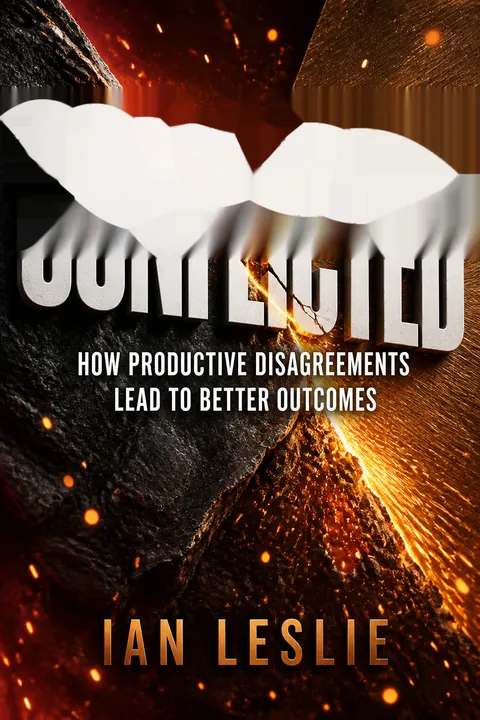
Conflicted by Ian Leslie receives overwhelmingly positive reviews for its insightful exploration of productive disagreement. Readers appreciate Leslie's engaging writing style, use of examples, and practical advice for navigating conflicts. The book challenges the notion that disagreements are inherently negative, instead arguing that they can foster growth, creativity, and better decision-making when approached constructively. Many reviewers found the book thought-provoking and applicable to various aspects of life, from personal relationships to professional settings. Some criticism focused on redundancy or lack of novel information.
People Also Read



Glossary
high-context culture
Meaning carried by contextA communication culture in which much meaning is implied rather than stated directly. Shared history, social roles, customs, and nonverbal signals help listeners interpret what is meant. The approach can support close relationships, but people unfamiliar with its unspoken rules may miss the message.
low-context culture
Meaning stated explicitlyA communication culture that relies heavily on direct language to convey intentions and information. It is common in diverse settings where people cannot assume shared customs or history. Directness makes negotiation among strangers easier, but can also make interactions feel impersonal and increase friction.
Motivational Interviewing
Draw out reasons for changeA counselling approach developed by William Miller and Stephen Rollnick for helping people consider change without ordering or shaming them. The practitioner listens carefully, reflects the person's meaning, and helps them explore their own mixed motivations. The method is based on the insight that pressure can provoke people to argue for staying the same.
righting reflex
The urge to correctThe impulse to fix another person's beliefs, choices, or feelings by explaining what is right. The book argues that this instinct often backfires: people who feel judged or controlled may defend their autonomy by resisting the correction. Listening first can reduce that resistance without requiring the listener to abandon their own judgment.
face
Desired public imageThe image of self that a person hopes to have recognized in a social interaction. Face can involve status, competence, identity, or dignity. When an argument threatens that image, people may focus on defending themselves rather than addressing the issue. Recognizing another person's face can make reconsideration less humiliating.
one-down
Feeling lower in statusA position in a negotiation where someone feels less powerful, respected, or secure than the other party. A one-down person may use aggressive or personal tactics to reclaim standing. The concept helps explain why apparently factual disagreements can become struggles over autonomy and recognition.
WEIRD
Western, educated, industrialized, rich, democraticAn acronym used by researcher Joseph Henrich and colleagues to describe populations from Western, Educated, Industrialized, Rich, and Democratic societies. Their research argues that many psychological findings drawn from these populations do not automatically describe humanity as a whole. The label highlights how a familiar worldview can be culturally specific.
Identity-Protective Cognition
Reasoning that guards belongingA term used by Daniel Kahan for the tendency to interpret information in ways that protect one's identity and group membership. On politically charged topics, people may accept or reject evidence partly according to what their community regards as acceptable. Greater knowledge does not necessarily remove this bias.
infinite game
Play designed to continueA concept from James Carse describing an activity with no final winner and no fixed end. Participants follow rules that keep the activity open and make continued participation possible. Applied to disagreement, it shifts attention from defeating an opponent to sustaining a process in which people can keep learning and creating.
FAQ
What’s Conflicted: How Productive Disagreements Lead to Better Outcomes by Ian Leslie about?
- Core premise: The book explores why disagreements often go wrong and how, when handled productively, they can lead to better outcomes in relationships, workplaces, and society.
- Interdisciplinary approach: Leslie draws on insights from psychology, negotiation, anthropology, and real-world examples like hostage negotiations and political conflicts.
- Focus on connection: Central to the book is the idea that honest human connection, emotional management, and understanding cultural differences are key to productive disagreement.
- Practical philosophy: Leslie offers both a philosophy and a toolkit for transforming toxic arguments into conversations that foster truth, intimacy, and innovation.
Why should I read Conflicted by Ian Leslie?
- Vital life skill: Productive disagreement is essential for personal relationships, workplace success, and the health of democracy, especially in a conflict-prone world.
- Unique insights: The book provides fresh perspectives, showing how conflict can foster closeness, creativity, and smarter decision-making.
- Actionable guidance: Leslie offers practical rules and strategies, not just theory, to help readers navigate difficult conversations with empathy and effectiveness.
- Real-world examples: Case studies from police interrogations, rock bands, and political negotiations illustrate the principles in action.
What are the key takeaways from Conflicted by Ian Leslie?
- Conflict is essential: Disagreement, when managed well, strengthens relationships, improves decisions, and fuels creativity.
- Relationship first: Trust, respect, and emotional connection are prerequisites for fruitful conflict.
- Avoid fight or flight: Instinctive aggression or avoidance is dysfunctional; learning to “let go of the rope” and resist controlling others is crucial.
- Harness bias and emotion: Confirmation bias and emotions can be harnessed for better group decisions if there’s a shared goal and open debate.
What are the “Rules of Productive Argument” in Conflicted by Ian Leslie?
- Nine rules summarized: The book distills productive disagreement into nine rules: First, connect; Let go of the rope; Give face; Check your weirdness; Get curious; Make wrong strong; Disrupt the script; Share constraints; Only get mad on purpose; plus the golden rule: Be real.
- Relationship before content: Establishing trust and making the other person feel valued is essential before tackling the substance of the disagreement.
- Embrace mistakes and curiosity: Acknowledging mistakes and fostering curiosity are key to overcoming bias and building understanding.
- Disrupt negative patterns: Breaking predictable argument scripts with novelty, humor, or empathy can open space for constructive dialogue.
How does Ian Leslie define and explain “productive disagreement” in Conflicted?
- Not just logic: Productive disagreement involves head, heart, and gut—logic, emotion, and intuition all play roles.
- Universal grammar: Leslie identifies a “universal grammar” of disagreement, drawing from experts in interrogation, therapy, and negotiation.
- Focus on growth: The goal is not to win but to learn, update views, and deepen relationships.
- Requires discipline: Productive disagreement is both a philosophy and a discipline, requiring conscious effort and skill.
How does Conflicted by Ian Leslie address the role of culture in disagreements?
- Culture as invisible water: Culture shapes how we see the world and communicate, often without us realizing it.
- WEIRD mindset: Leslie discusses how Western, Educated, Industrialized, Rich, Democratic (WEIRD) cultures differ fundamentally from others in reasoning and fairness perceptions.
- Misunderstandings from cultural clash: Disagreements often stem from clashes between different cultural worldviews and communication styles.
- Recognize your own biases: Understanding others requires seeing your own cultural assumptions, which are often mistaken for universal truths.
What does Conflicted by Ian Leslie say about the emotional dynamics of disagreement?
- Emotions shape thinking: Negative emotions like anger and sadness influence how we process information and respond in conflict.
- Managing escalation: Skilled negotiators control their emotions to prevent spirals of attack and defense, while unskilled ones escalate conflicts.
- Internal goal conflict: Leslie highlights the tension between lower-level goals (winning) and higher-level goals (relationship maintenance), urging readers to “kick the problem up a level.”
- Emotions as tools: Emotions can both help and hinder productive disagreement, so managing them is crucial.
How does Ian Leslie suggest handling mistakes and apologies in disagreements in Conflicted?
- Make wrong strong: Mistakes are inevitable but can strengthen relationships if acknowledged quickly and sincerely.
- Types of apologies: Leslie outlines basic, costly, commitment, and status apologies, each with different impacts.
- Costly apologies work best: Apologies that cost the apologizer something emotionally or materially are more effective at reducing conflict.
- Research-backed advice: Studies show sincere, costly apologies can even reduce malpractice lawsuits and foster trust.
What practical advice does Conflicted by Ian Leslie offer for stimulating curiosity in disagreements?
- Curiosity reduces bias: Scientific curiosity makes people more open to information that challenges their views, reducing partisan bias.
- Ask open questions: Use invitations like “Can you tell me more?” to show genuine interest and encourage elaboration.
- Foster epistemic emotions: Activating surprise and wonder, rather than anger or anxiety, keeps conversations open and productive.
- Model curiosity: Demonstrating curiosity yourself encourages others to reciprocate.
How does Conflicted by Ian Leslie address the impact of social media on disagreement?
- Internet fuels conflict: Social media platforms are designed to encourage disagreement, as it drives engagement and keeps users active.
- Low-context communication: Online interactions lack the rich context of face-to-face communication, making misunderstandings and hostility more likely.
- Echo chambers myth: Users often encounter diverse viewpoints, but this exposure can increase hostility rather than understanding.
- Moral outrage spreads: Platform algorithms incentivize outrage and negative emotions, often at the expense of genuine dialogue.
What are some real-world examples of productive disagreement in Conflicted by Ian Leslie?
- Wright brothers: Their intense but affectionate arguments led to innovation in aviation.
- Southwest Airlines: A culture of open conflict and respect among job functions improved coordination and profitability.
- Mandela and Viljoen: Mandela’s strategic respect transformed a deadly adversary into a political opponent, enabling peaceful democracy.
- Hostage negotiators: Experts use rapport, respect, and careful listening to de-escalate conflict and elicit cooperation.
What is the “infinite game” concept in Conflicted by Ian Leslie, and how does it relate to disagreement?
- Finite vs infinite games: Finite games have winners and losers; infinite games aim to continue play, fostering ongoing dialogue and learning.
- Democracy as infinite game: Democratic systems are designed to prevent permanent victory, encouraging continuous participation and adaptation.
- Disagreement as creativity: The goal is not to “win” but to create new understanding and solutions, making disagreement a creative, nourishing process.
- Sustaining relationships: Productive disagreement is about sustaining and enriching relationships, not ending them with a victory.
About the Author
Other books by Ian Leslie

Download PDF
Download EPUB
.epub digital book format is ideal for reading ebooks on phones, tablets, and e-readers.








