

Key Takeaways
Treat obvious, high-impact risks as urgent before certainty makes them costly.
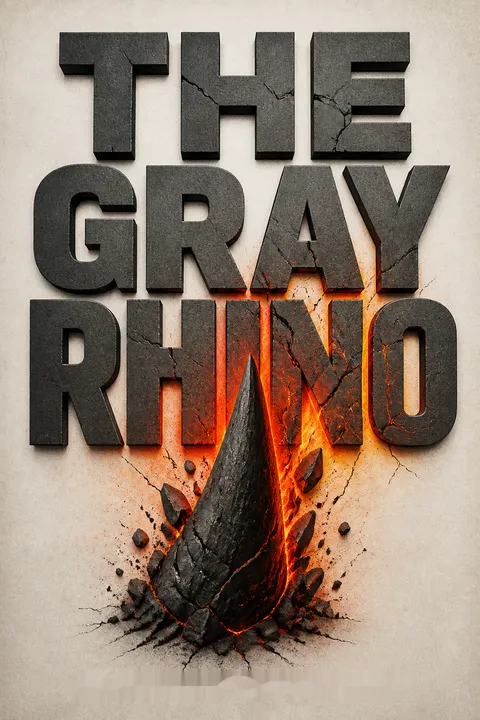
The animal is recognizable. A Gray Rhino is a highly probable, high-impact danger whose outline is visible early enough to permit a response. Unlike a Black Swan, it is not an unforeseeable surprise. Argentina’s 2001 debt crisis shows the cost of ignoring one: creditors rejected an early debt reduction of about 30 percent, then lost roughly 70 percent when the country collapsed. Greece’s private creditors agreed to restructure sooner in 2012, reducing the risk of a disorderly default, although Greece’s public-debt problems remained unresolved.
Timing is not certainty. The warning may not reveal exactly when a crisis will arrive, but uncertainty about its date does not make the danger imaginary. The book’s central distinction is practical: prepare for the obvious risks you can influence, while building resilience against events you cannot predict.
The metaphor is useful because it shifts attention from forecasting the exact moment of disaster to recognizing exposure early enough to preserve choices. That is a more realistic goal for leaders than perfect prediction. It also explains why a risk can be visible without being actionable for everyone: Argentina’s creditors, its government, and its citizens had different powers and incentives. A useful application is to ask two questions separately: how likely and damaging is the threat, and who can change its course? Without the second question, risk awareness can become anxious spectatorship.
Distrust reassuring consensus when evidence points toward a costly downside.
Belief edits evidence. The book uses emorationality to describe the blend of reason and emotion behind decisions. Optimism bias makes people overestimate favorable outcomes and discount bad ones; group pressure can make a questionable consensus feel safer than an unpopular warning. Icelandic investor Thor Bjorgolfsson saw that his country’s banks had grown dangerously large, yet later relied on information that supported continued optimism. When Iceland’s banking system collapsed in 2008, he lost his fortune and was left deeply in debt.
Predictions need calibration. Byron Wien’s annual list of surprising possibilities challenged conventional forecasts, while the Good Judgment Project improved forecasters’ accuracy by asking them to assign probabilities and track results. Neither approach makes the future certain. They make overconfidence and herd thinking more visible, giving decision-makers a better chance to question what they want to believe.
The crucial move is not to replace optimism with permanent pessimism. It is to make confidence answerable to evidence. Forecasting exercises can help because they reveal whether a person is consistently too certain, too cautious, or responsive to new information. Yet dissent alone is not proof of insight: outlier views can be wrong, and contrarianism can become its own performance. The strongest process gives minority warnings a fair hearing, tests them against data, and makes the people advocating a decision state what evidence would change their minds.
Route warnings to someone empowered to interrupt business as usual.
Signals need an owner. Dynegy risk officer Glenn Labhart questioned Enron’s valuation of illiquid assets, including turbines, and warned that the deal’s numbers did not add up. His report did not stop the proposed acquisition, but it helped secure protections that later limited Dynegy’s losses. A warning matters only if someone can understand it, deliver it to decision-makers, and act on it.
Make dissent operational. Before the Challenger launch, engineers warned that shuttle seals might fail in unusually cold weather. Decision-makers focused on the lack of proof that cold caused failure, rather than asking whether successful launches had ever occurred at such low temperatures. The book’s examples support practical safeguards: include diverse perspectives, check evidence for both success and failure, and give people clear authority to pause unsafe work. It also warns that interested parties may deliberately obscure evidence, manufacturing ignorance to protect the status quo.
This is a systems problem, not simply a courage problem. Organizations often celebrate candor while leaving the person who raises a concern without authority, status, or a route to decision-makers. A formal stop-work rule changes the social cost of dissent: the employee no longer has to win an argument before preventing an immediate hazard. Still, checklists and escalation channels can become rituals if leaders treat completion as evidence of safety. The useful test is whether an uncomfortable signal can alter a decision, not whether the organization can show that a warning form was filed.
Count the future costs of delay, not just today’s bill.
Delay feels cheaper. Muddling means recognizing a problem while postponing a decisive response, often through excuses about cost, political feasibility, or lack of urgency. Minneapolis’s I-35W bridge had been rated structurally deficient in inspections dating back to 1990, yet it was not scheduled for replacement until 2020. It collapsed in 2007, killing thirteen people. The replacement bridge opened just over a year later, showing how quickly action can follow catastrophe when the cost of waiting is no longer abstract.
Make inaction visible. The book argues that budgets and business plans often record the price of repairs but omit the costs avoided by making them. That accounting makes prevention look optional and failure look like bad luck. Infrastructure, preventive health care, and financial oversight all suffer from this blind spot. A better decision compares the immediate investment with the likely human, financial, and opportunity costs of doing nothing.
The bridge example exposes an accounting asymmetry: prevention produces an absence, while failure produces a visible event. That makes maintenance politically difficult even when its expected value is strong. Recording avoided costs can correct the asymmetry, but it should not create a blank cheque for every precaution. Forecasts of avoided damage are uncertain, and public resources have competing uses. The disciplined approach is to show assumptions, compare plausible scenarios, and make explicit who bears the risk if officials choose not to invest.
Diagnose the threat before deciding whether to repair, adapt, or exit.
Risks have different shapes. The book distinguishes familiar problems with known remedies from recurring disasters, structural causes that generate many symptoms, and dilemmas without a clean solution. It also identifies industries facing creative destruction, where an old business model may no longer be viable. These categories matter because one response cannot fit every threat. A company may need repairs, a new strategy, or an orderly retreat.
The cork industry adapted. Portuguese producers faced synthetic stoppers and screw caps after years of dismissing complaints about cork taint. They invested in cleaner production, improved quality controls, and explained cork’s value to win back premium wine producers. Kodak, by contrast, invented an early digital camera but protected its film business for years. It later entered digital photography, yet the market had changed again. Diagnosis means asking what is actually failing, what can still be preserved, and whether the old model deserves saving.
The taxonomy prevents a common leadership error: treating every threat as a problem that needs more effort within the existing model. Sometimes the answer is to fix a defect, as cork producers did; sometimes, as Kodak’s experience suggests, a firm must question whether its legacy business is still the right unit of survival. The categories are guides, not scientific bins. A single crisis can combine a recurring hazard, structural weakness, and unclear trade-offs. Diagnosis should therefore be revisited as evidence changes, rather than treated as a one-time label.
Interrupt postponement before panic strips away your remaining choices.
Crises have a familiar arc. The book describes a progression from denial, to delay, to arguments over solutions, then a rushed response or a damaging failure to respond. As a threat approaches, time shrinks and options close. The 2014 Ebola outbreak illustrates the danger of waiting for urgency: aid workers had warned that the epidemic was worsening, but the international response came late. The eventual emergency effort consumed enormous resources that might have supported stronger health systems beforehand.
Prepare while calm. Drills, checklists, stress tests, and preset decision triggers can help people act when fear makes careful reasoning harder. The author contrasts Ebola panic with the routine flu, a familiar threat that receives less public attention despite causing substantial illness each year. The point is not that every warning deserves alarm. It is to rehearse proportionate responses before emotion and time pressure dominate the decision.
Preparation helps by moving some decisions out of the moment when people are most stressed. Emergency procedures, however, are only as good as their assumptions and upkeep. A plan can create false confidence if leaders mistake its existence for readiness, as the Katrina example in the book demonstrates. Exercises should test the whole chain: whether signals arrive, whether authority is clear, and whether resources are available. The goal is not to eliminate judgment, but to reserve human judgment for the parts that cannot safely be automated.
Turn resource risks into measurable operating gains.
Measure the exposure. MillerCoors recognized that water scarcity threatened its ability to brew beer. Teams first assumed major technology spending would be necessary, then found that workers could identify practical changes inside the breweries. Adjusting kettle temperatures and cleaning routines reduced waste. More than 90 percent of the water footprint, however, came from agriculture, so the company also worked with barley growers.
Scale what works. Farmers in Idaho changed irrigation timing and equipment, among other practices, and reduced water use by 550 million gallons in 2014. SABMiller measured water use across breweries and set reduction targets, while building partnerships around watersheds shared with farms and communities. These cases show how a distant environmental danger becomes a business issue when translated into operational costs, supply reliability, and practical targets. They also show why a company cannot solve a shared resource problem by acting only within its own facilities.
Measurement makes an abstract threat legible to people who control budgets, while operational improvements can create a constituency for broader environmental action. The strongest feature of these examples is the move beyond factory boundaries: a company’s supply chain may carry most of its real exposure. That same move complicates responsibility. Businesses can help coordinate conservation, but they do not own the public resource or represent every affected community. Durable solutions need transparent data and shared governance, not only corporate efficiency targets.
Use a disaster to build resilience, not merely to look busy.
Recovery is a decision point. Calgary’s 2013 flood caused extensive damage and displaced nearly 100,000 people. The city’s emergency operations center, built after an earlier flood, used detailed mapping to identify a threatened power substation. A protective berm kept it operating and spared nearby communities from a much wider disruption. Yet earlier recommendations for flood prevention had largely gathered dust, a reminder that one successful preparation does not mean a system is ready.
Invest beyond the headline. Winnipeg expanded its Red River Floodway after earlier flooding. Officials estimate that the system has prevented far more damage than it cost, including billions in later avoided losses. By contrast, visible post-crisis measures can waste money or shift risk elsewhere if they are not coordinated. Recovery planning should assess changing hazards, compare alternatives, and account for who benefits and who bears the cost.
Resilience is more than rebuilding the damaged asset. It means understanding how a failure in one place can spread through utilities, transport, housing, and livelihoods. Calgary’s protected substation is a clear example of preventing cascading disruption. Still, resilience spending creates hard choices: a large protective project may benefit one district while diverting funds from basic services elsewhere. Public participation and transparent risk assumptions are therefore central, not decorative. A crisis can create political permission to act, but that permission should be used for considered changes rather than symbolic construction.
Protect time for distant threats before quarterly urgency consumes it.
The short term crowds out foresight. Future Hunters, a consulting group described in the book, helps organizations examine demographic, technological, and social trends that may reshape their businesses. Yet many companies had shortened their planning horizon until even a few years seemed distant. McKinsey research cited in the book found that 70 to 90 percent of the value of established companies’ shares depended on cash flows expected three or more years away, even as managers faced pressure to report quarterly results.
Make the horizon practical. Long-term thinking does not mean predicting the future perfectly. It means reserving time to test scenarios, protect investment in research, and connect strategy to a durable purpose. IBM repeatedly changed its products while trying to preserve its core beliefs; it shifted away from hardware toward services and software when its former strengths stopped guaranteeing success. The useful question is what must change for the organization to remain valuable.
The tension here is institutional: leaders are asked to create long-lived value using incentives that reward near-term performance. A personal resolution to think farther ahead cannot overcome that structure by itself. Boards, investors, and public agencies shape which time horizons are financially and politically survivable. Long-range planning also has limits: scenarios can become elaborate stories that protect current assumptions. Its value comes from making decisions reversible where possible, identifying early indicators, and deciding in advance what evidence would trigger a strategic change.
Turn your warning into a coalition that can protect what is at risk.
Spotting is only the start. The book ends with the rhinoceros itself, an animal threatened by human poaching. South Africa lost 1,215 rhinos to poachers in 2014. The Western black rhino had been declared extinct, and only a handful of Northern white rhinos remained. Conservationists faced a connected problem: criminal networks, demand for horn, corruption, weak enforcement, and local communities that needed viable livelihoods.
Keep the response joined up. The book describes approaches including stronger law enforcement, intelligence sharing, moving animals to safer locations, creating income from conservation, and reducing demand for horn. No single tactic can carry the effort. Its closing distinction is between a rhino spotter, who recognizes danger and speaks up, and a rhino keeper, who recruits allies and persists through the difficult work of changing outcomes. A warning becomes useful when it gathers people with the authority and resources to act.
The conservation example gives the metaphor an important reversal: humans are the danger charging toward the rhino. It also clarifies that an individual insight is fragile without institutions, local legitimacy, and sustained resources. A coalition can bring those pieces together, though coordination does not erase conflicts over costs or acceptable methods. The book’s emphasis on persistence is apt: success against one source of pressure can leave another untouched. A serious response measures outcomes over time and changes tactics when the threat changes.
Analysis
The book’s central contribution is a distinction between two kinds of uncertainty. Some dangers are difficult to imagine before they arrive; others are visible enough to describe, yet people and institutions fail to respond. That second category deserves its own language because it changes the managerial question. Instead of asking only whether a forecast is accurate, leaders must ask why credible warnings do not alter decisions.
The strongest parts of the argument connect individual psychology to institutional design. Optimism, conformity, and avoidance help explain why people discount threats. Short political cycles, conflicted financial incentives, and diffuse responsibility explain why organizations can preserve that avoidance even after a problem is recognized. The cases make clear that better information alone is insufficient. Warnings need a route to authority, a way to interrupt routine, and incentives that make prevention a rational choice for the people expected to deliver it.
The framework is most useful as a prompt for structured questions, not as a universal predictive model. Probability and impact are difficult to estimate, threats can interact, and the cost of acting too early can be real. Some apparent delay is strategic gradualism while institutions build legitimacy or capacity. Some proposed solutions create new risks, as post-disaster infrastructure decisions can show. Those complications do not weaken the book’s thesis; they sharpen it. The task is not to act maximally on every alarming possibility, but to make uncertainty explicit, compare the costs of action and inaction, and revisit decisions as evidence changes.
The lasting lesson is therefore procedural. Build organizations that can notice, challenge, diagnose, and respond before urgency becomes panic. Keep long-term risks visible when immediate pressures dominate. And treat prevention as real work, even when its success leaves no dramatic event to prove it was needed.
Review Summary
The Gray Rhino explores highly probable, high-impact threats that are often neglected. Readers appreciate Wucker's framework for recognizing and addressing these "gray rhinos," finding it relevant to business, government, and personal life. The book's anecdotes and examples illustrate the concept well, though some felt it was repetitive or lacked depth. Many found it a valuable companion to Taleb's "Black Swan" theory, while others criticized its writing style or perceived misinterpretation of Taleb's work. Overall, readers found the book thought-provoking but with mixed opinions on its execution.
People Also Read









Glossary
Gray Rhino
Visible, high-impact threatA highly probable, high-impact threat that is visible enough to recognize before it causes major damage. Unlike an unforeseeable shock, it has warning signs that people can interpret and often act upon. The term focuses attention on dangers ignored through denial, delay, distorted incentives, or failed collective response.
Black Swan
Rare, high-impact eventA rare, high-impact event that is difficult to predict in advance and appears more understandable after it occurs. The book uses the concept as a contrast to the Gray Rhino: resilience is the main defense against the truly unforeseeable, while visible probable dangers call for earlier recognition and action.
White Swans
Likely, low-impact eventsEvents that are highly probable but have relatively low impact. In the book’s probability-and-impact distinction, they generally do not demand the urgent attention reserved for high-impact risks. The category helps separate routine, manageable events from both rare catastrophes and obvious dangers with potentially severe consequences.
Five Stages of a Gray Rhino
A crisis-response sequenceThe book’s model of how people commonly respond to an approaching threat: they may deny it, postpone action, argue over a diagnosis or remedy, enter a panicked state, and finally act or suffer the consequences. The sequence is not inevitable, but it highlights points where leaders can change course.
Emorationality
Emotion mixed with reasonA term used for the combination of rational and emotional motives that shapes decisions. People do not assess risk as detached calculators: confidence, fear, social influence, and self-interest affect how evidence is interpreted. Recognizing this mixture helps explain why warnings can be understood intellectually yet fail to produce action.
Meta-Rhinos
Structural causes of threatsUnderlying institutional or social problems that generate multiple visible symptoms. Treating each symptom separately may leave the deeper cause intact. The book uses examples such as decision-making failures and the economic gender gap to show how structural weaknesses can contribute to several other risks.
Charging Rhinos
Threats becoming urgentIssues that have been present for some time but suddenly become acute and demand attention. Their speed can create urgency, but it can also encourage incomplete responses that address immediate symptoms without resolving deeper causes. A sudden escalation may connect to a threat that had previously been easier to ignore.
Recurring Rhinos
Known repeating hazardsThreats that are expected to recur, such as hurricanes, tornadoes, or epidemics, even when their exact timing and location are uncertain. Their repeated nature makes preparation possible through warning systems, drills, and established procedures. Complacency after earlier near-misses can still undermine readiness.
Conundrums
Threats without clear solutionsProblems that are widely recognized but lack an agreed, straightforward remedy. Inequality is one example discussed in the book: people may agree that it causes harm while disagreeing over responsibility, causes, and policies. Progress requires breaking the issue into specific goals and evaluating trade-offs.
Gordian Knots
Dilemmas with least-bad choicesEspecially difficult problems in which available responses appear deeply unsatisfactory and no clean solution is evident. The book applies the term to conflicts such as Syria and the Israel-Palestine question. Leaders may need to prioritize among threats and choose among imperfect options rather than wait for an ideal answer.
Domino Rhinos
Connected threats that cascadeA group of related threats in which one can trigger or amplify others. The book describes the financial crisis as a convergence of risky mortgages, weak risk management, and a liquidity crisis. These connected dangers need coordinated treatment because responding to one component alone may leave the larger cascade intact.
Manufactured denial
Deliberately produced ignoranceEfforts by people or organizations with a stake in the status quo to prevent others from recognizing an inconvenient problem. Tactics can include manipulating data, exploiting conflicts of interest, or presenting established evidence as unresolved controversy. The concept distinguishes intentional concealment from ordinary cognitive blind spots.
Rhino spotter
Person who recognizes dangerA person who notices a visible, high-impact threat that others overlook or dismiss, and makes the risk known. Spotting is an important first step, but it does not guarantee change. The warning must reach people with authority, attract support, and lead to decisions and sustained action.
Rhino keeper
Persistent organizer for actionA person who takes recognition beyond warning by recruiting allies, confronting obstacles, and maintaining commitment to a response. The book uses the term for people willing to challenge group habits and perverse incentives. Effective keepers help turn an individual insight into coordinated institutional or community action.
FAQ
What is The Gray Rhino: How to Recognize and Act on the Obvious Dangers We Ignore by Michele Wucker about?
- Core concept: The book introduces the "Gray Rhino" as a metaphor for highly probable, high-impact threats that are obvious but often ignored.
- Contrast with Black Swans: Unlike unpredictable Black Swan events, Gray Rhinos are dangers we see coming but fail to address.
- Purpose: Michele Wucker explores why individuals, organizations, and governments overlook these threats and provides a framework for recognizing and acting on them.
- Real-world examples: The book draws on financial crises, environmental disasters, and corporate failures to illustrate Gray Rhino scenarios.
Why should I read The Gray Rhino by Michele Wucker?
- Understanding predictable risks: The book helps readers identify and address the obvious dangers that are often overlooked due to denial or complacency.
- Practical strategies: It offers actionable advice for leaders, policymakers, and individuals to overcome psychological and organizational barriers to timely action.
- Opportunity in threat: Wucker shows how recognizing Gray Rhinos can lead to innovation, growth, and positive change, not just disaster avoidance.
- Broad relevance: The framework applies to business, government, and personal life, making it valuable for a wide audience.
What is Michele Wucker’s definition of a "Gray Rhino" in The Gray Rhino?
- Obvious, probable threat: A Gray Rhino is a highly probable, high-impact danger that is visible and obvious but often ignored or neglected.
- Contrast with Black Swan: Unlike rare, unpredictable Black Swans, Gray Rhinos come with warning signs and are foreseeable.
- Metaphor explained: The image is of a two-ton rhinoceros charging at you—hard to miss, yet often unaddressed.
- Purpose of the term: Wucker uses the concept to encourage proactive recognition and response to prevent avoidable disasters.
How does a Gray Rhino differ from a Black Swan according to Michele Wucker?
- Predictability: Gray Rhinos are foreseeable and come with warning signs, while Black Swans are rare and unpredictable.
- Impact: Both can have high-impact consequences, but Gray Rhinos are more likely and visible.
- Responsibility: Wucker argues we have the power and responsibility to act on Gray Rhinos, whereas Black Swans are outside normal expectations.
- Implications for action: The focus is on overcoming denial and procrastination to address threats we can see coming.
What are the five stages of responding to a Gray Rhino in The Gray Rhino?
- Denial: Initial refusal to acknowledge the threat, often due to fear or willful ignorance.
- Muddling: Partial recognition without decisive action, characterized by excuses and half-measures.
- Diagnosing: Thorough understanding and framing of the problem to motivate action.
- Panic: Crisis mode where emotions run high, leading to rushed or irrational decisions.
- Action: Effective measures are finally taken, ideally before panic sets in, to address the threat.
What human behaviors and biases contribute to ignoring Gray Rhinos in Michele Wucker’s framework?
- Optimism bias: People tend to underestimate negative outcomes and overestimate positive ones, leading to denial.
- Groupthink and conformity: Social dynamics suppress dissent and reinforce collective denial of obvious risks.
- Perverse incentives: Systems often reward short-term gains over long-term risk management, encouraging procrastination.
- Confirmation bias: Individuals favor information that supports their existing beliefs, making it harder to recognize threats.
What are some real-world examples of Gray Rhinos discussed in The Gray Rhino by Michele Wucker?
- Financial crises: The 2007–2008 global financial meltdown and Argentina’s sovereign default, where warning signs were ignored.
- Environmental threats: Climate change, water scarcity, and pandemics like Ebola, all with clear signs but delayed responses.
- Corporate failures: Companies like Kodak, Enron, and BlackBerry, which failed to adapt to obvious industry changes.
- Infrastructure disasters: Events like Hurricane Katrina and the Bangladesh factory collapse, where risks were visible but unaddressed.
What types of Gray Rhinos does Michele Wucker identify, and how should they be addressed?
- Inconvenient Truths: Recognized problems like climate change that require long-term commitment and shared responsibility.
- Recurring and Charging Rhinos: Repeated or sudden threats, such as hurricanes or financial crises, best managed with preparedness systems.
- Meta-Rhinos: Structural issues like political polarization, requiring root-cause solutions and governance improvements.
- Conundrums and Gordian Knots: Complex, seemingly unsolvable problems that need to be broken down into manageable parts.
- Creative Destruction: Threats requiring transformation or exit, such as technological obsolescence, which can open paths to innovation.
How does Michele Wucker in The Gray Rhino explain the problem with predictions and denial?
- Cognitive biases: Optimism and confirmation biases lead people to ignore or downplay obvious risks.
- Groupthink: Organizations suppress dissent, making it harder to recognize and act on threats.
- Systemic failures: Prediction and warning systems often fail because they assume rational actors, ignoring emotional and vested interests.
- Escalation of crises: Denial and failure to heed warnings allow manageable threats to become disasters.
What strategies does The Gray Rhino by Michele Wucker recommend for recognizing and acting on obvious dangers?
- Be a rhino spotter: Cultivate awareness and encourage diverse perspectives to break through denial and groupthink.
- Frame the problem: Define threats in emotionally resonant and actionable ways to motivate timely responses.
- Create habits and systems: Use automatic triggers, stress tests, and protocols to prompt action before panic sets in.
- Leverage crises: Use the urgency of a crisis to implement necessary changes and avoid wasted opportunities.
What lessons does The Gray Rhino draw from real-world crises like the 2008 financial crash and the Bangladesh factory collapse?
- Warning signs ignored: Both crises had clear warning signals that were denied or inadequately addressed.
- Systemic failures: Organizational cultures and incentive structures contributed to failures to act.
- Leadership matters: Effective leaders who recognized threats early could mitigate damage.
- Accurate diagnosis: Properly diagnosing the nature of the threat is crucial for effective response.
What are the key takeaways from The Gray Rhino by Michele Wucker?
- Herd behavior risks: Panic and herd mentality can worsen crises, so creating automatic responses helps avoid irrationality.
- Early urgency saves costs: Acting early and raising the stakes reduces the cost and damage of threats.
- Learn from other fields: Disaster warnings and epidemiology offer models for training automatic, effective responses.
- Balance emotion and reason: Recognize the role of fear and denial, but engage in reasoned, prepared decision-making.
- Long-term thinking: Purpose-driven leadership and strategic foresight are essential to prevent and manage Gray Rhinos before they trample us.
Download PDF
Download EPUB
.epub digital book format is ideal for reading ebooks on phones, tablets, and e-readers.








