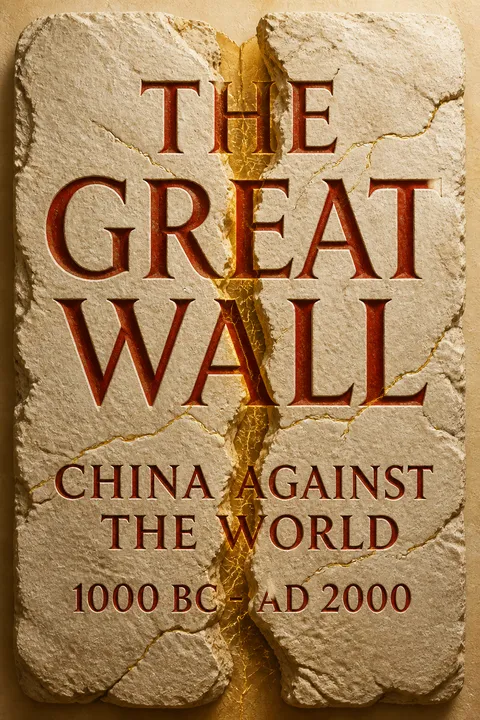


Key Takeaways
Read the Great Wall as a history of China’s changing relationship with outsiders
Two walls meet in 1793. Lord Macartney arrived in China hoping to open trade and establish Britain as a diplomatic equal. The Qianlong emperor instead treated his mission as a visit by subordinate foreigners, while the British refused the ritual of submission expected by the court. They left without the concessions they wanted, but Macartney was awestruck by the brick wall near Beijing. He admired the physical barrier even as he condemned the state’s political barriers to foreign contact.
A symbol, not a shortcut. The book follows both walls: the frontier fortifications, and the changing impulse to control contact with outsiders. The physical wall reflects choices about war, trade, territory, and government. Its meaning shifts across time, so it cannot serve as a simple portrait of an unchanging China.
What's striking is how a failed diplomatic encounter gives the book its method: the wall is both an object in the landscape and a story people tell about the landscape. That double vision helps explain why admiration and criticism can coexist. The physical barrier may look like engineering triumph while representing diplomatic rigidity. The metaphor is powerful, though it needs historical detail to stay honest. Without that detail, a changing frontier can too easily become a single, timeless claim about an entire civilization.
Stop imagining one ancient wall: China built many frontiers for different regimes
Many walls, not one. The Chinese term Changcheng means Long Wall, and before modern times it appeared inconsistently. Rulers built separate lines of earth, stone, and other local materials, often far apart and for different purposes. Qin and Han frontier works, for example, were largely tamped earth, not the familiar brick ramparts near Beijing. Those celebrated sections date mainly to the Ming dynasty, roughly five centuries ago, and were restored for visitors in the twentieth century.
The name blurs history. A single, continuous Great Wall suggests a stable border and a unified construction project. The historical record instead shows shifting defenses, abandoned sections, forts, and barriers that made use of natural terrain. Much of the older wall has eroded into low ridges or disappeared beneath sand and scrub.
The distinction between a monument and a collection of changing structures is more than a correction to a tourist fact. It changes the question from who built the Great Wall to what different governments were trying to do at particular frontiers. Naming can make a political process look natural and permanent. At the same time, the surviving Ming sections are genuinely impressive; rejecting the myth does not require denying the achievement. It means separating the accomplishment from the invented continuity.
Ask what a wall controls, because defense can conceal expansion
Position reveals purpose. Chinese records often describe walls as protection against nomadic raids. Yet some early barriers ran far north of the farmland they supposedly defended, into steppe territory. Their placement suggests they could also help seize land, station troops, regulate movement, and supervise trade routes. In the Warring States period, northern states built walls as they expanded into disputed regions, while the Qin pushed its frontier across the Ordos.
A border can reach outward. The Han built forts and walls along the Gansu corridor, partly to protect the Silk Road and the movement of goods, but also to secure Chinese authority in Central Asia. The frontier was not simply a line keeping two peoples apart. It was a zone where armies, merchants, farmers, and nomads met under unequal rules.
The book usefully tests a wall's purpose by asking where it stands, not only what its builders say it does. That is a practical way to examine any security project: trace who gains access, who loses movement, and which territory the barrier enables the state to govern. The distinction between defense and expansion is not always clean. A structure can protect settlements while extending imperial control over people who did not ask to be protected.
Read wall-building as a costly admission that policy has run out of options
Walls often followed failure. Early Chinese rulers had other ways to manage northern powers: diplomacy, trade, gifts, and military campaigns. Wall-building often became attractive when those approaches had failed, or when rulers could not afford another offensive. The Qin First Emperor's Long Wall was part of a sweeping program of forced labor and military control. His dynasty fell only a few years after his death, amid rebellion and popular anger at taxation and conscription.
The warning repeated. The Sui dynasty also built costly walls while demanding labor for other enormous projects. It soon collapsed, and later historians compared its fate to Qin's. This does not mean walls alone destroyed either regime. Rather, repeated wall-building became a visible sign of a governing strategy that demanded enormous resources without securing lasting safety.
A wall can be read as a costly commitment device: once built, it signals resolve, but it also ties future governments to maintaining a system that may no longer fit the threat. The book's examples connect infrastructure to political legitimacy, since coerced labor and unrelieved costs can turn a defense project into evidence of state abuse. The caution is not that every barrier means a regime is doomed. It is that the spectacle of construction can hide the political price of a policy.
Borrow an enemy’s strengths before building barriers against them
Adaptation beat purity. In 307 BC, King Wuling of Zhao faced objections when he proposed adopting the steppe tunic and mounted archery. His advisers saw the change as a betrayal of Chinese custom; the king saw it as a way to survive. The cavalry helped his state fight more effectively. The episode captures a recurring tension: rulers could denounce northern peoples as uncivilized while borrowing their most useful military techniques.
The Tang chose mobility. Centuries later, Emperor Taizong resisted an official's proposal to rebuild walls against the Turks. He instead exploited divisions among Turkic leaders, built alliances, and struck when their position weakened. The Tang expanded far into Central Asia without relying on long border walls. The pattern was not simple openness: military force remained central, but flexibility proved more effective than treating a fixed barrier as a complete strategy.
King Wuling's choice shows that cultural identity and practical competence are not always opposites. A society can borrow a technique without abandoning every value that gives it coherence. Taizong's strategy adds another lesson: understanding an opponent's political structure can matter as much as matching its weapons. Still, the Tang example should not become a simple argument against walls. It depended on military capacity and favorable political timing, conditions that other rulers did not always possess.
The Ming built its famous wall after military failure hardened into isolation
A defeat changed the frontier. In 1449, the Mongol leader Esen defeated a poorly prepared Ming expedition and captured the young emperor at Tumu. The Ming survived, but its reputation for military strength suffered. Afterward, the court grew less willing to negotiate and less able to defeat the Mongols in the field. During the sixteenth century, Mongol leaders sought trade in grain, clothing, and other goods. The Jiajing emperor repeatedly rejected their requests and punished officials who permitted contact.
The barrier took shape. In 1550, Altan Khan rode around the eastern end of the defenses and raided Beijing's suburbs. The Ming then expanded and strengthened walls, including the brick-and-stone stretches now famous to tourists. The wall was not simply an ancient inheritance. It was the product of a particular crisis, political rigidity, and military weakness.
This sequence makes the famous wall feel less like a timeless national reflex and more like a decision made under pressure. Military embarrassment narrowed the political room for compromise, while refusing trade helped keep conflict alive. A barrier can make a government's refusal to negotiate look firm, but it cannot resolve the reasons people keep approaching it. The episode also cautions against treating a later architectural achievement as proof that the policy behind it was wise.
A wall is only as strong as the people paid to defend it
The human system failed. Ming frontier soldiers endured cold, poor food, and unreliable supplies. Officers diverted pay and labor for private use; some guards bribed raiders to avoid attacks, while others abandoned exposed towers. Maintaining a wall required more than stone and brick. It depended on a functioning chain of command, reliable provisions, and people who had reason to remain loyal.
The final gate opened. In 1644, the Ming government was bankrupt, its armies depleted, and rebels under Li Zicheng were advancing on Beijing. The capital fell, but the Manchus still needed to pass Shanhaiguan, the heavily fortified eastern gateway. The Ming general Wu Sangui allied with them, and his forces helped open the way. The wall did not fail because it vanished. It failed because the political order behind it had collapsed.
The account distinguishes hardware from the institution that operates it. A fortification is not a self-enforcing boundary: it depends on salaries, food, trust, and decisions made by people under pressure. This is an unusually concrete way to understand infrastructure, which often appears most powerful in photographs and least visible in maintenance records. Wu Sangui's choice also shows that loyalty is not a permanent resource. Governments spend it down when they neglect the people expected to defend them.
Foreign admiration turned a failed frontier into China’s national masterpiece
Visitors made the myth. European Jesuits in the seventeenth century praised the wall they saw near Beijing, then presented it as a single, ancient structure built by Qin. Their maps and accounts spread that image across Europe. Later writers, including Voltaire, celebrated the wall as proof of Chinese greatness, even though its famous brick sections were much newer and the barrier had repeatedly failed to stop invasions.
China adopted the image. For much of its history, the Chinese state and public showed little interest in the wall as a national monument. In the twentieth century, as China faced invasion, political upheaval, and humiliation, nationalists such as Sun Yat-sen embraced it as evidence of Chinese ingenuity and endurance. The symbol's modern prestige owes much to the foreign gaze it was later taken to express.
The wall's reputation is itself part of the history: outsiders first simplified it, then Chinese nationalists found that simplification politically useful. That is not unusual for national symbols, which gain force by making complicated pasts easy to recognize. The useful tension here is that cultural pride need not depend on false claims. The wall remains a substantial human achievement even when its age, continuity, and military record are described accurately.
Track who praises the wall: each political era gives it a new job
A symbol changes hands. In the 1930s, as Japanese forces advanced through northern China, the wall became a rallying image for resistance and national unity. Mao Zedong also used it as a revolutionary emblem. After the Communist victory, restored sections became a showcase for diplomatic visitors and tourists, while much of the remaining wall was neglected or dismantled for building materials.
Praise can obscure conflict. In 1988, the television series River Elegy criticized the wall as a sign of inward-looking rule, using it to argue for openness and political change. After the 1989 crackdown, the state rejected that interpretation and promoted the wall as a patriotic treasure. Across these episodes, the masonry stayed largely the same; its political message changed with the speaker and the moment.
The wall works as a political symbol because it can be made to support opposite claims: courage or isolation, unity or repression, heritage or backwardness. That flexibility is a strength for whoever controls the story, but a warning for readers. When a symbol seems to prove everything, it may be doing less explanatory work than emotional work. River Elegy's criticism matters not because its allegory was flawless, but because it shows that national icons can be contested.
Control the information gate, and the old frontier returns in digital form
The frontier went online. By the early 2000s, China's expanding Internet connected users to foreign news and domestic discussion. The government promoted its economic value while trying to restrict politically sensitive material through the Great Firewall of China, a system of technical filtering and surveillance. Users could sometimes get around blocks, but officials also relied on uncertainty, self-censorship, and the risk of punishment to limit what people said publicly.
Openness remained selective. The Internet could expose official misconduct, spread criticism, or help organize protest. It could also channel public anger into anti-foreign nationalism that supported state priorities. The result resembles the older frontier dilemma: welcome useful exchanges, restrict destabilizing ones, and try to decide which traffic counts as a threat. The wall is no longer only a physical structure, but the underlying impulse to manage contact persists.
What's striking is the continuity in the governing problem, not a claim that digital censorship and a stone rampart are identical. Both involve deciding what crosses a boundary, but online control also depends on users, service providers, and their expectations of surveillance. That distributed arrangement can make enforcement harder to see and responsibility easier to shift. The book's early-2000s account is a historical snapshot, not a current measurement, but its central question remains useful: who gets to define openness, and on whose terms?
Analysis
The book's central achievement is to make a familiar monument unstable. It begins with the tourist's assumption that the Great Wall is one ancient object, then replaces that picture with a sequence of frontier policies, local barriers, abandoned defenses, and political interpretations. That shift is not merely corrective. It changes the explanatory unit from architecture to governance. The question becomes not how a wall was built, but what rulers believed they could accomplish by separating, supervising, or engaging with populations beyond it.
The book's strongest historical pattern is a recurring mismatch between political symbols and strategic results. Walls could express sovereignty, deter some raids, and help administer movement. Yet they also enabled expansion, drained resources, failed against mobile armies, and depended on defenders whose loyalty was never guaranteed. The Ming story compresses this contradiction especially well: an impressive construction grew out of diplomatic rigidity and military weakness, then proved unable to save a state whose institutions had already hollowed out. Infrastructure cannot compensate indefinitely for political failure.
The metaphor of a wall also makes the long history memorable, but it risks imposing a single open-versus-closed storyline on very different eras. Tang military expansion without walls, Han trade diplomacy alongside frontier forts, and Qing rule across territories on both sides of the old frontier do not fit a simple national temperament. Lovell's account is most persuasive when the wall remains a question rather than an answer, and when regional circumstances and individual decisions stay visible.
The modern chapters extend the metaphor to nationalism, tourism, and Internet control. Their evidence reflects the book's early-2000s moment, so its statistics and descriptions of online life should not be read as current conditions. The larger insight is less time-bound: states can pursue economic and cultural exchange while restricting political access, and can present that selectivity as either security or national virtue. The wall persists most powerfully as a way of imagining who belongs inside, who approaches from outside, and who has authority to open the gate.
Review Summary
The Great Wall by Julia Lovell offers a comprehensive overview of Chinese history through the lens of wall-building. Reviewers appreciated the book's accessibility, historical insights, and exploration of China's relationship with outsiders. Some found Lovell's tone sarcastic or critical of Chinese culture. The book covers 3000 years of history, examining the Great Wall's role in Chinese identity and foreign policy. While informative, some readers felt the narrative was disjointed or overly ambitious. Overall, it provides a unique perspective on Chinese history and culture.
People Also Read






Glossary
Changcheng
Long frontier wallThe Chinese term usually translated into English as Great Wall. Literally, it means Long Wall. Premodern sources used it inconsistently, and many referred to frontier defenses by other names. Treating Changcheng as one continuous, ancient structure obscures the many separate walls and fortifications built by different states and dynasties.
heqin
Peace through gifts and marriageA Han policy toward the Xiongnu, translated in the book as Peace and Friendship. The Chinese court offered goods, silk, grain, and sometimes imperial brides in exchange for periods of peace. It could reduce the cost of fighting, though the Xiongnu retained their independence and raids could resume.
tribute system
Ritualized foreign relationsA diplomatic arrangement in which foreign rulers or envoys formally acknowledged the Chinese emperor's superior status by presenting tribute and observing court rituals. In practice, the relationship could involve trade and valuable gifts from China to visitors. The ritual language of submission therefore did not always reflect the actual balance of power.
Mandate of Heaven
Heaven's right to ruleA political and moral idea used to explain why a dynasty had the right to govern. Emperors ruled so long as Heaven approved their virtue. Rebellions, disasters, and dynastic collapse could be interpreted as evidence that the mandate had been withdrawn and passed to a new ruler.
sai shi
Poetry of the frontierFrontier verse, a Tang-era poetic genre shaped by the growth of poetry writing among officials and aspiring civil servants. Poets posted to remote borders described harsh weather, warfare, distance from home, and the loneliness of service. Some poems praised military campaigns; others dwelt on the cost and futility of frontier conflict.
Great Firewall of China
Internet censorship systemThe name used in the book for Chinese government measures that restrict Internet access to selected material. These included filtering sites and keywords, monitoring online activity, and holding users and service providers responsible for content. The book also emphasizes informal control through surveillance fears and self-censorship.
Download PDF
Download EPUB
.epub digital book format is ideal for reading ebooks on phones, tablets, and e-readers.








