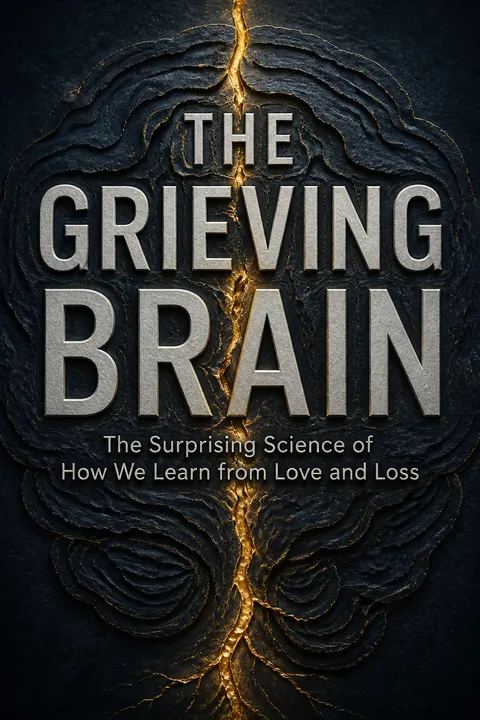


Key Takeaways
Treat grief as a wave, and grieving as your brain's slow relearning.
Two experiences, not one. O’Connor distinguishes grief, the recurring surge of pain, from grieving, the longer process of adapting to life without the person. A wave of grief can still arrive years after a death, even when daily life has become meaningful again. What changes is not necessarily the emotion itself, but a person’s familiarity with it and confidence that it will pass.
Learning happens through experience. The brain has built expectations around a loved one’s presence, from shared routines to where that person is likely to be. Those predictions are revised through repeated encounters with a changed world. A month of living, remembering, and making new choices teaches the brain more than a month spent unconscious. This is why adaptation cannot be hurried by a calendar or commanded by willpower.
The distinction between an emotion and the process of adapting prevents a common category error: interpreting every later wave as proof that no progress has occurred. It also frames recovery as learning from experience, not erasing attachment. That model makes room for both continuing love and changed daily life. The learning metaphor has limits, however. Bereavement is not a classroom problem with a clear answer or a finish line. Cultural practices, material hardship, and the circumstances of the death shape what experiences are available and how they are understood.
Expect your brain to search for the person it knows is gone.
The brain predicts presence. O’Connor describes the mind as using an internal map to anticipate where important people are, much as it predicts the position of furniture in a familiar room. In a rat study, neurons responded not only to a blue tower, but also to the place where it had stood after researchers removed it. That trace persisted for an average of five days as the rat adjusted to the change.
Attachment adds closeness. O’Connor organizes the brain’s sense of a loved one around three dimensions: here, now, and close. Death makes all three expectations fail at once. A bereaved person may reach for the phone, expect a familiar sound, or feel the urge to search. Such responses reflect a mind catching up with a reality it did not predict, not evidence of madness.
The mapping metaphor makes disorientation intelligible: the mind is not simply refusing a fact, it is updating a deeply practiced model. The rat finding offers a concrete demonstration that expectations can persist after their object disappears. It should not be mistaken for direct proof that the same cells explain human grief. Animal navigation research supports a useful analogy, while human attachment involves memory, culture, language, and individual meaning. Keeping that distinction clear preserves the explanatory value without turning a metaphor into a complete neural account.
Let factual knowledge and attachment's expectation of return coexist.
The mind holds different kinds of knowledge. Someone may remember receiving the news of a death, yet still expect the deceased to come through the door. O’Connor calls this conflict the “gone-but-also-everlasting” pattern. Episodic memory records particular events, such as the phone call or funeral. Other, less conscious knowledge is built from years of attachment and habit, and continues to predict the person’s presence.
Experience updates expectation. The two forms of knowledge do not necessarily change at the same pace. Chimpanzee mothers have been observed carrying and grooming dead infants, while also showing signs of recognizing the death. Human funerals and memorials can similarly make the loss tangible through shared actions and memories. These rituals do not remove pain, but they can help a person absorb what has happened without requiring every part of the mind to accept it at once.
This account offers a more humane alternative to labeling bereaved people as being in denial. A person can understand a death intellectually while still feeling, in habit or expectation, that the deceased might return. Rituals matter here not because they impose a universal timetable, but because they create shared, memorable encounters with the reality of loss. Their meaning varies across cultures and families, and not everyone has access to a body, funeral, or goodbye. The absence of those experiences can leave the loss harder to place.
Reject grief's stage script: most bereaved people never become depressed.
Grief does not follow a fixed sequence. The familiar five-stage account was developed from interviews with people facing terminal illness, then widely applied to bereavement. It was a description of experiences, not an empirically established schedule everyone must follow. People may experience some reactions, skip others, revisit old feelings, or find that acceptance grows unevenly.
Large studies reveal varied paths. In the Changing Lives of Older Couples study, researchers followed more than 1,500 older adults and interviewed surviving spouses after a death. More than half showed a resilient pattern, meaning they did not develop depression at the measured points six and eighteen months after losing a spouse. Other patterns included prolonged grief and depression that had begun before the death. These differences matter: seeing someone struggle after a loss does not reveal whether the struggle began with bereavement.
The findings correct a powerful cultural story: suffering is not a ladder of emotions that everyone must climb to earn recovery. The prospective study design is especially useful because it includes information from before the death, rather than relying only on a bereaved person’s later recollection. Still, resilience does not mean an absence of grief, and measurements at six and eighteen months cannot capture every private fluctuation. Population patterns offer context, not a verdict on an individual’s timetable or depth of love.
Separate ordinary grief from persistent yearning that disrupts daily life.
Grief and depression differ. Depression tends to spread across many areas of life. In prolonged grief, distress is more specifically organized around missing the deceased, often with intense yearning and difficulty imagining life without them. This distinction is not a reason to diagnose oneself. A grief disorder requires persistent symptoms and meaningful interference with work, family, or other responsibilities, considered in the person’s cultural context.
Targeted help can work. O’Connor describes Vivian, a widow who continued buying and cooking food for two, then threw away the uneaten half. In Complicated Grief Treatment, she explored painful memories, practiced facing them in manageable doses, and tried new routines. In a clinical trial among older adults, 70 percent receiving this treatment recovered, compared with 32 percent receiving another therapy. The point is not that every grieving person needs treatment, but that severe, stuck suffering is treatable.
The distinction protects two groups at once: people whose grief is painful but within a common range, and people whose persistent symptoms are disabling and deserve effective care. It also resists the idea that the intensity of love can be measured by the duration of impairment. Diagnostic thresholds remain difficult because grief varies across cultures and relationships, and a label can either open access to help or make ordinary suffering sound pathological. Assessment should focus on distress, functioning, time, and context together.
Move between mourning and practical rebuilding instead of demanding constant grief work.
Two kinds of strain follow loss. The Dual Process Model of Coping with Bereavement distinguishes loss-oriented stressors, such as yearning and reminders, from restoration-oriented stressors, such as handling finances, shopping, or parenting alone. Grieving involves moving between these demands, sometimes across a day and sometimes within minutes. A person might cry in a restroom, then return to work, or attend to paperwork before looking through old photographs.
Flexibility matters more than constant confrontation. Time away from grief can provide needed rest; it is not automatically denial. Conversely, practical activity cannot permanently replace attention to the loss. The model’s central insight is the movement between the two kinds of coping, alongside ordinary moments that belong to neither. As life becomes more manageable, the stressors may become less frequent or intense, while the bond and its reminders remain.
The model treats coping as responsive rather than moral. It avoids praising constant emotional exposure as brave and condemning distraction as weakness. That is valuable because attention and energy are limited, especially under stress. The model is best used as a map, not a rule requiring equal time in each mode. A person’s circumstances may make practical restoration urgent, while trauma, isolation, or cultural expectations may make loss-focused support harder to access. Flexibility includes recognizing when help from others is necessary.
Replace endless what-ifs with reflection that leads somewhere.
Replaying is not always processing. Counterfactual thinking imagines how events might have gone differently: if someone had called sooner, insisted harder, or made another choice. It can offer a sense of control, but it cannot establish what would actually have happened. Rumination is repetitive, passive thinking about distress. Research discussed by O’Connor distinguishes reflection, which can help organize thoughts, from brooding, which tends to keep a person circling the same questions.
Rumination can conceal avoidance. In studies using reaction-time and eye-tracking tasks, people who reported more grief-related rumination were more likely to show automatic avoidance of reminders of the deceased. The mind may revisit explanations while steering away from the felt reality of the loss. A useful question is not only whether a thought is true, but whether it can lead to a choice or action. If not, it may be time to shift attention or seek support.
The difference between reflection and brooding gives a practical test for thought: is it producing understanding or a next step, or merely replaying distress? This should be applied gently. Repeated thoughts can arise involuntarily, and a person should not be blamed for failing to switch them off. The evidence connecting rumination and avoidance is suggestive rather than a simple one-way causal story. Still, it reveals why intellectual analysis alone may not resolve grief: explanation and emotional contact are related, but they are not interchangeable.
Enter the present in doses, where grief and joy can both occur.
Acceptance is not approval. O’Connor describes accepting as noticing what is happening without trying to force it away or turn it into a permanent forecast. A wave of sadness may arrive, be felt, and recede. This differs from resignation, which assumes that nothing meaningful can happen again. Early on, the present may be tolerable for only brief moments; attention can return to it gradually.
Pleasure is allowed. In one study, bereaved participants who watched a funny clip after writing about their loss reported less sadness than those who watched a sad or neutral clip. Positive experiences do not cancel love or erase grief. They can widen attention and offer a break. Supporters can help by listening and staying close, rather than treating cheerfulness as the goal. Even sleep routines may need rebuilding because familiar bedtime cues have become reminders of absence.
The emphasis on doses respects how overwhelming acute grief can be while preserving access to ordinary life. The finding about humor is useful precisely because people may expect enjoyment to feel disloyal. It does not imply that positive emotion is a cure or that everyone should seek distraction at every moment. Present-moment attention can expose pain as well as comfort. Its value lies in allowing both to register, rather than letting avoidance of pain seal off every source of connection and pleasure.
Build a future that honors the dead without asking new bonds to replace them.
The future needs practice. Remembering personal episodes and imagining possible futures draw on overlapping mental capacities. People with complicated grief in one study had greater difficulty generating memories and future scenes that did not include the deceased. Planning small activities, then noticing how they actually feel, gives the brain new evidence about life as it is now. Holidays, weekends, and daily routines can be approached through experiments rather than demands for instant certainty.
A changed bond can remain real. New relationships do not have to fill the place of the person who died. The deceased may remain present through memories, values, rituals, or a continuing bond, while living people take on new roles. After her young son Ben died, Jeannette Maré helped create Ben’s Bells, a kindness project shaped by the support she had received. Her life was not the one she had imagined, but meaningful action became possible within it.
This perspective makes adaptation less like replacement and more like expansion: the past remains part of identity while new sources of care and purpose become available. Small plans are a form of information gathering, not a promise that an activity will feel good. That distinction reduces the pressure to choose perfectly. The story of Ben’s Bells also shows that meaning can emerge through connection and contribution without making tragedy seem beneficial or necessary. Growth after loss is possible, but it should never be demanded as proof of healing.
Analysis
O’Connor’s central contribution is not a claim that grief can be reduced to brain activity. It is a change in the question. Instead of asking why a bereaved person has not accepted an obvious fact, she asks what a prediction-making, attachment-shaped brain must learn when its most important person disappears. That shift turns searching, expectation, yearning, and sudden reminders from signs of irrationality into understandable consequences of a system built around relationships.
The book’s strongest synthesis joins neural prediction with psychological adaptation. The internal map explains why absence can feel unreal; the distinction between episodic and implicit knowledge explains why knowing about a death does not immediately extinguish expectation; and the dual process model explains why practical activity and grief-focused attention can alternate. These accounts make a coherent model without prescribing a uniform emotional route. The discussion of resilience is equally important: clinical samples overrepresent people who need help, while large prospective studies show that many bereaved people do not develop depression.
The neuroscience is most persuasive when it illuminates experience, and least persuasive if treated as a complete causal explanation. Rat navigation, vole bonding, and human imaging offer complementary clues, but none alone explains an individual’s grief. Brain activation is not a direct reading of a feeling, and a study taken at one moment cannot establish how neural activity changes across a grieving trajectory. O’Connor acknowledges these limits, which helps keep the argument humane rather than biologically deterministic.
The book’s practical implication is modest but consequential: adaptation is neither forgetting nor a forced march toward acceptance. It is the gradual accumulation of experiences that make a changed life more navigable. That framing also carries an ethical lesson for friends and clinicians. Support is not measured by whether it removes grief, but by whether it helps the bereaved person stay connected to reality, to other people, and to possible sources of meaning without invalidating the bond that remains.
Review Summary
The Grieving Brain receives mostly positive reviews for its scientific approach to understanding grief. Readers appreciate the neurological explanations and research-based insights, finding them helpful in processing their own experiences. Many praise the book's compassionate tone and accessible writing. Some readers note the book's focus on spousal loss and dense scientific content. Overall, reviewers find the book informative, validating, and a valuable resource for understanding the grieving process, though a few wished for more practical applications of the research.
People Also Read



Glossary
grief
Recurring pain of lossO’Connor uses grief for the intense emotion that surges after a loved one dies. It can recur throughout life, including after a person has adapted and built a meaningful life. A wave of grief is therefore not, by itself, evidence that grieving has failed or that adaptation has stopped.
grieving
Adaptation after a deathGrieving is O’Connor’s term for the changing process of learning to live meaningfully without a deceased loved one. It involves revising habits and expectations, responding to the loss, and rebuilding daily life. Unlike grief as an emotion, grieving has a trajectory, though that trajectory is not uniform or strictly linear.
here, now, and close
Three dimensions of attachmentO’Connor’s model for how the brain keeps track of loved ones. Here refers to physical location, now to time and expected return, and close to psychological attachment. Death disrupts all three expectations, helping explain why bereaved people may search for the deceased or feel that the person is somehow still present.
gone-but-also-everlasting theory
Conflicting knowledge after lossO’Connor’s description of the mind holding two conflicting forms of knowledge after a death. Episodic memories can establish that the person died, while attachment-based expectations and habits still anticipate the person’s presence. Repeated experience in the changed world gradually updates those expectations, but the two forms of knowledge need not change together.
Dual Process Model of Coping with Bereavement
Alternating forms of copingA model developed by Margaret Stroebe and Henk Schut. It distinguishes loss-oriented stressors, such as yearning and reminders of the deceased, from restoration-oriented stressors, such as new practical responsibilities and changed roles. Coping involves moving between these demands, with breaks in ordinary life also contributing to adaptation.
complicated grief
Severe, persistent grief difficultiesO’Connor uses complicated grief for a severe and prolonged form of grieving that can involve intense yearning, preoccupation with the deceased, and difficulty resuming meaningful activities. It is not simply a synonym for deep love or normal grief. Assessment considers persistence, interference with daily functioning, and cultural context; targeted psychotherapy can help.
Yearning in Situations of Loss (YSL) scale
Measure of yearning across lossesA self-report scale developed by O’Connor and Tamara Sussman to assess yearning in bereavement, romantic breakups, and homesickness. Its questions are adapted to the type of loss, allowing researchers to compare yearning across situations while distinguishing it from related experiences such as depression.
rumination as avoidance hypothesis
Thinking can evade feelingA hypothesis associated with bereavement researchers Margaret Stroebe and colleagues. It proposes that repetitive thought about a loss may sometimes distract from directly experiencing its emotional reality. Studies using reaction-time and eye-tracking tasks found that greater reported rumination was associated with stronger automatic avoidance of reminders of the deceased.
continuing bonds
Ongoing inner relationshipContinuing bonds are ways a bereaved person maintains a relationship with someone who has died through memory, conversation, rituals, values, or actions that honor the person. They vary widely between individuals and cultures. Their presence is not automatically a sign of unresolved grief; the relationship changes because direct physical interaction is no longer possible.
FAQ
What's The Grieving Brain about?
- Exploration of Grief and Neuroscience: The Grieving Brain by Mary-Frances O'Connor explores how our brains process the loss of loved ones, combining insights from neuroscience and personal experiences.
- Two-Part Structure: The book is divided into two parts, focusing on the painful aspects of loss and the restoration of life after loss, addressing specific questions related to grief.
- Scientific and Personal Insights: O'Connor blends scientific research with personal narratives, making the book accessible and informative for both lay readers and professionals.
Why should I read The Grieving Brain?
- Comprehensive Understanding of Grief: The book provides a deep understanding of grief, incorporating the latest neuroscience findings to explain why grief can feel overwhelming.
- Practical Insights: Readers gain practical insights into navigating their own grief or supporting others, emphasizing that grieving is a learning process fostering hope and resilience.
- Empathy and Compassion: It encourages empathy towards oneself and others experiencing grief, helping readers approach their experiences with greater compassion.
What are the key takeaways of The Grieving Brain?
- Grief vs. Grieving: O'Connor distinguishes between grief (the intense emotion) and grieving (the process of adapting), helping individuals navigate their emotional experiences.
- Neuroscience of Grief: The book explains how the brain struggles to adapt to the absence of a loved one, likening it to updating a mental map.
- Resilience in Grieving: Many people adapt well to loss, demonstrating resilience, and the book emphasizes the possibility of restoring a meaningful life through grieving.
How does The Grieving Brain explain the brain's processing of grief?
- Neural Mapping: The brain creates a "virtual map" of loved ones, which becomes disrupted upon their death, leading to confusion and emotional pain.
- Object-Trace Cells: These cells continue to fire even after a loved one is gone, indicating the brain's ongoing search for the deceased.
- Emotional Pain: Grief activates brain regions associated with emotional pain, similar to physical pain, highlighting the deep-rooted nature of grief in our brain's response systems.
What is the difference between grief and grieving as defined in The Grieving Brain?
- Grief as Emotion: Grief is the intense emotional response to loss, characterized by sadness, anger, and yearning.
- Grieving as Process: Grieving is the ongoing process of adapting to life after loss, involving learning to live without the loved one.
- Key Distinction: Understanding this distinction helps individuals recognize that while grief may never fully disappear, grieving can evolve, allowing for healing and adaptation.
How does The Grieving Brain define complicated grief?
- Chronic Grieving: Complicated grief involves a prolonged and intense reaction to loss that interferes with daily functioning.
- Neural Activation Differences: Neuroimaging studies show different brain activation patterns in those with complicated grief, particularly in the nucleus accumbens.
- Impact on Identity: Complicated grief can lead to a distorted sense of self, where individuals may feel incomplete without their loved one.
What is the dual process model of coping with bereavement in The Grieving Brain?
- Balance of Loss and Restoration: This model involves oscillating between loss-oriented and restoration-oriented activities to cope effectively.
- Flexibility in Grieving: Emotional flexibility is emphasized, allowing individuals to adapt their coping strategies based on their current emotional state.
- Practical Application: The book provides examples of applying this model, such as grieving while also seeking joy and connection with others.
How does The Grieving Brain address the concept of yearning?
- Yearning as a Normal Response: Yearning is a natural reaction to loss, reflecting deep emotional bonds with loved ones.
- Neuroscience of Yearning: Yearning activates brain regions associated with reward and craving, highlighting the complexity of grief.
- Healthy Expression of Yearning: Acknowledging and expressing yearning can be a healthy part of the grieving process, allowing individuals to honor their loved ones.
How does The Grieving Brain redefine our understanding of resilience in grief?
- Resilience as Common: O'Connor presents resilience as a common response to grief, with many individuals adapting well over time.
- Learning and Growth: Grieving is framed as a learning process, suggesting that individuals can grow and find meaning in their experiences of loss.
- Empirical Evidence: The book supports its claims with empirical evidence, showing that many people do not experience debilitating grief.
What role does emotional flexibility play in grieving according to The Grieving Brain?
- Adaptation to Change: Emotional flexibility is crucial for adapting to changes that come with loss, helping individuals cope more effectively.
- Variety of Coping Strategies: Developing a toolkit of coping strategies allows individuals to respond to their grief in beneficial ways.
- Avoiding Stagnation: Emotional flexibility promotes resilience and helps individuals find meaning in their new reality, avoiding prolonged suffering.
How does The Grieving Brain suggest maintaining a connection with deceased loved ones?
- Transforming Continuing Bonds: The book discusses transforming the relationship with the deceased into a continuing bond integrated into daily life.
- Creating New Memories: Encourages creating new memories that honor loved ones while allowing for personal growth.
- Embracing Complexity: Maintaining a connection with the deceased involves carrying their memory forward while living fully in the present.
What insights does The Grieving Brain provide about the neuroscience of grief?
- Brain Regions Involved: Details specific brain regions activated during grief, such as the insula and anterior cingulate cortex.
- Neuroplasticity and Learning: The brain's plasticity allows for learning and adaptation following loss, supporting the healing journey.
- Implications for Therapy: Insights from neuroscience can inform therapeutic approaches, leading to more tailored interventions for those struggling with complicated grief.
Download PDF
Download EPUB
.epub digital book format is ideal for reading ebooks on phones, tablets, and e-readers.








