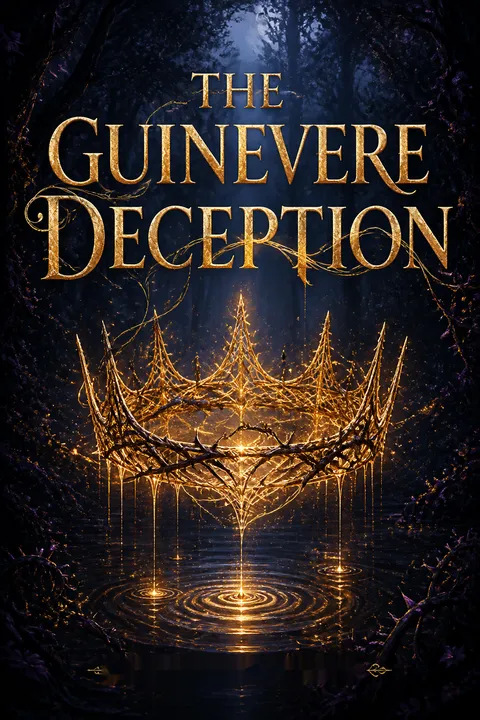


Plot Summary
Veil Over Camelot
On the road to Camelot, the veiled sixteen-year-old travels with Brangien and a ring of knights. A forest springs up where farms stood days earlier, then swallows a village, leaving cottages tangled in vines. At a river crossing, terror freezes the girl until Brangien holds her hand and Mordred carries her to dry ground.
Camelot rises from a mountain surrounded by water, and King Arthur welcomes his promised bride before a cheering crowd. The girl knows the name she wears belongs to someone dead. Merlin, who raised her in the forest, has sent her to take that princess’s place, but she does not know what danger he expects her to face.
The opening makes identity an assignment before it becomes a feeling. The heroine is not simply entering a court; she is being delivered into a role that others already recognize and celebrate. Her fear of water gives the mission an embodied cost, while her response to the sudden forest shows that she is more at home with the wild than with Camelot’s human-made grandeur. Brangien’s hand is the first counterweight to the men’s protective circle: care, rather than authority, enables the girl to move forward.
A Wedding Without a Name
After the ceremony, Arthur privately asks who his bride really is. She explains that Merlin is her father and that he sent her to protect the king from a coming magical threat. The real Guinevere died, and Merlin erased her from the convent’s memories so the impostor could inherit her place. Arthur accepts the deception and agrees their marriage need not be consummated.
He misses Merlin, whom Camelot banished when Arthur outlawed magic, yet he believes the banishment necessary to preserve order. Guinevere begins guarding his rooms with fragile knot spells made from hair, breath, and thread. That night, unseen insects sent by the Dark Queen die against her protections, confirming that something has already begun testing Camelot.
The marriage is both shelter and confinement. Guinevere gains access to Arthur, but only by letting a borrowed identity govern her movements and body. Arthur’s compassion makes the arrangement safer than she expected, yet his ban on magic means her protection must remain invisible. Their shared loyalty to Merlin creates instant intimacy while concealing how little either knows about the mission. The failed insect attack establishes a useful contrast: Camelot’s official strength is walls and law, while Guinevere’s defense is small, personal, and costly.
The Masked Arena Stranger
Brangien takes Guinevere through Camelot, where the queen discovers aqueducts, crowded streets, and the practical work Arthur has done to make the mountain city function. At the arena, a masked fighter defeats aspirants with uncanny speed and discipline, then vanishes without giving a name. Guinevere suspects a magical assassin because he climbs down Camelot’s sheer cliff after receiving a strange bundle from a woman.
Mordred, Arthur’s watchful nephew, also treats the fighter as a possible threat, though Arthur trusts the arena’s iron weapons to exclude fairies. Guinevere’s concern grows when she sees Mordred watching her as closely as he watches the stranger. She decides to investigate without exposing her own magic.
The arena turns Arthur’s ideals into a public institution: anyone may try to earn a place through skill, though the system still favors trained men. Guinevere sees both the promise and the vulnerability in that openness. Her suspicion is sharpened by a private knowledge of magic, but it also risks making every unfamiliar person look like an enemy. Mordred’s attention unsettles her because it is both protective and investigative. His watchfulness foreshadows a recurring tension between being seen as a person and being scrutinized as a possible danger.
Rocks Beneath the Market
Guinevere learns that Rhoslyn, the woman who supplied the masked fighter, has been tried for magic and banished. She follows the guards escorting Rhoslyn, only to see armed men waiting outside Camelot’s border to kill her. The masked fighter arrives first, drives off the attackers with arrows, and takes Rhoslyn deeper into the forest.
Guinevere steals a smooth stone from the woman and feels magic humming inside it. Later, she discovers similar stones mark points around the city and lead her to Rhoslyn’s empty home. She concludes that a hidden network is gathering magic against Arthur. The evidence is real, but she mistakes Rhoslyn’s efforts to help her family for a conspiracy against Camelot.
The episode exposes the moral gap between Arthur’s law and its enforcement. Rhoslyn receives banishment rather than death, but the guards’ indifference leaves her exposed to violence beyond the border. Guinevere recognizes the injustice before she understands the people involved, and her protective instincts turn uncertainty into a theory of conspiracy. The stones make that error materially persuasive: they are evidence of organized magic, but not necessarily hostile intent. The book asks whether vigilance remains virtuous when fear supplies the interpretation.
Merlin’s Crime Comes Due
On the journey to a meeting with the Picts, Mordred tells Guinevere that Merlin used magic to disguise himself as Uther Pendragon and deceive Igraine, Arthur’s mother, into believing her husband had returned. The revelation overturns Guinevere’s image of her guardian. At the camp, Sir Maleagant arrives uninvited, claims territory Arthur’s allies had negotiated away, and taunts the king through his wife.
Arthur later admits that Maleagant’s sister Elaine once loved him, became pregnant, and died after Arthur banished her and sent her away. Maleagant had plotted to use her child to seize power. Arthur spared him in the past, and now the former ally is growing into a threat on Camelot’s borders.
The section refuses to let benevolent outcomes cleanse coercive means. Arthur’s existence and Camelot’s founding depend on Merlin’s violation of Igraine, while Arthur’s own mercy toward Elaine helped leave Maleagant alive. Guinevere must now hold admiration and moral revulsion together rather than letting one cancel the other. The two men’s histories also mirror each other: both made choices for a future they considered necessary, and both left other people to bear the cost. Maleagant turns those inherited injuries into immediate political danger.
Fire Against the Fever
Arthur avoids Maleagant’s expected ambush by leading his company through a forest, where wolves attack from the mist. Sir Tristan pulls Guinevere from danger but takes a bite that infects him with a rapidly spreading poison. Arthur forbids Guinevere to use magic because discovery could undermine his rule, even if Tristan dies.
While the knights fend off wolves, she secretly sends cleansing fire into Tristan’s wound and burns away the infection. He wakes alive, and Mordred sees the forbidden spell but keeps it secret. On the ride back, Mordred cools Guinevere’s burned hand with leaves and gives her a flower, showing that he understands the wild magic she practices even when Camelot’s laws condemn it.
Guinevere’s decision makes care more than obedience. Arthur evaluates the risk through the stability of his kingdom, while she sees the particular body in front of her and refuses to let policy turn a preventable death into an acceptable loss. Her choice is not cost-free: she risks exposure and burns herself. Mordred’s silence becomes an ethical act, not merely a secret shared. The flower he gives her suggests that the forest is not only a source of danger; it also offers forms of knowledge and tenderness that Camelot’s rigid categories exclude.
Brangien’s Hidden Longing
Back in Camelot, Guinevere discovers that Brangien has been using sleep magic to search for Isolde, the woman she loved and lost when both she and Sir Tristan were banished. Brangien admits that she bewitched Tristan into helping her scry. Guinevere confirms through touch that Brangien means no harm, then uses Isolde’s hair to give Brangien a dream visit with her beloved.
The kindness binds the two women more closely, and Brangien begins teaching Guinevere her own magic. Meanwhile, Guinevere’s enchanted stones lead her to Rhoslyn’s former home, and news arrives that Sir Bors is hunting a dragon. Guinevere suspects the creature may be tied to the darkness she has been tracking.
Brangien’s secret reframes her from helpful attendant into a person with a private life and an allegiance beyond Camelot. Guinevere responds not by policing the forbidden spell but by learning what grief prompted it. Her magic becomes a means of connection rather than defense, and she discovers that secrecy can protect love as well as conceal danger. This deepens her growing community in Camelot, even as the dragon report pulls her toward a threat she cannot yet classify.
The Dragon’s Last Season
Guinevere rides with Brangien and Sir Tristan to find the dragon before Bors kills it. She locates the knight by extending her sight through a spell, then puts him to sleep just as he prepares a fatal blow. The wounded dragon lets her touch its head, sharing memories of its lost family and its approaching death.
It asks, through those memories, for one final year alone in the wild. Guinevere grants it that time, then alters Bors’s memory so he believes he killed the beast and will not hunt it again. She leaves the knight in filthy, convincing evidence of a victory. Her mercy preserves the dragon, but her violation of Bors’s mind leaves her ashamed.
The dragon’s request confronts Guinevere with the cost of progress in a form she can feel rather than theorize about. The creature is dangerous by history, yet its present desire is modest: time to meet its end without pursuit. Guinevere chooses compassion, but secures it through coercion, manipulating Bors’s memory and accepting that protection can become an act of control. Her conduct echoes Merlin’s methods in miniature. The resemblance troubles her because she is beginning to understand how good intentions can make force feel justified.
The Knight Beneath the Mask
During a later hunt, a boar with unnatural focus charges Guinevere and Brangien. Guinevere draws it away, but the masked fighter, now wounded, kills it before it can gore her. A black spider bites Guinevere, and its poison quickly overwhelms her. The fighter carries her to Rhoslyn’s settlement, where Rhoslyn and other women draw out the magical poison.
Guinevere heals the fighter’s deep wound with cleansing fire and a skin-binding spell, then learns the fighter is a woman who has trained to become a knight. She promises to protect the secret and support her bid for a place in Arthur’s court. The fighter gives her name as Lancelot and agrees to help Guinevere find Merlin.
The rescue reverses Guinevere’s assumptions about who needs protection. Lancelot is not merely a mystery to be solved, but a skilled person whose ambition is blocked by the rules governing who may become a knight. Guinevere’s healing creates reciprocity: she can offer practical aid without demanding that Lancelot surrender her own purpose. Rhoslyn’s community likewise contradicts the image of a hostile magical cell. Its members use their knowledge to save a stranger, revealing how little Guinevere’s earlier suspicion captured about their actual motives.
The Lake Takes Merlin
Guinevere and Lancelot reach Merlin’s abandoned cottage, then follow a magically compelled bird to a cave. The Lady of the Lake confronts Merlin there, accusing him of taking something precious from her. He acknowledges his guilt but does not resist when she raises a flood that collapses the cave and seals him inside. Guinevere believes Excalibur is what Merlin stole and hurries back to Arthur’s camp.
Arthur explains that Merlin had foreseen the confrontation and asked him to keep Guinevere safe, not to send her as his magical bodyguard. The revelation empties the mission she thought defined her. Yet Arthur asks her to remain, and she chooses to stay as queen, despite learning that the sword makes her feel an unnatural void.
The cave scene strips away the protective story Guinevere has used to justify her place. Merlin’s silence is not simply an information gap; it has shaped her choices and made her mistake danger to Arthur for danger to herself. Arthur’s confession restores some honesty while exposing his own part in the deception. Her choice to stay therefore matters precisely because the mission no longer compels her. The sword’s void introduces a further contradiction: the object that legitimizes Arthur’s power may be hostile to the magic at Guinevere’s core.
A Queen by Choice
After Arthur admits Merlin’s real instruction, Guinevere struggles with the thought that she is only a burden. When he returns from the border, he explains that he married her partly to prevent another political match and partly because Merlin’s daughter might become a trusted friend. He asks her to stay by choice, not duty, and she accepts.
Guinevere also tells him the truth about the dragon, though she softens the moral weight of changing Bors’s memory. Arthur agrees she may investigate Rhoslyn and the masked knight with his knowledge. She takes on the queen’s work, planning the tournament and learning how much labor lies beneath courtly appearances, while continuing to wonder whether Camelot can be home to someone like her.
Arthur’s explanation is affectionate but not uncomplicated. He chose Guinevere partly for his own relief, using the queen’s role to protect himself from political pressure and loneliness. Naming that selfishness gives their bond a more honest foundation, but it does not resolve Guinevere’s uncertainty about whether she belongs. Her acceptance is an act of agency rather than simple romantic surrender. The tournament preparations also make queenship concrete: it involves negotiation, logistics, and social labor, not merely standing beside a king.
Lancelot Wins Camelot
At the tournament, Lancelot defeats Sir Tristan, Sir George, Sir Gawain, Sir Percival, and Sir Bors, then matches Arthur closely enough that he declares her a knight. Guinevere watches proudly, though the contest and the sight of Excalibur trigger another wave of sickness. Before the celebration, she kisses Mordred and pulls away when the pain in her hand breaks the moment.
Mordred admits he loves her, but she cannot answer. A stranger enters her tent carrying a sack and knocks her unconscious. Maleagant takes her to a riverside prison, where he asks whether Arthur would trade Camelot for her. Guinevere knows he would not, and refuses to reveal the hidden passage into the castle.
Lancelot’s victory gives public form to a claim the court’s rules would otherwise suppress: worth cannot be measured by gender alone. At the same time, Guinevere’s private life remains unsettled. Mordred offers desire and attention, while Arthur represents a steadier but less exclusive attachment. Her abduction interrupts the choice before she can test it. Maleagant’s question about whether Arthur would sacrifice his kingdom transforms her romantic insecurity into a political calculation, and her refusal protects Camelot even when she doubts she matters to it.
A River Escape
Maleagant threatens to use Guinevere as leverage and discovers she will not reveal the secret tunnel. She nearly gives herself to the river rather than let him turn her against Arthur, but Lancelot breaks in and throws the guards into the water. To cross the channel, Guinevere climbs onto Lancelot’s back and finally faces the water without shame about her fear.
Lancelot explains that Brangien found Mordred, who recognized the prison and helped plan the rescue despite Arthur’s decision to wait. When Maleagant’s riders pursue them, Mordred joins the escape and proposes using a weapon Arthur would never choose: waking the ancient trees. Guinevere agrees to lead them into a forest and try to control it.
The escape makes interdependence visible. Guinevere’s survival depends on women and men acting beyond the king’s permission, while her crossing of the river turns an old terror into a deliberate risk taken with help. Arthur’s restraint is politically consistent, but it leaves others to absorb immediate danger. Mordred’s plan offers a way around that restraint by appealing to the magic Guinevere has tried to contain. The choice places her between loyalty to Camelot and the wild power that has always answered her touch.
The Trees Take Their Due
Guinevere wakes the trees with her blood, but their ancient hunger escapes her control. They kill Maleagant and begin rebuilding the Dark Queen from the earth. Mordred reveals that the queen is his grandmother and that he engineered the awakening to restore wild magic.
When Arthur arrives, Excalibur destroys the awakened trees, but Mordred uses Guinevere as a shield, forcing Arthur to choose between killing her and stopping the Dark Queen. Arthur lowers his sword. Mordred rides away with Guinevere, arguing that Camelot has made her a prisoner, but she burns his hands with fire and escapes. Returning to Arthur, she finds him alive, Lancelot wounded, Maleagant dead, and the Dark Queen loose in the forest.
The climax makes Guinevere’s power morally dangerous rather than automatically liberating. Her blood awakens a force that does not distinguish justice from appetite, and Maleagant’s death cannot be separated from the return of the Dark Queen. Mordred’s critique of Camelot is persuasive because the kingdom has excluded him and erased magic, but his solution repeats the coercion he condemns by using Guinevere as an instrument. Arthur’s refusal to kill her is a choice against the sword’s logic of absolute eradication. Guinevere’s escape rejects both political domination and romantic possession.
Rain Over Camelot
Arthur asks Guinevere to come home, and she agrees on two conditions: she will lead Camelot’s defense against the Dark Queen, and she will choose her own protector. Arthur accepts Lancelot for that role, while promising to knight her with a sword other than Excalibur. They return to Camelot together.
Brangien embraces Guinevere, and the crowd welcomes its queen; Dindrane arrives beside Sir Bors, suggesting a new companionship of her own. Guinevere rides the ferry across the lake despite her fear, then lets rain touch her face for the first time. The water renews her strength, but the final glimpse shows a face forming in a distant lake, still claiming what Merlin took.
The ending gives Guinevere a home without pretending that belonging ends the conflict. She chooses the queen’s role, but revises its terms: protection becomes her responsibility, and Lancelot’s appointment rejects the assumption that a queen must be guarded by the king alone. Her willingness to cross the lake marks a real change in her relationship to fear, not its disappearance. Rain offers renewal, while the stirring presence beneath the distant water prevents closure from becoming complacency. Camelot has been chosen, but its magical debts remain unpaid.
Analysis
The Guinevere Deception makes identity less a secret to be solved than a role with consequences. Its heroine enters Camelot under a borrowed name, but the impersonation is not only a disguise. It forces her to learn the daily labor of being a queen while confronting the violence that produced the kingdom she is meant to defend. Her emerging self is shaped by a succession of choices: protecting Tristan at the risk of exposure, sparing the dragon through a violation of Bors’s memory, and refusing Mordred even after he names the real cost of Camelot’s order.
The novel complicates the familiar opposition between civilization and wilderness. Arthur’s laws make roads safer, markets possible, and justice more imaginable than under Uther. Yet the ban on magic also leaves Rhoslyn’s community vulnerable to violence and dismisses forms of knowledge that can heal, protect, and connect. The Dark Queen, meanwhile, represents no simple restoration of moral balance. The wild is alive, but its life includes predation and indifference. Guinevere’s awakening of the trees shows how quickly the desire to defend a just cause can release power that does not share that cause.
Magic and politics therefore mirror one another. Merlin alters memory and history to create a future; Arthur restricts magic to preserve a human society; Guinevere discovers that neither intention nor love guarantees ethical action. Her final choice is not a clean reconciliation. She chooses Camelot while accepting that it has damaged what she is, and she insists on changing the terms of her service by claiming authority over her own protection. The closing rain signals renewal, but the Lady of the Lake’s stirring prevents triumph from becoming certainty. Guinevere has found a home, not an escape from history.
Review Summary
People Also Read





Characters
Guinevere
The borrowed queenA young forest-raised magician sent to Camelot under the identity of a dead princess, Guinevere is observant, compassionate, and inexperienced in ordinary human life. Her powers are intimate and costly: she reads traces through touch, binds spells with knots, and uses fire for cleansing. She enters court believing her worth depends on protecting Arthur, then discovers that service, affection, and identity do not fit neatly together. Guinevere’s central struggle is not simply whether to obey a king or use magic, but how to act ethically when every available choice can injure someone. She is drawn to the living world, from animals to crowded markets, and wants a place where she can be both powerful and known.
Arthur
Camelot’s idealist kingArthur is an eighteen-year-old king trying to build a just country from the ruins of his father’s rule. Raised partly among ordinary people, he attends to roads, markets, water systems, and the daily needs that grand stories tend to omit. His warmth and instinctive fairness coexist with a strict ban on magic, which he sees as a danger to the fragile order he has built. He loves his knights as family and bears responsibility as a personal burden, often choosing restraint even when it leaves enemies room to grow. With Guinevere, he hopes for friendship and honesty, though he does not always understand how the duties of kingship make her feel peripheral.
Mordred
The watchful royal nephewMordred is Arthur’s older nephew, a graceful swordsman who rarely competes in the arena and seems to notice what others overlook. He is loyal to Arthur, distrustful of easy explanations, and unusually attentive to Guinevere’s contradictions. His family history places him close to the wounds at Camelot’s foundation, and he carries a complicated understanding of both human law and wild magic. He is capable of tenderness, especially toward animals, but his intensity can make care feel like scrutiny. Mordred values freedom from imposed roles and recognizes how much Guinevere longs to be seen beyond her title, even as his own desires complicate that recognition.
Brangien
The queen’s steadfast maidBrangien is Guinevere’s eighteen-year-old companion and lady’s maid, practical enough to manage courtly clothes and warm enough to make Camelot less strange. She is quick-witted, observant, and more comfortable with people than Guinevere is, but her composure conceals grief and a persistent private love. Her loyalty is active rather than unquestioning: she protects Guinevere, keeps secrets, and takes risks for someone she trusts. Brangien’s knowledge of herbal and knot magic gives Guinevere a source of instruction outside Merlin’s influence. She helps the queen navigate social rules while reminding her that friendship can be chosen, reciprocal, and rooted in ordinary acts of care.
Lancelot
The masked aspirantA mysterious fighter who enters Camelot’s arena without a name, Lancelot is disciplined, resourceful, and driven by a long-held ambition to serve Arthur. The fighter’s unusual skill and refusal to explain themself make others suspicious, while their actions repeatedly reveal courage and loyalty. Lancelot has survived by training relentlessly and by adapting to a world that offers narrow paths to belonging. Their bond with Guinevere grows through mutual rescue and trust, not through rank. Lancelot’s desire to become a knight tests the difference between institutional permission and demonstrated worth.
Merlin
The time-haunted wizardMerlin raised Guinevere in the forest and helped shape Arthur’s rise, but his mind moves through time in ways that make him cryptic and difficult to trust. He is powerful, eccentric, and often more focused on outcomes than on explaining the human costs of his choices. His bond with Arthur is profound, and he entrusts Guinevere with a mission whose true purpose he does not fully reveal. Merlin represents magic at its most capable and most morally unsettling: he can protect, teach, and foresee, but he can also impose his will on other lives.
Rhoslyn
The banished village witchRhoslyn is a practitioner of inherited magic who is banished from Camelot for breaking its laws. She lives among women and children beyond the kingdom’s borders, where her priorities are keeping her family safe and helping those in need. Guinevere initially mistakes her magic for evidence of an attack, but Rhoslyn’s practical, unsentimental kindness complicates that judgment. She does not fit Camelot’s demand that magic disappear, yet she does not define herself by opposition to Arthur.
Sir Tristan
The loyal banished knightTristan is a skilled knight who came to Camelot after being banished from elsewhere. He is devoted to Arthur and protective of Brangien, whose history and private grief he understands. His courage is direct, expressed through action rather than grand claims, and he puts himself between danger and Guinevere without hesitation. Tristan’s presence connects the king’s circle to people who have lost their former homes but found a cause worth serving.
Sir Maleagant
The exiled rival kingMaleagant is a former ally of Arthur who now seeks territory and power along Camelot’s borders. He is strategic, intimidating, and adept at turning personal histories into political leverage. His past includes a failed attempt to use Arthur’s relationship with his sister, Elaine, as a route to the throne. Unlike Arthur, Maleagant treats people as instruments and measures mercy by its usefulness.
Dindrane
The overlooked court sisterDindrane is Sir Percival’s unmarried sister, living in the shadow of her brother’s household and her sister-in-law’s social authority. Sharp-tongued, proud, and socially perceptive, she meets Guinevere with pointed tests rather than deference. Beneath her barbs is a wish to be valued in her own right. Guinevere’s offer of friendship gives Dindrane room to exercise the intelligence and confidence that courtly convention has left underused.
Sir Bors
The scarred veteran knightSir Bors is an experienced knight with a withered arm, a forceful manner, and a strong sense of Camelot’s laws. He is quick to anger and often blunt, but he does not seek to harm the innocent. His past injury, inflicted by his sorcerer father, makes him wary of magic without making him a simple villain. Bors embodies the cost of fighting for order in a world where magical violence has left permanent marks.
The Dark Queen
The buried fairy sovereignThe Dark Queen is an ancient fairy power associated with the forests, animals, and magic that Camelot has tried to drive away. Though treated as defeated, her influence lingers in sudden forests and hostile creatures. She is patient, observant, and difficult to understand through human ideas of justice. Her presence forces Guinevere to confront the possibility that restoring the wild may mean restoring forces that do not care whether people survive.
The Lady of the Lake
The ancient water powerAn elemental being linked to the lake, the sword, and Merlin’s past, the Lady of the Lake is powerful enough to move through water as though it were her own body. Her history with Merlin is intimate and unresolved. She is neither an ordinary ally nor a predictable enemy, and her claims reveal that Camelot’s celebrated symbols may have been acquired at a cost the kingdom does not remember.
Sir Ector
Arthur’s adoptive fatherA wandering knight who helped raise Arthur alongside his son Kay, Ector is boastful, rough, and often tactless. He offers a glimpse of the harsher world Arthur grew up seeing, despite his own unpolished manners.
Sir Kay
Arthur’s adoptive brotherKay is Ector’s son and Arthur’s childhood companion. Like his father, he is a wandering knight whose crude recollections reveal how casually violence and exploitation were treated under Uther.
Isolde
Brangien’s absent belovedIsolde is the woman Brangien loved and served before coming to Camelot. Though absent from the court, she shapes Brangien’s private hopes and the risks she takes to find her.
Elaine
Arthur’s lost first loveElaine was Maleagant’s sister and Arthur’s former beloved. Her relationship with Arthur became entangled in a plan for political power, leaving a lasting grief that influences how he approaches love, trust, and responsibility.
Morgan le Fay
Mordred’s formidable motherMorgan le Fay is Arthur’s half-sister and Mordred’s mother. Her family history carries the grievance and danger that surround Arthur’s birth, connecting Mordred to the conflict between Camelot and the older magical world.
Plot Devices
The borrowed Guinevere identity
A life worn as armorMerlin places the forest-raised heroine in the position of a dead princess, erasing the real Guinevere from the memories of those who knew her. The substitution gives the heroine access to Arthur and Camelot, but forces her to perform a social identity she does not understand. The borrowed name becomes both protection and pressure: she can enter the queen’s rooms, yet has difficulty knowing which feelings belong to the role and which belong to herself.
Knot magic
Small spells with personal costsGuinevere binds temporary magic into hair, thread, breath, and other materials. Knots can protect rooms, confuse observers, blur sight, or carry a specific task, but each spell takes something from her and eventually loosens. Their modest scale suits a magician who must hide her powers in a kingdom where magic is outlawed. The rules also make her magic distinct from Merlin’s vast force and create practical limits during moments of pursuit or danger.
Excalibur
A sword that ends magicExcalibur establishes Arthur’s legitimacy and helped defeat the Dark Queen, but Guinevere experiences it as a void rather than a source of power. Its presence threatens magical beings and can erase the life within enchanted trees. The sword embodies Camelot’s attempt to secure human order by ending magic, while its unexplained origin links Arthur’s rule to the Lady of the Lake and Merlin’s concealed history.
Magic-bound stones
Hidden trails through CamelotRhoslyn and her allies use smooth stones that contain magic and help practitioners locate one another. Guinevere finds the stones and follows their traces through the city, treating them as evidence of a threat. Their true usefulness is more ambiguous: they indicate a network of people who practice forbidden magic, but do not by themselves reveal whether that network intends harm. The stones turn the problem of suspicion into a material trail Guinevere can investigate.
The river and the lake
Fear that carries old secretsWater is both Guinevere’s deepest fear and a channel through which powerful magic can move. Her terror repeatedly complicates travel around Camelot, while the Lady of the Lake’s presence makes that fear more than a personal weakness. The rivers also define Camelot’s defenses and geography. As Guinevere learns to cross them with help, water becomes a test of trust and agency, while its continuing movement carries the unresolved conflict beyond the kingdom’s walls.
Download PDF
Download EPUB
.epub digital book format is ideal for reading ebooks on phones, tablets, and e-readers.








