

Key Takeaways
Twenty-five died at Imperial when cost-cutting turned routine failures into traps.
A preventable chain. On September 3, 1991, maintenance workers cut and reconnected a hydraulic hose beside a fryer whose gas burners remained lit. The hose came loose, spraying flammable oil that ignited. Smoke quickly filled the plant. There had been no fire drills, and workers had no clear, illuminated escape routes. Sprinklers did not activate.
Exits became obstacles. A truck blocked the loading dock. Other doors were blocked or locked, including an exit locked from the outside after managers sought to keep flies out and workers inside. Twenty-five people died, among them eighteen women and twelve African American workers. Fifty-six escaped, many with lasting injuries. Loretta Goodwin survived after rescuers moved the truck and dumpster enough to pull her through a narrow gap.
The fire’s immediate trigger was mechanical, but its deadly scale depended on decisions made well before that morning: deferred repairs, locked exits, and absent evacuation practice. This distinction matters. A narrow investigation asks which component failed; a fuller one asks why several independent safeguards were missing at once. The account also resists a comforting story of a freak accident. That framing can make preventable conditions seem like bad luck, rather than choices that made workers bear risks management could have reduced.
Treat cheap prices as hidden transfers of risk, not pure efficiency.
Cheap was a governing idea. Simon uses the term for a social and political preference for lower wages, lighter regulation, and less attention to inequality, presented as a way to solve economic problems. By the 1990s, it shaped decisions from state business recruitment to factory maintenance and grocery shopping. Hamlet’s chicken products were inexpensive at the counter, but their price did not include every cost paid elsewhere.
The bill moved outward. Workers absorbed unsafe conditions and injuries; farmers took on debt; public agencies and taxpayers bore costs tied to enforcement, health, and assistance. The book does not argue that affordability is itself harmful. Its sharper point is that a low sticker price can reflect costs shifted onto people with little power to refuse them, rather than genuine savings for society.
A price is informative, but incomplete: it tells buyers what they pay directly, not who pays indirectly or who has the power to set the terms. This makes the book’s concept useful beyond food. It asks readers to examine distribution, not merely efficiency. The important nuance is that a cheap product can still be a real necessity for a household under pressure. Criticizing the system without blaming people for relying on its bargains keeps the analysis grounded in the difference between constrained consumption and unconstrained choice.
When a town loses union jobs, desperate workers lose power to refuse.
Hamlet’s economic floor fell. For much of the twentieth century, the railroad brought the town steady, unionized jobs that supported families and local businesses. As rail employment contracted, textile mills shed jobs, and Clark Equipment closed, that base weakened. By 1991, Hamlet’s rail yards employed fewer than 600 people, down from 1,500 a decade earlier. The county’s unemployment rate reached 18.4 percent by the end of the 1980s.
Imperial filled a void. Its $5.50-an-hour jobs paid better than many nearby alternatives, but workers described freezing rooms, painful repetitive work, strict bathroom rules, and threats of dismissal. Many were women supporting children, and many were Black. In a labor market with few options, a paycheck could offer a little independence while leaving workers unable to risk quitting or complaining.
The account links local decline to workplace power without treating workers as passive. Imperial employees built friendships, shared small resources, and helped one another endure the job. Yet solidarity could not erase the leverage created by scarce alternatives. This is a useful distinction between personal resilience and structural power: people can support one another and still lack meaningful bargaining options. The history also shows that job counts are a poor measure of economic recovery when the replacement work pays less, offers fewer protections, and transfers more risk to workers.
Cheap chicken depends on debt, speed, and costs hidden from diners.
Production was reorganized. In the grow-out system, poultry companies supplied chicks and feed while farmers provided buildings, equipment, labor, and often borrowed money for upgrades. Companies could demand larger, faster-growing flocks and cancel contracts, leaving growers with debt and few buyers. Industrial breeding and feeding also transformed broilers: a 1928 chicken took 112 days to reach 2.8 pounds; by 1995, a bird could exceed six pounds in 47 days.
The line carried the pressure onward. Processors such as Imperial turned chicken parts into tenders and other convenient products. Across North Carolina poultry plants, a 1989 study found that twenty-five out of every one hundred workers suffered an occupational injury. Cheap chicken therefore reflected more than clever production. Debt, animal confinement, repetitive labor, and rapid processing all helped lower the price consumers saw.
This supply-chain account makes visible how power travels through contracts: companies can coordinate production while leaving farmers responsible for capital costs and workers responsible for bodily wear. The resulting efficiency is real, but its benefits and burdens are unevenly allocated. The consumer is not the sole cause of the system, even when demand helps sustain it. That distinction matters because reforms aimed only at individual buying habits leave contract terms, workplace conditions, and industrial structure untouched.
Judge food choices against the budgets and hours people actually have.
Convenience met economic pressure. As wages fell and more women worked for pay, meals that were quick to prepare became useful to households juggling jobs, children, and care work. Industrial chicken products offered a low-cost way to feed a family, even when the food was heavily processed. Workers at Imperial sometimes went home with sore hands and little time or energy to cook from scratch.
The options were unequal. The book reports that, since the 1980s, the relative price of fruits and vegetables rose about 40 percent while processed foods fell about 40 percent. For a household with little money, the calories that cost less could be the rational purchase. Simon argues that rising obesity cannot be explained simply by weak willpower: income, time, and access shaped what people could eat. He also warns against treating bodies as proof of individual moral failure.
This framing turns a familiar debate away from character judgments and toward the conditions under which decisions are made. A person may know that fresh food is preferable and still lack the time, money, or nearby options to make it routine. That does not make every health outcome mechanically determined by income, nor does it make personal habits irrelevant. It does mean that advice centered on willpower alone can mistake unequal opportunity for individual failure, and can prescribe changes people cannot readily afford.
Safety laws mean little when inspectors, exits, and worker voice vanish.
Oversight was thin. The federal Occupational Safety and Health Act, passed in 1970, promised safer workplaces through inspections, standards, and penalties. But national OSHA staffing was sparse, and North Carolina had the country’s worst ratio of qualified safety inspectors to industrial sites. One estimate suggested a state workplace might receive a random inspection only once every seventy-five years. No safety inspector had visited Imperial before the fire.
Responsibilities stayed divided. USDA inspectors came to check food safety, not fire hazards. They were aware of the fly problem and accepted a plan that involved keeping an exit locked. Local officials also failed to inspect the plant adequately, despite earlier fires and warning signs. Workers feared dismissal, and the state did little to give their complaints force. The result was not simply a missing rule, but a system that did not reliably enforce rules or hear workers.
A safety standard changes behavior only when employers have reason to expect that violations will be found and penalized. Otherwise, responsible firms may pay for protections while competitors cut costs by neglecting them. This creates a collective-action problem: no single employer can safely shoulder the full expense if the market rewards corners being cut. The Hamlet case also shows the weakness of fragmented oversight. Each agency can fulfill a narrow mandate while hazards that cross those mandates remain unaddressed.
Count the aftermath as part of the disaster, not a separate story.
The losses continued. Survivors and families faced chronic pain, breathing problems, nightmares, flashbacks, and other symptoms associated with post-traumatic stress. Some received counseling, while others struggled with work, money, and isolation. Local churches, businesses, and neighbors provided practical help, from groceries and rides to assistance with bills. That care mattered, but it did not erase the injuries or uncertainty.
Justice remained contested. Emmett Roe pleaded guilty to twenty-five counts of involuntary manslaughter and received a sentence of nineteen years and eleven months; charges against his son and another manager were dropped. Settlements brought money to survivors and families, but many questioned whether the process was fair. The decision to keep the nearby Dobbins Heights fire crew on standby also remained disputed. Some saw a question of qualifications; many Black residents suspected racial bias, against a history that made trust scarce.
The aftermath demonstrates that legal closure and social repair are different tasks. Compensation can pay bills, but it cannot by itself restore health, resolve disputed memories, or make institutions trusted. The fire department controversy is especially consequential because people interpret emergency response through prior experience, not only through official explanations. The account is careful not to present the racial motive as settled fact. It shows instead that unequal histories shape what explanations seem credible, a point institutions should take seriously even when they dispute an allegation.
Keep telling Hamlet's story, because calling it an accident hides the pattern.
Reform did not transform the national debate. The 1911 Triangle Shirtwaist fire killed 146 people and helped spur a sweeping New York safety response whose political legacy reached into the New Deal. Hamlet’s fire prompted workplace-safety reforms in North Carolina, including stronger inspection and whistleblower protections, but the public attention faded and efforts to weaken regulation returned.
The pattern crossed borders. In 2013, a fire at a poultry plant in China killed 120 people behind locked doors. That same year, the collapse of a garment factory in Bangladesh killed more than a thousand workers making inexpensive clothes for global markets. These events differed in setting and detail, but each made visible the danger of isolated workplaces where labor is cheap, oversight is weak, and workers have little power. Remembering Hamlet challenges the claim that such disasters are unrelated accidents.
Historical comparison is powerful when it identifies a recurring mechanism without pretending that every event is identical. Hamlet, Triangle, and the later disasters differ in law, place, and industry; the meaningful parallel is the way production can separate low consumer prices from workers’ exposure to danger. Remembering is therefore more than commemorating the dead. It is a way to keep causal questions in view after headlines move on. The challenge is to turn that memory into institutions that protect workers before catastrophe makes their risks visible.
Analysis
The book’s central achievement is to make a single industrial fire legible at several scales without losing sight of the people inside it. Loretta Goodwin’s escape gives the story its human urgency. The history of Hamlet explains why a low-wage plant could become one of the town’s few dependable employers. The account of poultry production shows how cheap food was manufactured, while the history of OSHA and state recruitment clarifies why hazards went unchecked. These strands reinforce one another: the plant did not exist outside history, and the fire was not only a mechanical event.
The concept of cheap is most useful as a way to track where costs go. It connects low sticker prices to injuries, debt, public expense, and weakened worker power. That perspective is more precise than simply condemning consumerism or blaming one owner. Yet a broad concept can become too broad. If every harmful outcome is explained by cheap, the framework risks making the fire sound inevitable. It was not. Economic pressure mattered, but managers made choices about repairs and exits, officials made choices about enforcement, and workers had little authority over either.
The book also complicates the language of choice. A household buying inexpensive processed food is not equivalent to a firm choosing to avoid safety costs. The first may be a constrained response to low income and limited time; the second involves control over working conditions and risk. Keeping that distinction clear prevents structural analysis from flattening responsibility.
The aftermath strengthens the argument by showing that catastrophe does not end when flames are extinguished. Trauma, racial mistrust, contested legal outcomes, and the long delay in removing the ruins shaped daily life in Hamlet. The story’s practical question is therefore not whether affordability matters. It does. The question is whether a society should call a product efficient when its price depends on workers and communities absorbing costs that buyers never see. That measure of efficiency is incomplete, and the book makes the incompleteness impossible to ignore.
Review Summary
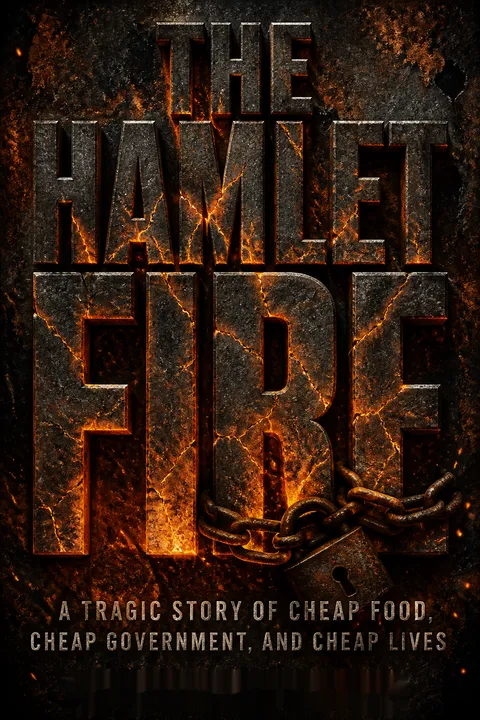
The Hamlet Fire is a thought-provoking book about a 1991 chicken processing plant fire in North Carolina. Readers praise Simon's thorough research and ability to connect the tragedy to broader issues of cheap labor, deregulation, and social inequality. Many found the book enlightening and well-written, though some felt it was disorganized or overly academic at times. The book examines how the pursuit of cheap food and labor led to unsafe working conditions, drawing parallels to earlier industrial disasters. Overall, reviewers recommend it as an important exploration of labor issues and economic policies.
People Also Read







Glossary
system of cheap
Low costs through shifted riskSimon’s name for a political and economic order that treats lower prices, lower wages, and reduced regulation as preferred solutions to social problems. Its apparent savings often depend on transferring costs to workers, farmers, public agencies, families, or the environment. The Hamlet fire shows how this logic could shape both private business decisions and public oversight.
poultry capitalism
Industrialized chicken productionThe interconnected system that produces inexpensive chicken through intense competition, corporate control of supply chains, contract farming, scientific breeding, high-speed processing, and low-cost labor. It expands output and lowers consumer prices, while shifting financial, physical, and environmental burdens onto growers, animals, workers, and communities.
grow-out system
Contracted chicken raisingA poultry-industry arrangement in which a company supplies chicks and feed, while a farmer provides housing, equipment, labor, and other operating costs. Farmers are paid according to production measures set by the contract. As companies demanded larger facilities and faster-growing birds, growers often borrowed heavily and risked losing both their contracts and their farms.
further-processed chicken
Chicken reshaped into convenience foodsChicken that has already been slaughtered and cut into parts, then transformed into products such as tenders, nuggets, or patties through added ingredients, breading, seasoning, and cooking. The category let smaller processors such as Imperial make saleable products from chicken parts and scraps, while meeting demand for convenient, inexpensive meals.
business progressives
Growth-first public officialsA political tradition, especially influential in the South, that presents economic development and job creation as the main routes to social improvement. Officials recruit businesses with infrastructure, incentives, low costs, and limited regulation. The approach can attract employment while giving less attention to job quality, worker safety, wages, and the distribution of economic gains.
cheap state
Government serving low-cost productionSimon’s term for public institutions that support business and low consumer prices through roads, subsidies, tax breaks, and other assistance, while underfunding worker protections and social services. The state is not absent from the economy. Its action is selective, helping production and commerce while leaving many human and community costs outside the price of goods.
FAQ
What's The Hamlet Fire about?
- Tragic incident: The book recounts the fire at the Imperial Food Products plant in Hamlet, North Carolina, on September 3, 1991, which killed 25 workers.
- Systemic failures: It explores the systemic issues, including negligence in safety regulations and the prioritization of profit over worker safety.
- Broader implications: Author Bryant Simon links the tragedy to national trends in labor, food production, and government regulation.
- Personal narratives: The book includes personal stories from survivors and victims' families, highlighting their struggles and quest for justice.
Why should I read The Hamlet Fire?
- Insightful analysis: The book provides a critical examination of the American food industry and the hidden costs of cheap food.
- Historical context: It connects the fire to economic changes in the U.S., particularly the shift towards low-wage labor and the decline of worker protections.
- Emotional storytelling: Simon humanizes the victims, making readers reflect on the real-life consequences of corporate greed and negligence.
- Call for change: It encourages readers to consider the implications of their food choices and the systems that produce them.
What are the key takeaways of The Hamlet Fire?
- Cheapness and tragedy: The pursuit of cheap food and labor led to unsafe working conditions, exemplified by the locked exits at Imperial.
- Economic exploitation: Economic pressures force workers into dangerous jobs with little regard for their safety or well-being.
- Systemic negligence: A lack of regulatory oversight and prioritization of profit led to unsafe working conditions and a preventable tragedy.
- Community activism: The book emphasizes the role of grassroots movements in advocating for worker rights and safety.
What are the best quotes from The Hamlet Fire and what do they mean?
- “The policies of cheap came at a cost.” This quote highlights the human suffering and exploitation resulting from the drive for lower prices.
- “You couldn’t complain, you couldn’t say anything.” Reflects the oppressive environment at Imperial, where workers felt powerless to advocate for their safety.
- “The fire was an accident waiting to happen.” Underscores the negligence of management in maintaining safety standards, suggesting the tragedy was predictable.
- “Choice, in the sense of what to eat, was a luxury that they didn’t really have.” Illustrates how economic constraints dictate workers' food choices and health outcomes.
How does The Hamlet Fire connect to broader themes of economic inequality?
- Labor exploitation: The book illustrates how the pursuit of profit often leads to the exploitation of vulnerable workers in low-wage industries.
- Deregulation consequences: Simon discusses how deregulation and prioritization of cheap goods over safety contribute to workplace neglect.
- Systemic issues: The fire serves as a case study for understanding the intersection of race, class, and labor rights in America.
- Economic disparities: The culture of cheap perpetuates economic disparities, particularly affecting marginalized communities.
What role did management play in the events leading up to the fire in The Hamlet Fire?
- Cost-cutting measures: Management prioritized profits over safety, leading to dangerous working conditions like locked exits.
- Neglect of safety protocols: Repeated warnings about safety issues were ignored, including the lack of fire drills and proper equipment maintenance.
- Disregard for workers: The management style fostered an environment where workers felt they could not voice concerns, contributing to the tragic outcome.
- Profit over people: The Roes' management decisions exemplified the prioritization of profit over worker safety and well-being.
What safety violations were present at the Imperial plant according to The Hamlet Fire?
- Locked exits: The plant had locked doors that prevented workers from escaping during the fire, a critical safety violation.
- Lack of fire safety measures: There were no sprinklers or fire drills, and maintenance often occurred without shutting off heat sources.
- Poor working conditions: The book details numerous safety violations, including slippery floors, blocked exits, and inadequate emergency protocols.
- Negligence in safety standards: These violations contributed significantly to the disaster and highlighted systemic failures in safety oversight.
How did the community of Hamlet respond to the fire and its aftermath in The Hamlet Fire?
- Immediate shock and grief: The community was devastated by the loss of life, with many families mourning loved ones.
- Calls for accountability: There were demands for better safety regulations and accountability from the Roes and the food industry.
- Memorialization efforts: The community held memorial services to honor the victims, fostering a sense of healing.
- Legal actions: Survivors and families pursued legal action against the company, seeking justice and accountability.
What role did government regulation play in the events leading up to the fire?
- Lack of inspections: The Imperial plant had not been inspected by OSHA despite previous violations and safety concerns.
- Deregulation trends: The broader trend of deregulation in the 1980s and 1990s weakened protections for workers.
- Political complicity: Government officials often prioritized economic growth over enforcing safety regulations.
- Minimal oversight: This lack of oversight allowed companies like Imperial to operate unsafely, endangering workers' lives.
How does The Hamlet Fire address issues of race and class?
- Racial dynamics: The book explores racial tensions in Hamlet, particularly in the aftermath of the fire.
- Class disparities: Economic inequality affects access to safety and health resources, with marginalized communities bearing the brunt.
- Activism and advocacy: The narrative emphasizes the importance of grassroots movements in advocating for marginalized groups.
- Systemic injustices: The fire serves as a stark reminder of the vulnerabilities faced by low-wage workers.
What lasting impact did the Hamlet fire have on workplace safety regulations?
- Legislative reforms: North Carolina enacted new laws aimed at improving workplace safety and increasing inspections.
- Increased awareness: The fire brought national attention to worker safety and corporate negligence issues.
- Ongoing challenges: Despite reforms, the culture of cheap continues to undermine worker safety.
- Catalyst for change: The legacy of the fire serves as a reminder of the need for vigilance in enforcing safety standards.
What specific methods or advice does The Hamlet Fire offer regarding workplace safety?
- Regulatory reforms: The book advocates for stronger enforcement of safety regulations and more frequent inspections.
- Community involvement: Emphasizes the importance of community activism in holding corporations accountable for unsafe practices.
- Education and training: Educating workers about their rights and safety protocols is crucial for preventing accidents.
- Proactive safety measures: Encourages a proactive approach to workplace safety rather than reactive measures after incidents occur.
Download PDF
Download EPUB
.epub digital book format is ideal for reading ebooks on phones, tablets, and e-readers.








