


Key Takeaways
Train the emotional system that conscious reasoning can only partly steer.
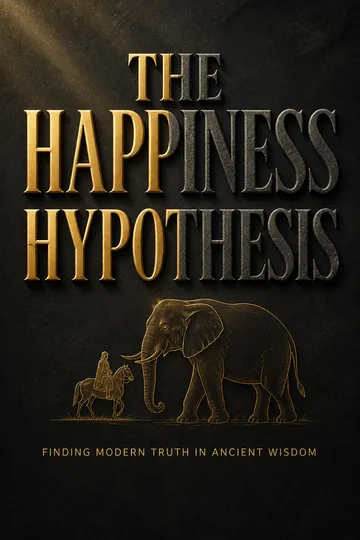
A useful map. Haidt describes the mind as a rider on an elephant. The rider represents conscious reasoning; the elephant represents the faster, largely automatic processes that include emotion, intuition, and bodily reactions. Reason can advise, but it cannot reliably force the elephant to obey. Brain-injury cases show why emotion is not merely an obstacle: people who lose ordinary emotional responses can retain logical skills yet struggle to make even simple decisions, because they cannot feel which option matters most.
Work with the whole mind. Split-brain research also found that people can invent convincing explanations for actions whose causes they cannot access. The rider is a storyteller as well as a planner. The metaphor is not a literal map of brain anatomy, but it helps explain why resolutions alone so often fail.
The metaphor usefully corrects the fantasy that sound reasoning automatically governs behavior. It also fits embodied approaches to decision-making, which treat bodily signals as part of how people evaluate choices, not noise to be discarded. Its limitation is that a rider and an elephant can imply two separate agents inside one person. The mind is better understood as many interacting processes, with no single component always in charge. Used as a practical reminder rather than a neural theory, the image makes self-control less mysterious and more workable.
Change your mental habits through practice, not through insight alone.
Insight fades quickly. A powerful realization can shift a person's outlook for a while, but it often does not change automatic responses. Haidt argues that lasting change requires retraining the elephant through repeated experience. One obstacle is the negativity bias: the tendency for threats and losses to register more quickly and strongly than comparable pleasures and gains. This helps explain why worry and self-criticism can persist even when a person knows they are unhelpful.
Use workable tools. Haidt discusses meditation, cognitive therapy, and antidepressant medication as different ways to alter recurring thought patterns. Cognitive therapy teaches people to notice and question distorted thoughts, often alongside small daily actions. Meditation trains attention, while medication can shift mood and temperament. These approaches are not interchangeable, and which helps depends on the person and the problem.
The emphasis on practice is a valuable bridge between psychological insight and behavior change. Repetition gives new responses a chance to become easier than the old ones, much as physical rehabilitation uses repeated movement to restore function. The section also resists treating one method as universally superior: attention training, structured therapy, and medication act through different routes. A useful caution is that the image of retraining can make difficult distress sound like a personal project alone. Access to care, safe surroundings, and supportive relationships can shape whether practice is possible.
Before defending a judgment, inspect the intuition your inner lawyer serves.
Feelings often come first. In Haidt's studies, people rapidly judged a story about adult siblings having consensual, protected sex as wrong, then struggled to explain why. When their reasons were challenged, they tended to invent new ones rather than revise the judgment. Haidt calls the reasoning voice the inner lawyer: it often argues for an intuitive verdict instead of impartially investigating it.
Look for your own bias. The pattern appears in ordinary self-interest, too. In one experiment, many participants who used a coin toss to assign a desirable task still chose the task for themselves, then reported that they had acted fairly. A practical response is to ask what evidence would weaken one's position, and to identify one contribution to a conflict before condemning the other person.
This account does not make reason useless. It explains why reason often works better as a tool for checking intuitions than as a detached judge. The distinction matters in public debate: a polished argument may express sincere conviction while still being shaped by identity or self-interest. Deliberate procedures can help, such as asking people to state the strongest case against their position before deciding. Still, fast moral intuitions are not automatically errors. They can reflect learned expertise, so scrutiny should improve judgment, not replace it with reflexive suspicion.
Use reciprocity to build cooperation, not to keep score.
Cooperation needs memory. The book presents reciprocity as a social strategy: begin generously, then respond in kind to how others treat you. It helps people cooperate beyond their families, where shared genes cannot explain every sacrifice. In the ultimatum game, for instance, many participants reject an unfair split even when accepting would leave them with money. Fairness and retaliation can matter more than the immediate payout.
Reputation extends the circle. Gratitude rewards generosity, while anger and revenge discourage exploitation. Gossip spreads information about who keeps commitments, making it possible to judge people one has not personally observed. Yet the same reflex can be manipulated. A free sample or an unsolicited favor may create pressure to give something back. Reciprocity works best when a favor is freely chosen, not when it becomes a hidden invoice.
Reciprocity is both a social technology and a moral hazard. It enables strangers to coordinate without a central authority, while reputation lets communities enforce expectations at low cost. But a balance of favors is not always a balance of power: employers, institutions, and salespeople can exploit the discomfort of feeling indebted. The useful distinction is between mutual responsiveness and exact accounting. Communities thrive when people remember obligations, but rigid scorekeeping can turn care into a transaction and punish those who have less capacity to repay.
Spend effort on enduring relationships and absorbing activities, not status upgrades.
The treadmill resets. People often adapt to new possessions, income, and comforts, so success brings less lasting happiness than expected. Haidt calls this the adaptation principle. Lottery winners and people who become paraplegic both tend, on average, to move back toward their earlier level of happiness, although adaptation is neither instant nor complete for everyone. Wealth can relieve hardship, but beyond basic needs, additional status and consumption often produce only a modest gain.
Choose better conditions. Haidt summarizes happiness as a combination of a biological set point, life conditions, and voluntary activities. Relationships matter, as do controllable environments and activities that absorb attention. Flow is a state of deep engagement when a task is challenging but matched to one's skills. Experiences, shared time, and meaningful effort tend to outlast another status purchase.
This account joins two different questions: what people adapt to, and what they value while doing it. The distinction helps explain why buying something impressive can lose its force while a close relationship or absorbing practice remains rewarding. It also guards against a simplistic anti-money message: financial security can remove serious stress, and disability or chronic illness does not always yield to adaptation. The practical lesson is to examine what a purchase or ambition is meant to provide. If the real need is belonging, mastery, or time, status goods may be an expensive substitute.
Let passion begin love, but let secure companionship prove its durability.
Love has different rhythms. Attachment theory describes how children use a trusted caregiver as a secure base, returning for comfort before exploring again. Haidt draws on this work to explain adult romantic bonds: close partners can become sources of safety and comfort, not just sexual attraction. Studies of rhesus monkeys helped establish the importance of contact and comfort, showing that infant monkeys clung to soft surrogate mothers even when milk came from a wire one.
Passion is not the whole story. Passionate love can be intense and consuming, but it tends to cool. Companionate love grows through care, trust, and shared life, and can endure after the initial rush fades. Treating permanent high passion as the test of real love can lead people to mistake a normal change in feeling for proof that the relationship has failed.
Separating passion from companionship gives couples a less brittle standard than the ideal of continuous romantic intensity. It also highlights that love is built through repeated acts of care, not only through private feeling. Attachment theory offers a useful account of security and exploration, though adult relationships are not simply childhood bonds replayed: partners negotiate equality, desire, and shared goals in ways a child and caregiver do not. The framework explains patterns without dictating which relationships should continue. Safety, respect, and mutual willingness remain essential.
Turn adversity into learning without pretending trauma is a gift.
Growth can follow crisis. Posttraumatic growth means positive change some people report after serious adversity. Haidt describes three common forms: discovering unexpected personal strength, deepening relationships with people who help, and revising priorities. A friend whose wife disappeared with their children found support from family and church members, shifted attention away from career status, and became more patient with others. His suffering remained real, even as some changes proved lasting.
Make meaning deliberately. Researcher James Pennebaker found that writing repeatedly about a painful event can help people organize thoughts and feelings into a clearer account. The book stresses that adversity can also cause lasting harm, including posttraumatic stress. Social support, timing, and individual resources affect the outcome. Trauma is not a reliable shortcut to wisdom, and preventing avoidable suffering remains important.
The distinction between growth and resilience matters. Resilience means returning toward functioning; growth suggests that a person has also changed in values, relationships, or self-understanding. Neither outcome makes the original harm worthwhile. Narrative work can help people connect experience to meaning, but it should not be imposed as a deadline or obligation to find a silver lining. A person may need practical protection, medical care, or time before reflection is useful. The section is strongest when it treats growth as a possible response, not a moral achievement expected of every survivor.
Practice strengths until virtue becomes a reliable habit, not a lecture.
Character is practiced. Franklin tried to improve himself by tracking thirteen virtues in a weekly chart. He focused on one virtue at a time, recording lapses rather than assuming that good intentions would suffice. The ancient thinkers made a similar point: virtues grow through repeated action, like a skill developed through practice. Moral knowledge alone may tell someone what to do, but it does not guarantee that the person will want to do it when temptation arrives.
Build from strengths. Positive psychology organizes character around six broad virtues: wisdom, courage, humanity, justice, temperance, and transcendence. Specific strengths, such as curiosity, kindness, perseverance, or gratitude, offer different routes toward them. Haidt recommends developing existing strengths as well as addressing weaknesses, because useful practice is more sustainable when it draws on what a person can already do well.
The shift from abstract rules to practiced capacities brings ethics closer to education and craft. People learn fairness not only by reasoning through dilemmas, but by participating in settings where fairness is modeled and expected. The strengths approach can make development more motivating than a permanent inventory of flaws. Yet strengths are not automatically virtues: confidence can become arrogance, and loyalty can defend an unjust group. Character requires judgment about when a capacity serves others and when it needs restraint.
Protect a sense of the sacred without making outsiders morally lesser.
Moral life has another dimension. Haidt describes three ethical lenses: autonomy, which protects individuals from harm; community, which protects groups and shared obligations; and divinity, which treats human life as sacred and seeks to avoid degradation. Disgust often marks perceived violations of purity, while elevation is the uplifting response to witnessing moral beauty. Awe at nature or human achievement can also make the self feel small and connected to something larger.
Sacredness can unite or divide. Religious rituals and shared beliefs can bind people into communities and give moral life coherence. But purity rules can also stigmatize people and justify exclusion. Haidt argues that secular people, too, can experience sacredness without believing in God. Understanding this moral dimension can make disagreements more intelligible without requiring agreement with every religious rule.
The framework helps explain why some moral disputes are not really about individual harm. One side may be defending personal choice, while another experiences the same choice as an assault on sacred order. Taking that difference seriously can improve listening. It does not settle the policy question, however. A sense of the sacred may sustain solidarity, but it can also elevate one group's norms above another group's dignity. In pluralistic societies, the challenge is to make room for spiritual meaning without allowing sacred claims to erase equal civic standing.
Build happiness between yourself, close relationships, purposeful work, and something larger.
Meaning emerges in connection. Haidt's final argument is that happiness is not simply an inner state or a prize delivered by external success. It grows from relationships among a person, the people they love, their work, and a wider community or purpose. Work can become a calling when it uses a person's abilities and contributes to something valued. Hospital janitors in one study sometimes found meaning by seeing their work as part of caring for patients, rather than as a list of cleaning tasks.
Look for fit. Haidt calls deep absorption combined with personal significance vital engagement. Meaning is strongest when bodily experience, conscious aims, and a person's social world reinforce one another. This does not require one grand mission. A stable relationship, useful work, and a community that shares one's commitments can make daily life feel coherent and worthwhile.
The relational account avoids treating purpose as a hidden object that everyone must discover. Meaning can be made through participation, skill, care, and belonging. It also clarifies why a job title alone cannot create a calling: working conditions and institutional goals matter. A person may want meaningful work but lack the freedom or resources to reshape a job. The framework therefore invites both individual action and attention to social design. Coherence is powerful, but it should not be mistaken for conformity; a coherent life can still require challenging the community that gives it shape.
Analysis
The book's most durable achievement is its refusal to choose between ancient moral insight and modern psychological explanation. Its organizing image of rider and elephant makes self-control a problem of coordination rather than heroic command. From there, the argument expands outward: individual judgment is socially biased, happiness depends partly on relationships and chosen activity, and meaning grows through participation in something beyond the self. The recurring move is to replace isolated causes with relationships among systems. That synthesis also exposes a tension. The book treats evolved tendencies as explanations of why people behave as they do, then often draws practical lessons from those tendencies. But an evolutionary origin does not itself make a behavior wise or just. Reciprocity can sustain cooperation and also entrench exclusion. Disgust can guard health and also stigmatize harmless difference. Group loyalty can make sacrifice possible and sharpen hostility toward outsiders. The book's own emphasis on balancing perspectives is essential here: psychological usefulness is not the same as moral legitimacy.
Its account of happiness is similarly strongest as a map, not a calculator. The formula combining disposition, life conditions, and voluntary activity clarifies why neither positive thinking nor wealth alone is enough. Yet the relative weight of these factors varies by health, culture, economic security, and stage of life. The book acknowledges some of this variation, especially when discussing trauma and disability, but its practical optimism can still make structural hardship seem more individually adjustable than it is.
The central insight remains compelling: flourishing is not a possession stored inside a person. It is a pattern of fit among emotion and reason, self and others, effort and ability, private values and shared life. That account gives ancient wisdom a testable psychological shape while leaving room for disagreement about what a good society should protect.
Review Summary
The Happiness Hypothesis by Jonathan Haidt explores the nature of happiness through ancient wisdom and modern psychology. Many readers praise its insightful analysis of human behavior, combining scientific research with philosophical ideas. The book discusses topics like the divided mind, reciprocity, and the pursuit of happiness. While some find it enlightening and thought-provoking, others criticize its broad scope and occasional digressions. Overall, reviewers appreciate Haidt's engaging writing style and the book's ability to challenge readers' perspectives on happiness and meaning in life.
People Also Read









Glossary
rider and elephant
Reason and automatic processesHaidt's metaphor for the divided mind. The rider represents conscious, verbal reasoning, which can plan and advise but has limited control. The elephant represents automatic processes, including emotions, intuitions, and bodily reactions. Effective behavior depends on their working together, rather than on reason simply overpowering emotion.
negativity bias
Bad weighs more than goodThe tendency for negative events, threats, and losses to affect attention and judgment more strongly than comparable positive events or gains. Haidt uses it to explain why criticism can outweigh praise, losses can feel larger than equal gains, and people may remain focused on danger even when opportunities are present.
affective style
Typical emotional balanceA person's characteristic tendency to experience positive or negative emotion. In Haidt's account, affective style reflects the balance between approach responses, which draw a person toward opportunities, and withdrawal responses, which encourage caution or avoidance. It is influenced partly by temperament and helps explain why people respond differently to similar circumstances.
happiness formula
Disposition, conditions, activityA framework expressing happiness as the combined influence of a person's biological set point, the conditions of life, and voluntary activities. It emphasizes that circumstances such as relationships and control matter, while chosen practices and absorbing activities can also affect well-being. The formula is a conceptual guide, not a precise predictive equation.
attachment theory
Safety enables explorationA theory of close bonds developed by John Bowlby and extended through later research. Children seek safety from caregivers and use a trusted caregiver as a secure base from which to explore. Repeated interactions shape expectations about whether comfort will be available. Haidt applies this framework to explain both childhood security and adult romantic attachment.
posttraumatic growth
Positive change after adversityPositive changes that some people report after coping with major trauma or crisis. These may include a stronger sense of personal capability, deeper relationships, or changed priorities. The term does not mean that trauma is beneficial overall, that everyone grows, or that serious distress and lasting harm are absent.
ethic of divinity
Protecting sacred human lifeOne of three moral orientations described by Richard Shweder and discussed by Haidt. It treats people as possessing sacred or divine worth and emphasizes purity, nobility, and avoiding degradation. It differs from the ethic of autonomy, focused on individual rights, and the ethic of community, focused on group duties and social order.
elevation
Uplift at moral beautyAn emotion Haidt describes as arising when someone witnesses moral excellence, generosity, or compassion. People may feel warmth or openness in the chest and a desire to become better or help others. Haidt distinguishes elevation from ordinary amusement and from admiration of nonmoral skill.
vital engagement
Absorption joined with meaningA way of relating to the world that combines flow, or deep absorption in an activity, with a sense that the activity matters. Haidt draws on Mihalyi Csikszentmihalyi and Jeanne Nakamura to explain how work, interests, and communities can become meaningful through sustained involvement and personal significance.
FAQ
What's The Happiness Hypothesis about?
- Exploration of happiness: The Happiness Hypothesis by Jonathan Haidt examines the nature of happiness, integrating ancient wisdom with modern psychological science.
- Divided self concept: Haidt uses the "rider and the elephant" metaphor to describe the divided nature of the human mind, highlighting the conflict between rational thought and emotions.
- Integration of ideas: The book combines insights from philosophy, psychology, and cultural studies to explore what makes life meaningful, emphasizing the balance between individual desires and communal values.
Why should I read The Happiness Hypothesis?
- Practical insights: The book offers actionable advice for achieving happiness, grounded in both ancient wisdom and modern research.
- Understanding human behavior: It helps readers understand their behaviors and motivations, leading to more fulfilling relationships and a greater sense of purpose.
- Engaging storytelling: Haidt's writing is accessible and engaging, using anecdotes and examples to illustrate complex psychological concepts.
What are the key takeaways of The Happiness Hypothesis?
- Happiness sources: Haidt suggests that happiness comes from both internal mindset and external relationships, emphasizing the dual sources of happiness.
- Importance of relationships: Strong social connections are crucial for happiness, often outweighing material wealth in contributing to well-being.
- Adversity and growth: Facing challenges can lead to personal growth and resilience, as illustrated by the "adversity hypothesis."
What are the best quotes from The Happiness Hypothesis and what do they mean?
- "There is nothing either good or bad, but thinking makes it so." This quote highlights the power of mindset in shaping experiences.
- "Happiness comes from within, and happiness comes from without." It emphasizes the dual sources of happiness, both internal and external.
- "What doesn't kill me makes me stronger." Reflects the idea that adversity can lead to personal growth and resilience.
What is the "rider and elephant" metaphor in The Happiness Hypothesis?
- Divided self representation: The metaphor illustrates the conflict between the rational mind (rider) and emotional processes (elephant).
- Limited control of the rider: The rider has limited control over the elephant, especially when strong emotions are involved.
- Working together for happiness: The goal is to harmonize the rider and elephant for better decision-making and emotional well-being.
How does The Happiness Hypothesis address the role of adversity in personal growth?
- Adversity hypothesis explained: Haidt posits that facing challenges can lead to personal growth and resilience.
- Posttraumatic growth concept: Individuals can experience positive changes following traumatic events, such as increased appreciation for life.
- Real-life examples: Haidt uses stories of individuals who thrived after hardships to illustrate the benefits of adversity.
What is the significance of relationships in The Happiness Hypothesis?
- Key to happiness: Strong social connections are one of the most important factors contributing to happiness.
- Impact of social support: Relationships provide emotional support, reduce stress, and enhance overall well-being.
- Reciprocity in relationships: Mutual support and kindness strengthen bonds, fostering a sense of belonging and community.
How does The Happiness Hypothesis define happiness?
- Multifaceted concept: Happiness is a combination of internal and external factors, including emotional well-being and meaningful relationships.
- Dynamic nature: Happiness is not a permanent state but fluctuates based on circumstances and personal growth.
- Role of gratitude and kindness: Engaging in positive behaviors like gratitude can enhance happiness.
What methods does The Happiness Hypothesis suggest for increasing happiness?
- Meditation and mindfulness: Practices like meditation help cultivate inner peace and reduce stress.
- Cognitive therapy techniques: Challenging negative thought patterns can foster a more positive outlook.
- Engaging in meaningful activities: Pursuing activities aligned with strengths and values fosters purpose and fulfillment.
How does The Happiness Hypothesis relate to modern psychology?
- Integration of ancient wisdom: Haidt bridges ancient philosophical teachings with contemporary psychological research.
- Scientific basis for happiness: The book is grounded in empirical research, offering evidence-based insights into happiness.
- Practical applications: Haidt provides strategies for individuals to enhance their happiness and quality of life.
What is the adversity hypothesis in The Happiness Hypothesis?
- Weak and strong versions: The weak version suggests adversity can lead to growth, while the strong version posits it's necessary for the highest personal development.
- Posttraumatic growth: Positive changes in values and perspectives can occur after significant challenges.
- Implications for parenting: Overprotecting children may deprive them of growth opportunities, advocating for a balance between safety and challenge.
How does The Happiness Hypothesis address the concept of virtue?
- Virtue hypothesis: Cultivating virtue leads to happiness, as emphasized by historical figures like Benjamin Franklin.
- Ancient wisdom: Virtues such as kindness and integrity are essential for well-being.
- Modern implications: Developing character strengths and engaging in virtuous actions can enhance happiness.
About the Author
Other books by Jonathan Haidt



Download PDF
Download EPUB
.epub digital book format is ideal for reading ebooks on phones, tablets, and e-readers.








